



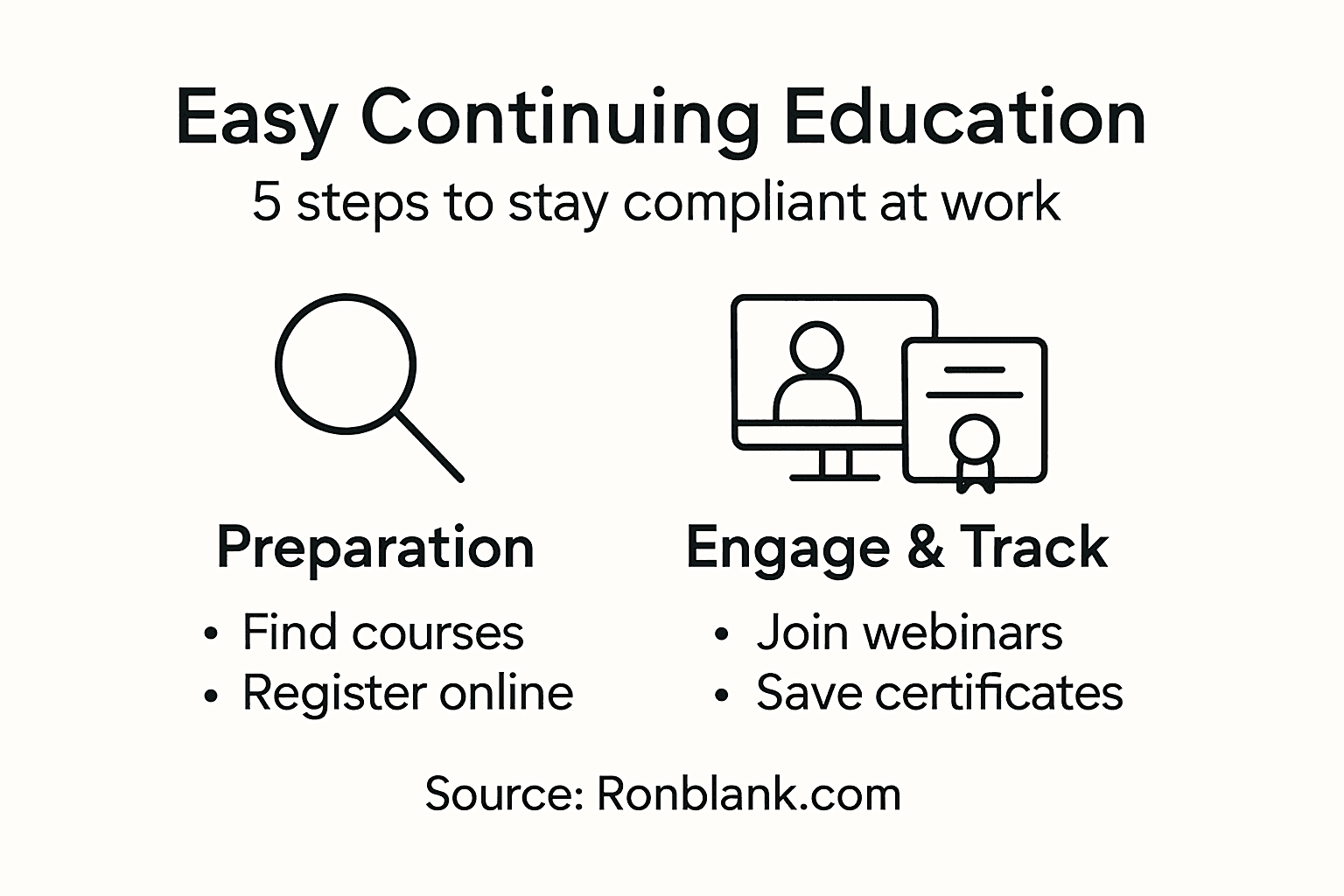
Finding the right courses can feel like sifting through endless options, especially when balancing AIA and RCEP requirements with real project demands. For architects and engineers, professional growth relies on selecting high-quality learning experiences that deliver both recognized credentials and practical skills. This guide highlights key steps for evaluating course accreditation, maximizing engagement, and weaving critical product specification knowledge into your continuing education strategy.
Table of Contents
- Step 1: Assess Accredited Course Options For Your Discipline
- Step 2: Register For Courses That Fulfill AIA And RCEP Requirements
- Step 3: Engage With Course Content Via Online, Webinar, Or Face-To-Face Formats
- Step 4: Integrate Product Specifications Into CE Course Selections
- Step 5: Verify Completion With Official Certificates And Reports
Quick Summary
| Key Point | Explanation |
| 1. Evaluate Accredited Courses | Research recognized continuing education providers and ensure courses align with industry standards and professional goals. |
| 2. Register for Relevant Courses | Confirm specific requirements for AIA and RCEP and select courses that meet accreditation and credit hour criteria. |
| 3. Maximize Engagement in Courses | Actively participate in online, webinar, or face-to-face formats to enhance learning and apply knowledge effectively. |
| 4. Integrate Product Specifications | Choose courses that emphasize product specifications and practical applications to deepen technical knowledge and skills. |
| 5. Document Course Completion | Collect and organize official certificates and records to ensure compliance with licensing requirements and facilitate renewals. |
Step 1: Assess accredited course options for your discipline
Launching a successful professional development strategy starts with carefully evaluating continuing education opportunities specific to your field. Identifying accredited courses that align with your career goals requires strategic research and understanding of industry-specific requirements.
Begin by exploring continuing education providers that offer recognized credentials in your professional discipline. Look for programs accredited by established organizations like AIA which ensures high-quality educational experiences. When assessing course options, focus on these critical evaluation criteria:
- Target audience matching your professional background
- Clear and specific learning objectives
- Recognized continuing education units (CEUs)
- Credentials from qualified presenters
- Comprehensive instructional methods
Selecting the right continuing education course is about matching your professional development needs with credible, targeted learning experiences.
The most effective approach involves thoroughly reviewing course descriptions and understanding how each program connects to your specific discipline’s requirements. Carefully evaluate course details to ensure they provide meaningful professional growth and meet your credentialing standards.
Pro tip: Create a spreadsheet to track potential courses, their accreditation status, and how they specifically align with your professional development goals.
Step 2: Register for courses that fulfill AIA and RCEP requirements
Navigating the registration process for professional continuing education requires careful attention to specific requirements for architects and engineers seeking to maintain their credentials. Understanding how to efficiently register for accredited courses will help you streamline your professional development and meet your discipline’s specific certification standards.
To successfully register for courses that fulfill AIA and RCEP requirements, follow these strategic steps:
- Verify your specific professional licensure requirements
- Check course accreditation status
- Confirm credit hour equivalencies
- Review renewal cycle timelines
- Select courses directly aligned with your discipline
Professional certification maintenance is not just about completing hours, but selecting high-quality educational experiences that enhance your technical expertise.
When registering, pay close attention to the specific documentation needed. Online course registration platforms often require professional license numbers, current contact information, and payment details. Architects and engineers should prioritize courses that not only meet credit requirements but also provide meaningful skill development relevant to their specific professional practice.
Pro tip: Create a dedicated email folder to organize course confirmation emails, certificates, and professional development tracking documents for easy reference during license renewal periods.
Step 3: Engage with course content via online, webinar, or face-to-face formats
Successful continuing education requires active participation regardless of the learning format you choose. Understanding how to maximize your engagement across different course delivery methods will help you extract maximum value from your professional development experience.


Each learning format offers unique opportunities for interaction and skill development. Consider these strategies for maximizing course engagement:
Here’s a comparison of common continuing education course delivery formats and their unique engagement benefits:
| Format | Interaction Level | Flexibility | Best For |
| Online Courses | Moderate (forums) | High (self-paced) | Busy professionals |
| Webinars | High (live Q&A) | Medium (scheduled) | Real-time learning and questions |
| Face-to-Face | Maximum (in-person) | Low (fixed location) | Networking and hands-on practice |
- Online courses
- Review course materials before scheduled sessions
- Participate actively in discussion forums
- Complete all recommended assignments
- Webinar formats
- Test technical setup before live sessions
- Prepare relevant questions in advance
- Take detailed notes during presentations
- Face-to-face workshops
- Arrive early to network with professionals
- Sit near the front for better interaction
- Bring supplemental note-taking materials
Professional learning is not about passive consumption, but active transformation of knowledge into practical skills.
Educational webinars provide flexible learning opportunities that accommodate different learning preferences. Architects and engineers should approach each format with intentionality, focusing on practical applications of course content that directly relate to their professional practice.
Pro tip: Create a dedicated digital or physical learning journal to document insights, key takeaways, and potential implementation strategies from each continuing education course.
Step 4: Integrate product specifications into CE course selections
Successful continuing education for architects and engineers requires strategic course selection that directly enhances professional technical knowledge. By intentionally choosing courses that incorporate product specifications and industry standards, you can maximize the practical value of your learning experience.
When selecting continuing education courses, focus on these key strategies for integrating product specifications:
- Prioritize courses that include detailed technical content
- Look for modules covering current industry standards
- Select programs with practical specification applications
- Seek courses featuring real-world product implementation
- Choose learning experiences with hands-on specification exercises
Effective continuing education bridges the gap between theoretical knowledge and practical professional application.
Systematic integration of standards ensures that your professional development directly supports your technical expertise. Architects and engineers should approach course selection as an opportunity to deepen their understanding of current product specifications and industry best practices.

Pro tip: Create a tracking spreadsheet that maps continuing education courses to specific product specification skills you want to develop, ensuring targeted and purposeful professional growth.
Step 5: Verify completion with official certificates and reports
Successful professionals understand that documenting continuing education is as critical as completing the courses themselves. Proper verification ensures you maintain your professional credentials and remain compliant with licensing board requirements.
To effectively document and verify your continuing education completion, follow these strategic steps:
- Collect official certificates immediately after course completion
- Verify credit hour details on each document
- Check provider accreditation information
- Organize digital and physical copies
- Record completion dates for each course
Professional credibility is built not just through learning, but through meticulous documentation of your educational journey.
Continuing education audits require comprehensive documentation that proves your commitment to professional development. Architects and engineers must maintain precise records that demonstrate compliance with licensing board requirements, including detailed course information and official verification.
Below is a summary of effective documentation practices to maintain compliance during license renewals and audits:
| Practice | Benefit | Example Document |
| Store Official Certificates | Easy audit access | PDF certificates |
| Track Completion Dates | Prevents missed requirements | Completion log in spreadsheet |
| Organize by Year and Discipline | Quick retrieval during renewal | Yearly folders by specialization |
| Verify Provider Accreditation | Ensures license validity | Provider approval letters |
Pro tip: Create a dedicated digital folder with subfolders organized by year and discipline, enabling quick and easy retrieval of continuing education certificates during professional license renewal or unexpected audit requests.
Simplify Your Journey to Continuing Education Compliance
Meeting continuing education requirements can feel overwhelming with all the accreditation details, course formats, and documentation involved. The article highlights common challenges such as verifying AIA and RCEP credit hours, selecting courses with relevant product specifications, and organizing certificates for easy license renewal. If you want to eliminate confusion and focus on growth instead of paperwork, specialized, accredited courses tailored for architects, engineers, and design professionals are essential.
At Ronblank, we develop accredited continuing education courses that meet the exacting standards discussed in the article. Our offerings include online courses, webinars, and face-to-face options designed to fit your busy schedule and professional needs. We also partner with building product manufacturers so you gain technical knowledge that enhances your specifications expertise while earning credit. Let us handle the details so you can engage deeply with meaningful education that advances your career.


Experience stress-free compliance and professional growth today Explore our full course catalog and discover how easy continuing education can be when you choose providers who understand your discipline and licensure requirements Visit Ronblank now to find your ideal accredited course and keep your credentials current with confidence.
Frequently Asked Questions
How can I assess accredited course options for my field?
Begin by researching continuing education providers that offer accredited courses relevant to your profession. Focus on criteria such as learning objectives, target audience, and recognized credentials to ensure matching your professional development needs.
What steps should I follow to register for courses that fulfill AIA and RCEP requirements?
Verify your professional licensure requirements and confirm the accreditation status of courses before registering. Pay attention to credit hour equivalencies and select courses aligned with your discipline to ensure compliance with certification standards.
How can I engage effectively with different course formats?
To maximize engagement, choose the learning format that best fits your schedule and learning style. For online courses, participate in discussion forums, while for webinars, prepare questions in advance to enhance real-time interaction.
What should I consider when integrating product specifications into my continuing education?
Focus on selecting courses that cover detailed technical content and current industry standards, ensuring they relate to practical applications. This approach will enhance your technical knowledge and improve the relevance of your education for real-world scenarios.
How do I verify completion of my continuing education requirements?
Collect official certificates immediately after completing each course and verify the credit hour details on these documents. Organize both digital and physical copies for easy access during audits or license renewals, ensuring compliance with professional standards.
What proactive steps can I take to maintain my continuing education records?
Create a dedicated digital folder organized by year and discipline to store course certificates and completion documents. Regularly update this folder to reflect your ongoing professional development and maintain easy access for future licensing requirements.