



Creating continuing education courses that meet AIA standards can feel like navigating a maze. Many architects and engineers invest months developing content only to face rejection or delays due to compliance gaps. This guide walks you through every step of developing AIA-compliant CEU courses in 2026, from understanding requirements to measuring success, helping you avoid costly mistakes and accelerate approval.
Table of Contents
- Understanding AIA CEU Compliance Requirements
- Prerequisites: What You Need Before Starting
- Developing Engaging And Effective Course Content
- Course Submission And Approval Process
- Common Mistakes And Troubleshooting
- Timeline, Budget, And Expected Outcomes
- Alternative Delivery Approaches And Tradeoffs
- Measuring Success And Outcomes
- Explore Ron Blank & Associates Services For CEU Development
- Frequently Asked Questions
Key takeaways
| Point | Details |
| AIA CEU courses require strict compliance | CEU compliance demands clear learning objectives and mandatory Health, Safety, and Welfare content. |
| Preparation saves time and resources | Access to AIA CE Dashboard, subject expertise, and documentation templates are essential prerequisites. |
| Engaging multimedia boosts approval rates | Interactive quizzes, diverse formats, and measurable objectives improve both learner retention and reviewer acceptance. |
| Submission requires iteration | Expect 2 to 4 months development time with feedback loops and revisions before final approval. |
| Success metrics guide improvement | Target >80% pass rates and 90% positive feedback to ensure course effectiveness and ongoing value. |
Understanding AIA CEU compliance requirements
Before you create a single slide or module, you need to understand what the AIA actually requires. The AIA CE Terms & Conditions establish the framework every course must follow. Missing these fundamentals guarantees rejection.
Health, Safety, and Welfare content isn’t optional for AIA members. HSW topics directly relate to protecting public health and building occupant safety. Courses addressing sustainable design, fire protection systems, structural integrity, or accessibility standards typically qualify. Non-HSW content on marketing or business development won’t meet HSW approval criteria.
Credit allocation follows strict Learning Unit rules. One LU equals one hour of structured learning. Your course must clearly state how many LUs participants earn and provide documentation showing the content justifies that time investment. Overestimating credits without substance will trigger reviewer pushback.
Learning objectives must be specific and measurable. Vague goals like “understand sustainable design” won’t pass. Instead, write objectives such as “identify three LEED certification strategies for commercial buildings” or “calculate thermal bridging values using ASHRAE standards.” Reviewers look for outcomes they can verify through assessments.
Key compliance elements include:
- Clear learning objectives stated upfront
- Verifiable HSW content throughout
- Accurate LU credit calculations
- Structured assessments to measure learning
- Documentation proving instructor expertise
Full compliance isn’t negotiable. About 40% of initial submissions require revisions because developers skip these foundational requirements. Getting this right from the start saves months of back and forth.
Prerequisites: what you need before starting
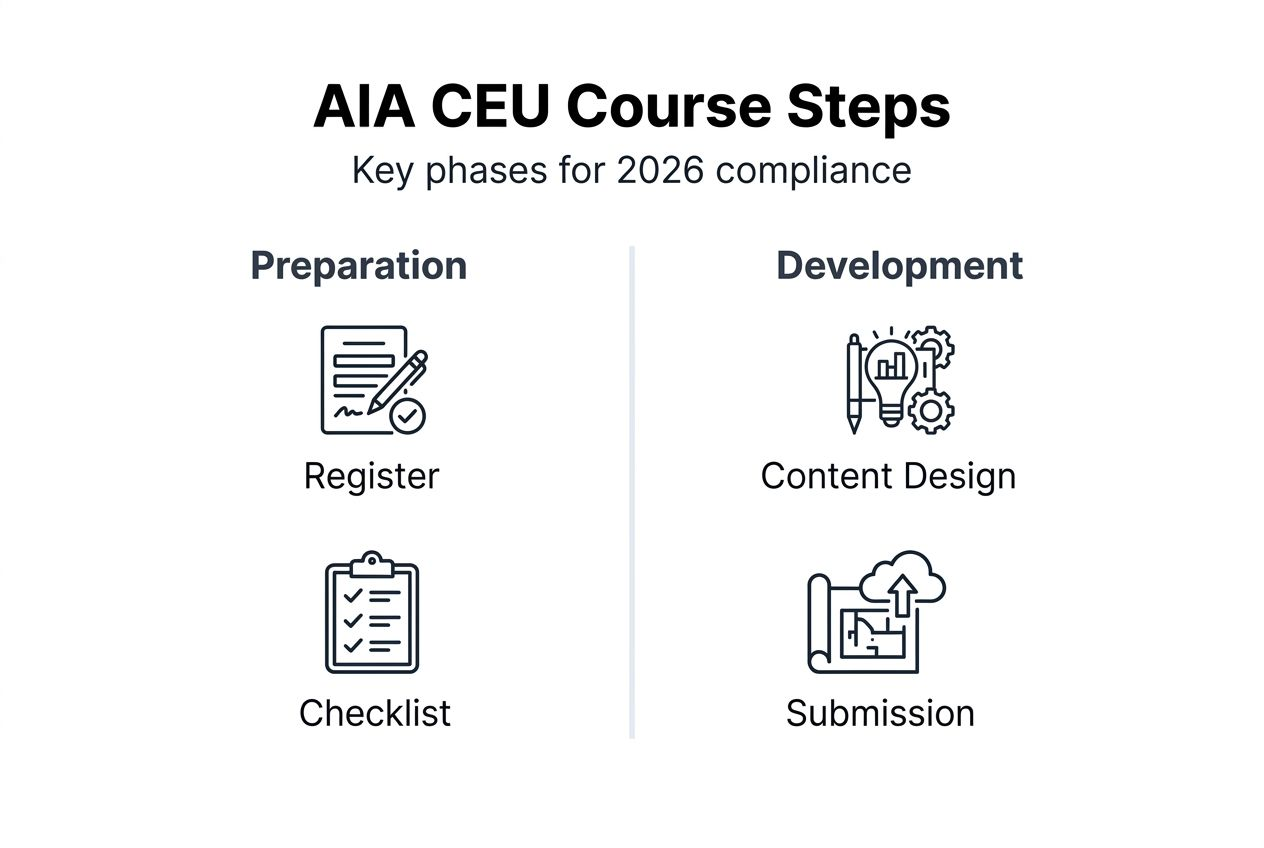
You can’t submit a course without proper registration and access. Start by registering as an AIA CE provider through their official system. This gives you dashboard access where you’ll submit courses, track approval status, and manage updates. Without this account, you’re stuck at the gate.
Understanding CE LU calculations prevents credit disputes. The Continuing Education Learning Unit system determines how much credit your course awards. One hour of instruction equals one LU, but interactive components and assessments affect the calculation. Study the current CELU standards before planning your course timeline.
Subject matter expertise separates approved courses from rejected ones. Instructors should possess relevant credentials in architecture, engineering, or building product knowledge. Prepare documentation like professional licenses, academic degrees, or industry certifications proving your qualifications.
Documentation templates streamline the submission process. Create compliance checklists covering HSW content verification, learning objective alignment, and assessment quality. Build course outline templates that capture all required elements including timing, materials, and instructor information.
Multimedia tools depend on your chosen format. Online courses need video editing software and learning management systems. Webinars require reliable conferencing platforms. Podcasts demand audio recording and editing capabilities. Match your tools to your delivery method before content creation begins.
Pro Tip: Set up a shared folder system early with sections for compliance documentation, content drafts, multimedia assets, and submission materials. This organization prevents last minute scrambling when you’re ready to submit.
Developing engaging and effective course content
Format selection impacts both learner experience and approval chances. Effective CEU formats include live webinars for real time interaction, on demand online modules for flexibility, podcasts for mobile learning, and face to face sessions for hands on practice. Choose formats matching your audience’s learning preferences and your production capabilities.


Interactive elements transform passive content into active learning. Use polls during webinars to gauge comprehension. Include case studies requiring participants to apply concepts. These features provide the completion verification reviewers require and boost learner engagement.
HSW content focus aligns with approval criteria while delivering genuine value. Structure your course around topics architects and engineers actually need: energy code compliance, seismic design updates, indoor air quality standards, or fire rated assembly specifications. Real world applications of HSW principles resonate with both learners and reviewers.
Measurable learning objectives guide content development. Break complex topics into specific, testable outcomes. Instead of covering “building envelope design,” create objectives like “calculate R values for wall assemblies” or “identify three common thermal bridging locations.” Each module should deliver on stated objectives with verifiable assessments.
Balance depth with engagement to maintain attention. Dense technical content needs breaking up with visual aids, real project examples, and interactive breaks. A 90 minute course should include at least three engagement points: opening poll, mid course case study, and final assessment.
Content development tips:
- Start with learning objectives, then build content to support them
- Include real project photos or drawings to illustrate concepts
- Break content into 10 to 15 minute segments for better retention
- Add downloadable resources like specification guides or code references
- Test content with a small pilot group before full submission
Pro Tip: Record a practice webinar with colleagues playing participant roles. Their feedback reveals confusing explanations, pacing issues, and technical glitches before official submission.
Course submission and approval process
Preparing documentation properly accelerates approval. Compile your course outline showing topics, timing, and learning objectives. Gather instructor credentials proving relevant expertise. Document HSW content with specific references to codes, standards, or research. Organize assessment questions demonstrating knowledge verification. Incomplete documentation guarantees delays.
Submit through the AIA CE Dashboard following current guidelines. Log into your provider account and navigate to new course submission. Upload all required documents in specified formats. Complete fields for course title, description, credit hours, and delivery method. Double check that HSW content flags are correctly marked.
Respond to reviewer feedback promptly and thoroughly. Most courses receive initial feedback within a few weeks. Reviewers might request clarification on learning objectives, additional HSW documentation, or stronger assessments. Address every point specifically and resubmit with a summary of changes made.
Maintain detailed records for compliance audits. Save all submission documents, reviewer correspondence, and approval confirmations. Track course updates and version changes. The AIA may audit your courses randomly, requiring proof of compliance and delivery as approved.
Common mistakes and troubleshooting
Missing HSW content tops the rejection list. Developers often create excellent technical content that doesn’t connect to health, safety, or welfare. A course on project management software fails unless it addresses how the tool improves building safety or occupant health outcomes. Strict alignment with AIA CE criteria prevents this costly mistake.
Lack of interactivity signals low quality to reviewers. Passive video lectures without quizzes, discussions, or activities bore views. Add at least one interactive element per learning objective. Simple multiple choice questions work, but scenario based assessments demonstrate deeper learning verification.
Unclear learning objectives confuse everyone involved. Objectives using vague language like “understand” or “appreciate” can’t be measured. Reviewers need objectives starting with action verbs: identify, calculate, compare, design, or evaluate. Each objective should connect to specific course content and assessment questions.
Revision statistics reveal common oversights:
Approximately 40% of initial CEU submissions require revisions before acceptance due to compliance gaps, particularly around mandatory HSW content and measurable learning outcomes.
Preventive measures save time and resources:
- Use compliance checklists before every submission
- Conduct peer review with experienced CE providers
- Test assessments with sample participants
- Verify HSW connections are explicit, not implied
- Budget extra time for revision cycles
When you receive rejection feedback, treat it as course improvement guidance. Reviewers often suggest specific fixes that strengthen your content. Implement their recommendations fully rather than minimal changes.
Timeline, budget, and expected outcomes
Realistic planning prevents frustration and cost overruns. Course development typically spans 3 to 6 months depending on complexity and format. A simple one hour webinar might take 3 months from concept to development to testing to approval. A comprehensive four hour multimedia course with interactive simulations could require 6 months or more.
Budget considerations vary significantly by production quality. Basic PowerPoint based webinars might cost $5,000 covering instructor time, slide design, and platform fees. Professional video production, custom graphics, learning management system integration, and interactive assessments can push costs toward $12,000. Match your budget to audience expectations and competitive positioning.

Success metrics guide your investment decisions:
| Metric | Target | Measurement Method |
| Assessment pass rate | >80% | Quiz scores and completion data |
| Participant feedback | 90% positive | Post course surveys |
| Approval timeline | <weeks | Submission to approval date |
| Repeat participation | 25% annual | Registration tracking |
| Spec Opportunities | Warm leads | Follow-up is critical |
Learner pass rates above 80% indicate appropriate difficulty and clear instruction. Lower rates suggest content is too advanced, poorly explained, or assessments don’t match instruction. Higher rates confirm effective teaching but verify assessments are rigorous enough.
Positive engagement feedback from 90% of participants validates your approach. Track comments on content relevance, instructor effectiveness, and format appropriateness. This feedback informs future course improvements and marketing messaging.
Plan resources for iterative development. Initial submission rarely achieves immediate approval. Budget time for reviewer feedback response and content revisions. Build flexibility into schedules and budgets for this reality.
Pro Tip: Create a project timeline working backward from your target launch date. Include buffer weeks for unexpected delays in review cycles or technical production issues.
Alternative delivery approaches and tradeoffs
Face to face instruction delivers the highest engagement but demands significant resources. In person courses allow hands on demonstrations, immediate question answering, and networking opportunities. However, you’ll need physical venues, travel coordination, and scheduling that accommodates participant availability. Costs run higher and scalability is limited.
Online webinars and modules offer excellent scalability and cost efficiency. You can reach hundreds of participants simultaneously regardless of location. Recording sessions creates on demand content for future revenue. Production costs stay relatively low and updates are simple. The tradeoff is reduced interactivity and potential for participant distraction.
Blended learning combines strengths of both approaches. Offer foundational content through online modules participants complete at their pace. Follow with live sessions for advanced topics, case study discussions, and networking. This hybrid model balances engagement with efficiency.
Format comparison:
| Delivery Method | Engagement Level | Cost Range | Scalability | Best For |
| Face to face | Very High | Varies on location/catering | Low | Hands on technical skills |
| Live webinar | High | $5,000 to $10,000 | High | Wide geographic audience |
| On demand online | Medium | $5,000 to $10,000 | Very High | Flexible scheduling needs |
| Blended | High | $5,000 to $10,000 | Medium | Complex topics needing both |
Audience size influences format selection:
- Small groups (10 to 30): Face to face maximizes interaction value
- Medium groups (100-150+): Live webinars balance engagement and reach
- Large audiences (100+ monthly): On demand modules provide unlimited access
- Mixed needs: Blended approach serves diverse learning preferences
Budget constraints often determine the decision. If resources are limited, start with webinar formats that deliver solid results at lower cost. Expand to multimedia online courses as revenue grows. Face to face sessions work best when sponsored by manufacturers or included in larger events.
Consider your competitive advantage when choosing delivery methods. If competitors offer only online content, live instruction differentiates your offering. If everyone does face to face workshops, convenient on demand modules might attract time pressed professionals.
Measuring success and outcomes
Completion quizzes and attendance tracking verify learning occurred. Require participants to pass assessments with minimum scores before earning certificates. Track who attended live sessions or completed online modules. This data proves course effectiveness and supports compliance audits.
Participant feedback reveals content relevance and engagement quality. Successful CEU courses achieve >80% pass rates on assessments and 90% positive feedback on relevance. Send post course surveys asking about content applicability, instructor effectiveness, and format appropriateness. Use specific questions rather than generic ratings.
Approval timeline measures process efficiency. Track days from initial submission to final approval. If your courses consistently take longer than 3 months, examine documentation quality or consider consultation with experienced providers. Faster approval means quicker revenue generation.
Repeat participation rates indicate ongoing value. Calculate what percentage of past participants register for additional courses. Rates above 25% annually suggest your content addresses real professional development needs. Lower rates might signal narrow topic selection or quality concerns.
Data analysis drives continuous improvement:
- Identify quiz questions with low pass rates needing better instruction
- Track which course topics generate highest enrollment
- Monitor feedback trends over time
- Compare performance across delivery formats
- Calculate return on investment for different course types
Use this information to refine existing courses and guide new development. If participants consistently praise hands on case studies, expand that element in future offerings. If assessment pass rates drop on specific topics, revise instruction or provide additional resources.
Successful courses generate both educational impact and business results. Balance learning effectiveness metrics with financial performance. A course with excellent feedback but poor enrollment needs marketing improvements. High enrollment with low satisfaction requires content enhancement.
Explore Ron Blank & Associates services for CEU development
Developing compliant CEU courses demands expertise in AIA standards, instructional design, and content creation. Ron Blank & Associates specialize in creating AIA-approved continuing education that meets strict compliance requirements while maximizing learner engagement.


Their end to end services cover content development, multimedia production, compliance documentation, and submission management. This comprehensive support eliminates common mistakes that delay approval and waste resources. Whether you’re creating your first course or expanding an existing program, partnering with experienced professionals accelerates success and ensures your investment delivers results.
Frequently asked questions
What are the AIA CEU requirements for course content?
Courses must include verifiable Health, Safety, and Welfare content to be an HSW course. Clear, measurable learning objectives aligned with AIA CE credit rules are mandatory. This ensures compliance with professional licensing requirements and delivers genuine value to practicing architects.
How long does it typically take to develop an AIA-approved CEU course?
Development usually requires 3 to 6 months from initial concept to final approval depending on course complexity and chosen delivery format. Some courses can be developed in a few weeks if the presenter is prepared. Simple webinars might achieve approval in 3 months while comprehensive multimedia courses can take 6 months. Allow additional time for potential revisions after initial submission.
What are common reasons AIA HSW CEU course submissions get rejected?
Missing mandatory HSW content, insufficient interactivity, and unclear learning objectives cause most rejections. Many initial submissions require revisions before approval. Thorough documentation, peer review before submission, and compliance checklists help avoid these costly pitfalls.
Which delivery methods are best for CEU courses?
Face to face instruction offers highest engagement but involves greater cost and logistical complexity. Online delivery through webinars or modules provides excellent scalability and cost effectiveness with somewhat reduced interactivity. Blended approaches combining online foundations with live sessions balance the benefits of both formats depending on your goals and available budget.