


TL;DR:
- CEUs are essential for maintaining licenses, memberships, and professional reputation.
- Requirements vary by organization and state, demanding proactive tracking and documentation.
- Investing in CEUs beyond minimums enhances skills, client trust, and long-term career growth.
Most design professionals treat continuing education units as a necessary annoyance, something to knock out before a renewal deadline and then forget about. That mindset is costing people real opportunities. CEUs are woven directly into your license status, your association membership, and increasingly, your reputation with clients who expect their designer to be current on codes, sustainability, and accessibility standards. Whether you hold an AIA membership, an ASID credential, or a state interior design license, the rules are specific, the stakes are real, and the upside of doing this right goes far beyond staying out of trouble.
Table of Contents
- What are CEUs and why do they exist?
- How CEU requirements vary: National, state, and association rules
- The real-world value of CEUs beyond compliance
- Avoiding common pitfalls: Audits, tracking, and state variation
- Why CEUs aren’t just a checkbox: A designer’s edge
- Next steps: Find quality CEUs online
- Frequently asked questions
Key Takeaways
| Point | Details |
|---|---|
| Compliance is crucial | Fulfilling CEU requirements is mandatory for maintaining licensure and membership. |
| Rules differ by state | Each state and association has unique CEU criteria you must know to avoid mistakes. |
| Real impact on skills | CEUs help designers stay current, meet client demands, and improve project outcomes. |
| Be audit ready | Track your CEUs and retain records to avoid penalties during compliance audits. |
What are CEUs and why do they exist?
A continuing education unit, or CEU, is a standardized measure of time spent in a structured learning activity. One CEU typically equals ten contact hours of instruction. In the architecture and design world, however, you will more often hear the term Learning Unit, or LU, which is the AIA’s preferred measurement. One LU equals one contact hour of approved education. Both terms describe the same fundamental idea: documented, verifiable learning that keeps professionals current.
Professional associations and state licensing boards introduced CEU mandates because design decisions directly affect public safety. A building that does not meet fire egress codes, a space that fails accessibility requirements, or a material specification that ignores indoor air quality standards can cause real harm. CEUs exist to close the gap between what you learned in school and what the profession requires of you today.
The AIA continuing education rules set a widely recognized benchmark. AIA requires 18 LUs annually, with at least 12 of those in Health, Safety, and Welfare topics, commonly called HSW. That distinction matters. HSW credits cover subjects like structural integrity, fire protection, accessibility, and hazardous materials. They are not optional electives.
“AIA requires members to complete 18 Learning Units (LUs) annually to maintain membership, with at least 12 in Health, Safety, and Welfare (HSW) topics.”
Beyond AIA, organizations like ASID and IIDA have their own requirements, and state licensing boards layer additional obligations on top of those. The result is a system that, while occasionally complex to navigate, reflects a genuine commitment to professional competence and public trust.
Here is what a complete CEU cycle typically involves:
- Learning: Completing an approved course, webinar, podcast, or face-to-face seminar
- Documentation: Receiving a certificate of completion with course number, provider, and credit hours
- Record retention: Keeping those certificates for the period your state or association requires, usually three to five years
- Reporting: Submitting or self-reporting credits to your association or licensing board by the renewal deadline
Think of it as a paper trail that proves your professional growth. Without it, you have no defense in an audit.
How CEU requirements vary: National, state, and association rules
Now that we understand CEUs’ purpose, let’s unravel how the specific requirements vary among different organizations and regions. This is where many designers get tripped up, because there is no single universal standard. Your obligations depend on where you are licensed, which associations you belong to, and sometimes even which specialty you practice.
State licensing boards mandate CEUs for architects and interior designers to renew licenses. Utah requires 20 hours biennially with 10 in HSW, Missouri requires 10 hours with all in HSW, and New Jersey requires 12 hours with 6 in HSW. These are not interchangeable. Meeting Utah’s requirement does not automatically satisfy New Jersey’s.
| Organization / State | Total CEUs Required | HSW Requirement | Cycle |
|---|---|---|---|
| AIA | 18 LUs | 12 LUs HSW | Annual |
| ASID | 10 CEUs | Varies by course | Biennial |
| IIDA | 10 CEUs | Varies by course | Biennial |
| Utah | 20 hours | 10 hours HSW | Biennial |
| Missouri | 10 hours | 10 hours (all HSW) | Biennial |
| New Jersey | 12 hours | 6 hours HSW | Biennial |
ASID and IIDA require 10 CEUs every 2 years for professional members, and those credits must come from IDCEC-approved courses. IDCEC, the Interior Design Continuing Education Council, is the approval body that vets course content for relevance and quality. If a course is not IDCEC-approved, it may not count toward your ASID or IIDA renewal, even if it is AIA-registered.
Managing multiple licenses and memberships at once requires a system. Here is a practical approach:
- List every active license and membership with its renewal date and credit requirement
- Identify overlapping credits by checking whether a course is approved by both AIA and IDCEC
- Create a tracking spreadsheet or use your association’s online portal to log completed credits in real time
- Set calendar reminders at least 90 days before each renewal deadline
- Verify credits are posted to your account after each course, rather than waiting until renewal season
This kind of proactive management turns a potentially stressful renewal into a routine process.
The real-world value of CEUs beyond compliance
With the rules on the table, let’s move beyond box-ticking and focus on the skills and outcomes CEUs can actually drive. Compliance is the floor, not the ceiling. The designers who treat CEUs as a learning investment rather than a paperwork obligation tend to produce better work, win better clients, and build more resilient careers.
CEUs ensure compliance with evolving codes, enhance skills in sustainability and technology, and improve project outcomes and client satisfaction. Consider a practical example: an interior designer who completes a CEU course on the latest energy code updates can catch specification errors before they become costly change orders. That kind of knowledge pays for itself on a single project.


Two-thirds of required AIA LUs must focus on HSW topics, which means the profession is deliberately steering designers toward the subjects that protect people. That is not bureaucratic overreach. It is a recognition that design decisions have consequences.
Pro Tip: Prioritize webinars on accessible design and sustainability when choosing your elective credits. These topics are evolving fast, and staying ahead of them positions you as the designer clients call when a project needs to meet LEED certification or ADA compliance.
The practical benefits of well-chosen CEUs extend in several directions:
- Client trust: Clients increasingly ask about your credentials and continuing education before signing contracts
- Employer value: Firms look for designers who bring current knowledge of codes, materials, and technology
- Project quality: Up-to-date knowledge of building science, acoustics, and indoor air quality translates directly into better specifications
- Risk reduction: Understanding current liability standards and code requirements reduces the chance of costly errors
- Network growth: Live courses and webinars connect you with peers and industry experts you would not otherwise meet
CEUs are one of the few professional development tools that simultaneously satisfy a mandate and build genuine competence.
Avoiding common pitfalls: Audits, tracking, and state variation
Understanding value is only half the battle. Here is how to avoid penalties and pass audits with ease. Audit risk is real, and the consequences of being unprepared range from fines to license suspension.
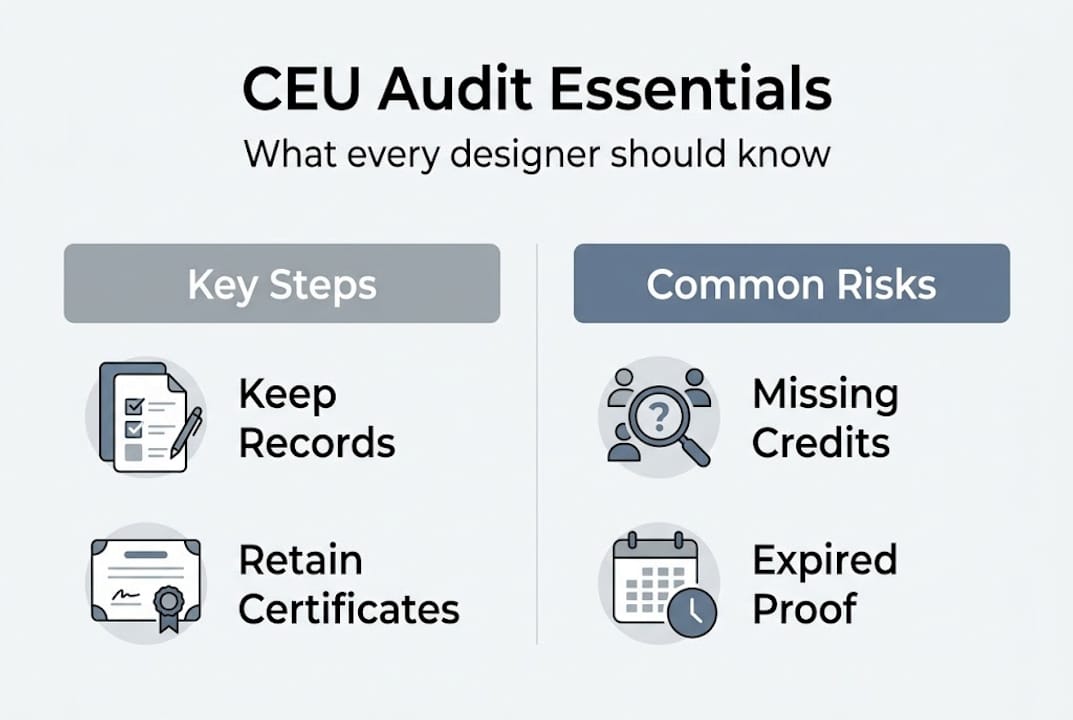
Audits require three to five years of record retention, credits do not carry over between cycles, and designers with licenses in multiple states face the added challenge of tracking different requirements simultaneously. That last point catches people off guard. Earning 20 hours in one cycle does not bank 10 hours for the next. Each renewal period starts fresh.

| Record Type | Minimum Retention Period | Format Accepted |
|---|---|---|
| Course completion certificates | 3 to 5 years | Digital or paper |
| Provider approval documentation | 3 years | Digital preferred |
| Self-reported credit logs | 5 years | Spreadsheet or portal |
| Association renewal confirmations | Indefinitely recommended | Digital |
Pro Tip: Use a dedicated folder in cloud storage, labeled by renewal year, to store every certificate immediately after course completion. Waiting until renewal season to gather records is how people discover missing credits at the worst possible time.
Here is a practical compliance checklist to keep you on track:
- Confirm your renewal dates for every license and membership at the start of each calendar year
- Calculate your credit gap by subtracting completed credits from your total requirement
- Register for courses early rather than cramming in the final month before renewal
- Download and save certificates immediately after completing each course
- Cross-reference credits to confirm they count toward all relevant jurisdictions
- Submit or verify reporting to each licensing board and association before the deadline
- Archive your renewal confirmation as proof that you completed the cycle successfully
Following this process consistently means an audit becomes a minor inconvenience rather than a crisis.
Why CEUs aren’t just a checkbox: A designer’s edge
We have spent a lot of time on rules and records, which is necessary, but let’s step back and reconsider what CEUs can really mean for your career. Here is the honest truth: most designers treat continuing education as the minimum required to keep their license. That creates an opening for you.
The design profession is changing faster than at any point in recent memory. Energy codes are tightening. Accessible design standards are expanding. Building technology, from parametric modeling to mass timber construction, is reshaping what clients expect. Designers who use their CEU hours to stay ahead of these shifts are not just compliant. They are genuinely more capable, and clients notice.
We have seen designers transform a single well-chosen course into a new service offering or a specialty that sets them apart in a crowded market. That is not luck. It is the compounding effect of treating every learning hour as an investment rather than a tax. The designers who thrive long-term are the ones who stopped asking “what is the minimum I need?” and started asking “what do I want to know next?” CEUs give you a structured reason to answer that second question every single year.
Next steps: Find quality CEUs online
Ready to take control of your CEU journey? Here’s a trusted place to begin.
If you are looking for a reliable source of AIA-registered and IDCEC-approved courses, online CEU courses at Ron Blank and Associates offer a curated library built specifically for architects, interior designers, engineers, and contractors. Courses are available as on-demand webinars, podcasts, and live sessions, so you can earn credits on your schedule without sacrificing quality.


Every course is designed to meet real association and state requirements, and the platform makes it straightforward to track your progress and download certificates the moment you finish. Whether you need HSW credits for your AIA membership, IDCEC-approved hours for ASID renewal, or state-specific credits for license renewal, you will find relevant, professionally produced content ready to go. Start browsing today and close your credit gap before your next deadline.
Frequently asked questions
What is the difference between AIA CEUs, LUs, and HSW credits?
AIA Learning Units measure the time spent in approved education, while HSW credits are LUs specifically focused on Health, Safety, and Welfare topics. Both count toward your total AIA annual requirement of 18 LUs.
Can CEUs earned for one association or state count for others?
Some courses are approved by both AIA and IDCEC, allowing credits to count toward multiple requirements, but state variations demand that you verify eligibility with each licensing board and association individually.
What happens if I’m audited and don’t have enough CEUs?
Failing an audit due to missing or undocumented credits can result in fines, membership suspension, or license loss. Audits require three to five years of retained records, so proactive tracking is your best protection.
Are online CEU courses and webinars accepted?
Yes, most state boards and associations accept online courses and webinars as long as they are IDCEC-approved or registered with AIA or another recognized credentialing body. Always confirm approval status before enrolling.