

Design never stands still. For architects and interior designers navigating rapid industry shifts, continuing education in designbecomes the bridge between foundational knowledge and current professional demands. As new materials emerge and technology continuously advances, keeping your credentials updated is about more than regulatory compliance—it is a strategy for staying relevant, growing expertise, and meeting global standards. This guide clarifies what counts as meaningful continuing education, helping you select paths that deliver both practical skills and recognized AIA credits.
Table of Contents
- Defining Continuing Education in Design
- Types of Accredited Design Courses Available
- Essential Skills Gained Through Ongoing Learning
- Fulfilling AIA Credits and Global Standards
- Career Advantages and Common Pitfalls
Key Takeaways
| Point | Details |
| Continuing Education Importance | Staying updated through continuing education is essential for architects and designers to maintain licensure and stay credible in a rapidly evolving industry. |
| Course Formats Variety | Numerous accredited formats exist, including online courses, webinars, and workshops, allowing professionals to choose what best fits their learning style and schedule. |
| Skill Development | Continuing education not only enhances technical skills but also develops soft skills like collaboration and problem-solving, crucial for modern design projects. |
| Strategic Learning | Professionals should strategically select courses that address their specific knowledge gaps and align with their career goals to maximize the value of their education efforts. |
Defining Continuing Education in Design
Continuing education in design refers to formal learning activities that architects and interior designers pursue after completing their initial professional credentials. Unlike remedial training or basic skill refreshers, it represents a strategic commitment to staying current with evolving industry standards, emerging technologies, and design methodologies.
At its core, continuing education in design serves three distinct purposes:
- Updating knowledge in response to rapid industry changes and technological advances
- Refreshing professional attitudes and expanding creative perspectives beyond foundational training
- Supporting the dual mastery of both artistic creativity and technical expertise required in modern design practice
Design is never static. Your role as an architect or interior designer demands constant evolution. The field itself transforms continuously as new materials emerge, building codes shift, sustainability standards tighten, and client expectations change. Continuing education bridges the gap between what you learned in school and what the profession demands today.
For AIA-registered professionals, continuing education takes on additional weight. The American Institute of Architects requires a specific number of learning units annually to maintain professional standing. This regulatory requirement aligns perfectly with the professional reality: staying current isn’t optional—it’s essential for credibility and competence.
Industry-specific knowledge and 21st-century skills form the foundation of meaningful continuing education. This means learning about building product specifications, construction methodologies, sustainability practices, and emerging design technologies. But it also means developing softer skills like client communication, project management, and adaptive problem-solving.
The scope of continuing education extends across multiple formats:
- Online courses offering flexibility and accessibility
- Webinars providing focused, timely content on specific topics
- Podcasts enabling learning during commutes or downtime
- Face-to-face workshops facilitating hands-on practice and peer discussion
What distinguishes continuing education from casual professional reading is its structured, credentialed nature. Courses registered with the AIA carry official recognition, documenting your commitment to professional development and ensuring your learning meets industry standards.
Continuing education transforms your practice from relying on yesterday’s knowledge to staying ahead of tomorrow’s challenges—keeping your designs relevant, compliant, and competitive.
Pro tip: Review your AIA credit requirements at the start of each year and strategically select continuing education courses that address both regulatory obligations and genuine knowledge gaps in your specific design specialty.
Types of Accredited Design Courses Available
Accredited design courses come in several distinct formats, each tailored to different learning styles and professional schedules. Understanding the options helps you select the right fit for your career goals and continuing education requirements.
The main categories of accredited courses include:
- Online courses offering self-paced learning accessible from anywhere
- Webinars providing focused, live or recorded sessions on specific topics
- Podcasts enabling learning during commutes or downtime
- Face-to-face workshops facilitating hands-on practice and peer collaboration
Professional development programs form the backbone of accredited continuing education. These structured courses blend scientific research with practical application, addressing real challenges you encounter in your design work.
Masterclasses represent another valuable option. They’re typically intensive, shorter programs led by industry experts who share specialized knowledge in areas like advanced sustainability design, cutting-edge building technologies, or specialized interior design niches.
Executive programs serve architects and designers seeking leadership development alongside technical growth. These courses combine business strategy, project management, and professional ethics with design-specific content.
Specialized training programs focus on particular competencies your firm or clients demand. Think LEED certification courses, building information modeling (BIM) training, or liability and risk management for design professionals.
Courses also differ in how they address content. Some emphasize technical skills—building codes, material specifications, software proficiency. Others tackle business and liability aspects crucial for protecting your practice.
Personalized educational concepts allow you to customize learning paths based on your specific gaps. Rather than sitting through generic content, you focus on skills directly relevant to your design specialization and career trajectory.
Accredited courses registered with the American Institute of Architects carry official recognition, ensuring your learning meets professional standards and counts toward licensure requirements.
What distinguishes truly valuable courses is their focus on practical application. Quality accredited courses don’t just teach theory—they show you how to implement new knowledge immediately in client projects and daily practice.
Here’s a comparison of common accredited course formats and their ideal use cases for design professionals:
| Course Format | Ideal For | Distinguishing Benefit |
| Online courses | Busy professionals, remote access | Flexible, self-paced learning |
| Webinars | Timely updates, quick refreshers | Live interaction, focused topics |
| Podcasts | On-the-go learning | Multitasking during commutes |
| Face-to-face workshops | Hands-on skills, networking | Peer interaction, practical exposure |
| Masterclasses | Advanced, niche expertise | Expert-led, intensive sessions |
| Executive programs | Aspiring leaders | Management and strategic growth |
| Specialized training | Regulatory or tech requirements | Deep dive in key competencies |
Pro tip: Before enrolling, verify that courses carry AIA accreditation and clarify exactly how many continuing education units (CEUs) they provide, ensuring they directly support your specific licensure obligations and career advancement goals.
Essential Skills Gained Through Ongoing Learning
Continuing education sharpens both technical and soft skills that define modern design practice. The skills you develop extend far beyond building codes and software—they fundamentally change how you approach projects and collaborate with teams.

Critical thinking, creativity, and adaptability form the foundation of 21st-century design competency. These aren’t peripheral extras—they’re central to solving complex client problems, navigating regulatory changes, and staying competitive as industry standards evolve.
Ongating learning develops practical skills across multiple dimensions:
- Technical mastery including building codes, material specifications, and emerging design software
- Sustainability expertise enabling you to design buildings and interiors with reduced environmental impact
- Collaborative abilities to work effectively with engineers, contractors, manufacturers, and multidisciplinary teams
- Business acumen covering project management, client relations, and practice liability
Reflective and analytical thinking empowers you to evaluate your own work critically and learn from each project. This metacognitive skill—thinking about how you think—accelerates professional growth and prevents you from repeating mistakes.
Sustainability knowledge has become non-negotiable. Today’s clients, building codes, and market demands require designers who understand LEED certification, net-zero design principles, lifecycle assessment, and material sustainability.
Collaboration skills matter more now than ever. Design happens in teams. Ongoing learning teaches you how to communicate effectively with architects, engineers, product manufacturers, and clients—ensuring specifications get implemented correctly and client visions become reality.
Designers who develop a heightened sense of responsibility for long-term design impacts create work that addresses complex societal challenges and promotes sustainable futures.
Problem-solving abilities deepen through exposure to real-world case studies and peer learning. When you study how others solved similar challenges, you build mental frameworks for tackling novel situations in your own practice.
Assessment and feedback mechanisms in quality continuing education help you identify remaining knowledge gaps. Practical assignments, quizzes, and peer discussion reveal where you need deeper understanding before encountering these issues in client work.
Pro tip: Prioritize courses with peer collaboration and real-world project applications over passive lectures—actively discussing design challenges and receiving feedback accelerates skill development far more than solo online modules alone.
Fulfilling AIA Credits and Global Standards
AIA continuing education credits represent the currency of professional credibility in architecture and design. Meeting these requirements isn’t bureaucratic busywork—it’s a concrete commitment to staying current and maintaining licensure.
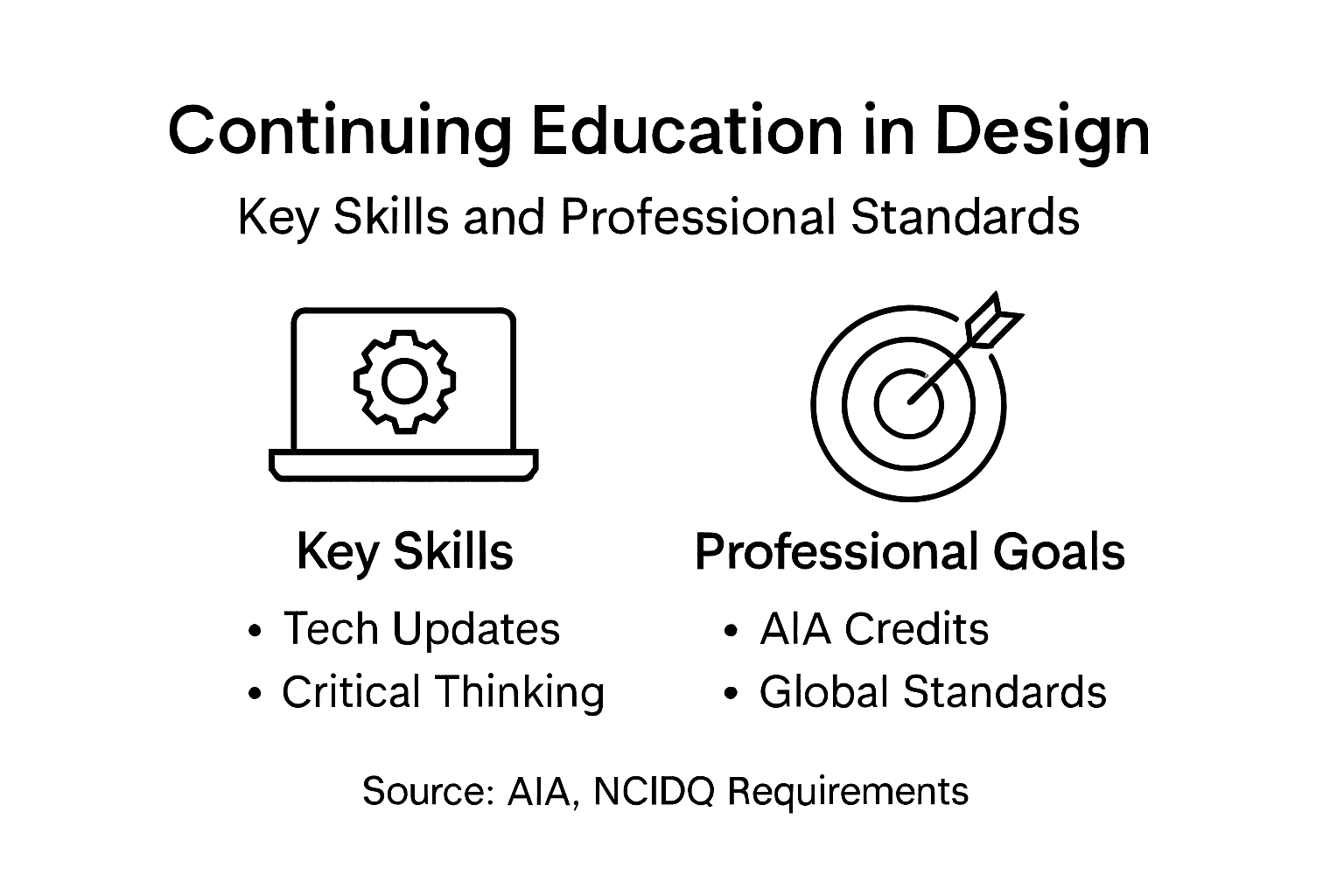
The American Institute of Architects mandates ongoing professional development to ensure practitioners keep pace with evolving codes, technologies, and best practices. Most states require architects to earn a specific number of learning units annually to renew their licenses.
Accredited continuing education programs are deliberately designed to fulfill these credit requirements while delivering substantive learning. Courses registered with the AIA carry official recognition, meaning the hours count directly toward your annual obligations.
Here’s what makes AIA-accredited courses valuable:
- Official recognition ensuring credits transfer across jurisdictions and count toward licensure renewal
- Standardized quality guaranteeing content meets professional standards set by the Institute
- Documented compliance providing proof of participation for licensing boards and employers
- Global alignment supporting professional standards for architects practicing internationally
Interior designers pursuing NCIDQ certification or state registration follow similar frameworks. Continuing education aligned with IIDA, ASID, or state-specific requirements ensures your learning meets professional expectations in your discipline.
Mandatory continuing education frameworks balance individual choice with professional accountability. Rather than dictating exactly what you study, accreditation bodies ensure you’re engaged in continual knowledge updates addressing evolving practice demands.
Global standards matter because design practice increasingly transcends borders. Whether collaborating with international teams, specifying products manufactured overseas, or working on projects subject to multiple regulatory jurisdictions, understanding global building standards strengthens your competency.
Tracking your credits prevents last-minute scrambling. Document completed courses immediately—noting the provider, course title, date, and AIA units earned. Most states require proof when you renew your license.
Fulfilling AIA credit requirements demonstrates to clients, employers, and regulatory bodies that you actively maintain professional competency and commit to industry standards.
Some continuing education serves double duty. Courses addressing sustainability, building information modeling, or emerging technologies often count toward AIA credits while directly enhancing skills you use in daily projects.
Pro tip: At the start of each calendar year, review your state’s specific AIA credit requirements, calculate how many units you’ve already earned, and strategically select remaining courses that address both regulatory obligations and genuine knowledge gaps in your practice area.
Career Advantages and Common Pitfalls
Continuing education opens tangible career doors. Architects and designers who invest in ongoing learning command higher fees, attract better clients, and earn promotions faster than peers who rely on outdated knowledge.
Career advantages of strategic continuing education include:
- Enhanced expertise making you the go-to specialist in your niche
- Competitive positioning differentiating you from less-committed competitors
- Client confidence demonstrating commitment to current best practices and standards
- Promotion readiness equipping you with skills leadership roles demand
- Professional credibility validated by recognized certifications and AIA credits
Up-to-date skills aligned with industry trends directly translate to career advancement. When you understand emerging technologies, sustainability standards, and client expectations, you become invaluable to your firm and clients.
But here’s where many designers stumble. Not all continuing education delivers real value. Common pitfalls undermine your investment:
- Misaligned course content that doesn’t match your practice specialization
- Lack of practical application teaching theory without real-world implementation
- Time conflicts making it difficult to balance learning with project deadlines
- Credential chasing earning credits without genuine skill development
- Passive learning formats that fail to engage your mind actively
Practitioners often struggle with sustained learning when courses feel disconnected from daily work. You sit through generic content addressing problems you don’t face, then struggle to apply concepts when you return to your desk.
Workload overload represents another hidden risk. Taking courses while managing demanding projects creates stress that undermines learning effectiveness. You’re exhausted, distracted, and less able to absorb and retain new information.
The voluntary nature of continuing education means responsibility falls entirely on you. Without systematic guidance, it’s easy to select comfortable courses covering familiar ground rather than challenging ones addressing genuine gaps.
Successful continuing education balances strategic skill building with practical relevance—ensuring every course directly strengthens your ability to serve clients and advance your career.
Quality matters more than quantity. One intensive course directly addressing your practice gaps delivers more value than five generic online modules earning easy credits.
The following table summarizes typical pitfalls in continuing education and strategies to avoid them:
| Common Pitfall | Resulting Problem | How to Avoid |
| Misaligned content | Little practical benefit | Align courses with real practice |
| Theoretical focus | Hard to apply knowledge | Choose application-based formats |
| Overloaded schedule | Poor knowledge retention | Plan learning during slower periods |
| Chasing credits only | Missed growth opportunities | Prioritize true skill development |
| Passive learning formats | Low engagement, poor recall | Seek interactive, peer-based options |
Selecting the right provider makes the difference. Look for courses from reputable organizations, instructors with real-world experience, and content addressing specific challenges your practice faces.
Pro tip: Before enrolling, honestly assess your actual knowledge gaps, then select courses addressing those specific areas rather than trending topics everyone discusses—this ensures learning transforms your practice rather than simply filling your transcript.
Elevate Your Design Career with Expert Continuing Education
The challenge of keeping your skills current amid rapidly changing industry standards and AIA requirements calls for a reliable, accredited source of professional learning. Staying ahead means more than just earning credits. It means embracing practical, relevant education that sharpens your technical expertise and strengthens your ability to deliver sustainable, innovative design solutions. For architects and interior designers seeking focused, flexible learning options like online courses, webinars, and face-to-face workshops, partnering with a trusted provider makes all the difference.

Discover how Ron Blank and Associates can help you meet your continuing education goals with courses registered by the American Institute of Architects and designed specifically for your professional challenges. Take control of your growth, fulfill your licensure requirements, and gain the competitive edge today. Visit our homepage to explore available courses and start transforming your practice through strategic learning now.
Frequently Asked Questions
What is continuing education in design?
Continuing education in design refers to formal learning activities that architects and interior designers undertake after obtaining their initial professional credentials, aimed at keeping their knowledge and skills up to date with industry changes.
Why is continuing education important for architects and interior designers?
Continuing education is crucial because it enables professionals to stay current with evolving standards, technologies, and methodologies, ensuring they meet clients’ needs and maintain their licensure and credibility in the field.
What types of continuing education courses are available for design professionals?
Design professionals can choose from various formats of continuing education courses, including online courses, webinars, podcasts, face-to-face workshops, masterclasses, and specialized training programs tailored to specific competencies.
How do I fulfill AIA continuing education requirements?
To fulfill AIA continuing education requirements, architects must complete accredited courses that provide learning units (LU), ensuring the content meets professional standards and counting directly towards licensure renewal.