

TL;DR:
- Podcasts enhance professional knowledge and motivation, especially when integrated into structured learning.
- Some podcasts and courses offer direct AIA CES or RCEP credits with proper registration and documentation.
- Listening should be complemented by active application and mentorship to bridge tacit knowledge gaps in architecture and engineering.
Continuing education doesn’t have to mean sitting in a conference room with a lukewarm coffee, flipping through slide decks. For architects and engineers, podcasts have quietly become one of the most flexible and surprisingly effective tools for professional development. Knowledge scores improve by over 15.5% when podcast-based learning is incorporated into a curriculum, outperforming many traditional methods. Yet most AEC professionals still treat podcasts as background noise rather than a legitimate path toward AIA CES and RCEP continuing education credits. This guide changes that, walking you through the research, the credit options, and the best podcasts to help you learn smarter and stay compliant.
Table of Contents
- How podcasts bridge industry and education for AEC professionals
- What does the research say about podcasts in professional learning?
- Navigating AIA CES and RCEP credits: What’s possible with podcasts?
- Top podcasts for AEC professionals: Recommendations for CE and beyond
- A practitioner’s perspective: Why podcasts are powerful and their most important limits
- Earn credits and elevate your expertise with podcast-based courses
- Frequently asked questions
Key Takeaways
| Point | Details |
|---|---|
| High-impact learning | Podcasts boost knowledge retention and motivation, especially for architects and engineers. |
| Credit-eligible options | Only specific podcasts from registered providers qualify for AIA and RCEP credits. |
| Action is critical | Active engagement and follow-up are crucial—passive listening delivers minimal gains. |
| Top podcast picks | A curated list of AEC podcasts supports both formal credit and lifelong learning. |
How podcasts bridge industry and education for AEC professionals
There’s a persistent gap in professional education: formal coursework teaches principles, but the job teaches practice. Podcasts sit in a rare middle ground, connecting both worlds in a format you can access during a commute, a site visit prep, or a lunch break. That accessibility isn’t just convenient; it’s genuinely powerful for motivation and retention.
Research confirms that podcasts bridge academic learning and industry practice by featuring professionals discussing real-world applications, which directly supports what Self-Determination Theory describes as intrinsic motivation. When you hear a structural engineer walk through a tricky curtain wall detail on a recent project, the learning sticks because it feels relevant. It’s not abstract. It’s your world.
Podcast formats vary widely, and that variety is part of what makes them so adaptable for AEC professionals:
- Expert interviews: One-on-one conversations with architects, engineers, or product specialists
- Roundtables: Multi-voice discussions on emerging trends like mass timber or net-zero design
- Case studies: Deep dives into specific projects, from concept through construction
- Q&A episodes: Listener-submitted questions answered by practitioners
Each format serves a different learning style. Case study episodes are particularly effective for engineers who think in systems and sequences. Roundtables work well for architects who want to understand how peers are navigating regulatory shifts or sustainability targets.
| Learning format | Engagement level | Best for |
|---|---|---|
| Classroom lecture | Moderate | Foundational concepts |
| Online self-paced course | Moderate to high | Structured CE compliance |
| Podcast (passive) | Low to moderate | Awareness and inspiration |
| Podcast (active, with notes) | High | Retention and application |
“The most impactful podcast learning happens when listeners treat episodes like a conversation with a mentor, not a radio program.”
Pro Tip: Keep a project journal alongside your podcast listening. After each episode, write two or three sentences connecting what you heard to a current or recent project. That small habit transforms passive listening into active learning.
What does the research say about podcasts in professional learning?
The numbers are more compelling than most people expect. A structured podcast curriculum produced knowledge score increases of 22.3% compared to just 6.8% for control groups using traditional methods alone. That’s not a marginal improvement; it’s a meaningful difference in how much professionals actually retain and can apply.
Comfort with complex material also improves. Participants in podcast-based programs reported feeling more confident discussing nuanced topics after completing a structured series. For architects and engineers navigating evolving codes, new materials, or sustainability standards, that confidence matters in practice.

Here’s a quick comparison of outcomes:
| Metric | Traditional learning only | Podcast-supplemented learning |
|---|---|---|
| Knowledge score improvement | 6.8% | 22.3% |
| Learner confidence | Moderate | Notably higher |
| Continued use after pilot | N/A | 89% planned to continue |
| Flexibility for busy schedules | Low | High |
That last data point is striking. When 89% of participants in a pilot study said they intended to keep using podcasts after the program ended, it signals genuine value, not just novelty.
Here’s how to integrate podcast learning into your CE portfolio effectively:
- Identify your credit gaps before selecting podcasts. Know whether you need health, safety, and welfare (HSW) hours or elective PDH credits.
- Choose structured series over random episodes when targeting knowledge depth.
- Document each session with date, episode title, provider, and a brief learning summary.
- Cross-reference with your AIA or RCEP transcript to track informal learning alongside formal credits.
- Schedule listening time as a recurring calendar block, treating it like a meeting you can’t skip.
“Podcasts are a highly effective supplement, though not a full replacement, for formal didactics.”
That framing matters. Podcasts work best when they’re woven into a broader CE strategy, not treated as a shortcut.
Navigating AIA CES and RCEP credits: What’s possible with podcasts?
Here’s the honest reality: most podcasts you find on a general search do not offer direct AIA CES or RCEP PDH credits. Few podcast award credits toward official AIA or RCEP requirements; the majority serve as supplemental learning that supports your practice without generating a certificate.
That said, a small but growing number of providers are changing this. Platforms like Ron Blank & Associates have developed podcast-format courses that are registered with the AIA Continuing Education System (CES) and meet RCEP PDH requirements. The Ron Blank sponsored Spec Shaman Podcast is one of the most listened to AIA podcast series for the AEC industry. These are structured differently from typical podcasts; they include learning objectives, post-episode assessments, and certificates of completion.
| Credit pathway | How it works | Example providers |
|---|---|---|
| Direct credit podcast | Registered with AIA CES or RCEP, includes certificate | Ron Blank |
| Self-reported learning | You document and self-certify informal learning | Any quality podcast |
| Informal learning | No credit, but builds knowledge and practice insight | 99% Invisible, Life of an Architect |
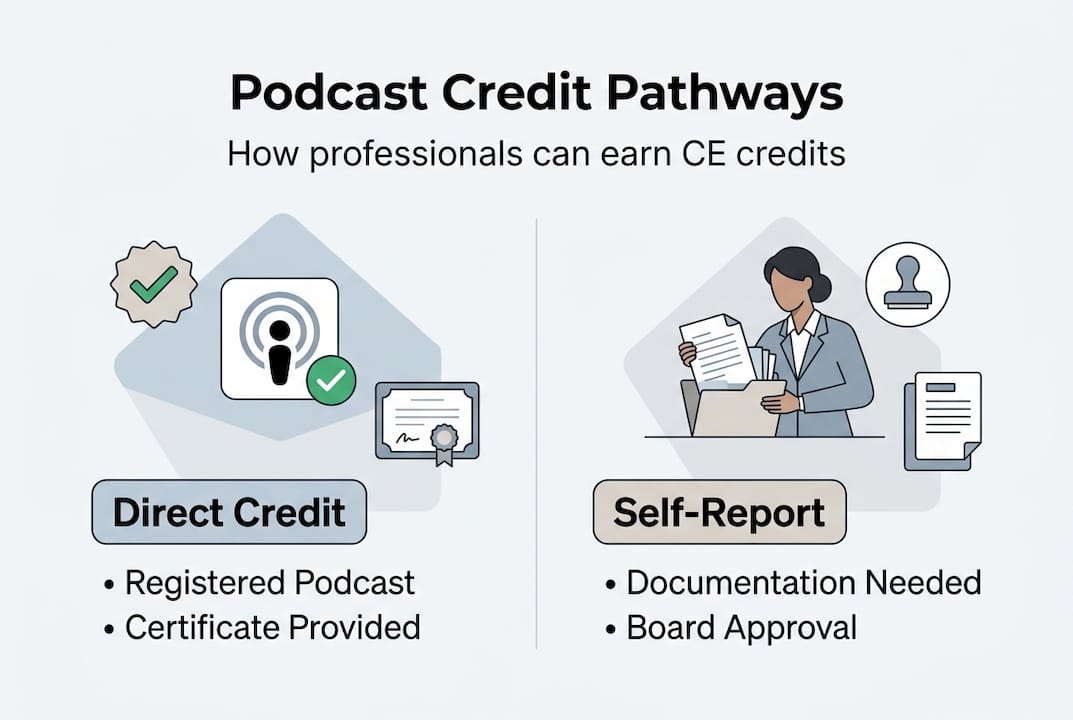
If you’re pursuing self-reported credits, documentation is everything. Most licensing boards that allow self-reported PDH hours require a clear record of what you learned, when, and why it’s relevant to your practice.
Pro Tip: Create a simple spreadsheet with columns for date, podcast name, episode title, learning objectives covered, and how it connects to your practice area. This takes five minutes per episode and makes license renewal far less stressful.
To verify whether a podcast episode is credit-eligible, look for:
- A registered provider number (AIA CES or RCEP listed)
- Stated learning objectives at the start of the episode
- A post-episode quiz or assessment
- A certificate of completion or reporting confirmation
- Clear instructions for how to log the credit with your licensing board
If any of these are missing, the episode likely qualifies only as informal or self-reported learning.
Top podcasts for AEC professionals: Recommendations for CE and beyond
With credit pathways clarified, here’s a curated list to build your listening queue. Leading AEC podcasts include Life of an Architect, AEC AI & Tech Strategy, Archispeak, and EntreArchitect, each serving a distinct audience within the profession.
CE-credit eligible:
- Ron Blank podcast courses: Registered with AIA CES and RCEP, covering topics from building enclosures to sustainable materials
Knowledge and professional growth:
- Life of an Architect: Practical career and practice management topics for architects at all career stages
- EntreArchitect: Business strategy and firm management for architecture practice owners
- Archispeak: Candid conversations on design culture, technology, and the evolving profession
- AEC AI & Tech Strategy: Forward-looking discussions on artificial intelligence and digital tools in the built environment
- 99% Invisible: Urbanism, design history, and the hidden forces shaping our built world
How to build a smart podcast schedule:
- Prioritize CE-credit episodes first to meet compliance deadlines
- Fill remaining time with knowledge-focused series aligned to your current project types
- Rotate between technical and soft-skills topics to develop a balanced professional profile
- Revisit episodes when starting a new project type; a structural episode hits differently when you’re mid-design
“Tacit knowledge transfer via podcasts is promising but imperfect. Passive listening risks creating a false sense of competence without genuine skill development.”
That caution is worth holding onto. The best AEC podcasts spark curiosity and surface ideas you can then pursue through hands-on practice, mentorship, or formal coursework. They are a starting point, not a finish line.
A practitioner’s perspective: Why podcasts are powerful and their most important limits
We’ve seen a lot of enthusiasm in the AEC community around podcasts as a professional development tool, and most of it is well-placed. But there’s a tendency to overestimate what passive listening actually delivers. Hearing an expert discuss passive house design principles while you’re driving is not the same as working through a detail with a senior colleague on a live project.
The knowledge gap in architecture is real and growing. As experienced practitioners retire, the tacit knowledge they carry, the kind built through decades of site visits, contractor negotiations, and material failures, doesn’t transfer automatically through podcast episodes. It transfers through mentorship, observation, and repetition.
Podcasts are genuinely excellent for expanding your awareness, staying current on industry shifts, and hearing how peers are solving problems you haven’t faced yet. That’s valuable. But the professionals we see growing fastest are the ones who treat podcast learning as a prompt for action, not a substitute for it. Listen to an episode on mass timber connections, then go find a project where you can apply even one idea. That’s when the learning compounds.
Pro Tip: After every podcast episode, write one sentence describing what you’ll do differently in your next project or client conversation. One sentence. That small commitment turns a passive habit into a professional development practice.
Earn credits and elevate your expertise with podcast-based courses
If you’re ready to move beyond informal listening and start earning real AIA CES and RCEP credits through podcast-format learning, we’ve built exactly that. Our courses at Ron Blank & Associates are registered with the AIA Continuing Education System and meet RCEP PDH requirements, delivered in formats that fit your schedule, including podcasts, online courses, and webinars.

Explore our current catalog of podcast-based CE courses covering building enclosures, sustainable materials, accessibility, and more. Each course includes clear learning objectives, a post-course assessment, and a certificate you can submit directly to AIA or your state licensing board. Stay current, earn your credits, and keep your practice at the leading edge of the profession.
Frequently asked questions
Can I earn AIA CES or RCEP credits just by listening to podcasts?
Only select podcasts from registered providers count directly for AIA CES or RCEP PDH credit; most podcasts serve as supplemental learning and require self-reporting with documentation.
What’s the proven benefit of podcast learning for professionals?
Studies show up to 22.3% improvement in knowledge scores for podcast-supplemented learners compared to just 6.8% for those using traditional methods alone.
How do I verify if a podcast offers continuing education credit?
Look for a registered provider number, stated learning objectives, a post-episode assessment, and a certificate of completion on the provider’s podcast page.
Are podcasts enough to replace live courses or mentorship?
No; podcasts are best used as a supplement because the tacit knowledge gap in architecture requires hands-on mentorship and real-world application that audio content alone cannot replicate.