

TL;DR:
- Achieving accreditation for AIA and RCEP broadens audience reach and enhances credibility.
- Proper course content, documentation, and timely reporting are critical for maintaining approval.
- Dual accreditation significantly increases attendance by engaging both architects and engineers.
Getting a course accredited for AIA and RCEP credit sounds straightforward until you’re staring at submission portals, documentation checklists, and compliance timelines that all seem to speak a different language. For building product manufacturers and architects alike, the stakes are real: accredited courses drive specification opportunities, satisfy continuing education requirements, and build lasting credibility with design professionals. Miss a step, and you risk losing your approved status or, worse, your audience’s trust. This guide walks you through every stage of the process, from understanding what accreditation actually means to delivering your course and reporting credits correctly, so you can move forward with clarity and confidence.
Table of Contents
- Understand accreditation basics: AIA CES and RCEP
- Prepare your course content and materials
- Submit for AIA CES and RCEP approval
- Host, deliver, and report your accredited course
- Avoiding common pitfalls and ensuring ongoing success
- Why dual accreditation is the secret weapon for audience growth
- Get expert help with AIA and RCEP course hosting
- Frequently asked questions
Key Takeaways
| Point | Details |
|---|---|
| Dual accreditation maximizes reach | Offering both AIA and RCEP credits makes your course attractive to a broader audience of architects and engineers. |
| Preparation is crucial | Comprehensive, accurate materials and topics aligned with HSW guidelines streamline the approval process. |
| Partnering simplifies hosting | Collaborating with local AIA chapters or expert platforms can ease course approval and delivery. |
| Ongoing compliance matters | Accurate reporting and periodic course updates protect your accredited status and build industry credibility. |
Understand accreditation basics: AIA CES and RCEP
Before you build a single slide deck, you need to know exactly what you’re working toward. An “accredited course” in the AIA and RCEP world isn’t just a course that someone says is good. It’s a program formally approved by a recognized body to award continuing education (CE) credit to licensed professionals.
The AIA Continuing Education System (CES) is the American Institute of Architects’ framework for approving courses that award Learning Units (LUs) to architects. Courses focused on Health, Safety, and Welfare (HSW) earn HSW-designated LUs, which architects need to meet state licensing requirements. The RCEP (Registry of Continuing Education for Professional Engineers) serves a different but overlapping audience: licensed engineers and other technical professionals who need Professional Development Hours (PDH) for their state board renewals. RCEP is an approved provider for dual credit, meaning a single course can satisfy requirements for both audiences simultaneously.
Why does dual approval matter? Because it dramatically expands who can attend your course and benefit from it. An architect and an engineer sitting in the same lunch & learn can both walk away with credit. That’s a powerful value proposition.
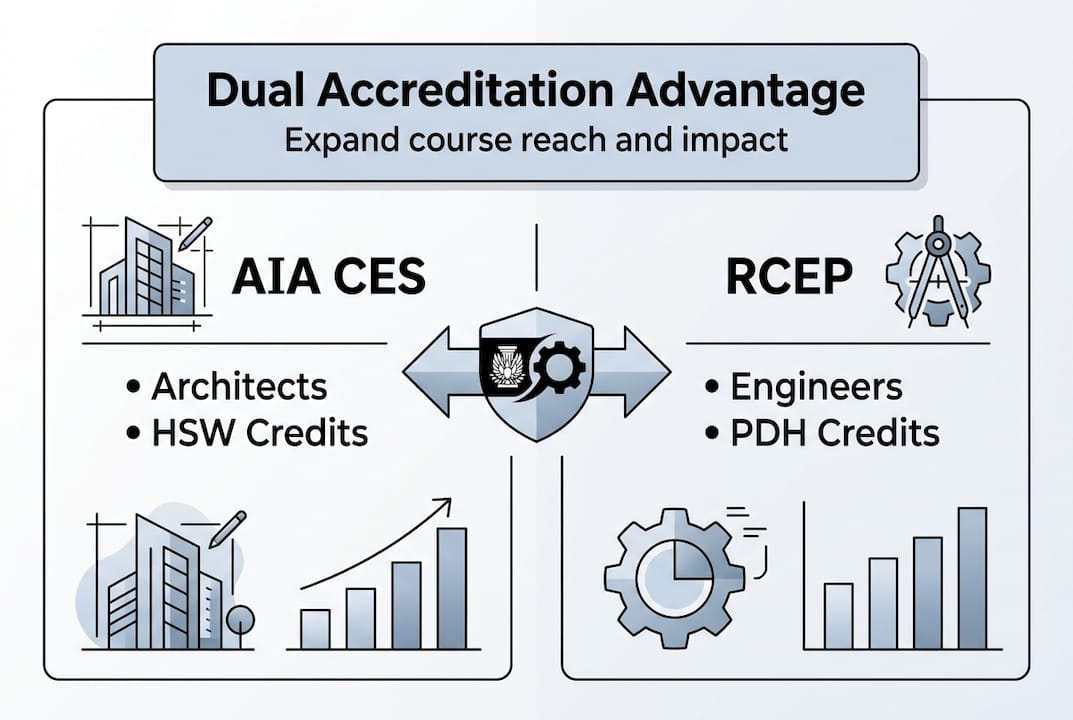
| Feature | AIA CES | RCEP |
|---|---|---|
| Primary audience | Licensed architects | Licensed engineers |
| Credit type | Learning Units (LUs/HSW) | PDH credits |
| Focus area | Architecture, HSW topics | Engineering, technical topics |
| Delivery formats | Live, online, hybrid | Live, online, hybrid |
| Provider model | AIA-registered providers | RCEP-approved providers |
Manufacturers host free courses as AIA CES providers, often in partnership with organizations that streamline the registration and delivery process. Common delivery models include lunch & learns, webinars, and formal event-based sessions. Each format has its place depending on your audience size, geography, and budget.
Prepare your course content and materials
With the definitions clear, the next step is building course content that actually meets AIA and RCEP standards. This is where many manufacturers stumble, not because they lack knowledge, but because they underestimate how structured the content requirements are.
Start with topic selection. Both AIA and RCEP prioritize Health, Safety, and Welfare (HSW) content, which covers topics like building envelope performance, fire safety, structural integrity, accessibility, and sustainable design. Choosing an HSW-aligned topic isn’t just a compliance checkbox; it’s a signal to your audience that the course delivers professional value, not a product pitch.
Here’s what you’ll need to compile before submission:
- Learning objectives: Clear, measurable outcomes (typically 4 to 6) that attendees will achieve
- Instructor biography: Credentials, relevant experience, and professional affiliations
- Presentation slides or handouts: Formatted, professionally designed course materials
- Assessment questions: A quiz or test (usually 5 to 10 questions) with a minimum passing score
- Course outline: A structured agenda showing time allocation for each topic
- Provider agreement: Signed documentation confirming compliance with AIA or RCEP standards
Free courses are common as a strategy to drive product specifications and nurture leads after completion. Manufacturers who offer no-cost accredited sessions consistently report stronger relationships with specifiers and design teams.
Pro Tip: Design your course for both live and on-demand delivery from the start. Recording a webinar and repurposing it as an on-demand module doubles your reach without doubling your workload. Just make sure your on-demand version meets the platform’s interactivity requirements for credit reporting.
Real-world example: A roofing manufacturer developed an HSW course on thermal bridging and building envelope performance. Because the topic applied equally to architects and engineers, they pursued dual AIA and RCEP approval and saw attendance nearly double compared to their previous single-accreditation sessions.
Submit for AIA CES and RCEP approval
Armed with your prepared materials, submitting your course for official approval is your next milestone. The process differs slightly between AIA and RCEP, but the core logic is the same: you’re demonstrating that your course meets the standards of an approved provider.
Here’s the general submission flow:
- Register as an AIA CES provider through the AIA’s online portal if you haven’t already
- Submit your course with all required documentation: learning objectives, assessment, slides, and instructor bio
- Register separately with RCEP if you want dual credit, as the two systems operate independently
- Submit your course to RCEP using their provider portal, mirroring the AIA submission structure
- Await review from each organization, responding promptly to any requests for clarification or revision
- Receive approval and your course number, which you’ll use for all future reporting
Many manufacturers offer courses using lunch & learn or webinar models as AIA CES providers, often in partnership with organizations that simplify the submission and approval process. Platforms like RonBlank.com are specifically built to help manufacturers navigate this workflow without getting lost in paperwork.
Pro Tip: Use template documentation provided by your hosting platform. Templates reduce the chance of formatting errors or missing fields, which are the most common reasons submissions get delayed or returned for revision.
Critical note: Accuracy in your documentation is non-negotiable. Inconsistencies between your learning objectives, assessment questions, and course content are the fastest way to trigger a rejection or a lengthy back-and-forth with the reviewing body. Treat your submission package like a professional proposal, because that’s exactly what it is.
Typical review timelines range from two to eight weeks depending on submission completeness and the organization’s current volume. Build that buffer into your launch planning.
Host, deliver, and report your accredited course
Once approved, you’re ready to host. But delivery and reporting are where many providers drop the ball, and a compliance misstep here can put your accreditation at risk.
| Factor | In-person delivery | Online delivery |
|---|---|---|
| Attendance tracking | Sign-in sheets, manual verification | Platform-generated attendance logs |
| Engagement proof | Facilitator observation | Polling, quiz completion, time-on-screen |
| Assessment delivery | Paper or digital quiz on-site | Integrated LMS quiz with auto-scoring |
| Credit reporting | Manual entry into AIA/RCEP portals | Automated or semi-automated reporting |
| Geographic reach | Local or regional | National or global |
| Cost per attendee | Higher (travel, catering) | Lower (no travel required) |
Lunch & learn, webinar, and event-based models are the most common delivery formats, and follow-up after the session is crucial for both lead nurturing and compliance. Here’s a clean reporting workflow that works for dual credit:
- Collect full name, license number, and state for each attendee
- Confirm assessment completion and passing score if applicable
- Report completions to AIA CES within the required window (typically 10 business days)
- Submit PDH records to RCEP using their reporting portal
- Issue certificates of completion to attendees for their personal records
- Retain all attendance and assessment records for a minimum of three years
Dual AIA and RCEP reporting boosts the perceived value of your course for attendees, giving them a reason to prioritize your session over competitors who only offer single-credit options.
Avoiding common pitfalls and ensuring ongoing success
To keep benefiting from your course offerings, you’ll need to maintain high standards and avoid costly mistakes. The good news is that most compliance failures are preventable with a little discipline and the right systems.
Here are the most frequent pitfalls we see:
- Incomplete documentation at submission: Missing instructor bios, vague learning objectives, or poorly written assessment questions slow down approval and frustrate reviewers
- Poor attendance record-keeping: Losing sign-in sheets or failing to capture license numbers makes credit reporting impossible
- Inadequate assessment design: Questions that are too easy, too vague, or unrelated to the learning objectives can trigger a compliance review
- Skipping the RCEP submission: Focusing only on AIA means you’re leaving engineers and a broader spec audience on the table
- Failing to renew courses annually: Approved courses typically require periodic review and renewal; letting them lapse means starting over
- No post-course follow-up: Missing the window to engage attendees while your brand is still fresh in their minds
Missing dual submission or incomplete attendance reporting can jeopardize your accreditation status, and recovering from a lapsed approval takes significantly more time than maintaining it in the first place.
Best practice: Schedule a quarterly audit of your course materials, attendance records, and reporting logs. When AIA or RCEP updates their standards, you want to catch the changes early and update your content before your next session, not after a compliance notice arrives.
Long-term, the manufacturers who succeed with accredited courses treat them as living assets, refreshing content, gathering attendee feedback, and building ongoing relationships with the design professionals who attended.
Why dual accreditation is the secret weapon for audience growth
Here’s something we’ve observed consistently: most manufacturers put all their energy into AIA accreditation and treat RCEP as an afterthought, if they think about it at all. That’s a missed opportunity that’s bigger than most people realize.
Engineers influence specifications just as much as architects in many project types, particularly in commercial, industrial, and infrastructure work. If your course only offers AIA credit, you’re invisible to that entire audience. Dual accreditation flips that dynamic. It signals that your course has broader professional value, and it gives engineers a concrete reason to attend rather than politely declining.
We’ve also seen dual-credit courses generate noticeably higher event turnout, simply because the invitation is relevant to a wider team. When an architect and their engineering collaborator can both earn credit from the same session, attendance decisions get easier for everyone involved.
The upfront work of dual submission is real, but it’s a one-time investment that pays dividends every time you host. Forward-thinking manufacturers treat free, accredited courses not as a marketing expense but as a brand placement strategy, putting their products in front of specifiers at exactly the moment those professionals are learning something new and valuable.
Get expert help with AIA and RCEP course hosting
If you’re ready to go from plans to accredited programming, working with an experienced partner makes the entire process faster and far less stressful.

At RonBlank.com, we specialize in AIA and RCEP course hosting for building product manufacturers and education providers who want to do this right the first time. From course development and dual-track submission to delivery, compliance reporting, and lead nurturing follow-up, we handle the complexity so you can focus on your audience. Whether you’re launching your first accredited course or scaling an existing program, we have the systems and experience to support you at every stage. Reach out and let’s talk about what’s possible for your brand.
Frequently asked questions
What topics are best for AIA and RCEP accredited courses?
Health, Safety, and Welfare (HSW) topics are the strongest choice because they are prioritized for dual credit by both AIA and RCEP, making them eligible for a wider professional audience.
How long does it take to get a course accredited by AIA and RCEP?
Approval timelines typically range from a few weeks to two months, and timelines vary by provider and the completeness of your submission package.
Can I host an accredited course online and in-person?
Yes, manufacturers host online and in-person sessions as AIA providers, and both formats can qualify for RCEP credit as long as they meet the respective delivery and assessment requirements.
What happens if I miss reporting attendee credits correctly?
Non-compliance with reporting can result in loss of your accredited provider status, so always follow the official documentation and submission timelines for both AIA and RCEP.
Is it worth offering free accredited courses?
Absolutely. Free accredited courses build leads and brand recognition within the AIA and engineering markets, and they consistently generate stronger specification opportunities than traditional sales outreach alone.