

TL;DR:
- Material classification into structural, envelope, and finishes guides design, codes, and specifications.
- Structural materials like concrete, steel, and timber have distinct performance profiles for various load demands.
- Understanding code classifications and performance data enables innovative, cost-effective material choices for modern buildings.
Material selection sits at the heart of every successful construction project, shaping structural integrity, energy performance, and long-term code compliance. Whether you’re specifying a mid-rise office building or a mixed-use residential complex, the wrong material choice can trigger costly redesigns, failed inspections, or worse, safety failures. Building materials are classifiedby function into structural, envelope, and finishes categories, each governed by distinct standards and performance benchmarks. This guide walks you through those classifications, the key standards that govern them, and a practical decision workflow you can apply immediately on your next project.
Table of Contents
- Core classifications of building materials
- Common types of structural materials
- Envelope and insulation materials: Thermal and protective roles
- Fire-resistance and code classifications: IBC Types I-V explained
- Material selection: Integrating codes, performance, and project goals
- Expert perspective: Rethinking the limits of conventional building materials
- Advance your expertise in building materials
- Frequently asked questions
Key Takeaways
| Point | Details |
|---|---|
| Functional classification | Building materials fall into structural, envelope, and finish groups with distinct roles. |
| Key structural options | Concrete, steel, timber, and masonry are the main structural materials, each suited to different needs. |
| Thermal performance focus | Insulation and envelope choices rely on thermal conductivity and compliance with codes like ASHRAE 90.1. |
| Fire code impact | Materials must align with IBC types I–V based on fire-resistance and safety. |
| Selection workflow | Professionals integrate code, performance, and project goals for optimal material choice. |
Core classifications of building materials
With this context, let’s clarify how professionals group building materials by their function and performance. At the broadest level, materials are classified as structural (load-bearing), envelope (weather barrier), or finishes (non-structural). Each class carries different performance requirements, testing protocols, and specification responsibilities.
Structural materials are those that carry and transfer loads through a building’s frame to its foundation. Concrete, steel, and timber are the workhorses here. They must meet defined mechanical properties and are governed by codes like ACI 318 and ASTM standards.
Envelope materials form the boundary between conditioned interior space and the exterior environment. This class includes:
- Rigid and batt insulation
- Cladding systems (metal panels, fiber cement, brick veneer)
- Vapor and air barriers
- Roofing membranes
Finishes are non-structural layers applied to interior or exterior surfaces. Paint, gypsum board, ceramic tile, and flooring fall here. They influence acoustics, fire rating, and aesthetics but do not carry loads.
“Treating finishes as an afterthought is one of the most common specification mistakes we see. The right finish system can contribute meaningfully to fire resistance and indoor air quality, two areas that directly affect occupant safety and LEED certification points.”
Pro Tip: When writing specifications, always tag materials by their classification first. This keeps your spec sections organized and helps reviewers quickly identify which code sections apply to each material type.
Understanding these three buckets is not just academic. It directly shapes which sections of the project manual you write, which consultants you coordinate with, and which code chapters govern your decisions.
Common types of structural materials
Now, let’s dive deeper into the main structural material types and their technical characteristics. The four dominant structural materials in commercial and residential construction are concrete, steel, timber, and masonry. Each has a distinct mechanical profile that makes it better suited for certain applications.
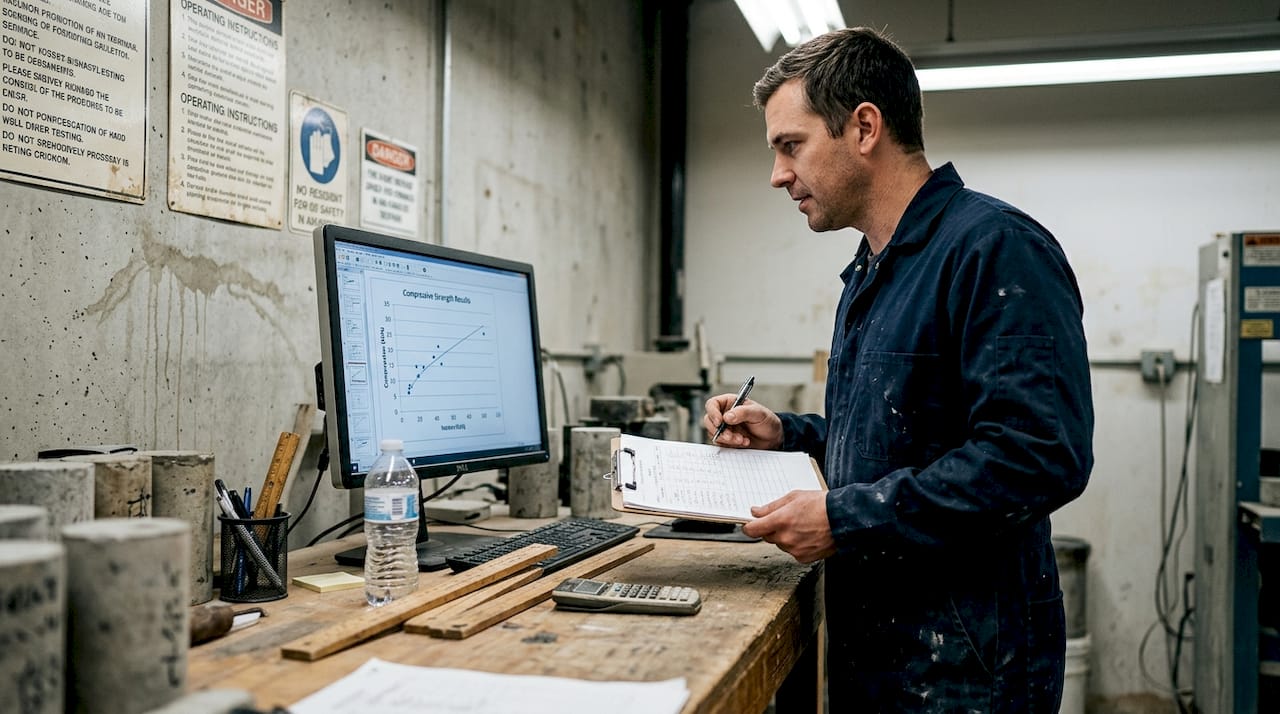
Concrete is the most widely used structural material globally. Its compressive strength typically ranges from 3,000 to 10,000 psi for standard mixes, with high-performance variants exceeding 15,000 psi. It is governed by ACI 318 for structural design and is prized for its fire resistance and formability.
Steel is specified by grade. ASTM A36 is the standard for general structural shapes, with a yield strength of 36 ksi. ASTM A992 is preferred for wide-flange sections used in moment frames, offering a yield strength of 50 ksi and tighter chemistry controls that improve weldability.
Timber and engineered wood are graded under the American Lumber Standards Committee (ALSC) system. Visually graded lumber and machine stress-rated (MSR) lumber carry different allowable stress values, and your specification must call out the correct grade for the application.
Brick and masonry offer excellent compressive strength, typically 1,900 to 3,000 psi for standard clay brick, but low tensile capacity, which is why reinforced masonry is common in seismic zones.
| Material | Compressive strength | Tensile strength | Key standard |
|---|---|---|---|
| Concrete (standard) | 3,000 to 10,000 psi | Low (requires rebar) | ACI 318 |
| Steel (A36) | N/A | 58,000 to 80,000 psi | ASTM A36 |
| Steel (A992) | N/A | 65,000 psi min | ASTM A992 |
| Timber (No. 2 Doug Fir) | 1,150 psi | 575 psi | ALSC |
| Clay brick | 1,900 to 3,000 psi | Very low | ASTM C216 |
Load combinations and demand calculations are governed by ASCE 7 standards, which define how gravity, wind, and seismic loads are applied to your chosen material. Always confirm that your mechanical property ranges are compatible with the load demands before finalizing a structural system.
Pro Tip: For projects in high-seismic or high-wind zones, verify that your structural material’s ductility and connection detailing requirements are addressed early in schematic design. Changing structural systems in design development is expensive and time-consuming.
Envelope and insulation materials: Thermal and protective roles
Beyond structural, the next crucial domain is the building envelope and its performance under thermal and environmental demands. The envelope is your building’s first line of defense against heat loss, moisture intrusion, and air infiltration. Getting it right is non-negotiable for energy code compliance and occupant comfort.
The key thermal properties you need to understand are:
- Thermal conductivity (k-value): The rate at which a material conducts heat. Lower values mean better insulation performance.
- Specific heat (Cp): The amount of energy needed to raise a unit mass by one degree. Higher values indicate greater thermal mass.
- Density: Heavier materials tend to have higher thermal mass but also higher conductivity.
Thermal conductivity data shows a dramatic contrast between insulation materials and structural ones. Mineral wool insulation, for example, has a k-value near 0.033 to 0.040 W/mK, while concrete sits around 1.7 W/mK. That difference is why you cannot rely on structural materials alone to meet thermal performance targets.
| Material | Thermal conductivity (W/mK) | Density (kg/m³) | Typical application |
|---|---|---|---|
| Mineral wool batt | 0.033 to 0.040 | 10 to 100 | Wall and roof insulation |
| Extruded polystyrene (XPS) | 0.029 to 0.035 | 25 to 45 | Below-grade and roof |
| Concrete (normal weight) | 1.65 to 1.80 | 2,200 to 2,400 | Structure, not insulation |
| Brick (clay) | 0.60 to 0.80 | 1,800 to 2,000 | Cladding, thermal mass |
| Gypsum board | 0.17 to 0.25 | 800 to 1,100 | Interior finish, fire rating |
ASHRAE 90.1 sets the minimum envelope performance requirements for commercial buildings, defining R-value minimums by climate zone and assembly type. Meeting these thresholds requires careful selection of insulation type, thickness, and continuous insulation placement to avoid thermal bridging.
“The envelope is where most energy code violations originate. Specifying the right R-value for your climate zone is not enough if your assembly details allow thermal bridging through framing or fasteners.”
Vapor barriers and air barriers are distinct systems with different performance criteria. Confusing the two is a common error that leads to moisture problems and potential mold issues down the line.
Fire-resistance and code classifications: IBC Types I-V explained
Appropriate selection also depends on how materials align with building codes and fire-resistance standards. The International Building Code (IBC) organizes construction into five types based on the fire-resistance rating of structural and envelope components.
- Type I (A and B): Non-combustible construction, typically structural steel with spray-applied fireproofing or reinforced concrete. Highest fire-resistance ratings, 3 hours for primary structure in Type IA.
- Type II (A and B): Also non-combustible but with lower or no fire-resistance requirements for some elements. Common in low-rise commercial.
- Type III (A and B): Non-combustible exterior walls with combustible interior framing. Often seen in mixed-use urban infill projects.
- Type IV (Heavy Timber): Large-dimension wood members with minimum cross-section requirements. Mass timber, including cross-laminated timber (CLT), now fits here under updated IBC provisions.
- Type V (A and B): Any materials permitted by code, including light wood frame. The most common type for residential construction.
IBC construction types now explicitly address advanced materials like CLT and lightweight high-strength concrete (LWHSC), which were previously edge cases requiring alternative means and methods approvals. Recent code cycles have expanded Type IV into three sub-types (IV-A, IV-B, IV-C) to accommodate tall mass timber buildings up to 18 stories.
| IBC type | Primary structure | Fire-resistance (primary) | Typical building use |
|---|---|---|---|
| Type I-A | Steel or concrete | 3 hours | High-rise, hospital |
| Type I-B | Steel or concrete | 2 hours | Mid-rise office |
| Type III-A | Wood interior, masonry exterior | 1 hour | Urban mixed-use |
| Type IV-B | Mass timber (CLT) | 2 hours | Tall timber, 12 stories |
| Type V-A | Light wood frame | 1 hour | Low-rise residential |
Knowing your IBC construction type before selecting materials is not optional. It defines the entire palette of allowable materials and assemblies for your project.
Material selection: Integrating codes, performance, and project goals
To bridge practice and code, let’s map a complete material selection workflow fit for today’s projects. A systematic approach prevents the common mistake of selecting materials based on familiarity or cost alone, then discovering code conflicts late in the design process.
Here is the decision sequence we recommend:
- Establish occupancy classification under IBC Chapter 3. Occupancy drives allowable construction types and fire-resistance requirements.
- Determine construction type based on building height, area, and sprinkler status. This defines your structural material palette.
- Calculate structural loads per ASCE 7, including gravity, wind, and seismic demands. Match material mechanical properties to demand.
- Select structural materials and confirm compliance with ACI 318, ASTM A36/A992, or ALSC grading as applicable.
- Design the envelope assembly to meet ASHRAE 90.1 R-value minimums for your climate zone. Account for thermal bridging and air barrier continuity.
- Specify finishes that support fire-resistance ratings and sustainability goals.
Porosity and density affect both structural performance and insulation value, which is why some materials serve dual roles. Autoclaved aerated concrete (AAC), for instance, offers moderate structural capacity with significantly better thermal performance than normal-weight concrete.
Pro Tip: When a project’s program pushes you toward an unconventional material, start with the IBC alternative means and methods path early. Document your performance equivalency argument before schematic design is complete, not after the building department asks for it.
This workflow is not a rigid checklist. It is a framework that keeps code compliance and performance goals aligned throughout design, reducing surprises during permit review.
Expert perspective: Rethinking the limits of conventional building materials
We have watched the AEC industry cling to familiar material combinations long after better options became code-compliant and cost-competitive. The honest truth is that material conservatism is often driven by liability fear, not performance data. Structural engineers who have never specified CLT avoid it because it feels unfamiliar, not because the code prohibits it or the performance data is lacking.
The next decade will blur the lines between structural and envelope functions in ways that challenge traditional specification categories. High-performance concrete with integrated insulation, structural insulated panels carrying meaningful loads, and mass timber assemblies with fire ratings that rival steel are not future concepts. They exist now, and the codes have caught up.
Our perspective is this: the professionals who invest in understanding the performance metrics behind material classifications, rather than defaulting to what they specified last time, will deliver better buildings and win more competitive projects. Unlearning subjective bias and anchoring decisions in standards-based performance data is the real skill the next generation of AEC professionals needs to develop.
Advance your expertise in building materials
Ready to put these insights into action for your next project or continuing education? Understanding material classifications, code types, and selection workflows is foundational knowledge, but staying current as codes evolve and new materials emerge requires ongoing professional development.

At Ron Blank and Associates, we develop AIA-registered continuing education courses that cover exactly these topics, from IBC construction types and envelope performance to emerging materials and specification best practices. Whether you prefer online courses, webinars, or face-to-face sessions, our building materials education resources are designed to keep architects, engineers, and contractors current, confident, and code-compliant. Explore our course catalog and take the next step in your professional development today.
Frequently asked questions
What are the main types of building materials used for structural support?
Concrete, steel, timber, and masonry are the principal materials, each with distinct strength and performance profiles that determine their suitability for different structural systems and load conditions.
How are building materials classified by building codes?
The IBC organizes construction into five types (I through V) based on fire-resistance ratings and combustibility, which directly determines the allowable materials and building heights for each project type.
Which codes and standards govern building materials and their use?
Key standards include ACI 318 for concrete, ASTM A36/A992 for steel, ALSC for lumber grading, ASCE 7 for load combinations, and ASHRAE 90.1 for envelope energy performance.
What thermal properties matter most for building material selection?
Thermal conductivity and specific heat are the most critical values, with lower conductivity favored for insulation materials and higher density often associated with structural materials that provide thermal mass.
Are advanced materials like mass timber and lightweight high-strength concrete widely code-accepted?
Recent IBC updates now explicitly accept mass timber in buildings up to 18 stories and recognize lightweight, high-strength concrete for many structural applications, provided projects meet applicable specification and testing standards.