

Juggling project deadlines while tracking licensure requirements can leave architects and interior designers searching for the most effective ways to earn AIA CE credits. The face-to-face classroom experience adds value that online formats sometimes miss, offering real-time interaction and immediate feedback from seasoned professionals. In-person courses not only satisfy official AIA requirements but also create opportunities for deeper understanding and peer connections, helping you grow your career and stay compliant with every renewal cycle.
Table of Contents
- Defining Face To Face Courses For AIA CE
- Types Of Face To Face Course Formats And Content
- How Face To Face CE Courses Fulfill Licensure Requirements
- Benefits And Limitations Versus Online Alternatives
- Legal, Safety, And Compliance Factors For Course Delivery
Key Takeaways
| Point | Details |
|---|---|
| Importance of Face-to-Face Courses | Face-to-face courses provide essential interaction and networking opportunities, enhancing learning and professional relationships. |
| Course Formats and Content | Various formats, including lectures, workshops, and seminars, cater to different learning needs and are designed to meet AIA standards. |
| Licensure Compliance | Completing AIA-registered face-to-face courses ensures automatic documentation for licensure renewal, streamlining compliance with state requirements. |
| Choosing the Right Course | Evaluate course agendas and formats to align with your learning style and professional development goals, balancing face-to-face and online options. |
Defining face to face courses for AIA CE
Face-to-face courses for AIA CE (Continuing Education) credits are in-person learning experiences that architects and interior designers attend at a specific location and time. Unlike online webinars or self-paced modules, these courses require your physical presence in a classroom or workshop setting.
The American Institute of Architects recognizes face-to-face courses as legitimate credit-bearing education when providers are properly registered. Your attendance and participation directly translate into AIA CE hours that count toward your professional development and licensure maintenance requirements.
What Makes Face-to-Face Courses Different
Face-to-face courses offer something digital formats cannot replicate: real-time interaction with instructors and peers. You can ask questions immediately, clarify complex concepts on the spot, and engage in discussions that deepen your understanding.
These courses typically run for several hours in a single day or span multiple sessions. Some are half-day workshops focusing on specific topics, while others are full-day intensives covering broader professional development areas.
Key characteristics of AIA-registered face-to-face courses include:
- Scheduled start and end times at a physical location
- Live instruction from qualified professionals with real industry experience
- Direct interaction allowing you to ask questions and discuss real projects
- Verified attendance documented by the course provider
- Immediate CE credit issuance upon course completion
- Structured curriculum designed to meet AIA standards and learning objectives
How They Differ from Other CE Formats
Online webinars offer flexibility but lack face-to-face engagement. Self-paced e-learning lets you study whenever you want, but you miss the real-time feedback and networking. Podcasts and recorded content are convenient but don’t provide interactive learning.
Face-to-face courses bridge this gap by combining structured learning with professional networking in a single experience.
Face-to-face courses create accountability through scheduled attendance and provide networking opportunities that enhance your professional growth beyond the credits earned.
Why This Format Matters for Your License
Your AIA membership and professional license require ongoing education to stay current with building codes, sustainability standards, and emerging design practices. Face-to-face courses fulfill this requirement while offering something extra: accountability and community.
When you commit to showing up at a specific time and place, you’re more likely to complete the course and retain the material. The interactive environment keeps you engaged throughout the learning experience.
Pro tip: _Check the course provider’s registration status with the AIA before enrolling to ensure your credits will be recognized and applied to your licensure requirements.
Types of face to face course formats and content
Face-to-face courses come in several distinct formats, each designed to meet different learning needs and time commitments. Understanding which format works best for your schedule and learning style helps you maximize your AIA CE credit acquisition.
The main formats you’ll encounter include lectures, discussions, workshops, and seminars conducted in classroom or conference settings. Each format leverages live interaction between instructors and participants to create engaging learning experiences.
Here’s a comparison of CE course formats to help you select the best fit for your professional development:
| Format Type | Ideal For | Typical Duration | Interaction Level |
|---|---|---|---|
| Lecture-Based | Updates and theory topics | 1-2 hours or half-day | Moderate (Q&A focused) |
| Workshop | Hands-on skill practice | 4-8 hours, intensive | High (direct feedback) |
| Seminar/Discussion | Complex issue exploration | 1-4 hours, multi-session | High (peer discussion) |
| Online Course | Flexible scheduling | Self-paced, variable | Low (asynchronous) |
Lecture-Based Courses
Lectures remain a common format where an expert instructor delivers structured content directly to a group of architects and designers. This format works well for building code updates, emerging sustainability trends, or technical skill development.
Lectures often include embedded question-and-answer sessions, allowing you to clarify concepts in real time. The instructor can adjust pacing based on audience comprehension and provide industry-specific examples.
Workshop Formats
Workshops emphasize hands-on learning through practical exercises and problem-solving activities. You might work with actual design software, mock building components, or case study materials relevant to current projects.

These typically run 4 to 8 hours and focus on specific technical skills like detailing, specification writing, or sustainability analysis. The interactive nature means you leave with immediately applicable knowledge.
Workshop characteristics include:
- Hands-on practice with real tools and materials
- Small group sizes encouraging personal attention
- Immediate feedback on your work and concepts
- Take-home resources for reference after the course
Seminars and Discussion-Based Learning
Synchronous learning activities like seminars emphasize collaborative discussion and peer engagement. These formats are perfect for exploring complex topics like design ethics, sustainable building practices, or emerging regulations.
Seminars typically involve 15 to 30 participants sitting around tables or in small groups, discussing case studies and real-world scenarios. You contribute your own project experience, learning from peers while earning credits.
Content Focus Areas
Face-to-face courses cover diverse topics aligned with professional practice needs:
- Building codes and standards compliance
- Sustainability and LEED certification
- Design principles and advanced techniques
- Technology and software applications
- Professional practice and business management
- Interior design specializations and trends
The strength of face-to-face formats lies in real-time interaction—instructors can address your specific project challenges and peers can share their own solutions.
Integrated Learning Approaches
Many providers now blend formats within a single course. You might have a morning lecture followed by afternoon workshop activities. This course design approach keeps participants engaged while accommodating different learning preferences.
Pro tip: _Review the course agenda and format before enrolling to ensure it matches your learning style—if you prefer hands-on practice, choose workshops over lecture-only sessions.
How face to face CE courses fulfill licensure requirements
State licensure renewal for architects and interior designers requires documented continuing education hours. Face-to-face AIA CE courses directly satisfy these mandatory requirements when completed through AIA-registered providers.
Every state architecture board sets specific CE hour requirements for license renewal. Most states require 12 to 18 hours annually, though some require more. Face-to-face courses count toward these totals.
Understanding AIA Learning Units
AIA CE courses operate on a Learning Unit system where one contact hour equals one Learning Unit. A half-day workshop (4 hours) provides 4 Learning Units; a full-day course (8 hours) provides 8 Learning Units.
AIA CE courses registered within the AIA Continuing Education System provide Learning Units accepted for AIA membership and state licensure renewals. This means the hours you spend in a face-to-face classroom directly count toward your renewal requirements.
Automatic Documentation and Reporting
When you complete an AIA-registered face-to-face course, the provider handles all documentation automatically. You receive a certificate of completion listing your name, course title, provider information, and credit hours earned.
Your attendance and completion are reported directly to the AIA CES (Continuing Education System) database. This streamlines compliance with professional continuing education requirements without requiring you to manually submit paperwork.
Key benefits of this system include:
- Automatic AIA database entry within days of course completion
- No manual submission required to state licensing boards
- Permanent record accessible through your AIA account
- Verification available whenever licensing authorities request documentation
Meeting State-Specific Requirements
Different states have varying requirements beyond credit hours. Some states require specific content areas like ethics, health and safety, or accessibility standards.
Many face-to-face courses are designed to address these state-mandated topics. When you enroll, check whether the course meets your state’s specific content requirements.
Tracking Your Progress
Your AIA account displays all completed courses and accumulated Learning Units. You can monitor your progress toward annual renewal requirements in real time.
This transparency helps you plan ahead and ensures you meet deadlines. Most professionals complete their requirements gradually throughout the year rather than cramming at renewal time.
Completing face-to-face courses creates an audit trail automatically—you don’t risk missing documentation deadlines or forgetting to submit credits before your license renewal date.
Why Face-to-Face Credits Stand Out
While online and self-paced courses also count, face-to-face courses offer verification certainty. The in-person attendance requirement creates clear documentation that satisfies licensing boards completely.
Many architects prefer this format precisely because the compliance burden disappears once you attend the course.
Pro tip: Check your state’s board website for any restrictions on credit types, then confirm your chosen course meets those requirements before enrolling to avoid surprises at renewal time.
Benefits and limitations versus online alternatives
Face-to-face and online CE courses each offer distinct advantages and trade-offs. Choosing between them depends on your schedule, learning style, and professional goals.
Face-to-face courses excel at creating meaningful connections and deeper learning, while online options provide unmatched flexibility. Understanding these differences helps you build a CE strategy that works for your career.
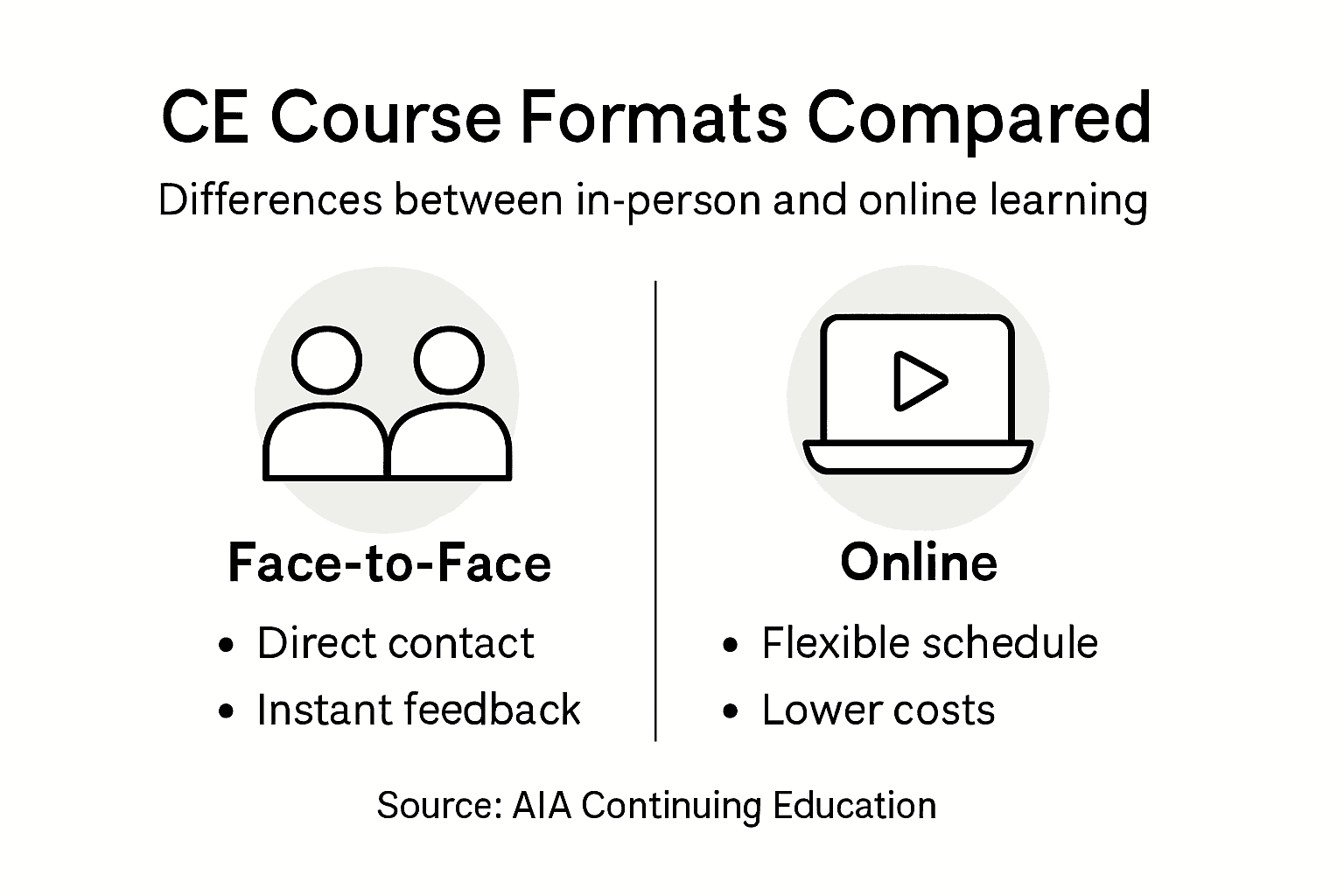
The following table highlights differences between face-to-face and online CE options:
| Attribute | Face-to-Face Courses | Online Courses |
|---|---|---|
| Learning Experience | Real-time, interactive | Self-paced, convenience |
| Networking Potential | High (in-person peer contact) | Minimal or virtual-only |
| Documentation | Automated, verifiable | Automated, requires review |
| Cost & Travel | Travel and venue required | No travel, lower cost |
The Face-to-Face Advantage
Face-to-face interaction enhances learning by providing richer social cues including facial expressions, gaze, and real-time feedback. These nonverbal elements improve understanding and creativity when tackling complex architectural problems.
You can ask clarifying questions immediately and watch the instructor respond to your specific situation. This dynamic exchange strengthens comprehension far more than watching a recording later.
Key benefits of in-person learning include:
- Immediate feedback from instructors on your questions and work
- Rich nonverbal communication enhancing understanding
- Networking with peers leading to professional relationships
- Hands-on practice with materials and tools in real time
- Accountability through scheduled attendance
Where Online Courses Win
Online alternatives offer flexibility that face-to-face courses cannot match. You control when and where you learn, fitting education around project deadlines and family commitments.
Online courses typically cost less and eliminate travel time. You can complete coursework at your own pace rather than sitting through content you already understand.
However, face-to-face learning is often perceived as more effective for outcomes requiring direct interaction and real-time support. Online formats may reduce interpersonal engagement despite their convenience.
The Trade-Off Reality
Face-to-face courses demand scheduling flexibility on your part. You must travel to a specific location at a specific time, which conflicts with busy project schedules.
Online courses offer convenience but require stronger self-discipline. Without the accountability of scheduled attendance, many professionals postpone coursework indefinitely.
The best CE strategy combines both: use online courses for flexible scheduling and supplementary learning, reserve face-to-face courses for complex topics requiring hands-on practice and direct mentorship.
Making Your Choice
Consider face-to-face courses when:
- Learning practical skills or software
- Exploring complex topics requiring clarification
- Seeking networking opportunities
- You need accountability to complete coursework
Choose online courses when:
- Your schedule demands maximum flexibility
- You’re reviewing familiar material
- You need to complete credits before a deadline
- Travel time or costs are prohibitive
Pro tip: Mix formats throughout your year—tackle one challenging face-to-face course per quarter to build your skills, then fill remaining requirements with flexible online options that fit your schedule.
Legal, safety, and compliance factors for course delivery
Face-to-face CE courses must operate within strict legal and safety frameworks to protect participants and maintain AIA registration status. Course providers handle these requirements so you can focus on learning.
Understanding these factors helps you choose reputable providers and ensures your credits will be recognized without complications. Compliance protects both your professional standing and the provider’s ability to deliver quality education.
AIA Registration and Accreditation
Only AIA-registered providers can offer courses that count toward your CE requirements. This registration process includes rigorous vetting of curriculum, instructor qualifications, and course delivery standards.
When you enroll with an accredited provider, you’re protected by established quality benchmarks. The provider has already demonstrated compliance with AIA standards before delivering courses.
Key compliance elements include:
- AIA CES database registration for course providers
- Curriculum review ensuring content meets professional standards
- Instructor qualifications verification and ongoing requirements
- Record-keeping protocols documenting all participant attendance
- Annual audits to maintain registration status
Liability and Insurance Requirements
Reputable course providers carry professional liability insurance covering their educational activities. This protects participants if course content contains errors or if unsafe conditions exist during delivery.
Providers must also maintain general liability coverage for physical injuries occurring during in-person courses. This creates a safety net for both attendees and instructors.
Venue Safety and Accessibility
Course venues must meet building codes and accessibility standards established by the Americans with Disabilities Act. This includes accessible entrances, parking, restrooms, and accommodations for participants with mobility or sensory disabilities.
Venues should provide safe seating, adequate lighting, climate control, and emergency exits. Professional providers verify these conditions before scheduling courses at any location.
Data Protection and Privacy
Your personal information and course completion records are protected under privacy regulations. Providers must secure your data against unauthorized access and only share information with authorized parties like the AIA CES database.
Before enrolling, check the provider’s privacy policy. Understand how your information will be stored and who will have access to it.
Compliance isn’t bureaucratic overhead—it’s the infrastructure that makes your CE credits transferable across states and trustworthy to licensing boards reviewing your renewal documentation.
What Reputable Providers Demonstrate
Legitimate course providers openly display their AIA registration credentials. They provide clear course syllabi, instructor biographies, and cancellation policies upfront.
They respond promptly to questions about compliance, answer concerns about course content, and issue certificates immediately upon completion without requiring additional paperwork.
Pro tip: Verify a provider’s AIA registration directly through the AIA website before enrolling to confirm legitimacy and protect your CE credit investment.
Elevate Your AIA CE Journey with Expert Face-to-Face Courses
Navigating the challenge of earning valid and verifiable AIA Continuing Education credits can feel overwhelming, especially when you want real-time interaction, immediate feedback, and professional networkingopportunities that only face-to-face courses provide. Whether you aim to fulfill state-specific licensure requirements or deepen your knowledge with hands-on workshops and expert-led discussions, ensuring your credits count means trusting AIA-registered providers who deliver quality and compliance guaranteed.
At Ron Blank and Associates, we specialize in developing and delivering continuing education courses tailored for architects, interior designers, engineers, and contractors. Our face-to-face courses are meticulously designed to offer the structured curriculum and live engagement emphasized in the article. With automatic attendance tracking and instant credit reporting to the AIA CES database, you can focus on learning while we handle the documentation. Explore how our face-to-face options combine accountability and community to power your professional growth today.

Ready to experience the unbeatable benefits of face-to-face learning for your AIA CE credits? Visit Ron Blank to browse available courses that align with your professional goals. Don’t wait until renewal deadlines approach—start building your skills, earning credits, and expanding your network now with trusted courses designed for your success.
Frequently Asked Questions
What are face-to-face courses for AIA CE credits?
Face-to-face courses for AIA CE credits are in-person learning experiences where architects and interior designers attend classes or workshops to earn continuing education hours that count toward their professional development and licensure requirements.
How do face-to-face courses differ from online CE formats?
Face-to-face courses provide real-time interaction with instructors and peers, allowing for immediate feedback and collaborative discussions. In contrast, online formats often lack this engagement but offer flexibility in scheduling.
How do I ensure that my face-to-face course credits will be recognized for licensure?
Before enrolling, check that the course provider is registered with the AIA. This ensures that the credits earned will meet the necessary requirements for AIA membership and state licensure renewals.
What types of content are typically covered in face-to-face courses?
Face-to-face courses can cover a range of topics, including building codes, sustainability, design principles, technology applications, and interior design trends, all designed to support the continuing education needs of professionals.