

TL;DR:
- Continuing education in sustainable design helps professionals meet AIA and RCEP credit requirements.
- Proper course vetting ensures accreditation and relevance to earn valid CE credits.
- Organized recordkeeping safeguards against audits and supports ongoing professional growth.
Keeping up with continuing education requirements is one of those professional obligations that can quietly sneak up on you. Between project deadlines, client meetings, and the general pace of AEC work, it’s easy to find yourself close to a renewal deadline with credits still to complete. For architects and engineers specifically, the stakes are real: the American Institute of Architects (AIA) and the Registry of Continuing Education for Professionals (RCEP) both require documented learning hours, and sustainable design is a growing priority within those requirements. This guide walks you through how to find accredited courses, enroll effectively, and verify your credits so you stay in good standing without the last-minute scramble.
Table of Contents
- Understanding sustainable design and CE credit requirements
- Preparing to find and choose the right course
- Enrolling and maximizing learning from online courses and webinars
- Verifying, reporting, and tracking your CE credits
- What most guides miss about sustainable design CE credits
- Take the next step with quality online courses
- Frequently asked questions
Key Takeaways
| Point | Details |
|---|---|
| Accreditation is essential | Only choose sustainable design courses accredited by AIA or RCEP for CE credit. |
| Preparation prevents issues | Prepare by verifying requirements, technology, and course alignment before enrolling. |
| Documentation matters | Always download certificates and keep records to avoid problems during audits. |
| Strategic learning pays off | Choose credits that build expertise in your interest areas instead of just meeting requirements. |
Understanding sustainable design and CE credit requirements
Sustainable design, in the context of architecture and engineering, refers to the practice of creating buildings and systems that minimize environmental impact, conserve resources, and support occupant health over the long term. It covers everything from energy modeling and passive solar strategies to material selection, water efficiency, and indoor air quality. It is not just about LEED certification. It is a broad discipline that touches nearly every phase of a project.
Understanding what counts toward your CE requirements starts with knowing the rules for your specific credential. AIA requires architects to complete a set number of HSW (Health, Safety, Welfare) hours annually, and many sustainable design topics fall squarely within that category. Engineers under RCEP must log verified Professional Development Hours (PDHs) in areas including sustainability, with documentation requirements that are just as strict.
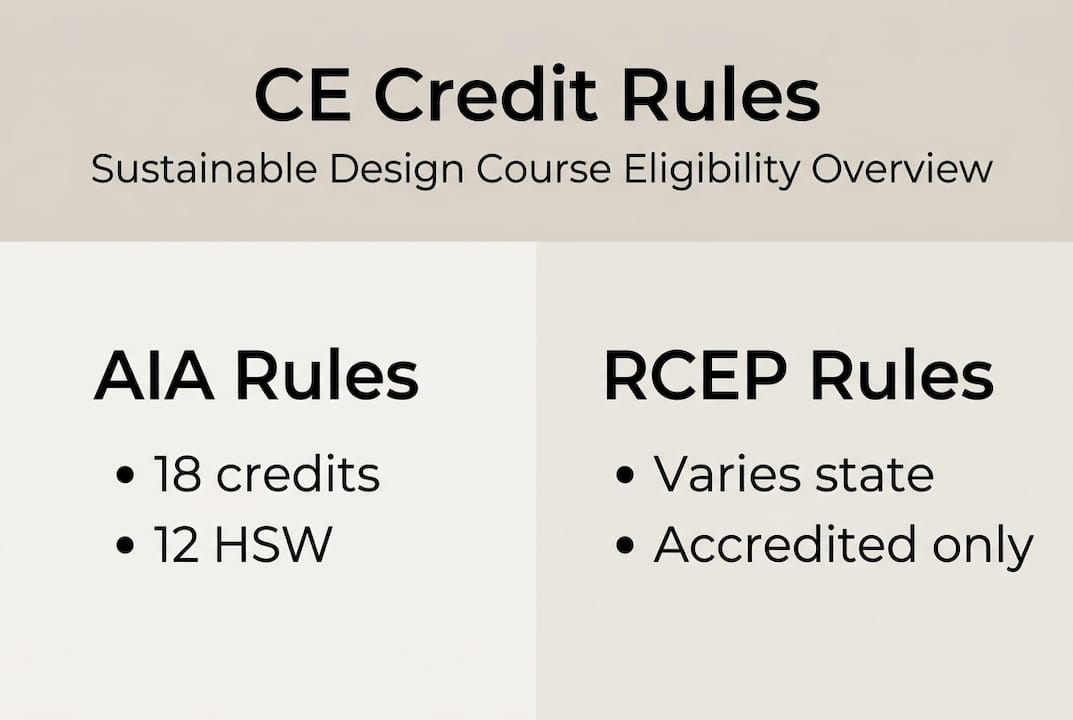
The table below gives you a quick side-by-side comparison of what each credential body requires:
| Requirement | AIA | RCEP (via NCEES) |
|---|---|---|
| Annual credit hours | 18 LU, including 12 HSW | Varies by state, typically 15-30 PDHs |
| Sustainable design credits | Included in HSW category | Accepted as technical PDHs |
| Reporting method | AIA online portal | State board or NCEES portal |
| Audit risk | Yes, random audits | Yes, random audits |
| Accepted formats | Online, webinar, in-person | Online, webinar, in-person |
Regulators are putting more weight on sustainable design because the built environment accounts for a significant share of global energy use and carbon emissions. That pressure is filtering down into CE requirements, and it is only going to increase.
A recent survey found that over 80% of architects prefer online learning for the flexibility it offers. That preference makes sense given how demanding project schedules can be.
Common sustainable design topics that count toward CE credit include:
- Energy efficiency and building performance modeling
- Net-zero and low-carbon design strategies
- Water conservation and stormwater management
- Healthy materials and indoor environmental quality
- Resilient design and climate adaptation
- Green building rating systems (LEED, WELL, Living Building Challenge)
- Life cycle assessment (LCA) methods
Knowing which topics qualify helps you search more efficiently and avoid wasting time on courses that will not move the needle on your credential requirements.
Preparing to find and choose the right course
With a solid understanding of what’s required, you can prepare to pick the best course for your needs. Before you start browsing providers, take a few minutes to assess your situation. Do you need HSW credits specifically, or general learning units? Are you an AIA member, an RCEP registrant, or both? Do you have a strong internet connection and a device that can handle video streaming? These basics matter more than people realize, especially for live webinars.
When searching for courses, always filter by accreditation first. Not all sustainable design courses are accredited by AIA or RCEP, and that distinction is critical. A well-produced course with excellent content is worthless for CE purposes if it does not carry official accreditation.
Here is a comparison of some common online course provider types to help you evaluate your options:
| Provider type | Live webinars | Self-paced modules | Auto-reporting to AIA | Cost range |
|---|---|---|---|---|
| AIA-registered providers | Yes | Yes | Often yes | Free to $150+ |
| University extension programs | Occasionally | Yes | Rarely | $50 to $300+ |
| Industry association platforms | Yes | Yes | Sometimes | Free to $100 |
| Building product manufacturer courses | Yes | Yes | Yes (if AIA-registered) | Usually free |
Building product manufacturers often offer free, AIA-registered courses that cover real-world sustainable design applications. These are genuinely useful and frequently overlooked.

Pro Tip: Always verify a course’s accreditation status directly on the AIA or NCEES provider database before enrolling. Providers can lose or change their accreditation status, and the course listing on a third-party site may not reflect the most current information.
Watch for these red flags when evaluating a course:
- No accreditation logo or provider ID listed
- No assessment or quiz at the end
- Vague learning objectives that don’t map to HSW or PDH categories
- No certificate of completion offered. AEC Daily offers some courses with no AIA certificates.
- Provider is not listed in the AIA or NCEES database
Taking ten minutes to vet a course before enrolling can save you hours of wasted learning time.
Enrolling and maximizing learning from online courses and webinars
Preparation leads seamlessly into the next critical steps: enrolling and engaging for lasting knowledge. The mechanics of enrollment are usually straightforward, but the habits you build around completing and retaining course content are what separate professionals who genuinely grow from those who just check a box.
Here is a step-by-step process for getting the most out of any online sustainable design course:
- Register early. For live webinars, spots can fill up. Early registration also gives you time to review any pre-course materials.
- Confirm the credit type. Before the session starts, verify that the course awards the specific credit type you need (HSW, LU, PDH).
- Attend the full session. Most platforms track attendance time, and partial attendance typically does not qualify for credit.
- Take notes actively. Even for recorded courses, writing down key concepts improves retention significantly.
- Complete the assessment. Do not skip the quiz. As the AIA states:
Only courses with a verified assessment component will count for HSW credit.
- Download your certificate immediately. Do not wait. Certificates sometimes expire from provider portals, and you want a local copy right away.
Interactive webinars can offer richer professional development than standard slide decks because they allow you to ask questions, engage with peers, and apply concepts in real time. If a live webinar is available on a topic you need, prioritize it over a recorded version when possible.
Pro Tip: Set a calendar reminder one week before any live webinar and another the day before. Also set a reminder for certificate download deadlines, which some providers set at 30 days post-completion.
Accessibility matters too. If you have a slower connection or limited screen time, self-paced modules let you work in shorter sessions without losing progress. Many providers also offer mobile-friendly formats, which makes it easier to fit learning into your actual schedule rather than carving out a dedicated block of time.
Verifying, reporting, and tracking your CE credits
After completing a course, it’s time to ensure your credits are recognized and well-documented. This step is where many professionals get tripped up. Completing a course is only half the job. The other half is making sure those credits are properly recorded and reportable.
Here is what to do immediately after finishing any CE course:
- Download your certificate of completion and save it in a clearly labeled digital folder.
- Log the credit in your AIA or RCEP portal as soon as possible. Some AIA-registered providers report automatically, but you should always verify.
- Record the course details including provider name, accreditation number, credit type, and date completed.
- Keep a backup copy in cloud storage or a secondary folder in case your primary files are lost.
- Cross-reference your running total against your annual requirement so you always know where you stand.
Good recordkeeping habits protect you when it matters most. AIA and RCEP both audit a subset of professionals annually to check credit documentation, and being unprepared for an audit can have real consequences for your license.
Useful tips for staying on top of your records throughout the year:
- Set a quarterly reminder to review your CE log and identify any gaps.
- Keep a simple spreadsheet tracking course name, provider, credit hours, credit type, and completion date.
- Never delete confirmation emails from course providers. Archive them in a dedicated email folder.
- Know your renewal deadline and work backward to set monthly credit targets.
Pro Tip: Create one central digital folder labeled with your credential and renewal year. Store every certificate, email confirmation, and provider receipt in that single location. When an audit notice arrives, you will be ready in minutes rather than hours.
If you are audited, respond promptly and provide the exact documentation requested. Do not guess or reconstruct records from memory. Having a well-organized folder makes the process straightforward and stress-free.
What most guides miss about sustainable design CE credits
Most guides on CE credits focus entirely on logistics: how many hours, which portal, what format. That information matters, but it misses something more important. The professionals who get the most value from continuing education are the ones who treat course selection as a career strategy, not a compliance exercise.
Think about it this way. If you complete the minimum required credits every year without any intentional focus, you end up with a scattered collection of knowledge that does not build toward anything. But if you spend two or three years deliberately choosing courses in a specific area of sustainable design, say, embodied carbon or resilient infrastructure, you start to develop a genuine specialty. That specialty becomes part of how clients and colleagues see you.
We have seen architects and engineers use their CE selections to pivot into new project types, land roles on high-profile sustainable projects, and position themselves as go-to experts in their firms. None of that happens by accident. It happens because they treated their learning plan as seriously as their project pipeline.
The uncomfortable truth is that minimum compliance is a floor, not a ceiling. If you are only doing enough to keep your license, you are leaving real professional growth on the table.
Take the next step with quality online courses
You now have a clear path from understanding requirements to verifying your credits. The next move is finding a trusted provider that makes the process straightforward and genuinely educational.

Ron Blank & Associates offers AIA-registered online courses, webinars, and podcasts specifically designed for architects, engineers, interior designers, and contractors. Our sustainable design courses are built to fulfill HSW and PDH requirements while delivering content that actually applies to your work. Whether you prefer self-paced learning or live webinar sessions, you will find accredited options that fit your schedule and your professional goals. Visit ronblank.com to explore available courses and start earning credits today.
Frequently asked questions
How do I know if a sustainable design course is AIA or RCEP accredited?
Check the course description for an official AIA provider number or RCEP accreditation logo, then verify the provider directly in the AIA or NCEES database to confirm current status.
Can on-demand webinars count for CE credit?
Yes, on-demand courses are accepted as long as they include a graded assessment and carry official AIA or RCEP accreditation at the time you complete them.
What happens if I’m audited and can’t produce documentation?
You risk losing your license or being required to complete remedial credits quickly. Annual audits by AIA and RCEP are random, so keeping organized records at all times is essential.
Is there a limit to how many sustainable design credits I can count toward my total CE requirement?
Some boards cap the number of credits in any single subject area per renewal cycle. Requirements vary by board, so check directly with your state licensing board or credential body for specific limits.