

TL;DR:
- Sustainable design is a core competency for all design professionals, emphasizing early site analysis and passive strategies. Implementing passive design, evaluating embodied carbon through EPDs, and utilizing digital tools significantly enhance building performance and reduce environmental impact. Continuous verification, stakeholder engagement, and integrated workflows foster sustainable outcomes and ongoing improvement in building practices.
Unsustainable buildings consume roughly 40% of global energy and generate a significant share of construction waste, and the design decisions your team makes in the first few weeks of a project determine most of that outcome. Knowing how to create sustainable design is no longer a specialty skill reserved for LEED consultants. It is a core professional competency for every architect, interior designer, and contractor working today. This guide walks through the full process, from site analysis and passive strategies to material selection, digital workflows, and post-occupancy verification, with the depth and specificity that working professionals actually need.
Table of Contents
- Key takeaways
- How to create sustainable design: foundations first
- Passive strategies that actually move the needle
- Materials and technologies: beyond the surface
- Digital tools and integrated workflows
- Verification and continuous improvement
- My honest take on where most firms get it wrong
- Continue your sustainable design education with Ronblank
- FAQ
Key takeaways
| Point | Details |
|---|---|
| Start at concept, not schematic | Critical sustainability decisions made early prevent costly retrofits and maximize performance. |
| Passive design delivers free savings | Orientation and shading alone can cut heating energy by 20 to 30% at zero added cost. |
| Materials carry hidden carbon costs | Evaluating embodied carbon via EPDs and choosing bio-based or recycled materials lowers lifecycle impact. |
| Digital tools sharpen decisions | BIM and energy modeling catch clashes early and reduce physical sample waste before construction starts. |
| Verification closes the loop | Post-occupancy evaluation turns project data into lessons that improve every subsequent design. |
How to create sustainable design: foundations first
Before any schematic line gets drawn, you need a clear picture of what the site, the climate, and the client’s goals are actually telling you. Skipping this phase is one of the most common reasons sustainable design intentions fail to materialize in the finished building.
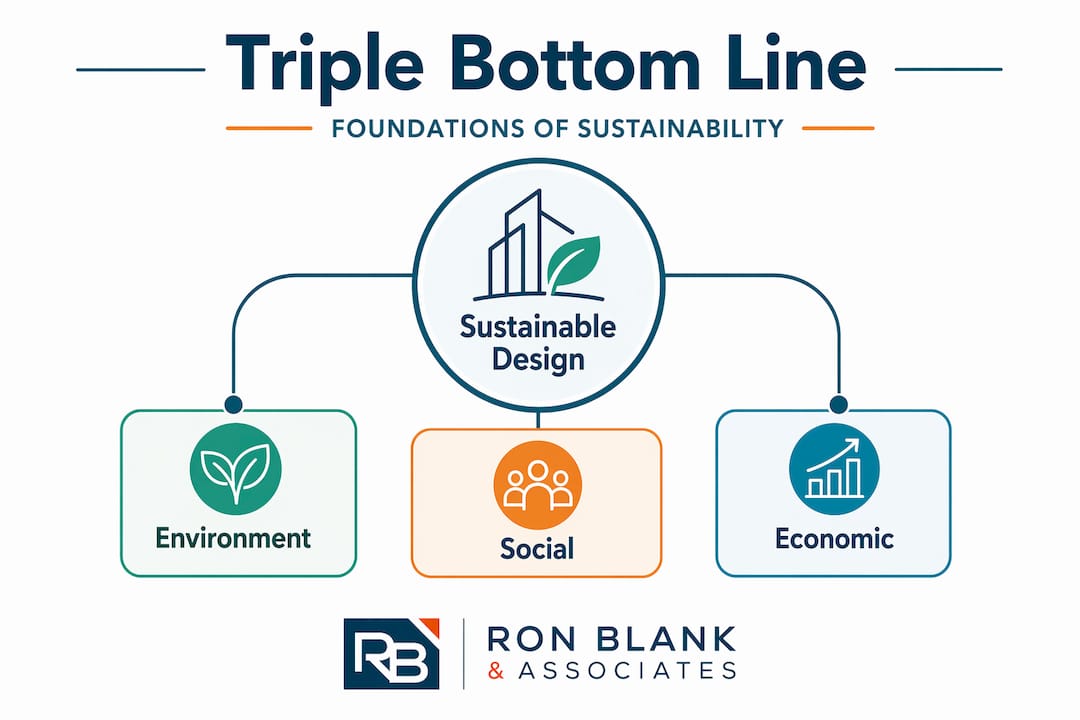
Sustainable design balances environmental, social, and economic factors simultaneously. That triple-bottom-line framework means your site analysis cannot focus only on solar access. You also need to ask how the building will serve occupants, support the surrounding community, and hold its value over time.
Site and climate factors to evaluate at project outset
| Factor | What to assess | Why it matters |
|---|---|---|
| Solar orientation | True south exposure, shading obstructions | Drives passive heating and cooling potential |
| Prevailing winds | Seasonal wind direction and speed | Informs natural ventilation strategy |
| Local precipitation | Annual rainfall and storm intensity | Shapes stormwater and water harvesting design |
| Topography | Slope, drainage, ground cover | Affects thermal mass, runoff, and siting options |
| Existing vegetation | Tree canopy, root zones | Natural shading and biodiversity preservation |
| Urban heat island risk | Hardscape ratio, nearby reflective surfaces | Guides material choices for roofs and paving |
Pro Tip: Run a climate analysis using a tool like Climate Consultant or WeatherShift before your first client meeting. Walking in with a psychrometric chart and a clear passive strategy recommendation immediately differentiates your process from a conventional design approach.
Set measurable sustainability goals that align with the specific project type and client priorities. A 30% energy use intensity reduction target reads very differently than a vague commitment to “green design,” and it gives every consultant on the team a benchmark to design toward. Early alignment on goals, shared during project kick-off with the full design team, prevents the painful and expensive exercise of retrofitting sustainability into a design that was never structured to support it.
Passive strategies that actually move the needle
Passive design is where the highest return on effort lives. Orientation alone reduces heating energy by 20 to 30% in cold climates at no additional cost. When you combine orientation with shading, thermal mass, and natural ventilation, passive strategies can cut heating and cooling loads by 50 to 70%. No mechanical upgrade delivers that ratio of savings to investment.
Follow this sequence when integrating passive strategies into your design:
- Orient the primary glazing toward true south (in the Northern Hemisphere) to maximize winter solar gain and simplify shading calculations for summer overhangs.
- Size overhangs using solar angle calculations specific to your latitude, not rules of thumb. A 45-degree overhang that works in Minneapolis will block too much winter sun in Atlanta.
- Position operable windows to enable cross ventilation by placing inlets on the windward facade and outlets on the leeward side at a higher elevation to exploit the stack effect.
- Specify thermal mass materials such as concrete, masonry, or rammed earth in direct sunlight paths to absorb heat during the day and release it at night, smoothing temperature swings.
- Seal and insulate the building envelope to a performance level that matches your passive design intent. A well-oriented building with poor insulation is like a fuel-efficient engine in a car with no doors.
Common pitfalls to avoid: glazing that is oversized on east and west facades creates uncontrollable solar gain in the morning and afternoon that no overhang geometry can adequately address. Similarly, adding high-performance glazing without first optimizing orientation gives you a diminishing return. Fix the free variables before spending money on expensive systems.
Pro Tip: Model your passive design decisions in an energy simulation tool like DesignBuilder or EnergyPlus before finalizing the building footprint. Seeing a 25% swing in annual energy use between two orientation options gives clients a compelling, data-backed reason to accept your recommendation.
Materials and technologies: beyond the surface
Choosing materials for environmentally conscious design requires looking past first cost and aesthetic performance to understand what each product contributes to the building’s total environmental footprint.
Embodied carbon and EPDs
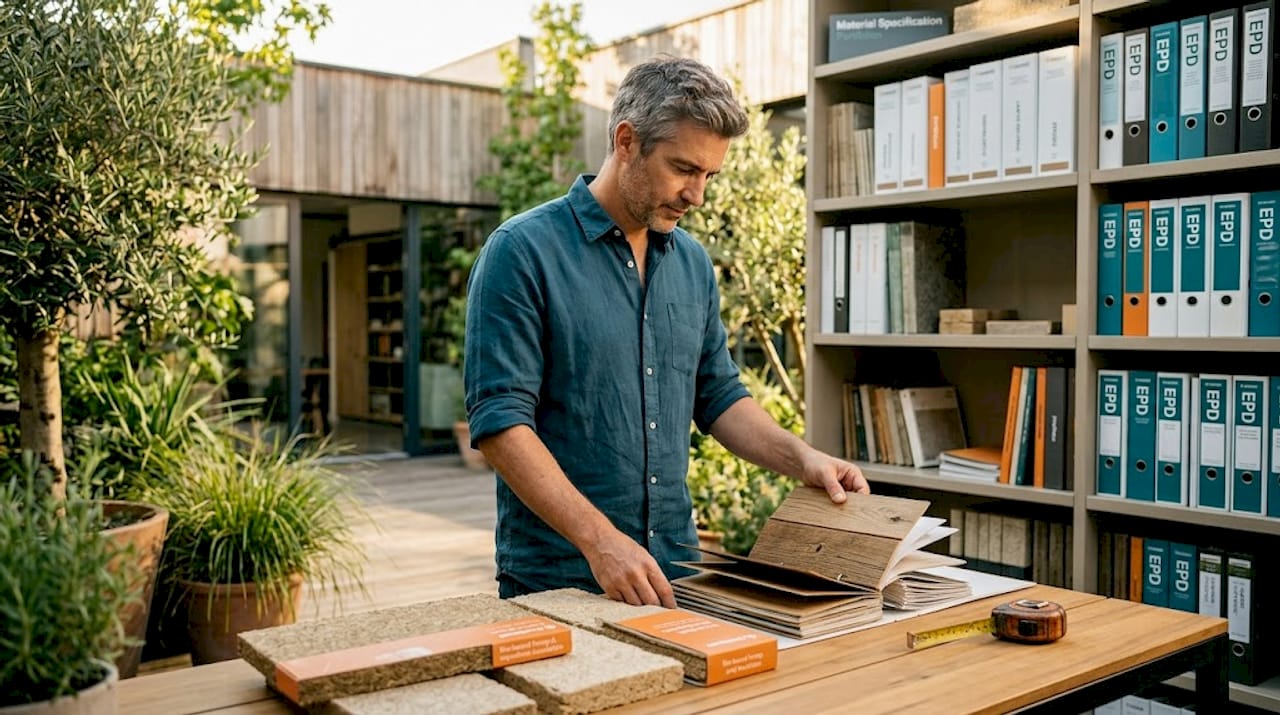
Environmental Product Declarations (EPDs) give you verified, third-party data on a material’s global warming potential, energy use, and resource consumption across its lifecycle. Requesting EPDs from manufacturers during specification is now standard practice for LEED v4.1 and Living Building Challenge projects, but the habit is worth building regardless of whether you are pursuing certification.
Bio-based materials such as cross-laminated timber (CLT), hempcrete, and straw bale store carbon rather than emit it during production, making them particularly effective at reducing a project’s embodied carbon profile. Recycled steel and reclaimed brick carry significantly lower embodied carbon than their virgin equivalents. For natural stone selections, locally quarried options eliminate long-haul transport emissions and often come with stronger traceability on extraction practices.
Cost versus long-term performance
| Strategy | Upfront cost premium | Typical payback period |
|---|---|---|
| LED lighting systems | Minimal to 2% | 6 to 18 months |
| Building envelope improvements | 2 to 7% | 2 to 4 years |
| High-performance glazing | 3 to 8% | 3 to 6 years |
| CLT structural system | 5 to 15% | Lifecycle savings via durability |
Green buildings reduce operating costs by 16.9% over five years on average. Framing material and system upgrades through that lens converts the conversation from “added cost” to “predictable savings,” which is a much easier conversation with budget-conscious clients.
Design for deconstruction is a concept worth embedding in your specifications early. Specifying mechanical connections over adhesives, modular assemblies, and single-material components means the building can be disassembled and its materials recovered at end of life rather than sent to landfill. This circular economy thinking is increasingly required under emerging building regulations in several U.S. states.
Pro Tip: When a client pushes back on a sustainable material’s upfront cost, ask them what their five-year energy budget looks like. Most clients have never modeled that number, and the exercise reframes the entire conversation around total cost of ownership rather than line-item sticker shock.
Digital tools and integrated workflows
The design profession now has access to tools that can sharpen sustainable decision-making at every phase of a project. The discipline is knowing how and when to use them.
Building Information Modeling (BIM) does more than coordinate geometry. When used with discipline, BIM and digital visualization catch design clashes early, reduce physical mockup iterations, and lower material waste before a single product ships to site. On a mid-size commercial project, early clash detection can eliminate thousands of dollars in rework that would otherwise consume materials and labor with no productive output.
Key digital tools and their roles in designing with sustainability:
- Energy modeling platforms (EnergyPlus, eQUEST, Sefaira): Run early-phase energy simulations that quantify the impact of orientation, glazing ratio, and envelope performance before you commit to a structural system.
- Lifecycle assessment software (Tally, One Click LCA): Calculate embodied carbon across material options so your specification team can make data-backed substitutions rather than educated guesses.
- BIM platforms (Revit, ArchiCAD): Integrate sustainability data directly into the model so that area schedules, material quantities, and performance targets stay linked and current.
- Computational design tools (Grasshopper, Dynamo): Automate the generation and evaluation of shading device geometries or facade configurations, testing dozens of options in the time it would take to manually calculate one.
Early stakeholder alignment via digital previews accelerates approvals and reduces costly design changes. Photorealistic renders linked to performance data let clients see and understand sustainable choices rather than just read about them in a spec sheet. That combination of visual clarity and quantified benefit is far more persuasive than a performance table alone.
Pro Tip: Set a “decision gate” at the end of schematic design where energy model results, embodied carbon estimates, and material selections are formally reviewed by the full project team. Without a structured review moment, digital tools produce data that gets filed rather than acted on.
Verification and continuous improvement
Getting a building designed sustainably is half the job. Confirming that it actually performs as intended, and learning from the gap between prediction and reality, is what separates firms that improve project over project from those that repeat the same mistakes.
Start by setting specific, measurable performance metrics at the beginning of the project. Energy use intensity (EUI) targets, water use reduction percentages, and construction waste diversion rates give the whole team concrete benchmarks to track.
Certification frameworks are useful for structuring the verification process:
- LEED provides a credit-based structure covering energy, water, materials, and indoor environmental quality, with strong market recognition in North America.
- BREEAM offers a similar framework with broader adoption in international markets and stronger weighting on ecological impact.
- Passive House sets the most stringent energy performance thresholds in the industry and requires verified air leakage testing as a condition of certification.
Post-occupancy evaluation (POE) is still underused in the U.S. market, which is a genuine missed opportunity. A structured POE at 12 months post-occupancy reveals how occupant behavior, operational decisions, and actual weather patterns interact with the designed systems. Durable, well-specified materials and low-VOC finishes contribute to occupant health outcomes that a POE can also document.
Feed the findings back into your office’s standard details, specification sections, and energy model calibration. That is how individual project experience becomes institutional knowledge.
Continue your sustainable design education with Ronblank
Sustainable design practice is evolving fast, and staying current on passive strategies, material science, and code requirements takes more than a conference session every few years. Ronblank develops AIA-registered continuing education courses specifically for architects, engineers, interior designers, and contractors who want to deepen their sustainable design expertise. The courses are available as online modules, webinars, podcasts, and face-to-face formats, so you can learn in the format that fits your schedule. Whether you are preparing for a LEED project, evaluating new building products, or refining your firm’s specification standards, explore Ronblank’s course catalog and find the education your practice needs to design at a higher level.
FAQ
What is sustainable design in architecture?
Sustainable design in architecture is the practice of creating buildings that balance environmental, social, and economic performance across their full lifecycle, minimizing resource consumption and supporting occupant health and community well-being.
How do passive design strategies reduce energy use?
Passive strategies such as solar orientation, thermal mass, and natural ventilation can reduce heating and cooling loads by 50 to 70% by using the building’s form and envelope to manage temperature rather than relying on mechanical systems.
When should sustainability goals be set in a project?
Sustainability goals should be established during the concept phase, before schematic design begins. Critical decisions made early in the process have the greatest impact on performance, while changes made later become progressively more expensive.
What certifications verify sustainable design outcomes?
LEED, BREEAM, and Passive House are the leading certification frameworks. Each provides structured verification criteria covering energy, water, materials, and indoor environmental quality, with Passive House setting the most rigorous energy performance thresholds.
How do EPDs help with sustainable material selection?
Environmental Product Declarations provide third-party verified data on a material’s embodied carbon and resource consumption, giving design teams an objective basis for comparing materials and making specification decisions grounded in lifecycle impact rather than assumptions.