

Finding the right path through continuing education can feel overwhelming when you need to balance projects, sustainability goals, and strict AIA and IDCEC requirements. With every renewal cycle, architectural and design professionals face the challenge of choosing courses that not only count for credits, but also offer detailed building product information crucial for everyday work. This guide highlights effective online options and practical strategies so you can stay compliant and confidently specify materials for your next green building project.
Table of Contents
- Step 1: Assess CE Requirements From AIA, GBCI, And IDCEC
- Step 2: Select Online Courses That Specify Building Products
- Step 3: Register For Webinars And Podcasts With Well-Lit Images
- Step 4: Complete Interactive Modules And Track CEU Credits
- Step 5: Verify Earned Credits With Your Professional Bodies
Quick Summary
| Key Point | Explanation |
| 1. Understand CEU Requirements | Review specific CEU obligations from AIA, GBCI, and IDCEC to stay compliant and maintain active licensing status. |
| 2. Choose Approved Online Courses | Seek online courses that are recognized by AIA, GBCI, and IDCEC, focusing on practical, actionable content related to building products. |
| 3. Register for Quality Webinars | Ensure webinars and podcasts are visually professional and instructor-led, enhancing the educational experience while earning credits. |
| 4. Track Interactive Learning Progress | Actively document completion of interactive modules to ensure accurate credit tracking and efficient renewal of certifications. |
| 5. Verify Credits with Professional Bodies | Collect all certificates and submit them properly to ensure recognition of CEUs by AIA, GBCI, and IDCEC before deadlines. |
Step 1: Assess CEU Requirements from AIA, GBCI, and IDCEC
Navigating continuing education credits for architects and designers requires understanding the unique requirements of professional certification organizations like the American Institute of Architects (AIA), Green Business Certification Inc. (GBCI), and Interior Design Continuing Education Council (IDCEC). Each organization maintains specific standards for earning professional development hours that keep design professionals current with industry best practices.
To effectively assess your CEU requirements, follow these systematic steps:
- Review your specific professional license type
- Check current certification cycle dates
- Understand credit hour minimums for each organization
- Verify acceptable course categories
The AIA requires 18 learning units (LUs) every year, with specific requirements for health, safety, and welfare (HSW) credits. GBCI credentials like LEED AP demand additional sustainability-focused coursework, while professional development tracking becomes crucial for maintaining your certification.
A design professional must proactively manage their continuing education to maintain active licensing status.
Each organization has nuanced requirements that demand careful attention. The IDCEC, for instance, allows credits from multiple approved providers and requires documentation of completed courses.
Here’s a comparison of CEU requirements and documentation standards for major professional organizations:
| Organization | Required Units | Key Focus Areas | Documentation Method |
| AIA | 18 LUs every year | HSW credits, architectural practices | Online transcript, course certificates |
| GBCI | Coursework plus specialty credits | Sustainability and green building | Portal-based reporting, certificates |
| IDCEC | Varies by credential | Multiple providers, design practice | Self-reporting, documented proof |
Pro tip: Maintain a detailed digital portfolio of your completed courses and credits to streamline your renewal process.
Step 2: Select Online Courses That Specify Building Products
Selecting online courses that effectively teach building product specification requires a strategic approach to maximize your continuing education credits and professional development. Your goal is to find courses that not only meet certification requirements but also provide practical insights into modern architectural materials and technologies.
When searching for quality courses, focus on the following key criteria:
- Courses approved by AIA, GBCI, and IDCEC
- Content featuring detailed building product information
- Instructors with industry-specific expertise
- Comprehensive coverage of CSI divisions
Professional organizations offer free online courses targeting building professionals with exceptional resources for architects seeking specialized knowledge. These courses typically cover critical areas such as sustainability, building materials, construction codes, and product-specific technical details.
Successful course selection goes beyond credit hours – it’s about gaining actionable knowledge that enhances your professional capabilities.
Pay close attention to courses that provide in-depth analysis of building products, material performance characteristics, and emerging technologies. Look for programs that offer practical case studies and real-world application scenarios that directly relate to your specific design practice.

Pro tip: Create a spreadsheet to track course credits, learning objectives, and potential application to your current or future projects.
Step 3: Register for Webinars and Podcasts with Well-Lit Images
Engaging with online continuing education resources requires strategic registration and careful attention to visual presentation, especially when selecting webinars and podcasts that will help you earn professional development credits. Your goal is to find high-quality learning experiences that not only meet certification requirements but also provide clear, professional visual content.
When registering for online educational resources, consider these key strategies:
- Verify AIA and IDCEC course approvals
- Check instructor credentials and presentation quality
- Review course learning objectives
- Assess image and video production standards
- Prioritize webinars with professional visual design
Look for platforms that offer high-resolution, well-lit images and designers to enhance your learning experience. Pay special attention to courses with clear visual presentations that showcase architectural details, building products, and design innovations.
Professional development is not just about earning credits – it’s about experiencing high-quality, visually engaging educational content.
Make sure to document each registration carefully, noting the specific learning units, credit hours, and professional development categories associated with each webinar or podcast. Some organizations offer tracking tools for credit documentation.
Pro tip: Create a dedicated email folder for course confirmations and certificates to streamline your professional development record-keeping.
Step 4: Complete Interactive Modules and Track CEU Credits
Successfully completing interactive continuing education modules requires a strategic approach to maximize your professional development and ensure accurate credit tracking. Your goal is to navigate online learning platforms efficiently while maintaining precise documentation of your educational achievements.
When engaging with interactive learning modules, focus on these key strategies:
- Complete modules systematically
- Take detailed notes during each session
- Verify real-time credit tracking
- Validate course completion requirements
- Capture immediate course certificates
Professional platforms like interactive online modules with credit tracking offer comprehensive solutions for architects seeking streamlined continuing education experiences. These platforms typically provide automated tracking, allowing you to monitor your progress and maintain accurate records of your professional development credits.
Successful CEU credit management is about consistent engagement and meticulous documentation.
Each interactive module typically requires active participation, including quizzes, knowledge checks, and comprehensive assessments to demonstrate learning. AIA and IDCEC requirements demand thorough engagement with course content, not just passive viewing.
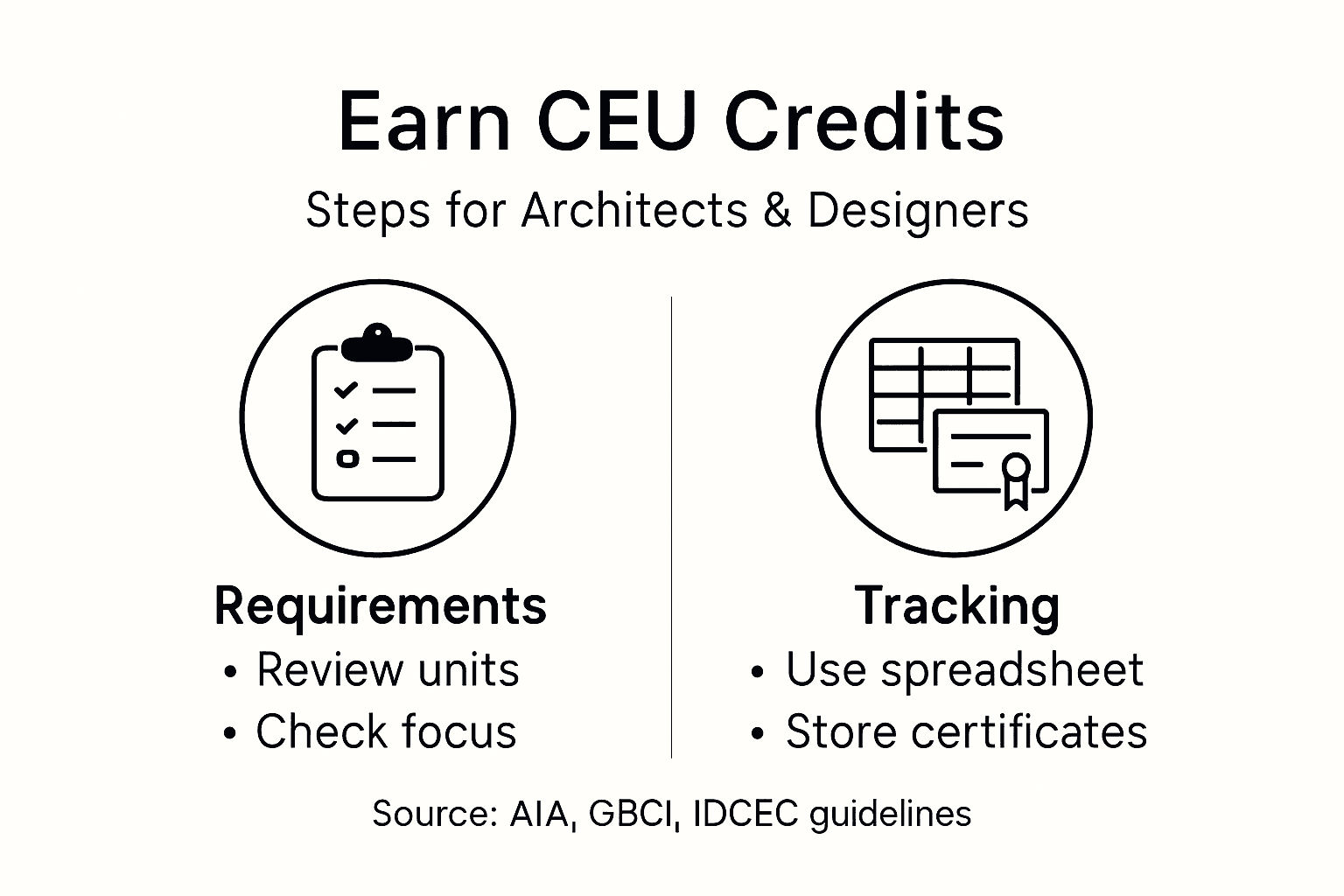
Key benefits of interactive CEU platforms for architects and designers:
| Platform Feature | Professional Impact |
| Automated credit tracking | Minimizes manual recordkeeping errors |
| Real-time completion verification | Immediate certification for renewals |
| Engaging learning modules | Supports skill development and retention |
Pro tip: Schedule dedicated time each month to review and update your professional development credits to prevent last-minute certification scrambles.
Step 5: Verify Earned Credits with Your Professional Bodies
Ensuring your continuing education credits are properly documented and recognized by professional organizations requires a systematic and proactive approach. Your goal is to navigate the verification process efficiently, maintaining compliance with AIA, GBCI, and IDCEC requirements while preserving your professional credentials.
When verifying your earned credits, implement these critical strategies:
- Collect all course completion certificates
- Review credit requirements for each organization
- Match course content with professional development categories
- Maintain digital and physical documentation
- Submit credits before certification renewal deadlines
Carefully cross-reference your completed courses with the specific requirements of each professional body. Tracking documentation meticulously helps prevent last-minute complications during certification renewal periods.
Professional credential maintenance is a continuous process that demands attention to detail and strategic planning.
Each professional organization has unique verification protocols. Some require direct submission of course certificates, while others allow online credit tracking through personal professional development portals. Understand each organization’s specific submission process to ensure smooth credit recognition.
Pro tip: Create a dedicated digital folder with subfolders for each professional organization to streamline your credit verification and documentation process.
Simplify Your CEU Journey with Expert Support from Ron Blank
Keeping up with continuing education credits can feel overwhelming when managing the detailed requirements from organizations like the American Institute of Architects, GBCI, and IDCEC. With specific mandates on HSW credits, sustainability knowledge, and meticulously tracking certificates, staying compliant while deepening your expertise on building products is a real challenge. You need reliable solutions that make earning and verifying CEUs straightforward and effective.
At Ron Blank, we specialize in developing continuing education courses designed specifically for architects, interior designers, engineers, and contractors. Our courses are fully registered with the AIA and include comprehensive online offerings, webinars, and podcasts that focus on building product specification and industry best practices. Experience engaging content that not only fulfills your professional development requirements but also equips you with practical knowledge to enhance your projects.

Take control of your professional growth today by exploring our expertly crafted continuing education courses. Whether you need to meet AIA, GBCI, or IDCEC requirements, our platform supports you with seamless credit tracking and verified certificates. Visit Ron Blank now to start earning CEU credits with confidence and advance your design career.
Frequently Asked Questions
What are the CE requirements for AIA, GBCI, and IDCEC?
The CEU requirements vary by organization. AIA requires 18 learning units every year, while GBCI credentials like LEED AP have additional sustainability coursework. Check your specific certification cycle to ensure compliance with each body’s unique requirements.
How can I select effective online courses to earn CE credits?
Select online courses offered by AIA, GBCI, or IDCEC that provide detailed information on building products and meet your learning objectives. Focus on courses featuring expert instructors and comprehensive coverage to enhance your professional knowledge.
What should I consider when registering for webinars and podcasts?
When registering for webinars and podcasts, verify that the courses are approved by AIA and IDCEC. Additionally, check the quality of visual content and the credentials of the instructors to ensure an engaging and informative experience.
How do I complete interactive modules to earn CE credits?
To complete interactive modules, engage actively with the content, take notes, and verify real-time credit tracking. Ensure you meet all course completion requirements to receive your certificates promptly after finishing the modules.
How can I verify my earned CEU credits with professional organizations?
Verify your CEU credits by collecting course completion certificates and cross-referencing them with the specific requirements of AIA, GBCI, and IDCEC. Submit your documentation before renewal deadlines to maintain your professional credentials.
What are the best practices for maintaining documentation of my CE credits?
Maintain clear documentation by creating a dedicated digital folder for course certificates and progress tracking. Organize your credits regularly, ideally each month, to avoid last-minute scrambling during certification renewals.