

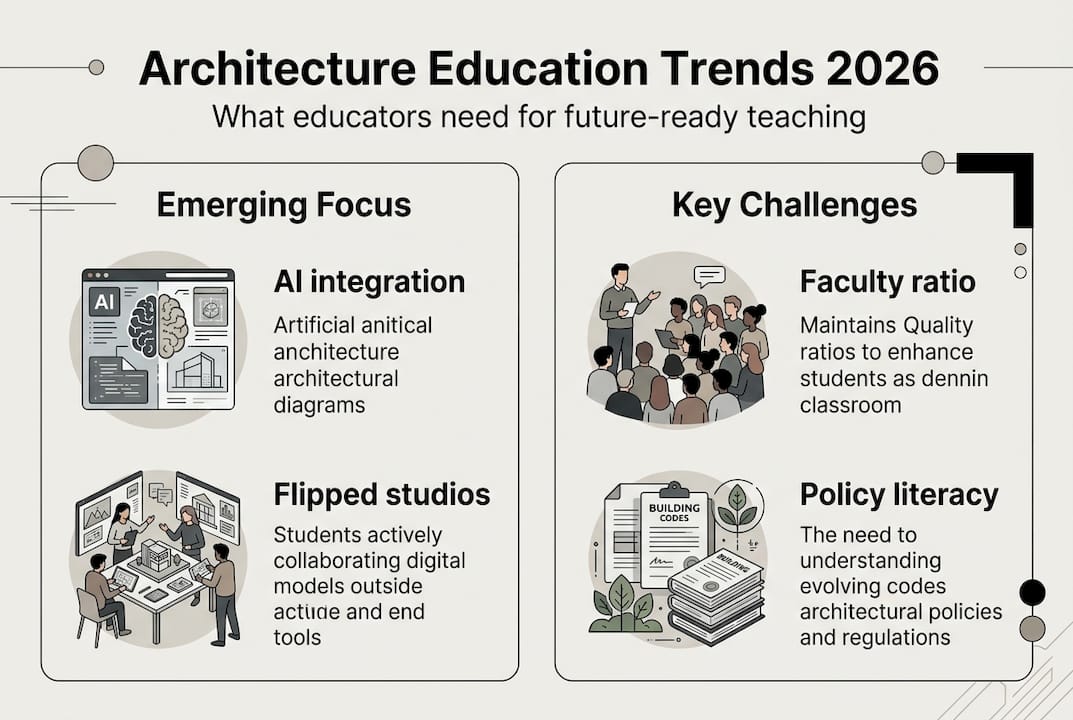
Architecture education stands at a fascinating crossroads in 2026. While over 90% of schools now integrate sustainability and nearly all promote interdisciplinary collaboration, critical gaps persist that threaten to undermine these advances. Only 38% address architects as policymakers, just 29% focus on innovative education models, and 35% struggle with faculty-student ratios. This disconnect between widespread adoption of some trends and neglect of others reveals the complex landscape educators and architects must navigate to prepare students for meaningful practice.
Table of Contents
- Key takeaways
- Understanding Education 4.0 and AI integration in architecture
- Flipped studio learning: a transformative pedagogical ecosystem
- Bridging practice, teaching, and research: transformative practice-based education
- Global trends and challenges: sustainability, interdisciplinary collaboration, and policy literacy
- Advance your architecture education practice with expert resources
- Frequently asked questions
Key Takeaways
| Point | Details |
|---|---|
| Sustainability adoption | More than nine in ten schools now embed sustainability in curricula and almost all promote interdisciplinary collaboration. |
| Education 4.0 shift | Education 4.0 blends digital technologies AI and student centered learning to reshape undergraduate design build projects. |
| AI practicality ethics | AI driven tools enable personalized learning, more design iterations, and a smoother transition to professional practice while raising ethical questions about authorship and bias. |
| Flipped studio value | Flipped studio learning reframes the studio to emphasize in class application and active problem solving. |
Understanding Education 4.0 and AI integration in architecture
Education 4.0 represents a fundamental shift in how architecture programs prepare students for contemporary practice. This framework blends digital technologies, artificial intelligence, and student-centered learning to create more responsive and effective educational experiences. Rather than treating technology as an add-on, Education 4.0 integrates AI-driven computational design directly into undergraduate design-build projects, fundamentally changing how students approach creative problem solving.
The integration of AI tools in architectural studios offers compelling benefits for both students and educators. Personalized learning paths adapt to individual student needs, allowing faster learners to explore advanced concepts while providing additional support where students struggle. AI-driven computational design tools enable students to explore far more design iterations than traditional methods allow, fostering innovation through rapid prototyping and testing. These technologies also introduce students to the same tools they’ll encounter in professional practice, smoothing the transition from education to employment.
Yet challenges accompany these opportunities. Ethical questions around design authorship emerge when AI generates portions of student work. Educators must help students understand when AI assistance crosses into academic dishonesty and how to properly attribute AI contributions. Bias embedded in AI training data can perpetuate problematic design assumptions unless students learn to critically evaluate AI outputs. Integrating AI meaningfully into design critiques requires rethinking traditional review formats to address both human creativity and algorithmic contributions.
Key digital tools reshaping architectural pedagogy include:
- Generative design platforms that explore thousands of design variations based on specified parameters
- Virtual and augmented reality systems enabling immersive spatial experiences before construction
- Building information modeling software integrating design, analysis, and documentation
- Machine learning tools analyzing precedent studies and generating design recommendations
- Collaborative cloud platforms facilitating real-time teamwork across distributed locations
Pro Tip: Balance AI assistance with fundamental design skills by requiring students to sketch initial concepts manually before using computational tools. This ensures they develop core spatial reasoning abilities while still benefiting from AI’s exploratory power.
The pedagogical impact extends beyond tool proficiency. Students develop critical thinking skills as they evaluate AI suggestions rather than accepting them uncritically. They learn to frame design problems in ways that leverage computational power while maintaining human judgment about aesthetic and experiential qualities. This balanced approach prepares architects who can harness technology without becoming dependent on it.
Flipped studio learning: a transformative pedagogical ecosystem
Flipped studio learning reimagines the traditional architecture studio by inverting the typical information delivery model. Instead of instructors presenting concepts during class time while students apply them independently later, students engage with foundational content before class through videos, readings, and digital resources. Studio time then focuses on active application, collaborative problem solving, and personalized feedback. This approach transforms studios from passive lecture halls into dynamic workshops where learning happens through doing.

The flipped studio model rests on four essential pillars that work together to create effective learning environments. Pedagogical design structures content delivery and studio activities to maximize engagement and skill development. Technology readiness ensures both infrastructure and instructor capability to support digital learning resources. Learner readiness addresses student motivation, self-direction skills, and access to necessary tools. Context adaptation recognizes that successful implementation varies based on institutional resources, student populations, and program goals.
Benefits of flipped studio learning include:
- Increased student autonomy as learners control pacing of foundational content consumption
- More productive studio time focused on application rather than passive information transfer
- Enhanced peer learning through collaborative problem solving during class sessions
- Personalized instructor feedback addressing individual student challenges
- Better preparation for self-directed professional practice after graduation
“Flipped studio learning creates a transformative pedagogical ecosystem where technology readiness, learner preparation, and contextual factors combine to shift studios from instructor-centered presentations to student-centered active learning experiences.”
Implementing flipped studios effectively requires careful attention to equity and access. Not all students have reliable internet access or suitable spaces for engaging with pre-class content at home. Educators must provide on-campus access to digital resources and consider hybrid approaches that accommodate diverse student circumstances. The model works best when instructors design pre-class content specifically for their courses rather than relying solely on generic online resources.
Pro Tip: Start small by flipping one or two studio sessions per semester rather than attempting a complete course transformation immediately. This allows you to refine your approach based on student feedback and identify which content types work best in flipped format.
Assessment strategies also need rethinking in flipped studios. Traditional exams testing knowledge recall become less relevant when students can access information resources continuously. Instead, assessments should focus on application, synthesis, and creative problem solving demonstrated through design work. Studio critiques gain importance as primary evaluation moments where students defend design decisions and demonstrate understanding of principles encountered in pre-class content.
Bridging practice, teaching, and research: transformative practice-based education
Traditional studio pedagogy often creates artificial separation between academic learning and professional practice. Students complete hypothetical projects disconnected from real constraints, clients, and construction realities. Research remains the domain of faculty rather than an integral part of student learning. This fragmentation leaves graduates unprepared for the integrated thinking required in professional practice where design, technical, and research skills must work together seamlessly.
The practice-based pedagogical model addresses these disconnects by centering education on actual architectural projects that students engage with as practitioners would. Rather than simulating practice, students participate in real practice under faculty guidance. This experiential approach transforms abstract concepts into tangible skills while revealing the complex relationships between design intentions, technical execution, and built outcomes.
Implementing transformative practice-based education involves these key steps:
- Engage students in actual architectural projects with real clients, sites, budgets, and regulatory requirements rather than hypothetical exercises.
- Facilitate structured reflection where students analyze their design decisions, construction challenges, and outcomes to extract transferable principles.
- Integrate research as students investigate precedents, materials, technologies, and theories relevant to their specific project challenges.
- Share outcomes through presentations, publications, and exhibitions that communicate both project results and learning insights to broader audiences.
- Iterate the cycle as students apply lessons from completed projects to new challenges with increasing sophistication.
This model fosters deeper understanding because students encounter the full complexity of architectural practice rather than sanitized academic versions. They learn to navigate conflicting requirements, advocate for design quality within budget constraints, and adapt to unexpected site conditions. Technical knowledge becomes meaningful when students must specify actual materials and details that will be built. Sustainability principles gain urgency when students see how decisions affect real energy consumption and environmental impact.
For educators, practice-based teaching requires different skills than traditional studio instruction. Faculty become project facilitators and reflective coaches rather than primarily design critics. They must cultivate relationships with community partners, manage legal and liability issues, and coordinate logistics while maintaining educational focus. The rewards include student engagement levels that exceed traditional studios and graduates who transition to professional practice with unusual confidence and competence.
Students benefit from authentic learning experiences that build portfolio work demonstrating real problem solving rather than speculative designs. They develop professional networks through community partnerships and gain realistic understanding of practice economics and project delivery. Perhaps most importantly, they learn to see themselves as practitioners capable of meaningful contributions rather than novices awaiting future relevance.
Global trends and challenges: sustainability, interdisciplinary collaboration, and policy literacy
The UIA Global Survey 2025 provides unprecedented insight into architectural education worldwide by gathering data from schools across diverse geographic, economic, and cultural contexts. This comprehensive assessment reveals both encouraging progress and persistent gaps that educators must address to prepare students for contemporary practice. The survey’s scope encompasses curriculum content, pedagogical approaches, resource allocation, and emerging priorities that shape how future architects learn their craft.
| Metric | Percentage | Implication |
|---|---|---|
| Schools integrating sustainability | >90% | Widespread recognition of environmental responsibility |
| Programs promoting interdisciplinary collaboration | 99% | Near-universal acknowledgment of teamwork importance |
| Curricula addressing architects as policymakers | 38% | Significant gap in civic engagement preparation |
| Focus on innovative education models | 29% | Limited pedagogical experimentation |
| Schools reporting faculty ratio challenges | 35% | Resource constraints affecting instruction quality |
Key challenges and opportunities for educators include:
- Expanding policy literacy to prepare architects for advocacy, regulatory engagement, and civic leadership roles
- Experimenting with innovative pedagogical models beyond traditional studio formats
- Addressing faculty-student ratios to enable more personalized mentorship and feedback
- Balancing sustainability integration depth with other essential competencies
- Leveraging interdisciplinary collaboration for genuine synthesis rather than superficial coordination
“While over 90% of architecture schools now integrate sustainability and 99% promote interdisciplinary collaboration, only 38% address architects as policymakers and just 29% focus on innovative education models, revealing critical gaps in preparing students for expanded professional roles.”
The sustainability integration success reflects two decades of focused effort by accreditation bodies, professional organizations, and progressive schools. Nearly all programs now include environmental analysis, energy modeling, and sustainable material selection in their curricula. Yet this widespread adoption sometimes remains superficial, treating sustainability as a checklist item rather than fundamental design driver. Educators must deepen this integration to address climate adaptation, circular economy principles, and social equity dimensions of environmental responsibility.
Interdisciplinary collaboration’s near-universal presence similarly masks variation in implementation quality. Some programs achieve genuine integration where architecture students work alongside engineers, landscape architects, and urban planners on shared projects with combined learning objectives. Others limit collaboration to isolated exercises or guest lectures that don’t fundamentally change how students approach design. Effective interdisciplinary education requires institutional commitment, shared faculty appointments, and assessment methods that reward synthesis.
The policy literacy gap represents a critical missed opportunity. Architects increasingly influence building codes, zoning regulations, climate action plans, and design review processes. Yet most education programs focus exclusively on project-level design skills without preparing students for these broader civic roles. Addressing this gap requires curriculum space for policy analysis, advocacy skill development, and understanding of governmental decision making processes.
Faculty ratio challenges undermine educational quality across all these areas. When instructors must divide attention among too many students, personalized feedback suffers, mentorship becomes superficial, and innovative pedagogical experiments feel too risky to attempt. Schools must advocate for resources that enable optimal learning conditions while exploring technology and peer learning strategies that extend faculty capacity.
Advance your architecture education practice with expert resources
Staying current with evolving architecture education trends requires ongoing professional development and access to cutting-edge insights. The landscape shifts rapidly as new technologies emerge, pedagogical research advances, and practice demands evolve. Educators who invest in continuous learning position themselves to offer students the most relevant and effective preparation for contemporary architectural practice.

Ron Blank & Associates provides comprehensive continuing education resources specifically designed for architects, educators, and design professionals seeking to enhance their expertise. Our AIA-registered courses cover emerging trends, innovative pedagogies, and practical strategies for improving educational outcomes. Whether you’re exploring AI integration, developing flipped studio models, or strengthening sustainability curricula, our expert-led programs deliver actionable knowledge you can implement immediately. Explore our course catalog to discover professional development opportunities that align with your educational goals and help you prepare the next generation of architects for meaningful practice.
Frequently asked questions
What is Education 4.0 in architecture?
Education 4.0 integrates digital technologies like AI and computational design tools with personalized, student-centered learning approaches to modernize architecture pedagogy. It emphasizes collaboration platforms, immersive technologies, and data-driven design exploration. This framework prepares students for contemporary practice by teaching both technical proficiency and critical evaluation of algorithmic outputs. Education 4.0 represents a fundamental shift from instructor-centered knowledge transmission to technology-enhanced active learning.
How does flipped studio learning improve architecture education?
Flipped studios increase active learning and student autonomy by moving foundational content delivery outside class time through videos and digital resources. Studio sessions then focus on application, collaborative problem solving, and personalized instructor feedback. This approach adapts to diverse learner needs through flexible pacing and multiple content formats. Students develop self-direction skills essential for professional practice while benefiting from more productive use of valuable studio time with instructors and peers.
What challenges do architecture schools face in 2026?
Many schools struggle with optimal faculty-student ratios, with 35% reporting this as a significant challenge that limits personalized mentorship. Critical gaps exist in teaching architects’ roles as policymakers, addressed by only 38% of programs despite growing importance. Just 29% focus on innovative pedagogical models, suggesting resistance to experimentation. These challenges coexist with successful sustainability integration, creating uneven preparation for contemporary practice demands.
How can architects and educators use AI ethically in design education?
Ethical AI use requires reflective practice addressing authorship and bias in design critiques and student work. Educators should teach students to critically evaluate AI suggestions rather than accepting them uncritically, recognizing embedded biases in training data. Co-design learning approaches position AI as a collaborative tool that enhances rather than replaces human creativity. Clear attribution standards help students understand appropriate AI assistance levels. This balanced approach prepares architects who leverage technology responsibly while maintaining professional judgment and ethical accountability.