

TL;DR:
- Design standards are living frameworks guiding decisions in safety, sustainability, and performance.
- They are developed through consensus, become law when adopted into building codes, and vary between prescriptive and performance-based types.
- Mastery involves proactive engagement and ongoing education to leverage standards for innovation and credentialing.
Design standards are often misunderstood as fixed rulebooks that professionals consult once and forget. In reality, they are living frameworks that shape every decision you make, from material selection to accessibility compliance and sustainability benchmarks. If you think standards are just about safety checklists, you are missing most of the picture. Documented technical specifications published by recognized bodies establish uniform criteria for materials, processes, products, and systems across architecture, engineering, and interior design. Understanding how they work, who creates them, and how they evolve is one of the most practical investments you can make in your professional credentials and daily practice.
Table of Contents
- Defining design standards and why they matter
- How design standards are developed and adopted
- Types of design standards: Prescriptive vs performance-based
- Design standards in interior design: Accessibility and professional guidelines
- Why true mastery of design standards means going beyond the rule book
- Advance your expertise with AIA CE courses on design standards
- Frequently asked questions
Key Takeaways
| Point | Details |
|---|---|
| Design standards defined | Design standards set uniform criteria for safety, performance, and accessibility in architecture and design. |
| Development and adoption | Standards are created by recognized bodies and become law when referenced in building codes. |
| Prescriptive vs performance | Prescriptive standards detail requirements; performance-based standards allow flexible solutions for desired outcomes. |
| Interior design accessibility | ASID and ANSI standards guide inclusive and adaptive spaces that meet accessibility needs. |
| Mastery leads to innovation | True expertise uses evolving standards to create safer, more creative, and competitive designs. |
Defining design standards and why they matter
Design standards are not optional guidance. They are the backbone of professional practice in the AEC industry, and treating them as anything less puts projects, clients, and your credentials at risk. At their core, design standards are documented technical specifications published by recognized bodies that establish uniform criteria for materials, processes, products, or systems in architecture, engineering, and interior design, ensuring safety, accessibility, sustainability, and performance.
Think about what that means in practice. When you specify a structural system, select finishes for a healthcare facility, or design a public space, you are working within a web of standards that govern everything from load tolerances to indoor air quality. These are not bureaucratic hurdles. They are the shared language of the profession.
Several major organizations publish the standards that architects, engineers, and interior designers rely on every day:
- ANSI (American National Standards Institute): Coordinates voluntary consensus standards across industries
- ASCE (American Society of Civil Engineers): Structural and civil engineering standards, including the widely referenced ASCE 7 for minimum design loads
- ASTM International: Material testing and performance standards covering thousands of products and systems
- ACI (American Concrete Institute): Concrete design and construction standards, including ACI 318
- ASHRAE: Energy efficiency and mechanical system standards, including the influential ASHRAE 90.1
“Design standards provide the technical foundation that allows professionals to make defensible, evidence-based decisions. Without them, every project would require reinventing the wheel, and the results would be inconsistent at best and dangerous at worst.”
For your credentials and legal compliance, understanding which standards apply to your project type and jurisdiction is not just good practice. It is a professional obligation. Licensing boards, AIA continuing education requirements, and project specifications all assume you know how to navigate this landscape.
How design standards are developed and adopted
Standards do not appear out of thin air. They emerge from structured, consensus-driven processes that involve industry experts, researchers, regulators, and practitioners. Understanding this process helps you anticipate when standards will change and why.
Here is how the development process typically works:
- Proposal: A standards development organization (SDO) or working group identifies a need for a new standard or revision.
- Drafting: Technical committees draft the standard based on research, testing data, and expert input.
- Public comment: The draft is released for public review, allowing stakeholders to flag issues or suggest improvements.
- Consensus vote: Balloting occurs among committee members, requiring broad agreement before the standard advances.
- Publication: The finalized standard is published and made available for adoption.
- Legal adoption: Jurisdictions reference standards in building codes, making them legally enforceable.
Standards developed through ANSI consensus processes by SDOs like ASCE, ASTM, ACI, and ASHRAE become mandatory when adopted into law, such as when the International Building Code (IBC) references ASCE 7 or ASHRAE 90.1.
This is where the codes vs. standards distinction matters. A standard is a technical document. A code is law. The IBC, for example, is a model code that jurisdictions adopt and amend. It references dozens of standards, which then carry legal weight in those jurisdictions.
| Feature | Design standard | Building code |
|---|---|---|
| Created by | SDOs via consensus | Government or model code bodies |
| Legal status | Voluntary until adopted | Mandatory when enacted |
| Examples | ASCE 7, ASTM E84, ACI 318 | IBC, IECC, local amendments |
| Update cycle | Varies by organization | Typically 3-year cycles |
Pro Tip: Track which edition of a standard your jurisdiction has legally adopted. Many jurisdictions lag behind current editions, so the “latest” standard may not be the one you are legally required to follow on a given project.
Types of design standards: Prescriptive vs performance-based
Not all standards work the same way. The two primary approaches, prescriptive and performance-based, have very different implications for how you design, document, and justify your decisions.
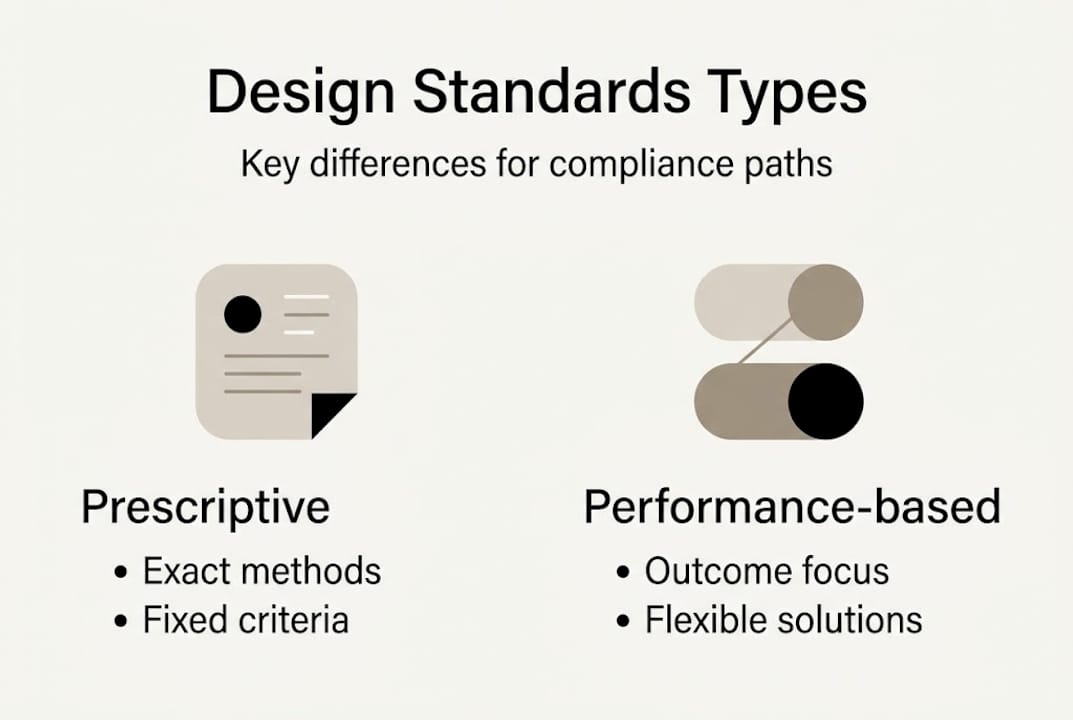
Prescriptive standards specify exact methods, such as rebar spacing requirements in ACI 318, while performance-based standards specify outcomes, such as a required fire rating, and allow alternative methods to achieve them.

| Aspect | Prescriptive standards | Performance-based standards |
|---|---|---|
| Approach | Exact requirements and methods | Defined outcomes, flexible methods |
| Design freedom | Limited | High |
| Documentation burden | Lower | Higher (must prove equivalence) |
| Best for | Routine projects, standard materials | Innovative designs, new materials |
| Examples | ACI 318 rebar spacing, IBC egress widths | NFPA fire ratings, ASHRAE energy targets |
Prescriptive standards are reliable and efficient for standard project types. You know exactly what is required, and compliance is straightforward to document. The tradeoff is that they can feel restrictive when you are working with innovative materials or unconventional geometries.
Performance-based standards open the door to creative solutions, but they require more rigorous analysis and documentation. You need to demonstrate that your alternative approach achieves the required outcome, which often means commissioning additional testing or modeling.
Key implications for your practice:
- Mass timber construction is a strong example of performance-based flexibility in action. Standards evolve with technology, as seen when mass timber building heights increased under NBC 2025, reflecting new fire performance data and engineering research.
- Energy compliance often blends both approaches. ASHRAE 90.1 offers prescriptive compliance paths alongside energy cost budget and performance-based alternatives.
- Fire-resistive construction frequently uses performance testing (ASTM E119) to qualify assemblies that do not fit prescriptive tables.
Understanding which type of standard applies to your project, and which compliance path you are following, is essential for both design efficiency and defensible documentation.
Design standards in interior design: Accessibility and professional guidelines
Interior designers navigate a distinct set of standards that intersect with architecture but carry their own professional weight. Accessibility is the most critical area, and it is also one of the most actively evolving.
ASID provides professional guidelines for interior designers, including resource guides on adaptive living and barrier-free design, while ANSI A117.1 sets the technical accessibility requirements that most jurisdictions adopt.
Here is a snapshot of key standards interior designers should know:
| Standard | Focus area | Key requirements |
|---|---|---|
| ANSI A117.1 | Accessibility | Clearances, reach ranges, turning radii |
| ADA Standards | Federal accessibility law | Public accommodations, commercial facilities |
| ASID Guidelines | Professional practice | Ethics, sustainability, adaptive living |
| ASHRAE 62.1 | Indoor air quality | Ventilation rates for occupied spaces |
| NFPA 101 | Life safety | Egress, occupancy loads, finishes |
Accessibility standards are not static. They respond to demographic shifts, advances in assistive technology, and evolving legal interpretations. ANSI A117.1, for example, is updated on a regular cycle and often precedes changes to the ADA Standards for Accessible Design.
Practical areas where interior designers must apply these standards include:
- Adaptive living environments: Aging-in-place design, universal design principles, and residential accessibility retrofits
- Barrier-free commercial interiors: Door hardware, flooring transitions, counter heights, and restroom configurations
- Wayfinding and signage: Tactile signage requirements, contrast ratios, and mounting heights under ANSI A117.1
- Finish material performance: Flame spread ratings under ASTM E84 and smoke development indices for interior finishes
Why true mastery of design standards means going beyond the rule book
Here is something we do not say enough in continuing education: strict compliance is the floor, not the ceiling. Professionals who treat standards as boxes to check are leaving real value on the table, and in competitive project environments, that gap shows.
We have seen this play out repeatedly. Architects and designers who engage with evolving standards early, before they become legally mandated, consistently have an advantage. They are already fluent in the new requirements when a jurisdiction adopts them, which means faster project delivery and fewer costly revisions.
The contrarian view worth considering is this: standards can actually expand creative possibilities rather than restrict them. Performance-based standards, in particular, reward professionals who understand the underlying intent well enough to propose innovative alternatives. That requires going beyond memorizing requirements and genuinely understanding what the standard is trying to achieve.
There is also a credentialing dimension that gets overlooked. AIA continuing education requirements exist precisely because standards evolve. Staying current is not just about compliance. It is about maintaining the depth of knowledge that separates a trusted advisor from someone who just fills out forms. Engaging with standards as living documents, rather than static references, is what that looks like in practice.
Advance your expertise with AIA CE courses on design standards
If this guide has clarified how design standards work and why they matter for your practice, the next step is structured learning that counts toward your credentials. Staying current with evolving standards across structural, accessibility, energy, and interior design categories is exactly what AIA-registered continuing education is designed to support.

At Ron Blank and Associates, we offer design standards CE courses registered with the American Institute of Architects, available as online courses, webinars, podcasts, and face-to-face sessions. Whether you are working toward your AIA CE requirements or deepening your compliance knowledge in a specific area, our courses connect real-world standards to practical application. Explore our catalog and find the courses that align with your next project or credentialing goal.
Frequently asked questions
How do design standards differ from building codes?
Design standards set technical specifications developed through consensus processes, while building codes are law and often reference those standards to make them legally enforceable. Codes become mandatory when adopted by a jurisdiction, such as the IBC referencing ASCE 7.
Which organizations publish design standards relevant to architects and designers?
ANSI, ASCE, ASTM, ACI, and ASHRAE are the major bodies. These organizations publish uniform criteria covering structural loads, material performance, energy efficiency, accessibility, and professional practice guidelines.
What is the difference between prescriptive and performance standards?
Prescriptive standards specify exact requirements, such as rebar spacing in ACI 318, while performance standards define the outcome required, such as a fire rating, and allow alternative methods to achieve it.
What accessibility standards apply to interior design?
ANSI A117.1 sets accessibility requirements for clearances, reach ranges, and barrier-free configurations, while ASID guides best practices for adaptive and inclusive interior environments.
How often are design standards updated?
Update cycles vary by organization, but standards evolve with technology and societal needs, as seen with mass timber height increases in NBC 2025. Professionals should review authoritative sources regularly rather than assuming current knowledge stays current.