

TL;DR:
- Project specifications are the legal and technical backbone that define building quality and standards.
- Architects are responsible for early, clear, and coordinated specifications that prevent disputes and cost overruns.
- Effective specification writing requires clarity, consistency, industry standard adherence, and proactive collaboration.
Project specification is one of those tasks that looks straightforward on the surface but carries enormous weight beneath it. Many architects and engineers treat it as a documentation formality, something to check off before construction begins. That mindset is costly. Specifications are the legal and technical backbone of any project, and the architect who treats them as a leadership function rather than a clerical one will see measurably better outcomes. This guide breaks down why specifications matter so deeply, what architects are truly responsible for, and how you can sharpen your approach to reduce risk and deliver higher-quality projects.
Table of Contents
- Why project specifications matter in architecture
- Core responsibilities of architects in project specification
- Best practices for effective specification writing
- Navigating challenges and edge cases in specification
- A new way to view the architect’s impact on project outcomes
- Advance your expertise in project specification
- Frequently asked questions
Key Takeaways
| Point | Details |
|---|---|
| Architects lead risk reduction | Precise specifications safeguard the project against disputes and misunderstandings. |
| Clarity is essential | Clear, consistent language prevents costly errors and misinterpretation. |
| Collaboration matters | Effective coordination with engineers and stakeholders ensures specification quality. |
| Best practices prevent issues | Following established guidelines minimizes ambiguity and conflict in project documents. |
Why project specifications matter in architecture
Having set the stage for why this task is often underestimated, let’s take a closer look at its true importance.
A project specification is a written document that defines the quality, performance, and standards required for materials, products, and workmanship on a construction project. It works alongside drawings, not as a supplement, but as an equal partner in the construction document set. Drawings show what gets built. Specifications define how and to what standard.
When specifications are weak, vague, or internally inconsistent, the consequences ripple across the entire project. Contractors submit substitution requests for lower-cost materials. Disputes arise over what was actually required. Change orders multiply. Owners end up with buildings that don’t perform as intended, and architects find themselves in the middle of conflicts they could have prevented.
“Poor specifications lead to disputes; best practices mitigate risks through precision and coordination.”
One common misconception is that the specification is primarily the contractor’s problem to interpret. In reality, it is the architect’s document, and the architect bears professional responsibility for its clarity. Another misconception is that boilerplate master specifications are sufficient without customization. Every project has unique site conditions, owner requirements, and design intent that generic language simply cannot capture.
Here are the key risks architects help manage through precise specification:
- Material substitution risk: Vague product descriptions invite substitutions that compromise design intent or performance.
- Construction disputes: Ambiguous language creates fertile ground for contractor claims and owner dissatisfaction.
- Cost overruns: Incomplete specifications lead to bid gaps, where contractors price risk into their numbers or exclude scope entirely.
- Regulatory non-compliance: Missing code references or performance standards can result in failed inspections and costly rework.
- Operational failures: Poorly specified mechanical, electrical, or envelope systems can result in buildings that underperform for decades.
These are not hypothetical risks. They show up on real projects, in real budget meetings, and in real arbitration proceedings. Understanding this is the first step toward treating specification with the seriousness it deserves.
Core responsibilities of architects in project specification
With stakes this high, what exactly should the architect be doing in specification? Here’s a breakdown.
The architect’s role in specification spans the entire project lifecycle, from early design decisions through construction administration. It is not a task that begins when the drawings are nearly complete. It starts at concept, when product categories and performance goals are first being considered.

Architects often lead prescriptive specifications to maintain design control, meaning they name specific products, manufacturers, or detailed installation methods rather than leaving those decisions to contractors. This approach protects design intent but requires the architect to stay current on product performance, availability, and code compliance.
It is also important to distinguish the architect’s role from that of engineers and specifiers. Engineers typically author the technical sections related to their discipline, such as structural, mechanical, or electrical specifications. A dedicated specifier, when part of the team, brings deep expertise in specification language and master guide formats. But the architect coordinates all of these contributions and ensures they align with the overall design intent and project requirements.
Here are the key tasks architects undertake in writing and managing project specifications:
- Define performance goals early: Establish what the building must achieve in terms of energy performance, durability, acoustics, and sustainability before product selection begins.
- Select and customize specification sections: Adapt master guide specifications to reflect actual project conditions, not generic defaults.
- Coordinate with drawings: Every specification section should align with what is shown on the drawings, with no contradictions or gaps.
- Review engineer-authored sections: Ensure consistency in terminology, formatting, and cross-references across all disciplines.
- Manage substitution requests: Evaluate contractor-proposed substitutions against the original design intent and performance criteria.
- Conduct pre-bid and pre-construction reviews: Clarify specification intent before construction begins to reduce RFIs (requests for information) and change orders.
Pro Tip: Start your specification outline at the same time you begin schematic design. Early decisions about product categories and performance standards will save hours of revision later and prevent the last-minute scramble that leads to errors.
Best practices for effective specification writing
Having outlined the architect’s main tasks, let’s focus on how these can be performed to the highest standard.
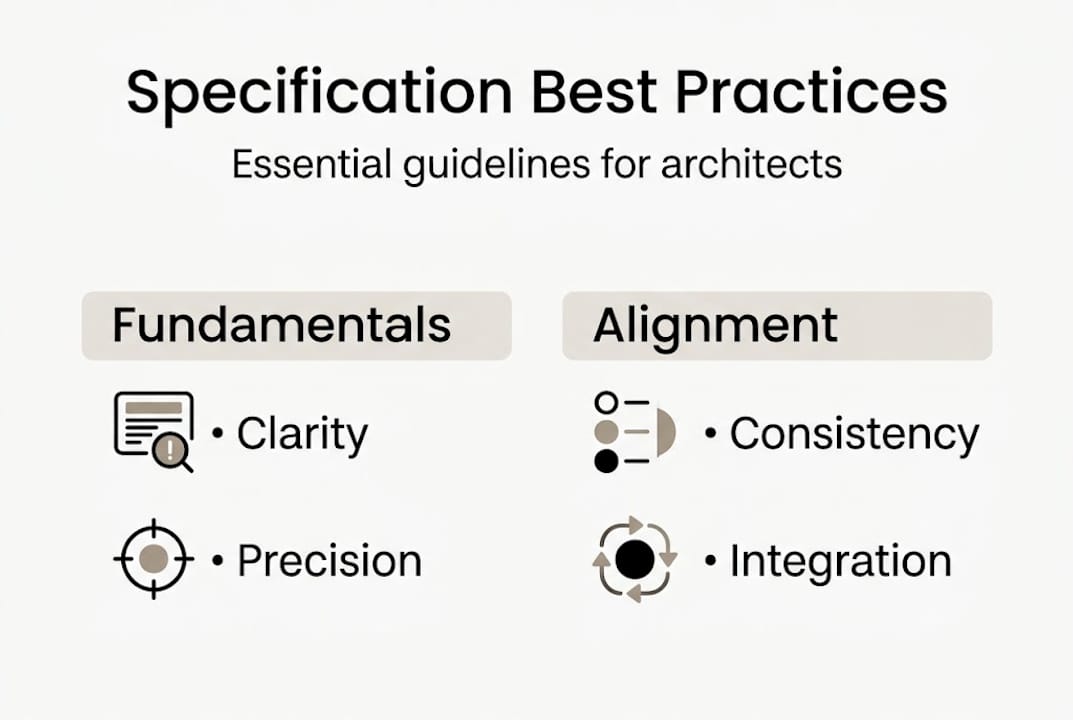
Specification writing best practices center on four fundamentals: clarity, precision, consistency, and alignment with industry standards such as MasterFormat, which is the Construction Specifications Institute’s numbering system for organizing project information.
One of the most practical distinctions in specification writing is the choice between performance specifications and prescriptive specifications. Each has a different role, and architects need to know when to use which.
| Specification type | What it defines | Architect’s role | Best used when |
|---|---|---|---|
| Performance | Required outcomes (e.g., R-value, fire rating) | Sets measurable benchmarks | Flexibility is acceptable or innovation is encouraged |
| Prescriptive | Specific products, materials, or methods | Names exact requirements | Design control and quality consistency are priorities |
Both types have legitimate uses, and many specifications blend them. The key is intentionality. Know why you are choosing one approach over the other for each section.
Common pitfalls that trip up even experienced specifiers include:
- Using vague terms like “as required” or “as needed”: These phrases shift decision-making to the contractor and invite inconsistent results.
- Failing to update boilerplate sections: Master specifications include placeholder text and optional clauses that must be edited for each project.
- Ignoring drawing and specification conflicts: If a drawing shows one product and the specification names another, contractors will choose the cheaper option, and disputes follow.
- Omitting submittal requirements: Without clear submittal procedures, you lose quality control during construction.
Pro Tip: Read your specification sections out loud. If a sentence is confusing when spoken, it will be misinterpreted in the field. Simple, direct language is not a sign of unsophisticated work. It is a sign of professional discipline.
Navigating challenges and edge cases in specification
Solid best practices can fail in the real world. Here’s how to spot and address potential hazards before they escalate.
Common specification challenges include ambiguities from vague language, inconsistent terminology, conflicts between specification sections or with drawings, and errors from lack of technical understanding. These are not rare exceptions. They are the norm on projects where specification is treated as an afterthought.
Here is a look at common edge cases, their typical impacts, and how to resolve them:
| Edge case | Typical impact | Resolution approach |
|---|---|---|
| Conflicting documents (drawing vs. spec) | Contractor claims, change orders | Establish a clear order of precedence in the contract |
| Ambiguous product descriptions | Substitutions, disputes over quality | Use manufacturer names, model numbers, or measurable criteria |
| Inconsistent terminology | Misinterpretation across trades | Create a project glossary and apply it consistently |
| Missing installation requirements | Field errors, warranty voids | Reference manufacturer instructions and industry standards |
| Outdated referenced standards | Code non-compliance | Verify all referenced standards are current editions |
To proactively resolve common conflicts before they reach the field, consider these steps:
- Establish document hierarchy: Clearly state in the general conditions which document governs when conflicts arise.
- Cross-reference systematically: Every specification section should reference relevant drawing sheets, and vice versa.
- Conduct a coordination review: Before issuing for bid, compare specification sections against drawings for every major building system.
- Engage engineers early: Bring structural, mechanical, and electrical engineers into specification reviews, not just drawing reviews.
- Use RFI logs proactively: Track questions from previous projects to identify recurring ambiguities in your master specifications.
The coordination piece is especially important. Architects who work in silos, writing specifications without regular input from engineers and contractors, produce documents that look complete but fall apart under construction conditions. Specification is a team sport, and the architect is the coach.
A new way to view the architect’s impact on project outcomes
After examining the technical details, let’s step back for a candid perspective on what really moves projects forward.
Here is something the industry rarely says out loud: most project failures trace back to specification, not design. The design gets celebrated. The specification gets blamed quietly, after the fact, in a conference room full of lawyers.
Conventional wisdom in architecture tends to elevate design as the primary value architects bring to a project, while treating specification as a support function. We think that framing is backwards. Specification is where design intent either survives or gets diluted. It is where the architect’s decisions become enforceable commitments. Firms that treat specification as a leadership function, investing in training, coordination, and quality review, consistently see fewer disputes, fewer change orders, and higher owner satisfaction.
The architects and engineers who earn the most trust from owners and contractors are not always the most creative designers. They are the ones whose documents are clear, consistent, and buildable. That reputation is built one well-written specification at a time. If you want to lead projects rather than just design them, specification expertise is the skill worth developing.
Advance your expertise in project specification
Armed with this new perspective, you may want to build your expertise even further.
Specification mastery does not happen by accident. It comes from deliberate study, peer learning, and staying current on industry standards, products, and best practices. Continuing education is one of the most direct paths to that expertise, and it also helps you meet your AIA (American Institute of Architects) learning unit requirements.

At Ron Blank & Associates, we develop architect continuing education courses registered with the AIA and delivered online, through webinars, podcasts, and face-to-face programs. Our courses are built for working professionals who want to sharpen their specification skills, understand building products more deeply, and lead their projects with greater confidence. Explore our course catalog and take the next step toward specification excellence.
Frequently asked questions
What is the architect’s main responsibility in project specification?
The architect leads the translation of design intent into clear, enforceable requirements within project documents. Architects often lead prescriptive specifications to maintain design control throughout the construction process.
How do poor specifications affect project outcomes?
Poor specifications increase the risk of disputes, cost overruns, and delays due to ambiguity or conflicts in the documents. Poor specifications lead to disputes, and only precision and coordination can reliably prevent them.
What are the most common challenges in specification writing?
Ambiguities, inconsistent terminology, and conflicts between documents are frequent problems that derail projects. Common specification challenges also include errors from insufficient technical understanding of materials and systems.
How can architects avoid specification pitfalls?
Use clear, consistent language, coordinate with drawings, and regularly review specifications with all stakeholders. Specification writing best practices also include adhering to industry standards and conducting thorough reviews before issuing documents for bid.