

TL;DR:
- Innovative construction methods like 3D concrete printing, MMC, and voxel assembly are proving faster, more sustainable, and cost-effective in 2026. However, regulatory fragmentation and financing mismatches remain the primary barriers to scaling these technologies across projects. Successful adoption depends on industry coordination, early stakeholder engagement, and mapping the regulatory and financial pathways.
The pressure on architects and engineers entering 2026 is real. Clients want faster schedules, regulators want lower carbon, and budgets haven’t grown to match either demand. Innovative construction methods in 2026, meaning the broad category the industry often calls advanced building technologies and Modern Methods of Construction (MMC), are no longer experimental talking points. They’re project delivery tools with documented performance records. This article breaks down the methods gaining traction right now, what the data actually shows, and how to evaluate them for your next project.
Key Takeaways
| Point | Details |
|---|---|
| Evaluate before you adopt | Assess each method against your project’s timeline, budget, carbon targets, and regulatory environment before committing. |
| 3D concrete printing delivers measurable gains | Real projects show timeline reductions of 3 months or more and material savings approaching 45% compared to conventional builds. |
| MMC cuts time and cost at scale | Modern Methods of Construction can reduce build time by 20 to 50% and lower per-unit costs by approximately 20% on larger developments. |
| Regulatory friction is the real bottleneck | Technology readiness is not the limiting factor. Financing structures and fragmented building codes are the actual barriers to scaling new methods. |
| Embed carbon data early in BIM | Sixty percent of construction professionals now measure embodied carbon digitally, and front-loading that data in BIM objects improves both accuracy and auditability. |
1. How to evaluate innovative construction methods in 2026
Before committing to any emerging technique, you need a consistent framework for comparison. Not every method suits every project type, and the cost of a poor fit shows up late when it’s expensive to reverse.
Here are the five criteria worth applying to any new method you evaluate:
- Time savings and schedule impact. How much faster is this method at each phase? Does speed at the factory create a bottleneck on site, or do both sequences align?
- Cost implications at scale. Some methods show strong unit economics only above a certain project volume. Confirm whether the savings math works for your specific scope, not an idealized scenario.
- Embodied carbon reduction. With whole-life carbon reporting becoming standard practice, methods that don’t address embodied carbon upfront are already behind the curve.
- Labor and workforce requirements. Reduced on-site labor sounds attractive, but it shifts skill requirements to factory workers, digital coordinators, and robotic technicians. Plan for that transition.
- Regulatory and financing complexity. Some methods still face code fragmentation and lending structures that don’t align with off-site manufacturing schedules. Know the local regulatory picture before the project starts.
Pro Tip: When presenting a new method to a client or stakeholder group, map it against all five criteria on a single slide. Decision-makers respond to structure, and it saves you from having to defend a technology choice in isolation without context.
2. Concrete 3D printing for faster builds and less waste
Concrete 3D printing, technically known as additive manufacturing for construction, has moved well past the proof-of-concept stage. European projects completed in 2025 and early 2026 are producing performance data that should matter to any professional still watching from the sidelines.
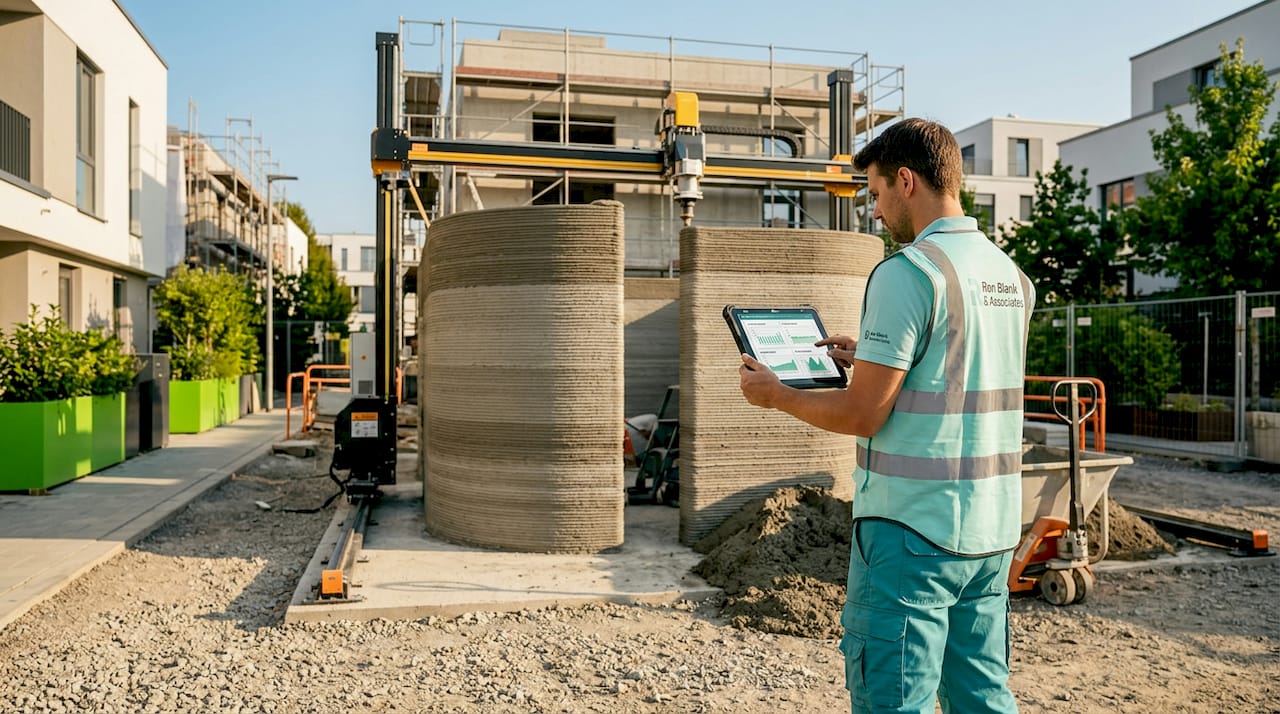
The most cited example is a residential project in France where the load-bearing structure printed in 34 daysversus a projected 50 days, with the overall project timeline cut by approximately 3 months compared to conventional construction. Labor on site was halved. Material waste dropped by about 50%. And because the curved geometry eliminated the need for traditional formwork, the project used roughly 10% less concrete through combined automation and design optimization.
The renovation case is equally striking. A Barcelona nightclub conversion finished in 7 weeks instead of 5 months, with concrete usage dropping from 110 tons to 60 tons, which avoided approximately 50 tons of CO₂ emissions on a single mid-size project.
Key advantages for professionals evaluating this method:
- Geometry optimization that traditional formwork makes prohibitively expensive
- Substantial reduction in on-site labor exposure, which directly affects safety records
- Measurable carbon reductions tied to both reduced material volume and optimized mix design
- Potential for sequencing optimization, where strategic gantry repositioning can further improve print time efficiency on larger structures
Pro Tip: If you’re specifying a 3D printed structure for the first time, get the mix design certified before the structural engineer locks in the reinforcement strategy. The two decisions interact more than most teams anticipate.
3. Modern methods of construction (MMC) and modular building
MMC is the umbrella term for off-site fabrication, modular construction, panelized systems, and volumetric building, and it’s generating the strongest cost data of any method in this space right now.
A 2026 analysis from the Committee for Economic Development of Australia found that MMC reduces build time by 20 to 50% and cuts costs by approximately $116,000 per apartment on average, with savings exceeding $13.6 million on larger residential buildings. Those are not theoretical figures. They come from projects where the factory manufacturing cadence replaced sequential on-site trades.
The advantages for large residential and mixed-use developments are particularly strong:
- Parallel manufacturing and site preparation compresses overall schedule
- Factory-controlled environments improve quality consistency and reduce rework
- Reduced site disruption benefits urban infill projects where neighbor relations and logistics are constrained
- Prefabricated modules arrive inspection-ready, which simplifies final regulatory sign-off
The barrier is not the technology. The regulatory and financing mismatches are the real friction points. Traditional construction lending releases capital based on on-site progress milestones, which doesn’t align with a model where most of the value is created inside a factory weeks before installation. Lenders see that as risk. Solving that structural mismatch requires early coordination between the project team and the financing source, not just good construction planning.
4. Robotic voxel-based assembly
Voxel assembly is one of the most technically interesting emerging construction technologies gaining attention in 2026. The concept involves building structures from standardized three-dimensional units, or voxels, assembled by robotic systems rather than human crews.
The sustainability comparison is striking. Research published in 2026 found that plywood voxels produce only 17% of the embodied carbon of equivalent 3D concrete printing, while steel voxels come in at 36%.
| Voxel material | Embodied carbon vs. 3D concrete printing |
|---|---|
| Plywood voxels | 17% (83% lower) |
| Steel voxels | 36% (64% lower) |
| Precast concrete | Comparable baseline |
A team of 20 robots can match or beat existing methods in both speed and cost at certain scales, which suggests voxel assembly is approaching genuine commercial viability rather than staying in the research-only category.
Current challenges worth noting include fire resistance certification for timber-based voxel systems and long-term durability data that peer reviewers will expect before structural engineers can justify code-compliant specifications. This is a method to track closely and pilot selectively, not to apply wholesale across an office building portfolio in 2026.
5. Digital embodied carbon measurement integrated with BIM
Sustainable construction practices in 2026 are increasingly defined by how well a project team measures and manages embodied carbon throughout the design and build process, not just at handover.
According to the NBS Digital Construction Report 2025, 60% of construction professionals now use digital technology to measure embodied carbon, up from 40% in 2023. Nearly 90% agree it positively affects sustainability outcomes.
The practical workflow shift involves embedding carbon data directly at the BIM object level from the earliest design stages. Here’s how leading teams are doing it:
- Select BIM objects with Environmental Product Declaration (EPD) data already attached, so carbon calculations update automatically when designs change.
- Set lifecycle stage thresholds at the beginning of schematic design, not during construction documentation, to preserve decision-making flexibility.
- Run carbon audits at each design gateway rather than a single end-of-design check. This catches material substitution opportunities before specifications are locked.
- Use carbon data in BIM objects to generate client-facing carbon reports that align with LEED, BREEAM, and emerging mandatory disclosure requirements.
The professionals who build this workflow now will be ahead of clients who are about to make it a contractual requirement. That shift is already underway in the UK and Australia, and it’s accelerating in North America.
6. Advanced robotics and automation on the job site
Beyond voxel assembly, broader job site robotics are reshaping what skilled trades actually do on a project. Autonomous bricklaying, rebar tying, concrete finishing, and structural inspection are all moving from pilot programs to procurement line items.
The productivity case is straightforward. Robots don’t fatigue, their output is consistent, and they can operate in conditions that create safety exposure for workers. For architects and engineers, the more interesting implication is in specification. When a robotic system governs tolerances, the achievable precision changes, and so does what you can specify in terms of finish quality and dimensional accuracy.
The workforce implication deserves honest discussion. Automation shifts labor demand from manual installation toward system programming, calibration, and quality oversight. That’s a skills transition requiring deliberate investment from firms and trade partners, not something that happens automatically when the robot arrives on site.
7. High-performance mass timber systems
Mass timber has matured from a niche preference to a mainstream structural option for mid-rise and commercial buildings. Cross-laminated timber (CLT), glulam, and nail-laminated timber (NLT) systems now have extensive code coverage in the International Building Code, and tall wood buildings are no longer regulatory exceptions in most U.S. jurisdictions.
The carbon story is compelling. Timber sequesters carbon during growth and continues to store it when used as a structural material. Combined with prefabricated panel fabrication, mass timber projects consistently achieve faster schedules than comparable concrete structures, with meaningfully lower embodied carbon profiles.
For engineers, the fire resistance question has been answered conclusively enough for code adoption. The char layer behavior of mass timber under fire conditions is now well-modeled, and the structural performance data supports specifications up to 18 stories in most jurisdictions. If you haven’t revisited mass timber feasibility on a current project, the code and cost landscape has shifted enough to make that review worthwhile.
My take on what’s actually holding back progress
I’ve spent a lot of time working with AEC professionals navigating the gap between what these technologies can do and what actually gets built. And I’ll be candid: the technology is ready. The bottleneck isn’t on the engineering side.
What I’ve found is that regulatory fragmentation and financing mismatches are the two problems that kill more promising projects than any technical limitation. The Terner Center’s 2026 report makes this explicit for California, and the pattern holds in every high-cost market I’ve seen. Building codes differ by jurisdiction in ways that prevent manufacturers from achieving the standardization that makes off-site construction financially viable. Lenders still tie draw schedules to on-site milestones that don’t map onto a factory production model. Those two structural problems matter more than any individual technology choice.
What I’ve learned is that the professionals making the biggest gains are the ones who treat innovation as an ecosystem coordination problem rather than a technology selection problem. They bring the lender into the conversation during schematic design. They engage the building department before the permit set. They document factory quality assurance in a format lenders can evaluate. That coordination work is unglamorous. It doesn’t show up in the technical specifications. But it’s the reason some teams get to use these methods and others don’t.
My advice: pick one method your firm wants to move from research to practice in 2026, and spend as much time mapping the regulatory and financing path as you spend evaluating the technical performance. That’s where the project actually wins or loses.
— Brad
How Ronblank supports your professional development in construction innovation
Staying current on advanced construction strategies isn’t optional when clients and project requirements are moving this fast. The challenge most AEC professionals face isn’t access to information. It’s finding education that goes deep enough to actually change how you practice.

Ronblank develops AIA-registered continuing education courses specifically for architects, engineers, interior designers, and contractors who want to understand and apply modern building methods, not just read about them. Courses cover topics from mass timber specification to embodied carbon workflows, delivered as online courses, webinars, podcasts, and face-to-face sessions. Ronblank also works directly with building product manufacturers to get their products specified into real projects, which means the education connects to the actual specification decisions you make on current work. If your firm is building out its approach to sustainable construction practices and wants CE credit for the process, explore Ronblank’s courses and see what fits your current project pipeline.
FAQ
What is the difference between MMC and traditional construction?
Modern Methods of Construction (MMC) uses off-site fabrication and assembly to replace sequential on-site trades, reducing build time by 20 to 50% and cutting per-unit costs by approximately 20% at scale compared to conventional site-built methods.
How much faster is concrete 3D printing than conventional methods?
Recent European projects show overall timeline reductions of approximately 3 months, with specific structural elements printed in 34 days versus a projected 50 days, alongside labor reductions of approximately 50% on site.
What is the biggest barrier to adopting innovative building methods in 2026?
Regulatory fragmentation and financing structures tied to on-site milestones are the primary barriers, not technology readiness. Both the Terner Center and CEDA identify these as the critical constraints limiting adoption at scale.
How do I integrate embodied carbon tracking into a BIM workflow?
Attach Environmental Product Declaration data to BIM objects at the earliest design stages so carbon calculations update automatically, and run carbon audits at each design gateway rather than a single end-of-project check.
What makes voxel-based assembly different from modular construction?
Voxel assembly uses standardized three-dimensional building blocks assembled by robotic systems, producing embodied carbon as low as 17% of equivalent 3D concrete printing, whereas conventional modular construction typically relies on human crews to install larger prefabricated room-sized modules.