

TL;DR:
- Building code compliance is a layered discipline that requires understanding how regulations are structured, enforced, and interpreted in practice.
- Learned professionals must track cross-references, amendments, and exceptions through iterative review, not a one-time check, to prevent costly errors.
Building codes look simple from a distance. You flip to the right section, read the rule, apply it, and move on. That is the assumption most professionals carry into their first few projects, and it works just fine until the day a cross-reference sends you three chapters deeper, a local amendment overrides the model code text, and the inspector flags work you were certain was compliant. The reality is that building code compliance is a layered discipline, not a checklist exercise. This guide walks you through how codes are structured, how enforcement actually works, where experienced teams get tripped up, and how emerging tools are reshaping the practice.
Table of Contents
- What are construction codes and why do they matter?
- How are building codes structured? Decoding the rulebook
- Code compliance in action: The enforcement process explained
- Edge cases and exceptions: Navigating complex compliance scenarios
- The future of code compliance: Digital tools and evolving approaches
- What most guides miss about mastering construction codes
- How Ron Blank & Associates helps you stay ahead on code compliance
- Frequently asked questions
Key Takeaways
| Point | Details |
|---|---|
| Codes are interconnected | Building codes are complex systems of general and specific rules, cross-references, and exceptions. |
| Compliance is milestone enforced | Licensed officials verify compliance at defined project stages with strict enforcement authority. |
| Edge cases require scrutiny | Jurisdiction-specific exceptions and edge conditions must be actively researched and documented. |
| Technology assists, but doesn’t replace expertise | Automation helps with code checks, but human interpretation remains essential due to ambiguity and change. |
| Ongoing education is key | Staying current with codes, tools, and local amendments is crucial for successful, compliant project delivery. |
What are construction codes and why do they matter?
Construction codes are legally adopted rules that govern the design, materials, methods, and installation of buildings and their systems. They are not advisory guidelines. They carry the force of law in every jurisdiction that adopts them, and that means non-compliance can stop a project in its tracks, require costly rework, or in serious cases result in mandatory demolition of completed work.
The primary purpose of construction codes is life safety. They set minimum standards that protect occupants, first responders, and adjacent properties from structural failure, fire spread, electrical hazards, and dozens of other risks. A secondary but equally important purpose is standardization. When every project in a jurisdiction follows the same baseline rules, owners, insurers, and lenders can make consistent risk assessments.
Here is what formal enforcement looks like in practice:
- Plan review: Submitted drawings are checked against the adopted code edition before a permit is issued
- Foundation inspection: Footings, reinforcement, and soil conditions are verified before concrete is poured
- Rough framing inspection: Structural, electrical, plumbing, and mechanical rough-ins are reviewed before insulation and drywall
- MEP inspections: Mechanical, electrical, and plumbing systems are checked at defined intervals
- Final inspection: The completed project is evaluated for overall code conformance before a certificate of occupancy is issued
“Construction-code compliance in the U.S. is enforced primarily through inspections at defined milestones, verifying that permitted work matches the legally adopted code edition and local amendments.”
The enforcement mechanism is both formal and sequential. Missing or failing one inspection does not just delay that phase; it can cascade into schedule and budget impacts across the entire project. Understanding the process before you break ground is not just good practice. It is essential project management.
How are building codes structured? Decoding the rulebook
Most codebooks share a common logic once you know what to look for. The challenge is that they are written for legal precision, not for readability. Interpreting building code books as an interconnected set of rules rather than a collection of isolated statements is the foundational skill that separates professionals who consistently deliver compliant projects from those who get surprised mid-construction.
Codebooks are typically organized into three broad layers. General provisions establish baseline rules that apply broadly across occupancy types and construction classifications. Specific provisions then narrow the rules for particular conditions, systems, or assemblies. Referenced standards, such as ASHRAE 90.1 or NFPA 72, are incorporated by reference and carry the same legal weight as the code itself, even though they live in separate documents.
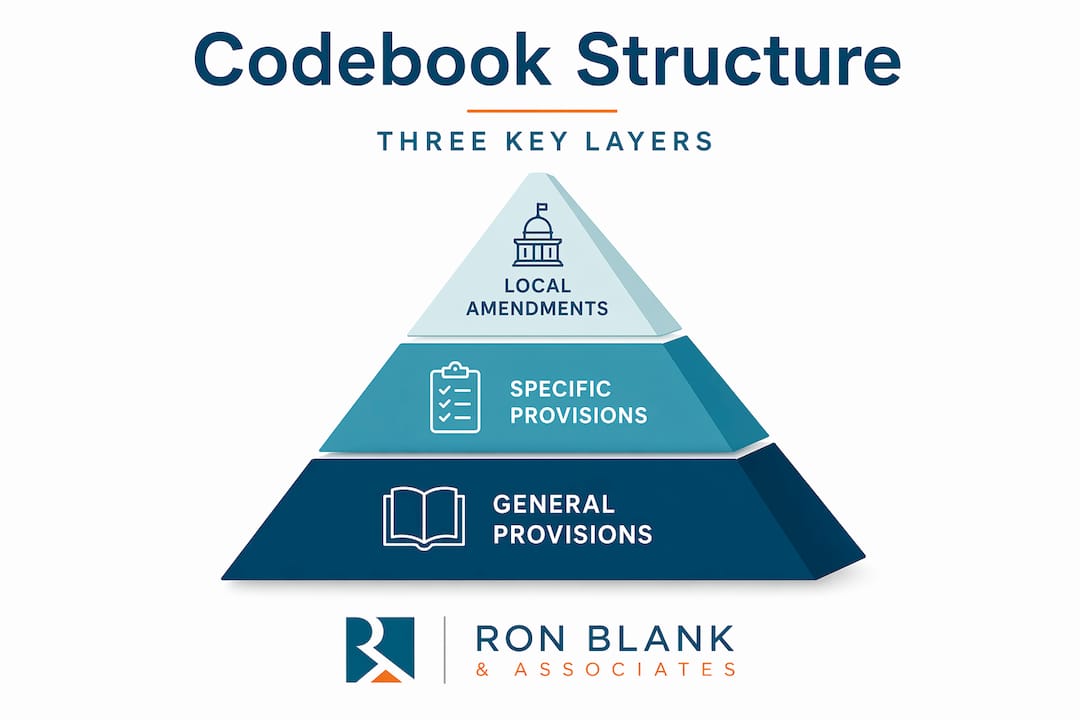
Understanding how citation types interact is critical. Here is a comparison to illustrate:
| Citation type | What it means | Compliance impact |
|---|---|---|
| Prescriptive requirement | Specifies exact materials, dimensions, or methods | Straightforward to verify; little design flexibility |
| Performance-based requirement | Defines the outcome or safety level to achieve | Requires engineering analysis and documentation |
| Exception clause | Permits deviation from a base rule under stated conditions | Must meet all conditions precisely or the exception is void |
| Cross-referenced standard | Incorporates a separate document by reference | Requires obtaining and reading that additional document |
| Local amendment | Jurisdiction-specific modification to model code text | Can override any of the above; always check first |
Use this step-by-step framework when mapping a project requirement to the code:
- Identify the occupancy classification and construction type for your project
- Locate the general chapter that governs the system or element in question
- Read the base rule completely before looking for exceptions
- Check for specific provisions that apply to your occupancy or construction type
- Trace every cross-reference to its source document and read it in full
- Check the jurisdiction’s amendment list for any modifications to that section
- Document your interpretation pathway so you can defend it at plan review
Pro Tip: Keep a printed or digital copy of the jurisdiction’s local amendment document open alongside the model code. Amendments are rarely labeled in the model code text itself, so it is easy to miss them if you are not actively looking.
Code compliance in action: The enforcement process explained
Knowing the structure of the code is one thing. Navigating the enforcement process is another, and both skills are necessary for smooth project delivery. The compliance lifecycle follows a predictable sequence, but each stage has specific documentation and readiness requirements that teams must prepare for in advance.

| Project stage | Key compliance checkpoint | Responsible party |
|---|---|---|
| Pre-design | Confirm adopted code edition and local amendments | Architect/Engineer of Record |
| Permit application | Submit drawings for plan review | Architect with permit expediter |
| Site preparation | Verify geotechnical conditions meet code | Geotechnical engineer |
| Foundation work | Foundation inspection before pour | General contractor, inspector |
| Framing/rough-in | Rough structural and MEP inspection | GC, subcontractors, inspector |
| Insulation/enclosure | Insulation inspection before close-in | GC, inspector |
| System testing | Mechanical, electrical, fire alarm testing | Subcontractors, commissioning agent |
| Certificate of occupancy | Final inspection and punchlist clearance | Owner, GC, inspector |
When preparing for each inspection, work through this checklist:
- Confirm the inspection scope with the Authority Having Jurisdiction (AHJ) before scheduling
- Have the approved permit drawings on-site and accessible to the inspector
- Stage any required test reports, product data sheets, and installation records
- Walk the inspection area in advance to identify any conditions that deviate from drawings
- Assign a knowledgeable site representative who can answer technical questions in real time
Pro Tip: Do not wait for the inspector to find a question. Proactively document your compliance pathways at each milestone, including photographs, test results, and written interpretations. This record reduces rework risk and gives you a defensible paper trail if a dispute arises.
The milestones in code compliance are not bureaucratic formalities. They are checkpoints that, when handled correctly, protect both the project and the professional license of every team member involved.
Edge cases and exceptions: Navigating complex compliance scenarios
Edge cases are where projects live or die at inspection. Even experienced teams get caught by them, and the reason is almost always the same: someone read the base rule, confirmed it applied, and stopped there without checking whether an exception, a cross-reference, or a local interpretation changed the outcome.
Common edge cases in construction code compliance include:
- Life-safety pathway survivability: Requirements under the IBC and NFPA 72 affect how fire alarm and emergency voice systems are routed; life-safety pathway survivability is a nuanced area where code provisions can drive specific engineering design choices that are not obvious from a surface reading
- Duct penetrations in rated assemblies: Whether a duct penetration through a fire-rated horizontal assembly requires a damper, a firestop, or qualifies for an exception depends on conditions that ICC clarifies for duct penetrations in a way that often surprises even seasoned MEP engineers
- Egress path exceptions: Occupancy-specific exceptions to egress path geometry or travel distances can void the general rule entirely, but they come with precise triggering conditions
- Accessible route exceptions: Alterations and additions in existing buildings carry a different set of accessibility requirements than new construction, and the exceptions are not always intuitive
- Energy code compliance tradeoffs: Using a whole-building performance path under ASHRAE 90.1 instead of the prescriptive path introduces documentation requirements that many teams underestimate
“On a mid-rise office renovation project, our team applied what we believed was a valid duct penetration exception through a rated floor-ceiling assembly. The exception was real; we had read the code correctly. But the local amendment required a specific firestop product test classification that our installed assembly did not meet. The inspector caught it at rough-in. Three weeks of rework followed, all because we had verified the model code and stopped short of checking the amendment list.”
The resolution in complex cases almost always involves direct communication with the AHJ. Requesting a formal interpretation in writing, with your specific conditions documented, creates a record that protects the project and clarifies the path forward. Never rely on a verbal agreement with an inspector for an edge case. Get it in writing.
The future of code compliance: Digital tools and evolving approaches
The construction industry is making genuine progress in applying technology to code compliance, and the tools are becoming harder to ignore. BIM-integrated code-checking platforms can flag potential violations automatically as models are developed, reducing the chance that a non-compliant condition makes it all the way to plan review. But the technology has real limitations, and understanding them prevents over-reliance on automation.
Automating regulatory compliance through BIM-integrated systems faces a core challenge: translating ambiguous and frequently updated regulatory text into machine-interpretable logic. Translating that text into rules a software system can apply requires a series of human judgment calls, and those judgments need to be revisited every time the code is updated.
Here is what that process looks like in practice:
- Extract the code text for a specific provision and break it into discrete logical conditions
- Define the data attributes in the BIM model that correspond to each condition
- Write the rule logic in the checking software and validate it against known examples
- Test the rule against a range of edge cases, including exception conditions
- Update the rule whenever the code edition changes or a local amendment is issued
The prescriptive versus performance-based divide matters here too. Prescriptive rules are relatively straightforward to automate because the conditions are specific. Performance-based requirements are much harder to encode because they require engineering judgment, analysis, and documentation that software cannot fully replicate.
Pro Tip: If your firm is adopting digital code-checking tools, assign a dedicated person to track code edition updates and maintain the rule sets. The software is only as current as the rules it runs, and outdated logic can create a false sense of security that is worse than no automation at all.
Human expertise remains the backbone of compliant project delivery. Technology is a powerful support tool, but the professional judgment to recognize when a rule has been correctly applied, when an exception actually fits, and when to escalate a question to the AHJ is not something software replaces.
What most guides miss about mastering construction codes
Here is something we have seen repeatedly across many projects and continuing education courses: most compliance failures do not happen because a professional did not know the rule. They happen because someone treated code reading as a one-time task instead of an iterative process.
The pattern goes like this. You identify the applicable section, confirm the base rule applies, check the obvious exceptions, and move forward. What gets missed is the second and third pass, where you trace the cross-references that the cross-references point to, where you check whether a referenced standard was updated since the current code edition was adopted, and where you look for the specific provision that quietly overrides the general rule you were relying on.
Anticipating exceptions is as vital as knowing the rules. That is not a soft suggestion. It is the practical lesson that edge cases in code compliance almost always teach the hard way, when real-world geometry, system routing, and occupancy conditions collide with provisions that were written for a different scenario.
We have also seen over-reliance on automation create blind spots. A digital checker that runs clean does not mean the project is compliant. It means the project complies with the rules the software was programmed to check, as of the last time someone updated those rules. That is a meaningfully smaller statement than most teams realize.
“Anticipating exceptions is as vital as knowing the rules.”
Pro Tip: For any complex interpretation or edge case, request a written clarification from the code official before finalizing the design. File that document with your project records. If a compliance question surfaces later, that written response is your most valuable protection.
The professionals who navigate codes most confidently are not the ones who have memorized the most rules. They are the ones who have built a consistent, disciplined process for reading codes iteratively, documenting their interpretation pathways, and asking the right questions early.
How Ron Blank & Associates helps you stay ahead on code compliance
Staying current with construction codes is not a passive process. Codes update on three-year cycles at the model level, local jurisdictions amend them on their own schedules, and new referenced standards emerge regularly. Keeping your knowledge sharp enough to stay compliant across all of it takes structured, ongoing education.

Ron Blank & Associates offers continuing education and compliance support designed specifically for architects, engineers, interior designers, and contractors who need to go deeper than a surface reading of the codebook. Our AIA-registered courses cover code interpretation, enforcement processes, edge cases, and the evolving role of digital compliance tools, delivered as online courses, webinars, podcasts, and face-to-face sessions. Whether you are working toward license renewal hours or building the code fluency your team needs to deliver complex projects with confidence, we are here to support that growth.
Frequently asked questions
What is the difference between prescriptive and performance-based building codes?
Prescriptive codes specify exact methods and materials, while performance-based codes define safety outcomes that must be achieved, allowing more design flexibility but requiring more engineering analysis and documentation to demonstrate compliance.
Who enforces construction code compliance during a project?
Licensed building officials enforce code compliance, primarily through milestone inspections that occur at defined stages before, during, and after construction, verifying that work matches the adopted code edition and any local amendments.
How do local amendments affect building code interpretation?
Local amendments can override or modify model code requirements, so always check jurisdiction-specific rules before finalizing your documentation, since code books function as interconnected systems where specific provisions and local modifications can supersede the general rules.
Can digital tools fully automate code compliance checks?
Digital tools help identify potential violations early, but automating regulatory compliance faces real limitations because ambiguous code language and frequent updates require ongoing human judgment to translate into accurate machine-readable rules.
What are common pitfalls in construction code compliance?
Professionals most often miss exceptions, cross-references, or local amendments, and edge cases in code compliance involving real-world system routing, penetrations, and egress conditions are where these oversights most frequently lead to inspection failures and costly rework.