

Managing the demands of professional credentials can leave architects and interior designers searching for reliable, flexible solutions. With compliance rules evolving and project requirements changing, continuing education credits are more important than ever. Online courses make it easier to stay current, offering immediate documentation, specialized content, and convenient access. This article explores how digital platforms help design professionals streamline credit acquisition, minimize mistakes, and meet American Institute of Architects and Interior Design Continuing Education Council requirements efficiently.
Table of Contents
- Online Learning For Continuing Education Credits
- Types Of Online Courses For AIA Compliance
- How Online Learning Platforms Work
- Requirements For Earning AIA And IDCEC Credits
- Risks, Responsibilities, And Compliance Issues
- Mistakes To Avoid In Online Continuing Education
Key Takeaways
| Point | Details |
| Importance of Online Learning | Online platforms provide flexible, cost-effective options for architects and designers to earn required continuing education credits. |
| Course Types for Compliance | Diverse online courses cover essential topics, such as sustainability, technical skills, and professional practice management, tailored to AIA requirements. |
| Compliance Necessity | Adhering to AIA and IDCEC guidelines is crucial; non-compliance can lead to severe professional consequences, including license suspension. |
| Documentation Best Practices | Professionals should meticulously document course completions and maintain organized records to simplify tracking and reporting. |
Online learning for continuing education credits
Architects and interior design professionals face increasing pressure to maintain their credentials through ongoing education. Continuing education credits have become a critical component of professional development, ensuring practitioners stay current with evolving industry standards, technological advancements, and regulatory requirements.
Online learning platforms have revolutionized how design professionals acquire these mandatory credits. These digital education solutions offer several compelling advantages:
- Flexibility to complete courses at your own pace
- Access to specialized training from industry experts
- Cost-effective alternative to in-person seminars
- 24/7 availability of learning materials
- Immediate documentation and tracking of completed credits
The American Institute of Architects (AIA) has increasingly recognized online learning as a legitimate and valuable method for meeting continuing education requirements. Professional development resources now include comprehensive digital courses covering critical topics like sustainable design, building technologies, and legal compliance.
Most online learning platforms for AIA credits follow a standardized format. Participants typically complete interactive modules, pass assessment quizzes, and receive immediate credit documentation. These courses often provide detailed breakdowns of learning objectives, allowing architects to strategically select programs that align with their specific professional development needs.
Pro tip: Always verify that your online continuing education courses are pre-approved by the AIA to ensure they count toward your professional licensing requirements.
Types of online courses for AIA compliance
Architects seeking to maintain their professional credentials have access to a diverse range of online learning optionsdesigned specifically to meet AIA continuing education requirements. AIA courses offer comprehensive programs that address multiple professional development needs across various specializations.
The primary categories of online courses for AIA compliance typically include:
- Sustainability and Climate Action
- Green building design principles
- Energy efficiency strategies
- Sustainable material selection
- Technical Skills Development
- Building information modeling (BIM)
- Emerging architectural technologies
- Construction documentation techniques
- Professional Practice Management
- Business development strategies
- Legal and ethical practice guidelines
- Project management methodologies
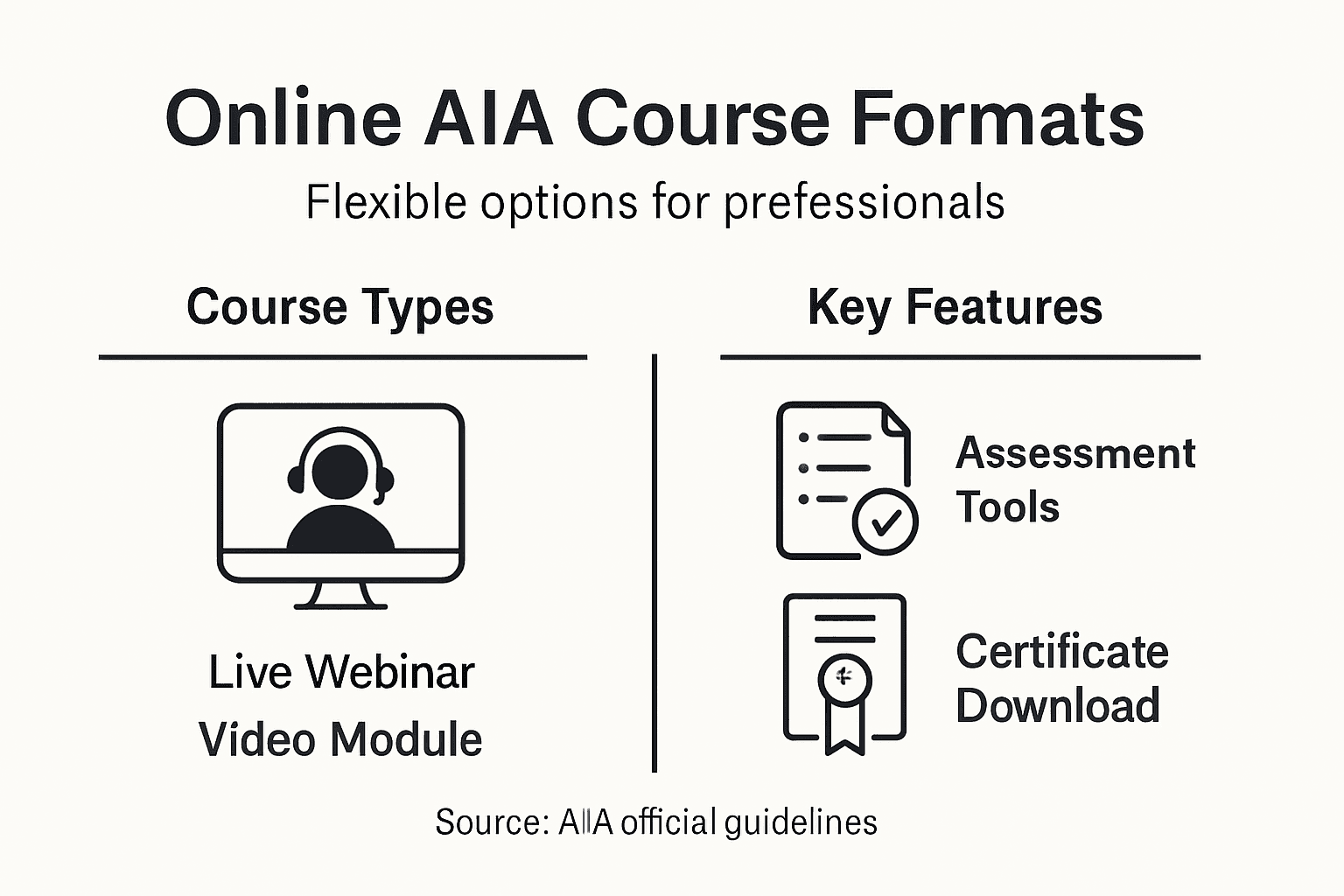
Most online courses provide flexible learning formats, including live webinars, pre-recorded video modules, and interactive digital workshops. Architects can select courses that precisely match their professional interests and credit requirements, ensuring a targeted approach to continuing education.
Interactive assessment tools and immediate credit documentation make these online platforms particularly attractive for busy professionals. Participants can typically complete courses at their own pace, track their progress, and receive instant verification of completed continuing education units.

Pro tip: Always download and save your course completion certificates immediately after finishing an online AIA-approved course to maintain accurate professional development records.
How online learning platforms work
Online learning platforms for architects have developed sophisticated systems to streamline continuing education credit acquisition. Continuing education credit platforms have transformed the traditional approach to professional development, making the process more accessible and user-friendly.
The typical workflow for online learning platforms involves several key stages:
- User Registration
- Create a professional profile
- Verify architectural credentials
- Select preferred learning formats
- Course Selection
- Browse AIA-approved course catalogs
- Filter courses by credit type and specialty
- Review course descriptions and learning objectives
- Learning Engagement
- Access interactive course modules
- Complete video lectures and reading materials
- Participate in digital assessments
Most platforms incorporate advanced tracking technologies that automatically document a professional’s learning progress. These systems generate comprehensive reports, allowing architects to monitor their continuing education credits in real-time and ensuring they meet AIA compliance requirements.
Interactive features like progress tracking, mobile compatibility, and instant certification make these platforms incredibly attractive to busy design professionals. Participants can learn at their own pace, access materials from multiple devices, and receive immediate verification of completed coursework.
Pro tip: Schedule dedicated time each quarter to review your continuing education credits and plan upcoming courses to maintain consistent professional development.
Requirements for earning AIA and IDCEC credits
Professional architects and interior designers must navigate specific continuing education requirements to maintain their professional credentials and stay current with industry standards. While the American Institute of Architects (AIA) and the Interior Design Continuing Education Council (IDCEC) have distinct guidelines, they share fundamental principles for earning professional development credits.
The core requirements for earning AIA and IDCEC credits typically include:
- Documentation Standards
- Maintain accurate records of completed courses
- Keep digital or physical certificates of completion
- Track credit hours across different categories
- Credit Hour Specifications
- AIA requires 18 continuing education hours annually
- IDCEC mandates 10 or more continuing education units per reporting period
- Credits must be from approved educational providers
- Content Qualification Criteria
- Courses must relate directly to professional practice
- Learning materials should enhance design, technical, or professional skills
- Programs must be developed by recognized industry experts
Most professional organizations require participants to complete courses through accredited learning platforms. These platforms ensure that the educational content meets rigorous professional development standards, covering critical areas like sustainable design, building technologies, ethical practices, and emerging industry trends.
Architects and interior designers must be proactive in understanding their specific credentialing board’s requirements. While AIA and IDCEC share similar frameworks, individual state licensing boards may have additional or unique continuing education mandates that professionals must carefully track and fulfill.
Here’s a quick comparison of AIA and IDCEC credit requirements for professionals:
| Organization | Annual Credit Requirement | Approved Providers Only | Primary Focus Areas |
| AIA | 18 hours per year | Yes | Architecture, ethics, safety |
| IDCEC | 10 units | Yes | Interior design, technology, compliance |
Pro tip: Create a dedicated digital folder to store all continuing education certificates and maintain a spreadsheet tracking your completed credits to simplify annual reporting requirements.
Risks, responsibilities, and compliance issues
Navigating the complex landscape of continuing education requires architects and interior designers to understand the potential risks and professional responsibilities associated with maintaining their credentials. Failure to comply with AIA and IDCEC requirements can result in significant professional consequences that extend beyond simple credit reporting.
Key compliance risks for design professionals include:
- Licensing Implications
- Potential suspension of professional license
- Inability to practice or bid on projects
- Financial penalties for non-compliance
- Documentation Vulnerabilities
- Incomplete or inaccurate credit tracking
- Missed reporting deadlines
- Insufficient documentation of completed courses
- Professional Reputation Risks
- Loss of professional credibility
- Reduced client trust
- Potential negative impact on future career opportunities
Professionals must maintain meticulous records and proactively manage their continuing education requirements. This involves not just completing courses, but carefully documenting each learning experience, verifying the accreditation of educational providers, and ensuring that all completed coursework meets the specific standards set by AIA, IDCEC, and individual state licensing boards.
The consequences of non-compliance can be severe, potentially jeopardizing an entire professional career. Some state licensing boards may impose significant fines, require mandatory additional training, or even suspend professional credentials for repeated or significant compliance failures.
The following table outlines risks of non-compliance and their impacts on professionals:
| Risk Type | Example Consequence | Potential Career Impact |
| Licensing | License suspension or loss | Ineligible for projects |
| Documentation | Missed reporting deadline | Administrative penalties |
| Reputation | Loss of client trust | Reduced career advancement |
Pro tip: Conduct a quarterly audit of your continuing education credits and create a detailed tracking system that flags potential compliance gaps at least 60 days before your reporting deadline.
Mistakes to avoid in online continuing education
Design professionals must navigate online continuing education carefully to maintain their professional credentials. AIA continuing education guidelines highlight several critical mistakes that can compromise credit acquisition and professional standing.
Common pitfalls in online continuing education include:
- Procrastination Traps
- Waiting until the last minute to complete credits
- Rushing through course materials
- Failing to plan for credit requirements
- Documentation Errors
- Incomplete record-keeping
- Not saving course completion certificates
- Misunderstanding credit type requirements
- Course Selection Mistakes
- Choosing non-approved educational providers
- Overlooking specific licensing board requirements
- Neglecting to verify course accreditation
Credit type misunderstandings can significantly impact a professional’s ability to meet continuing education requirements. Many architects and interior designers fail to distinguish between Health, Safety, and Welfare (HSW) credits and general elective credits, potentially leaving gaps in their professional development documentation.
Technological challenges can also derail online learning efforts. Professionals must ensure stable internet connections, compatible devices, and adequate time for course completion. Technical difficulties or incomplete course modules can result in lost credits and additional administrative burdens.
Pro tip: Create a dedicated digital folder with subfolders for each reporting period, immediately saving and organizing course certificates as soon as you complete them to prevent last-minute documentation stress.
Elevate Your Architecture Career with Trusted Online Continuing Education
The challenge of meeting AIA continuing education requirements while balancing a demanding practice can feel overwhelming. Staying compliant means keeping thorough records, selecting only AIA-approved courses, and earning credits in critical areas like Health, Safety, and Welfare. At Ron Blank & Associates, we understand these pain points and provide expertly designed online courses, webinars, and podcasts that fit your busy schedule. Our programs are fully registered with the American Institute of Architects and tailored to help you maintain your professional credentials with confidence.

Discover how our flexible learning solutions simplify credit tracking and ensure you avoid compliance pitfalls. Take control of your continuing education today by exploring our comprehensive offerings at Ron Blank & Associates. Empower your professional growth with courses that deliver immediate documentation and the expertise you need to advance your career without unnecessary stress.
Frequently Asked Questions
What are continuing education credits and why are they important for architects?
Continuing education credits are mandatory units that architects must earn through professional development courses to maintain their credentials. They ensure that architects stay current with industry standards, technological advancements, and regulatory requirements.
How can online learning help architects meet their continuing education requirements?
Online learning offers flexibility, enabling architects to complete courses at their own pace. It also provides access to specialized training and immediate tracking of completed credits, making it an ideal solution for busy professionals.
What types of online courses are available for AIA compliance?
Online courses for AIA compliance typically cover various categories, including sustainability and climate action, technical skills development, and professional practice management, allowing architects to choose programs that align with their specific needs.
What should architects consider when selecting online courses for continuing education?
Architects should verify that online courses are pre-approved by the AIA, ensure the courses relate directly to their professional practice, and keep accurate records of their completed courses to avoid documentation errors.