

TL;DR:
- Architects are involved throughout all construction phases, from pre-design to construction administration.
- Their role in construction is to observe conformance, review submittals, not supervise or guarantee work.
- Understanding contract scope, liability limits, and delivery methods is essential for managing risk and professional success.
Architects are far more than the people who sketch beautiful buildings on paper. That image, while flattering, is dangerously incomplete. From the earliest pre-design conversations through the final punch list, architects carry legal, contractual, and creative responsibilities that shape every outcome on a project. Misunderstanding where that role begins and ends creates real risk, both for the architect and for the project team. Whether you are pursuing AIA continuing education credits, working on project specifications, or simply trying to understand how architects fit into the construction process, this guide gives you a clear, honest picture of what architects actually do.
Table of Contents
- Breaking down the architect’s role across construction phases
- Construction administration: Duties, boundaries, and legal nuances
- Product specification and material selection: Architects’ critical influence
- Delivery methods and how they reshape the architect’s authority
- Liabilities, limitations, and mitigating risk as an architect
- Why understanding the architect’s true role is more critical than ever
- Advance your architectural expertise with AIA learning opportunities
- Frequently asked questions
Key Takeaways
| Point | Details |
|---|---|
| Each project phase matters | Understanding your responsibilities in every phase helps protect your license and your firm. |
| Construction admin is limited | Architects observe for conformance but do not direct the contractor’s methods or guarantee workmanship. |
| Specification shapes outcomes | Thoughtful product choices by architects influence sustainability, safety, and compliance. |
| Project delivery method shifts authority | Design-build can reduce the architect’s authority and increase governance risks compared to traditional models. |
| Manage liability proactively | Use clear contracts, periodic inspections, and up-to-date education to sharply limit your professional risk. |
Breaking down the architect’s role across construction phases
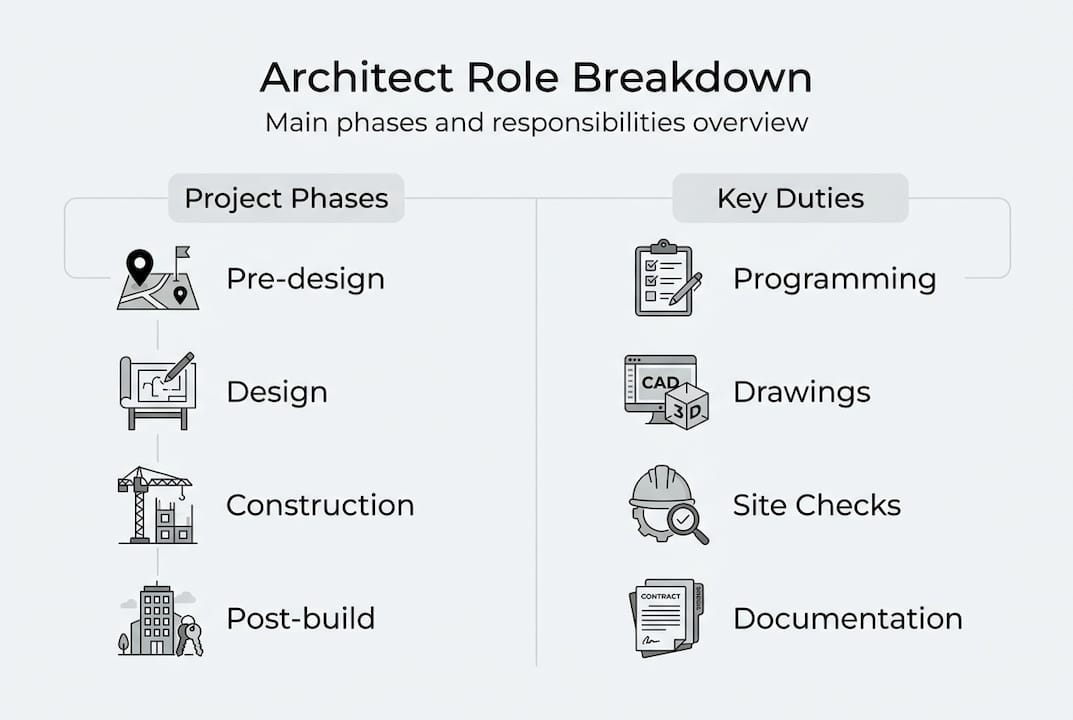
With those misconceptions in mind, let’s break down the architect’s step-by-step involvement throughout a typical construction project. Architects provide services across phases including pre-design, schematic design, design development, construction documents, bidding and negotiation, and construction administration. That is a wide arc of responsibility, and the level of involvement shifts significantly from one phase to the next.
Here is a quick look at each phase and the architect’s primary focus:
- Pre-design: Site analysis, programming, feasibility studies, and establishing project goals with the client
- Schematic design: Early concept drawings, massing studies, and initial code review
- Design development: Refining the design, coordinating with engineers, and developing material selections
- Construction documents: Producing detailed drawings and specifications that contractors will use to build
- Procurement (bidding/negotiation): Assisting with contractor selection, answering bidder questions, and reviewing bids
- Construction administration: Observing the work, reviewing submittals, responding to RFIs, and interpreting contract documents
The architect’s influence is highest during design development and construction documents, where decisions lock in cost, performance, and compliance. During construction administration, the role shifts to oversight and interpretation rather than direct control. Understanding AIA contract phases helps clarify what is expected at each stage and protects all parties from scope creep or misaligned expectations.
| Phase | Architect’s primary role | Client interaction level |
|---|---|---|
| Pre-design | Programming and feasibility | High |
| Schematic design | Concept development | High |
| Design development | Coordination and refinement | Moderate |
| Construction documents | Technical production | Low to moderate |
| Procurement | Bid support | Moderate |
| Construction administration | Observation and interpretation | Low |
Pro Tip: Keep detailed records at each phase, including meeting notes, submittal logs, and site visit reports. This documentation is your best defense in a liability dispute and can also support AIA credit documentation for continuing education requirements.
Construction administration: Duties, boundaries, and legal nuances
Now that you understand the broader phases, let’s focus on what actually happens once ground is broken. Construction administration is probably the most misunderstood phase of the architect’s work, and getting it wrong can have serious legal consequences.

During this phase, architects administer contracts, conduct site visits to check for conformance with the design documents, review submittals and shop drawings, and respond to requests for information from the contractor. These are specific, defined duties. What architects do not do is equally important to understand.
Here is what falls outside the architect’s scope during construction:
- Supervising contractor means, methods, sequences, or safety programs
- Directing workers on the jobsite
- Guaranteeing the contractor’s workmanship or schedule
- Performing continuous, full-time inspection of all work
As the AIA B101 standard agreement makes clear, architects conduct site visits for conformance, review submittals and RFIs, but do not supervise means and methods or guarantee workmanship. That language matters. It draws a firm line between the architect’s professional responsibility and the contractor’s operational control.
“The architect’s role during construction is one of periodic observation, not continuous supervision. This distinction is not a loophole. It reflects the reality that contractors are the experts in how to build, while architects are the experts in what to build.”
Misreading this boundary is where many project disputes begin. Owners sometimes expect architects to catch every defect. Contractors sometimes assume the architect’s approval of a submittal means the design is being changed. Neither assumption is correct. Periodic visual inspections create liability only for patent defects, meaning visible problems that a qualified professional should have caught. Latent defects hidden inside walls or below grade are a different matter entirely.
Product specification and material selection: Architects’ critical influence
With clear admin boundaries established, another powerful area of impact is how architects select and specify project materials. This is where the architect’s decisions ripple outward in ways that affect building performance, sustainability goals, and long-term cost.
Architects specify products and materials and are central to research, evaluation, and selection, influenced by sustainability, performance, and US manufacturing considerations. The specification process is not a quick decision. It follows a deliberate sequence:
- Identify performance requirements based on code, climate, and project goals
- Research available products and manufacturers that meet those requirements
- Evaluate products for sustainability credentials, such as LEED compliance or Environmental Product Declarations
- Confirm cost alignment with the project budget
- Write specifications that define acceptable products and substitution criteria
- Review submittals during construction to confirm the contractor is using specified materials
Here is a simplified comparison of how material choices play out across key criteria:
| Criteria | Standard material | Sustainable alternative |
|---|---|---|
| Upfront cost | Lower | Moderate to higher |
| Long-term performance | Variable | Often better |
| Code compliance | Meets minimum | Exceeds minimum |
| LEED contribution | Minimal | Significant |
| Maintenance burden | Moderate | Often lower |
The architect’s responsibility does not end at writing the spec. Reviewing specification best practices regularly helps ensure your documents reflect current code requirements and the latest product innovations from leading manufacturers.
Pro Tip: Build a living specification library that you update annually. As codes change and new products enter the market, outdated specs create compliance gaps and expose you to liability.
Delivery methods and how they reshape the architect’s authority
Beyond the design desk and jobsite, the delivery model you choose shapes the architect’s power and exposure. Not all projects follow the same structure, and the architect’s authority varies significantly depending on how the project is organized.
The main delivery methods include:
- Design-bid-build: The traditional model where the architect leads design, then a contractor is selected through competitive bidding. The architect maintains a direct relationship with the owner throughout.
- Design-build: The architect and contractor work under a single contract with the owner, often with the contractor in the lead role.
- Construction manager at risk (CMAR): A construction manager joins early in design, taking on cost and schedule risk while the architect retains design authority.
- Integrated project delivery (IPD): All major parties share risk and reward under a single multi-party agreement.
In design-build delivery, architects may have a subordinate role to the constructor, with real risks in governance and design integration. That shift is significant. When the contractor leads, the architect’s ability to make independent professional judgments can be constrained by cost and schedule pressures.
Here is a striking data point worth knowing: only 3.5% of project issues are design-related. The vast majority of problems stem from construction execution, coordination failures, or scope misalignment. Yet when architects are not in a position of authority, they can still absorb disproportionate blame. Understanding how delivery method affects your legal exposure is not optional. It is a core competency for any practicing architect today.
Liabilities, limitations, and mitigating risk as an architect
As project complexity and integration increase, understanding liability and ways to minimize risk is critical. Architects operate in a profession where the gap between what clients expect and what the law actually requires can be wide enough to drive a lawsuit through.
The major categories of liability architects face include:
- Design flaws: Errors or omissions in drawings and specifications that lead to construction problems or building failures
- Inspection limits: Failure to identify patent defects during periodic site visits that a reasonable architect should have caught
- Contractual exclusions: Scope items that were never formally excluded but that the client assumed were included
- Third-party claims: Injuries or damages to parties not in the direct contract, such as future occupants or neighboring property owners
Architects are liable only for patent defects visible in periodic inspections, not as guarantors of all construction quality. That is an important distinction. You are not an insurer of the project. You are a professional who applies reasonable care.
One concept that often surprises architects is contributory negligence. If a client ignores your recommendations, pushes you to cut corners, or interferes with your ability to perform proper site observations, their conduct can actually reduce or bar their own claims against you. Document every instance where your professional advice was overridden.
Pro Tip: Review your contract language carefully before signing. AIA construction contracts are designed to set reasonable role boundaries, but project-specific modifications can erode those protections. Always have legal counsel review significant amendments.
Why understanding the architect’s true role is more critical than ever
With liabilities and scope clarified, it is clear the progression of the architect’s role is more nuanced and more important than it first appears. We have seen a persistent myth in the industry: that architecture is primarily about design talent and creative vision. The reality is that the most effective architects today are as fluent in contract language as they are in building codes, and as comfortable discussing risk allocation as they are presenting design concepts.
The profession has evolved. Delivery methods are more complex. Owners are more litigious. Sustainability requirements are more demanding. And the consequences of misalignment between what the contract says and what the owner expects have never been more expensive. Architects who treat continuing education as a checkbox exercise are leaving themselves exposed. Those who genuinely invest in understanding phase-specific duties, contract administration, and liability management are building careers that hold up under pressure.
We believe the architects who thrive in the next decade will be the ones who treat legal and collaborative fluency as a core professional skill, not an afterthought. Design is the entry ticket. Contract mastery is what keeps you in the game.
Advance your architectural expertise with AIA learning opportunities
For architects and designers looking to master every project phase and fulfill AIA credits, continuing education is a powerful next step. Structured learning programs give you the frameworks, case studies, and contract insights that real-world projects demand, and they help you stay current as codes, delivery methods, and liability standards evolve.

At Ron Blank and Associates, we develop AIA-registered continuing education courses delivered as online courses, webinars, podcasts, and face-to-face programs. Whether you want to sharpen your understanding of construction administration, product specification, or risk management, our courses are designed to give you credit hours that actually build your professional capability. Explore our course catalog and take the next step in your architectural career today.
Frequently asked questions
What is the architect’s legal responsibility during construction?
The architect is responsible for periodic site inspections and contract administration, but not contractor means, methods, or overall workmanship. The architect observes for conformance, reviews submittals, and responds to RFIs within a defined professional scope.
How does the architect’s role change in design-build projects?
In design-build delivery, the architect may work under the constructor, with less authority and more governance risk than in traditional delivery models. This shift can limit the architect’s independent professional judgment.
Are architects liable for construction defects?
Architects are liable only for design-related flaws and for patent defects visible in periodic inspections, not for all construction defects. The contractor retains responsibility for means, methods, and workmanship.
Why is continuing education about the architect’s role important?
Keeping current with role definitions and contracts is essential for legal compliance and AIA certification. As delivery methods and liability standards evolve, structured education helps architects stay protected and effective.