

TL;DR:
- Universal design aims to create environments usable by all people without adaptation, beyond just those with disabilities.
- Implementing universal design early reduces costs and enhances inclusivity, benefiting diverse user groups and organizations financially.
Universal design is one of those concepts that most professionals think they understand until they try to apply it. The common assumption is that what is universal design really means is designing for people with disabilities. That framing is understandable, but it misses the point almost entirely. Universal design means usability by all people to the greatest extent possible, without adaptation or specialized modification. No separate entrance. No afterthought ramp. Just good design that works for everyone, from the start.
Table of Contents
- Key Takeaways
- What universal design actually means
- Why the benefits of universal design extend to everyone
- Examples of universal design in practice
- Challenges and misconceptions professionals face
- How to implement universal design from the start
- My take on where universal design really stands
- Continue your universal design education with Ronblank
- FAQ
Key Takeaways
| Point | Details |
|---|---|
| Universal design benefits everyone | Older adults, parents with strollers, and people with temporary injuries gain as much as users with disabilities. |
| Seven principles guide practice | Ronald Mace’s 1997 framework gives designers a concrete structure to evaluate and apply universal design. |
| Early integration saves money | Adding universal design features at the project outset adds less than 1% to costs versus costly retrofitting later. |
| Accessible design is not the same | Accessible design targets specific disabilities; universal design addresses all abilities and preferences from the beginning. |
| Inclusive design is expanding the model | Emerging frameworks now fold in race, gender identity, neurodiversity, and culture as equity considerations. |
What universal design actually means
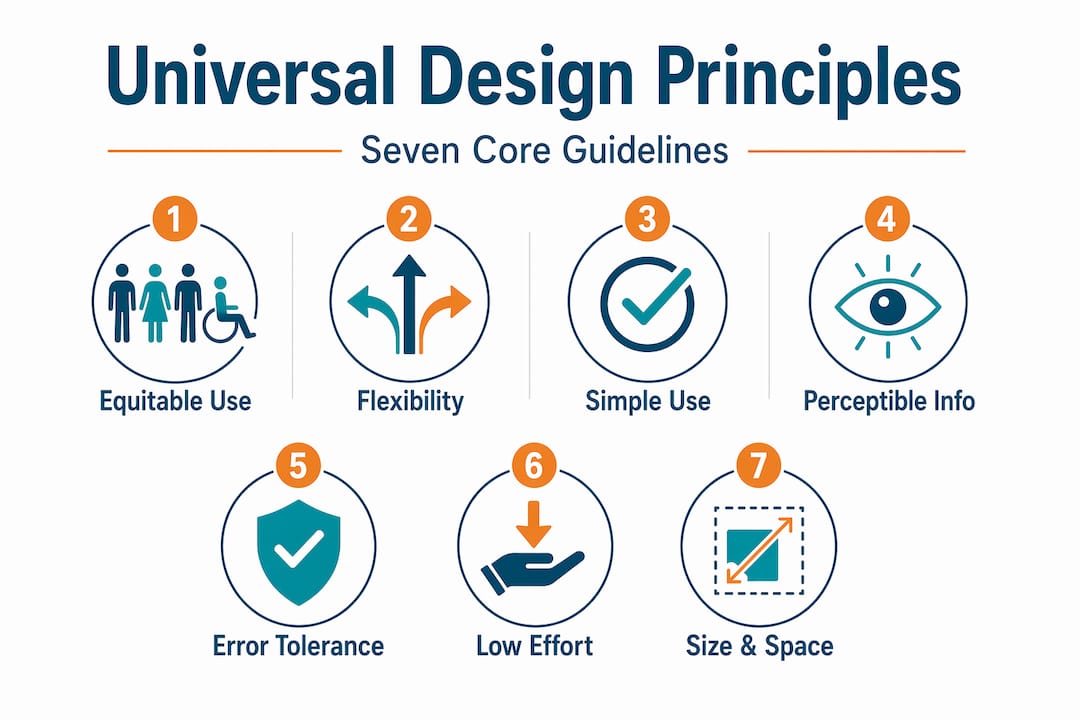
Ronald Mace, a wheelchair user and architect at North Carolina State University, coined universal design in 1988 and formalized it through seven guiding principles in 1997. His motivation was direct: he believed that good design should not require people to seek out a special version of a product or a building just to participate fully. The seven principles he developed remain the foundational framework for the field today.
Here is how those principles translate into professional practice:
- Equitable Use: The design works for people with diverse abilities. A single entrance usable by everyone, rather than a main door plus a side ramp, is the clearest architectural example.
- Flexibility in Use: The design accommodates a wide range of preferences and abilities. Scissors designed for both left-handed and right-handed users are a product-level classic.
- Simple and Intuitive Use: The design is easy to understand regardless of experience, literacy, or concentration. Think pictographic wayfinding in a hospital.
- Perceptible Information: The design communicates necessary information effectively, regardless of ambient conditions or the user’s sensory abilities.
- Tolerance for Error: The design minimizes hazards and adverse consequences of accidental or unintended actions.
- Low Physical Effort: The design allows efficient, comfortable use with minimal fatigue. Lever-style door handles instead of round knobs serve this principle directly.
- Size and Space for Approach and Use: Appropriate size and space is provided regardless of the user’s body size, posture, or mobility.
Pro Tip: When evaluating a design against these principles, work through each principle with a specific user persona in mind, not a generic one. A 70-year-old with early-stage arthritis and a parent pushing a stroller will reveal entirely different friction points in the same space.
One distinction worth making explicit: accessible design targets specific disabilities and typically responds to regulatory minimums like ADA compliance. Universal design starts earlier, designs more broadly, and treats inclusion as a design quality rather than a compliance checkbox.
Why the benefits of universal design extend to everyone
There is a useful exercise here. Picture the range of people who use a public library on a weekday morning. You will find older adults with varying mobility, parents with infants in carriers or strollers, college students with backpacks, construction workers stopping in on a break, and yes, people using wheelchairs or white canes. Universal design benefits all of these users, not just those with permanent disabilities.
That breadth translates directly into business value. Consider these realities:
- Organizations that prioritize accessibility retain 76% of customers with disabilities and avoid up to $6.9 billion in lost revenue annually.
- The disability market alone represents over $490 billion in disposable income in the United States, and that number grows substantially when you include family members and caregivers.
- Buildings and products designed for universal use report consistently higher user satisfaction scores across all user groups, not just those with specific needs.
“Universal design is about design intention to maximize usability, not a perfect solution for all competing needs.” — Colorado Virtual Library
The ethical case is equally strong. Designing spaces that exclude people based on ability is increasingly seen as a failure of professional responsibility, not just a compliance gap. And from a demographic standpoint, the numbers are stark. The U.S. population is aging at a significant rate, meaning that spaces designed with universal principles today will serve the same users more effectively as they age. Future-proofing is not abstract here. It is measurable.
Examples of universal design in practice
Seeing universal design principles in action across different domains makes the concept click in ways that theory alone cannot.
Universal design in architecture
The built environment offers the clearest and most consequential examples of universal design in architecture. Zero-step entrances, for instance, benefit wheelchair users but also benefit delivery drivers with hand trucks, travelers with rolling luggage, and anyone recovering from knee surgery. Lever handles and curb-less showers are similar: they originated as accessibility features and are now standard in aging-in-place design and luxury residential construction because they work beautifully for everyone.

Wider doorways (36 inches rather than the typical 32-inch minimum) are another straightforward example. They accommodate wheelchairs, yes, but also furniture movers, parents carrying sleeping children, and hospital staff pushing gurneys.
| Design feature | Primary accessibility benefit | Broader usability benefit |
|---|---|---|
| Zero-step entrance | Wheelchair and walker access | Strollers, luggage, hand trucks |
| Lever door handles | Reduced grip strength required | Easier use when hands are full |
| Curb-less shower | Mobility device access | Aging-in-place, aesthetic appeal |
| Wider doorways | Wheelchair clearance | Furniture, equipment, caregiving |
| Adjustable countertops | Seated user access | Multiple user heights in shared spaces |
Universal Design for Learning in education
The educational application of universal design is known as Universal Design for Learning, or UDL. Developed in the 1980s and now widely adopted in K-12 and higher education, UDL applies the same logic to curriculum and instruction that architects apply to buildings. Rather than designing a single method of instruction and then accommodating students who struggle with it, UDL asks educators to build multiple means of representation, expression, and engagement into the curriculum from the start.
A lecture supported by captions, visual diagrams, and hands-on activities is a UDL environment. It serves students with auditory processing differences, English language learners, and highly visual thinkers, along with every student who benefits from reinforcing ideas through multiple modalities.
Challenges and misconceptions professionals face
Even experienced practitioners run into honest difficulty with universal design. The most persistent challenge is the tension between genuinely conflicting user needs. A design that maximizes low physical effort (smooth floors, no thresholds) may create slip hazards for users with certain neurological conditions. A design optimized for users with low vision may overwhelm users with sensory sensitivities. Universal design addresses intention and process, not guaranteed outcomes for every user in every context.
The field is also grappling with a genuine evolution in scope. Emerging inclusive design frameworks now address race, culture, gender identity, neurodiversity, and socioeconomic factors as equity dimensions that traditional universal design frameworks did not explicitly name. The Alliance for Inclusive Design at NC State has been central to this shift, pushing the conversation from “usability for people with disabilities” toward “equity for all marginalized groups.”
Pro Tip: When you hit a conflict between competing user needs, document the trade-off explicitly in your project notes. Show the client or stakeholder that you considered both populations and made a reasoned decision. That transparency protects you professionally and builds trust.
A few misconceptions worth addressing directly:
- Universal design is not a checklist. ADA compliance is a checklist. Universal design is a design philosophy applied through professional judgment.
- Universal design does not require sacrificing aesthetics. The most successful universal design solutions are ones you cannot identify as accessibility features because they look and function like excellent design.
- Universal design is not only for public buildings. Residential architects, product designers, and interior designers all work in domains where these principles apply meaningfully.
How to implement universal design from the start
The single most important thing you can do to implement universal design effectively is to introduce it at the programming phase, not the construction documents phase. Retrofitting accessibility features costs 2 to 20 times more than integrating them from the outset, and the results are almost always inferior. A ramp added after the fact communicates that someone was an afterthought. A zero-step entrance designed in from the beginning communicates nothing except good architecture.
Here is a practical sequence for integrating universal design strategies into your project workflow:
- Conduct a user diversity audit at programming. Who will actually use this space? List the full range of ages, abilities, languages, and body types. Include temporary conditions like pregnancy, injury recovery, and fatigue.
- Map the seven principles to your project type. Not all principles carry equal weight in every project. A children’s museum and a corporate headquarters have very different priority profiles.
- Evaluate products and specifications through a universal design lens. When selecting hardware, fixtures, and finishes, ask manufacturers directly how their products perform across user abilities.
- Build universal design criteria into your scope of work. When working with contractors, be explicit about tolerances, clearances, and installation requirements that support your design intent.
- Test with real users when possible. Walkthroughs with people who have mobility, vision, or cognitive differences surface problems that no checklist will catch.
Every $1 invested in accessibility can yield up to $100 in value through better user experience and reduced risk. That is a business case most clients will not argue with when it is presented clearly.
Pro Tip: Frame universal design to skeptical clients as risk management, not altruism. Aging demographic trends, litigation exposure, and tenant retention data make a stronger initial argument than equity alone. Once the project is underway, the design quality speaks for itself.
My take on where universal design really stands
I have watched this field long enough to say this plainly: purely universal design remains aspirational. No single design solution works perfectly for every human being across the full range of ability, age, culture, and context. That is not a criticism of the framework. It is an honest acknowledgment of what design can and cannot do.
What I find genuinely encouraging is the shift toward intersectional and inclusive design thinking. The expansion of the NC State framework to address race, neurodiversity, and gender identity is not a distraction from universal design. It is a necessary maturation of the same core idea. You cannot design inclusively for some people while ignoring the lived experiences of others.
In my experience, the projects that get universal design right are the ones where the design team commits to it as a value, not a deliverable. That means asking harder questions during programming. It means pushing back on clients when cost-cutting removes features that matter. It also means being honest when a design falls short and documenting why. The advocacy dimension of this work is real, and it belongs inside the profession. Continuing education on universal design principles, the kind that goes beyond ADA minimums and into genuine usability thinking, is still one of the most underdeveloped areas in the AEC sector.
— Brad
Continue your universal design education with Ronblank
If you are serious about applying universal design principles in your practice, the next step is structured education that goes beyond code minimums. Ronblank develops AIA-registered continuing education courses specifically for architects, interior designers, engineers, and contractors who want to build genuine expertise in accessibility, usability, and inclusive design. The courses are available as online modules, webinars, podcasts, and face-to-face sessions, so you can learn in the format that fits your schedule.
Building product manufacturers also work with Ronblank to get their accessible and universal design products specified on real projects. Whether you are a design professional expanding your knowledge or a manufacturer looking to connect with specifiers, Ronblank has the tools and relationships to move your work forward. Explore the course catalog and get in touch with the team to see what fits your professional development goals.
FAQ
What is the official definition of universal design?
Universal design is defined as the design of products and environments to be usable by all people, to the greatest extent possible, without the need for adaptation or specialized design. The definition was established at North Carolina State University.
How is universal design different from accessible design?
Accessible design focuses on meeting minimum standards for users with specific disabilities, typically through regulatory compliance. Universal design addresses the full range of human ability and preference from the beginning of the design process, not as an add-on.
What are the seven principles of universal design?
The seven foundational principles are: Equitable Use, Flexibility in Use, Simple and Intuitive Use, Perceptible Information, Tolerance for Error, Low Physical Effort, and Size and Space for Approach and Use.
Does universal design cost more to implement?
When integrated early in the design process, universal design features typically add less than 1% to project costs. Retrofitting comparable features after construction can cost 2 to 20 times more, making early integration both the smarter and more affordable choice.
What is Universal Design for Learning?
Universal Design for Learning, or UDL, applies universal design principles to education by building multiple means of representation, expression, and engagement into curriculum design from the start, rather than modifying instruction after the fact for specific learners.