

Acoustics gets treated like a finish selection far too often — something to sort out after the walls go up. But for architects and interior designers working on commercial, institutional, or mixed-use projects, that habit is expensive. Poorly managed sound leads to costly retrofits, dissatisfied occupants, and spaces that simply do not perform the way they were intended. Whether you are designing an open-plan office, a school, a healthcare facility, or a restaurant, acoustic performance shapes how people experience a space every single day. This guide walks through core acoustic principles, key performance metrics, and practical design strategies you can apply from pre-design through project completion.
Table of Contents
-
Key acoustic phenomena: Absorption, reflection, and diffusion
-
An insider perspective: What most designers miss about interior acoustics
Why acoustics matter in interior environments
Interior acoustics is the science of controlling how sound behaves within a built environment. That includes how sound is generated, how it travels, how it is absorbed or reflected by surfaces, and how it ultimately reaches the listener. For design professionals, this is not an abstract science. It directly affects how well occupants can communicate, concentrate, rest, or heal, depending on the building type.
Acoustics affects occupant comfort, productivity, and regulatory compliance in ways that are increasingly hard to ignore. Building codes, wellness certification programs like WELL and LEED, and accessibility standards such as ADA are all pushing acoustic performance toward the foreground of design decisions, not the background.
The consequences of getting it wrong are visible in the most common project types:
-
Open offices: Lack of speech privacy leads to distraction and reduced concentration. Workers report frustration even in beautifully designed spaces.
-
Classrooms: Poor speech intelligibility means students, especially those with hearing impairments, miss critical information. ANSI S12.60 sets specific background noise and reverberation time standards for this reason.
-
Restaurants: A space that is too live (highly reflective) forces patrons to raise their voices, which compounds the problem. This is sometimes called the restaurant noise spiral.
-
Healthcare environments: Noise in hospitals is directly tied to patient recovery times and staff error rates. The stakes are not just comfort. They are clinical.
“The most common acoustic mistake is treating material selection as the starting point. Geometry, layout, and ceiling height are already shaping the acoustic outcome before a single finish is specified.”
That observation from experienced acoustic consultants carries real weight. Acoustic design is not a product decision. It is a spatial decision, and it begins the moment you start sketching floor plans. Every design team owes it to their clients to bring acoustics into the conversation at the earliest stages of the process, not as a retrofit plan after the fact.
Key acoustic phenomena: Absorption, reflection, and diffusion
To specify materials and design spaces that perform acoustically, you need a working understanding of three core phenomena: absorption, reflection, and diffusion. Each plays a distinct role in shaping how sound behaves in a room.
Absorption is the process by which materials convert sound energy into heat, reducing the amount of sound that remains in the space. The performance of an absorptive material is quantified by its absorption coefficient (α), which ranges from 0 (total reflection) to 1.0 or slightly above (near-total absorption). For specification purposes, the Noise Reduction Coefficient (NRC), measured per ASTM C423, averages the absorption coefficients at 250, 500, 1000, and 2000 Hz. High-NRC materials (0.70 to 0.95) are ideal for ceilings and walls where controlling reverberation is the priority. Mineral fiber ceiling tiles, fabric-wrapped panels, and wood acoustic panels all fall into this category.
Reflection occurs when sound energy bounces off a hard surface rather than being absorbed. Materials like concrete, glass, and gypsum board have very low absorption coefficients (often below 0.05 at mid-frequencies) and return most of the sound energy back into the room. Controlled reflection is not inherently bad. In auditoria and performance spaces, strategic early reflections can actually support clarity and warmth. In everyday commercial interiors, however, unchecked reflection creates echo and noise buildup that undermines both comfort and function.
Diffusion scatters sound energy in multiple directions rather than allowing it to concentrate or create a focused echo. Diffusive surfaces, such as angled walls, textured finishes, or purpose-built diffuser panels, create a more even distribution of sound energy throughout the space. This produces a sense of spaciousness and reduces the harsh flutter echoes common in rooms with parallel reflective walls.
Practical applications for each:
-
Absorption: Suspended ceiling panels, wall-mounted fabric panels, upholstered seating
-
Reflection: Polished concrete floors used intentionally in retail or gallery settings
-
Diffusion: Angled ceiling geometry, bookcase-style diffuser panels, irregular wall surfaces
Pro Tip: Target RT60 (reverberation time, or how long a sound takes to decay by 60 dB) by addressing ceiling absorption first. Covering 20 to 30 percent of the ceiling area with high-NRC material is often enough to bring a room into a functional acoustic range before any other interventions are needed.
Measurement standards and performance metrics
Specifying acoustic materials without understanding how performance is measured is like specifying glazing without knowing U-values. The numbers matter, and understanding how to read them gives you real leverage in design decisions and product conversations.
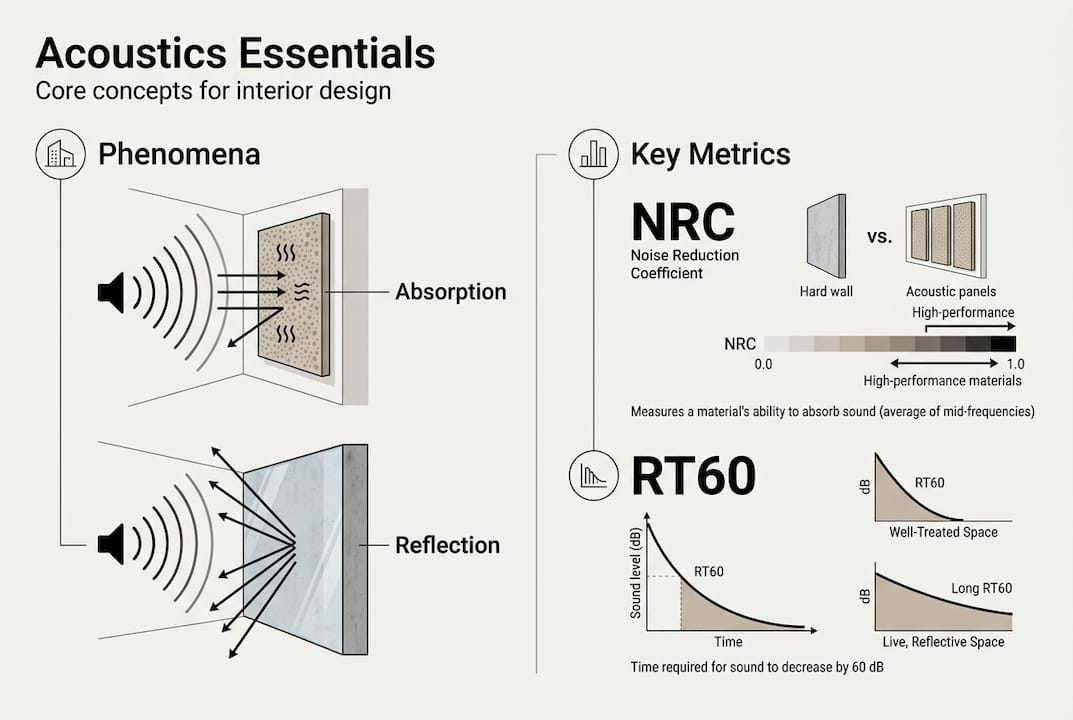
Design professionals measure absorption using NRC, evaluate completed spaces per ISO 3382-2, and determine RT60 targets based on the intended functional outcomes of each space type.
Here is a practical workflow for obtaining and interpreting performance data on a project:
-
Define the acoustic goal for each space type (e.g., speech intelligibility in a classroom, privacy in an open office).
-
Identify the RT60 target based on room use and occupancy patterns.
-
Calculate room volume and estimate required absorption area using the Sabine or Eyring equation.
-
Select materials with NRC ratings that match your calculated absorption needs.
-
Document manufacturer test data per ASTM C423 for specifications and submittals.
-
Conduct post-occupancy measurement using a calibrated sound source and measurement software to verify RT60 against target.
-
Adjust as needed, which may mean adding supplemental panels or modifying surface finishes in problem zones.
Post-construction verification is a step that too many project teams skip. Measured performance often differs from modeled performance, and catching the gap early saves significant cost and frustration.
Design strategies for effective interior acoustics
Once you understand the science and can read the metrics, the next challenge is translating that knowledge into design decisions that hold up in real projects. The good news is that most effective acoustic strategies are also good design strategies.
Here are proven best practices to build into your workflow:
-
Prioritize the ceiling plane first. It offers the largest continuous surface area and the greatest single-surface impact on RT60.
-
Coordinate acoustic elements with lighting and HVAC from the beginning. Suspended baffles and luminaires compete for the same ceiling zone.
-
Combine absorption and diffusion rather than relying on one mechanism alone. A room that is only absorptive can feel dead and fatiguing to work in.
-
Use zoning to manage acoustic differences within large open plans, separating collaborative areas from focus zones with strategic placement of absorptive partitions.
-
Address flanking paths, meaning sound that travels around, above, or below barriers rather than through them, especially in open-ceiling office designs.
Pro Tip: Always validate with post-occupancy measurements. A well-modeled acoustic plan is a starting point, not a guarantee. Field conditions, furniture placement, and occupancy patterns all influence the final acoustic result.
An insider perspective: What most designers miss about interior acoustics
Here is something we see across some projects: design teams treat acoustics as a compliance checkbox rather than a design driver. The conversation comes up at construction documents stage, a few panels get added to meet a target NRC, and everyone moves on. That approach technically satisfies the brief, but it leaves enormous value on the table.
The biggest missed opportunity is at the earliest stages. Room geometry, ceiling height, and massing decisions made during schematic design have more impact on acoustic outcomes than any material swap at construction documents. A room with parallel hard surfaces and a nine-foot ceiling is fighting itself acoustically before a single product is specified.
We also see an over-reliance on standard ceiling tile as the default acoustic solution. Tile has its place, but it tells the same story in every space. Designers who integrate acoustics from the beginning have room to create spaces that are both high-performing and memorable. That combination is what clients remember and what earns referrals.
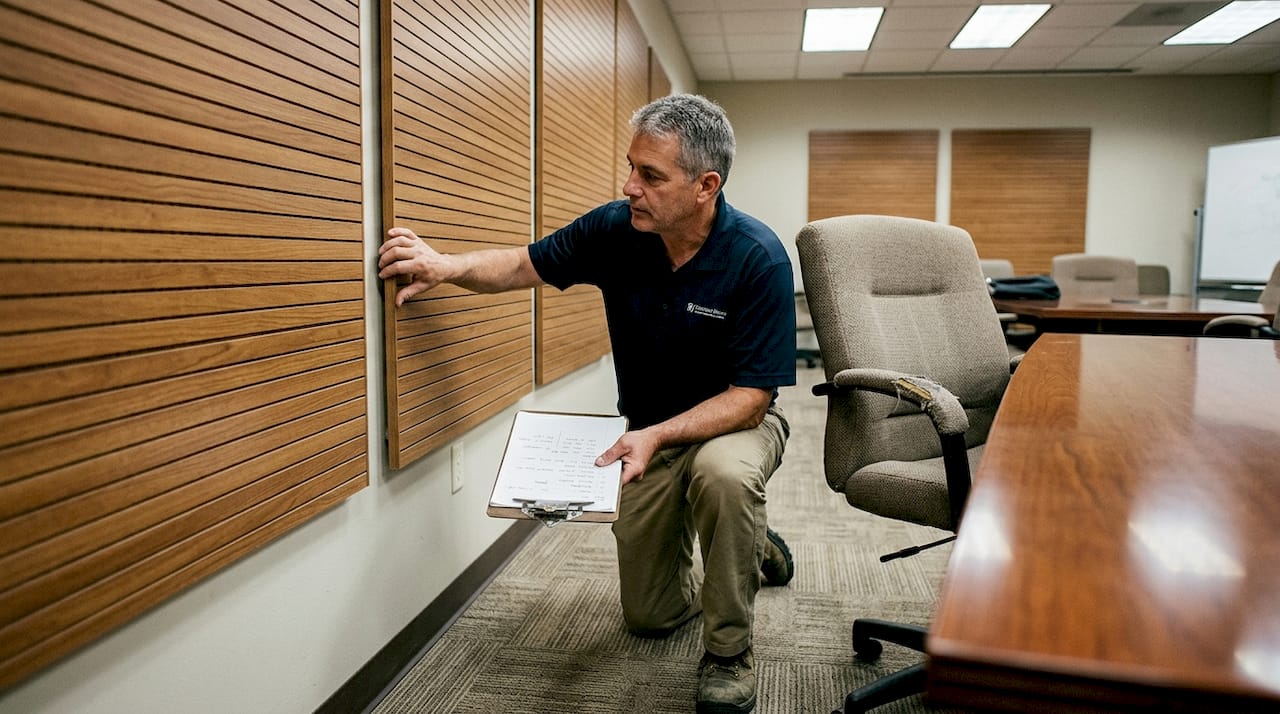
Post-occupancy surveys are the other piece most teams skip. Buildings change after occupancy. Furniture arrangements shift, uses evolve, and the acoustic environment shifts with them. Building a habit of checking in six months after occupancy is one of the most underused practices in the profession, and one of the most valuable.
Advance your expertise with professional resources
For designers ready to deepen their knowledge and earn CE credits, dedicated resources can make all the difference in how you apply acoustic principles across project types.

At Ron Blank and Associates, we offer acoustics continuing education courses registered with the American Institute of Architects, covering material science, measurement standards, and design application in formats that fit your schedule. Whether you prefer online courses, webinars, or face-to-face sessions, our programs are built for working professionals who need practical, applicable knowledge. Acoustic design is one of those disciplines where a structured learning path genuinely changes how you approach projects, and your clients will notice the difference.
Frequently asked questions
What is the NRC rating in acoustics and why does it matter?
NRC (Noise Reduction Coefficient) measures how well a material absorbs sound across mid-range frequencies, and it an important metric for comparing acoustic materials for ceilings and walls. Higher NRC values for panels (0.70 to 0.95) indicate stronger absorption and better noise and echo control in interior environments. SAA (Sound Absorption Average) has has been integrated in newer ASTM standards, and for more precise acoustic design, engineers often look at absorption coefficients per frequency band rather than a single averaged number.
How do you choose materials for interior acoustic control?
Select materials based on their NRC rating, their intended location (ceiling versus wall), and how they interact with both the acoustic goals and the visual character of the space. High NRC panels in the 0.70 to 0.95 range are typically ideal for walls and ceilings where reverberation control is the priority.
When should you start considering acoustics in the design process?
Acoustic planning should begin at the schematic design phase, not at construction documents. Early decisions about ceiling height, room geometry, and material palette shape the acoustic outcome far more than late-stage product substitutions. Balance absorption and diffusion early, starting with ceiling placement, for best results.
What standards or tests are relevant for interior acoustics?
The two most referenced standards in interior acoustic specification are ASTM C423, which measures material sound absorption and assigns NRC values, and ISO 3382-2, which governs room acoustics measurement including RT60. Familiarity with these noise mitigation standards is essential for specification work and post-occupancy verification.