

TL;DR:
- Podcasts offer flexible, in-depth learning that fits into architects’ busy schedules.
- Listening to approved podcasts can count toward official Continuing Education credits with proper documentation.
- They are a valuable tool for staying current with emerging trends, industry insights, and professional growth.
Most architects don’t need another reminder that Continuing Education requirements exist. You know the deadlines, you know the credit hours, and you’ve probably sat through at least one seminar that felt like it could have been an email. What’s changing fast is how those credits can be earned. Podcasts have quietly become one of the most flexible and genuinely useful tools for professional development in the AEC sector. Whether you’re commuting, managing a job site walkthrough, or squeezing in lunch between client meetings, audio learning meets you exactly where you are. This guide breaks down why podcasts are worth your attention, how they translate into official CE credits, and how to use them strategically.
Table of Contents
- Why podcasts matter for architects’ learning and professional growth
- How podcasts earn you Continuing Education credits
- Staying updated: Using podcasts for emerging trends and industry insights
- Maximizing podcast learning: Tips for effective integration into your professional life
- Our perspective: What most architects overlook about learning through podcasts
- Explore more Continuing Education options through Ron Blank & Associates
- Frequently asked questions
Key Takeaways
| Point | Details |
|---|---|
| Flexible learning | Podcasts allow architects to earn CE credits and learn on their schedule. |
| Latest industry trends | Podcasts keep you updated on the newest advances in architecture and design. |
| Easy CE credit integration | Many podcasts are recognized for Continuing Education—just track your participation. |
| Practical application tips | Strategic use of podcasts can improve project outcomes and career growth. |
Why podcasts matter for architects’ learning and professional growth
The idea that serious professional learning requires a conference room and a PowerPoint deck is fading fast. Podcasts have grown dramatically as a professional learning resource for architects, and it’s not hard to understand why. The format fits the reality of how architects actually live and work.
On-demand audio means you control the schedule. A 45-minute podcast episode can cover topics like passive house design, evolving ADA compliance, or mass timber structural systems with the same depth you’d get from a formal lunch-and-learn. The difference is that you can listen at 6 a.m. on a run, or replay a section three times until a technical concept clicks.
Key advantages architects cite for podcast-based learning:
- Flexible timing: listen during commutes, site visits, or downtime
- Wide topic range: from building codes to business development
- Access to practitioners and thought leaders who rarely present at regional conferences
- No travel costs or scheduling conflicts
- Episodes are archived, so you can revisit content when it becomes relevant to a project
Audio learning also reinforces critical thinking in a way that passive slide-watching often doesn’t. When you’re listening without visual distractions, your brain works harder to organize and retain the information. Many architects report that concepts discussed in podcast format stick longer than material covered in traditional seminars.
Here’s a quick comparison of how podcast-based learning stacks up against conventional CE methods:
| Learning format | Schedule flexibility | Cost | Depth of content | Credit availability |
|---|---|---|---|---|
| In-person seminar | Low | High | High | Pre-approved |
| Webinar | Medium | Low to moderate | High | Often pre-approved |
| Podcast | Very high | Free to low | Medium to high | Pre-approved or self-reported |
| Online course | High | Low to moderate | High | Pre-approved |
Statistic: Podcast listenership among professionals in skilled trades and design fields has grown by more than 40% over the past five years, with architecture-specific content now spanning hundreds of active series.
The shift isn’t a trend. It’s a durable change in how professionals consume knowledge, and architects who ignore it are leaving a genuinely convenient learning channel on the table.
How podcasts earn you Continuing Education credits
Given podcasts’ unique flexibility, here’s exactly how to translate listening into recognized Continuing Education progress.
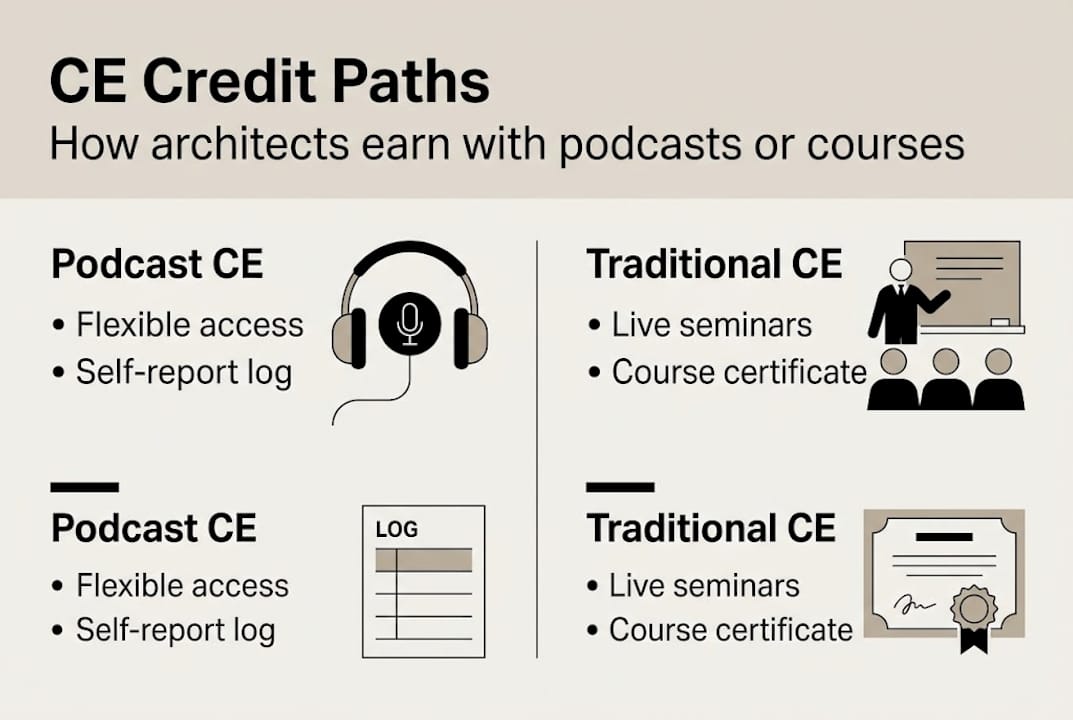
Some podcasts are pre-approved for CE credits by NCARB and AIA, while others fulfill self-reported requirements. That distinction matters because it changes how you document your learning and what you can claim toward your annual or biennial reporting cycle.
Step-by-step: Earning CE credits through podcasts
- Identify eligible content. Start by checking whether a podcast or episode carries AIA or NCARB pre-approval. Many providers list a course number directly in show notes or on their website.
- Listen with intent. Pre-approved episodes often include a short quiz or reflection component you must complete to claim the credit. Set aside time to engage fully, not just passively.
- Complete any required assessments. Some providers require you to answer a few questions online after listening to verify comprehension before credit is issued.
- Document your learning. For self-reported credits, record the episode title, provider name, date listened, topic category, and estimated credit hours in a personal log.
- Submit credits to AIA or your state board. Pre-approved credits often load automatically to your AIA transcript. Self-reported credits require manual entry with your documentation ready.
Pro Tip: Keep a dedicated listening log, even for pre-approved episodes. If your state board ever audits your CE record, having detailed notes on episode content, learning outcomes, and how you applied the material is your best protection.
Here’s a side-by-side look at how pre-approved and self-reported podcast credits compare:
| Credit type | Documentation required | Accepted by AIA | NCARB eligible | Effort to claim |
|---|---|---|---|---|
| Pre-approved podcast | Minimal, auto-logged | Yes | Often yes | Low |
| Self-reported podcast | Detailed personal log | Yes, with documentation | Varies by state | Medium |
The practical takeaway is that pre-approved content is easier to claim, but self-reported options significantly expand your library of usable episodes. A good habit is to categorize your listening by AIA’s LU (Learning Unit) or HSW (Health, Safety, and Welfare) credit types, since HSW credits often carry stricter requirements.
Staying updated: Using podcasts for emerging trends and industry insights
Beyond earning required credits, podcasts help you stay at the leading edge of your profession.

One of the most underrated benefits of podcast learning is the speed at which content gets produced and released. When a new energy code drops or a high-profile building failure prompts regulatory discussion, podcast hosts can cover it within days. Compare that to a conference session that was planned eight months earlier, and the advantage becomes obvious.
Podcasts are an effective medium for learning about emerging trends and innovations in unconventional construction, including topics that rarely make it into formal curricula.
Topics architects are actively learning through podcasts right now:
- Mass timber and cross-laminated timber (CLT) structural applications
- Net-zero and Passive House certification pathways
- AI-assisted design tools and their limitations in practice
- Updates to the International Building Code (IBC) and local amendments
- Biophilic design principles and their measurable occupant outcomes
- Adaptive reuse of commercial buildings post-pandemic
“The best podcast episodes I’ve encountered don’t just describe what’s happening in the industry, they put you in conversation with the people shaping it. That’s a level of access that most practitioners never get through traditional CE channels.” — Architecture podcast host and licensed architect
Vetting credible podcast sources is worth doing once and doing well. Look for shows hosted by licensed practitioners, institutional voices like the AIA or leading schools of architecture, or journalists who cover the built environment. Check that guests are identified with verifiable credentials. Episode frequency and longevity also signal reliability: a show that has published consistently for three or more years is generally more trustworthy than a six-episode launch with no follow-through.
The practical payoff is real. Architects who actively follow trend-focused content report being better prepared for client conversations about sustainability certifications, more confident when reviewing specifications that include unfamiliar materials, and quicker to flag code compliance issues before they become field problems.
Maximizing podcast learning: Tips for effective integration into your professional life
Understanding the value and process of podcasts is just the start. Integration is where benefits multiply.
Consistent podcast learning cultivates a habit of lifelong education for architects, but building that habit requires some structure. Passive listening is better than nothing, but intentional listening is what turns audio content into professional growth.
How to integrate podcast learning effectively:
- Set learning goals before you start. Choose podcasts that align with a specific gap: maybe you want deeper knowledge of acoustic design, or you’re preparing for LEED AP renewal. Goal-setting keeps your library focused.
- Schedule listening like any other professional commitment. Block 30 to 45 minutes on your calendar two or three times a week. Commutes work well; so does lunchtime or early morning.
- Take notes immediately after listening. You don’t need to pause and write mid-episode. A two-minute voice memo or a few typed bullet points right after the episode ends captures the ideas before they fade.
- Track CE progress in a shared document. If you work in a firm, a shared spreadsheet with episode titles, credit hours, and completion dates keeps the whole team accountable and saves time during reporting cycles.
- Revisit episodes when a project calls for it. An episode on curtain wall thermal bridging may be irrelevant in April and essential in October when a relevant project lands.
Pro Tip: Organize a small study group with two or three colleagues. Share a curated playlist of five to seven episodes each month, then meet briefly to discuss takeaways and application. This converts solitary listening into collaborative learning and multiplies the value of every episode.
Common pitfalls to avoid:
- Treating all podcast content as CE-eligible without checking documentation requirements
- Listening while multitasking on complex tasks, which tanks retention
- Picking popular shows over relevant ones
- Forgetting to log episodes immediately, making documentation reconstruction painful later
Our perspective: What most architects overlook about learning through podcasts
After all these practical applications, it’s time to reflect on what sets exceptional podcast learners apart.
Here’s something we’ve observed consistently: architects tend to underestimate the intellectual range that quality podcast series actually cover. Many assume podcasts are surface-level content, a highlights reel of ideas without the structural depth of a formal course. That assumption leads practitioners to use podcasts only for informal browsing rather than genuine professional development. It’s a real missed opportunity.
The architects who get the most out of podcast learning are the ones who treat it as applied education, not ambient noise. They listen to an episode on mass timber detailing and then bring one question from it into their next project coordination meeting. They hear a discussion on specification writing and immediately audit a current project for the gap that was just described.
We’d also push back on the idea that podcast learning is inherently solitary and informal. When used with structure, including logs, peer discussion, and deliberate topic selection, it meets the bar for meaningful CE by every standard that matters. The format isn’t the limitation. How you engage with it is.
Podcasts also expose you to voices outside your immediate professional circle, practitioners from different regions, project scales, and design philosophies. That breadth can shift how you approach a design problem in ways a familiar seminar speaker rarely does.
Explore more Continuing Education options through Ron Blank & Associates
If you’re ready to put your learning into action, here’s where to go next.
Podcasts are a powerful piece of a broader CE strategy, but they work best when paired with structured courses, webinars, and AIA-registered content that covers the full range of your credit requirements. At Ron Blank & Associates, we’ve built a library of AIA-registered continuing education resources designed specifically for architects, engineers, interior designers, and contractors.

Our catalog includes online courses, live webinars, and podcast-format content, all organized to help you meet your CE obligations efficiently and stay genuinely current in your practice. Whether you’re looking to satisfy HSW credit requirements or explore a new specialty area, our platform makes it straightforward. Visit Ron Blank & Associates to explore what’s available and take the next step in your professional development.
Frequently asked questions
Can architects really earn official CE credits through podcasts?
Yes. Podcasts can count for CE credits per AIA policy, provided the content meets Learning Unit standards and proper documentation is maintained for self-reported episodes.
Are podcast-based Continuing Education credits accepted nationwide?
Most states accept audio-based CE when content is relevant and documented correctly, but state requirements differ for how credits can be earned, so verifying with your state licensing board before claiming is always a smart move.
What are the best types of podcasts for architects’ professional development?
Architectural podcasts offer trend analysis, sustainability content, code updates, and practitioner interviews, making topic-specific shows focused on your current practice areas the most effective choice.
How can I verify if a podcast episode is eligible for CE credit?
Check the provider’s website or show notes for an AIA course number, or follow your state’s self-reporting guidelines. Eligibility is based on CE provider approval or self-assessment rules depending on the episode and your licensing jurisdiction.
Are podcasts sufficient to stay ahead on emerging trends in architecture?
When selected carefully, podcasts deliver up-to-date insights on emerging trends, but pairing them with formal courses and code reviews gives you the most complete and defensible professional development record.