

Promoting AIA accredited continuing education courses presents unique challenges for building product manufacturers. A staggering 40% dropout rate plagues non-optimized course delivery while up to 25% of submissions face rejection due to misaligned accreditation requirements. This comprehensive guide provides a stepwise promotional strategy tailored specifically for manufacturers seeking to increase their continuing education programs success, combining accreditation compliance with proven marketing tactics to maximize enrollment and course completion rates.
Table of Contents
- Prerequisites And Preparation
- Course Accreditation And Timeline Management
- Effective Marketing Channels And Delivery Platforms
- Common Mistakes And Troubleshooting
- Alternative Promotion Approaches And Tradeoffs
- Expected Results And Success Metrics
- Enhance Your Online Ce Course Promotion With Ron Blank & Associates
- Frequently Asked Questions About Promoting Online Ce Courses For Aec Professionals
Prerequisites and Preparation
Before launching any promotional campaign, you must establish a solid foundation that meets both accreditation standards and technical requirements. Understanding AIA accreditation criteria is critical for course eligibility and prevents costly resubmissions that delay your marketing timeline. Start by thoroughly reviewing accreditation standards for AEC courses to ensure your content aligns with educational objectives and learning hour requirements.
Audience analysis forms the second pillar of successful preparation. Research your target professionals’ continuing education credit needs, preferred learning formats, and typical engagement patterns. Architects prioritize Health Safety Welfare (HSW) credits while engineers often seek specific technical certifications. Understanding these nuances allows you to craft messaging that resonates with each discipline’s professional development goals.
Technical infrastructure cannot be overlooked in today’s mobile-first environment. Your delivery platform must support seamless access across devices, as professionals increasingly complete courses during commutes or between client meetings. Verify that your learning management system provides responsive design, reliable video streaming, and automated certificate generation.
Essential preparation steps include:
- Compile comprehensive course documentation with detailed learning objectives
- Verify all instructional materials meet continuing education standards
- Test mobile compatibility across iOS and Android devices
- Create branded promotional assets optimized for multiple channels
- Establish tracking systems for enrollment metrics and completion rates
Pro Tip: Create a detailed accreditation checklist that maps every course element to specific AIA requirements. This simple tool prevents oversights that trigger the 25% rejection rate and keeps your promotional timeline on track.
Course Accreditation and Timeline Management
Managing the accreditation timeline strategically determines when you can begin promotional activities and directly impacts your course launch success. Typical 8-12 week timeline for AIA course approval impacts promotional scheduling, so you must submit documentation well before your intended marketing campaign begins.
Follow this structured approach:
- Prepare comprehensive course documentation including instructor qualifications, learning objectives, and assessment methods that demonstrate compliance with continuing education standards.
- Register as an education provider for RCEP, IDCEC, and GGCI to establish credibility and expand your promotional reach beyond AIA members to the broader engineering community.
- Submit all materials with meticulous attention to formatting requirements and supporting documentation to avoid delays caused by incomplete applications.
- Schedule marketing activities to begin immediately after approval confirmation, capitalizing on the momentum of accreditation success.
- Maintain organized records of all correspondence and approval documentation for future course updates and renewals.
Accurate documentation reduces the 25% rejection and resubmission risk that plagues poorly prepared applications. Every delay in accreditation extends your time to market and reduces the promotional window before your course content becomes outdated. Review AIA accreditation timeline guidance to understand critical milestones and build realistic project schedules.
Pro Tip: Submit your accreditation application on Monday or Tuesday morning. Review committees typically process submissions early in the week, and this timing positions your materials at the top of their queue rather than competing with Friday afternoon submissions that may wait until the following week.
Effective Marketing Channels and Delivery Platforms
Multi-channel marketing stands as the cornerstone of successful course promotion, achieving up to 40% more enrollments compared to single-channel approaches. You must identify where your target audience spends professional time and meet them with relevant messaging that addresses their specific continuing education needs.

Email marketing delivers exceptional results for AEC professionals. Targeted email marketing yields 20-35% open rates and 8% click-through rates for AEC CE courses, far exceeding general industry benchmarks. Segment your email lists by discipline, credit type needed, and previous engagement patterns to maximize relevance.
Platform selection directly influences completion rates. On-demand, mobile-optimized platforms like AIAU reduce 40% dropout rates by allowing professionals to learn at their own pace across devices. Compare your options carefully:
| Channel | Engagement Rate | Cost Efficiency | Best For |
| Targeted Email | 20-35% open rate | High | Direct promotion to existing contacts |
| Professional Association Listings | 15-25% click-through | Medium | Building credibility and authority |
| Social Media (LinkedIn) | 8-12% engagement | Low to Medium | Awareness and thought leadership |
| On-Demand Platform | 60-75% completion | High | Flexible professional schedules |
| Live Webinars | 40-50% attendance | Medium | Interactive learning preference |
Key promotional tactics include:
- Develop email sequences that emphasize specific credit types and learning outcomes
- Create landing pages optimized for mobile viewing with clear credit information
- Leverage LinkedIn Groups focused on AEC professional development
- Partner with state and local AIA chapters for co-promotional opportunities
- Utilize retargeting campaigns to re-engage professionals who visited but did not enroll
Pro Tip: Schedule promotional emails for Tuesday through Thursday between 10 AM and 2 PM Eastern time. AEC professionals check email during mid-morning breaks and lunch periods, and midweek timing avoids Monday’s inbox overload and Friday’s early departures.
Common Mistakes and Troubleshooting
Even experienced course providers encounter promotional pitfalls that suppress enrollment and completion rates. Ignoring accreditation compliance causes a 25% rejection rate, delaying promotion and wasting valuable marketing resources on courses that cannot be delivered.
Frequent mistakes include:
- Launching marketing campaigns before receiving final accreditation approval, creating credibility issues when courses must be postponed
- Neglecting mobile optimization despite 60% of professionals accessing courses via smartphones and tablets during travel
- Failing to clearly communicate credit types and quantities in promotional materials, leading to enrollment from professionals seeking different credentials
- Overlooking certificate delivery automation, causing delays that frustrate learners and damage provider reputation
- Using generic marketing messages that do not address discipline-specific continuing education requirements
When enrollment falls short of projections, audit your promotional messaging for clarity about learning outcomes and credit specifics. Professionals make enrollment decisions based primarily on whether the course meets their immediate licensing needs. If completion rates lag, investigate your platform’s mobile experience and identify friction points in the user interface.
Maintain meticulous records of all marketing metrics including email performance, landing page conversion rates, and enrollment sources. This data reveals which channels deliver quality enrollments versus those generating clicks without conversions. Review avoiding accreditation mistakes regularly to stay current with evolving requirements.
Troubleshooting low engagement often reveals misalignment between your course positioning and audience needs. Survey non-completers to understand barriers they encountered and adjust your delivery or support systems accordingly.
Alternative Promotion Approaches and Tradeoffs
Beyond traditional marketing channels, alternative promotional strategies offer unique advantages for reaching AEC professionals. Integrating building product promotion with CE courses increases enrollment by 15% by providing practical application context that appeals to professionals seeking immediately applicable knowledge.
Product specification co-promotion creates natural synergies. When you develop continuing education content around innovative building materials or construction techniques, manufacturers gain specification opportunities while your course offers real-world relevance. This partnership approach reduces your marketing costs while expanding reach through manufacturer networks.
Compare these alternative approaches:
| Approach | Enrollment Impact | Resource Investment | Flexibility | Best Application |
| Live Webinars | High interaction, 40-50% attendance | High (scheduling, facilitation) | Low (fixed times) | Complex technical topics requiring discussion |
| On-Demand Courses | 60-75% completion | Medium (production quality) | High (anytime access) | Busy professionals needing schedule flexibility |
| Association Partnerships | 15-25% credibility boost | Medium (relationship building) | Medium | Establishing authority in new markets |
| Building Product Integration | 15% enrollment increase | Low to Medium (content alignment) | High (mutual benefit) | Specification-driven continuing education |
Professional association partnerships add instant credibility but require relationship cultivation and may involve revenue sharing arrangements. State and local AIA chapters often seek quality educational content and can provide promotional support through their member communications. Explore integrated building product promotion to understand how specification services complement continuing education delivery.
Live webinars create engagement through real-time interaction and Q&A sessions but limit participation to scheduled times that may not fit professional calendars. On-demand courses sacrifice immediate interaction for accessibility that accommodates varied schedules. Consider offering both formats with premium pricing for live sessions that include direct instructor access.
Expected Results and Success Metrics
Establishing clear benchmarks allows you to measure promotional effectiveness and identify areas requiring adjustment. Multi-channel marketing can boost enrollment 25-40% with clear credit tracking increasing completion by 20%, but you must track specific metrics to verify these outcomes.
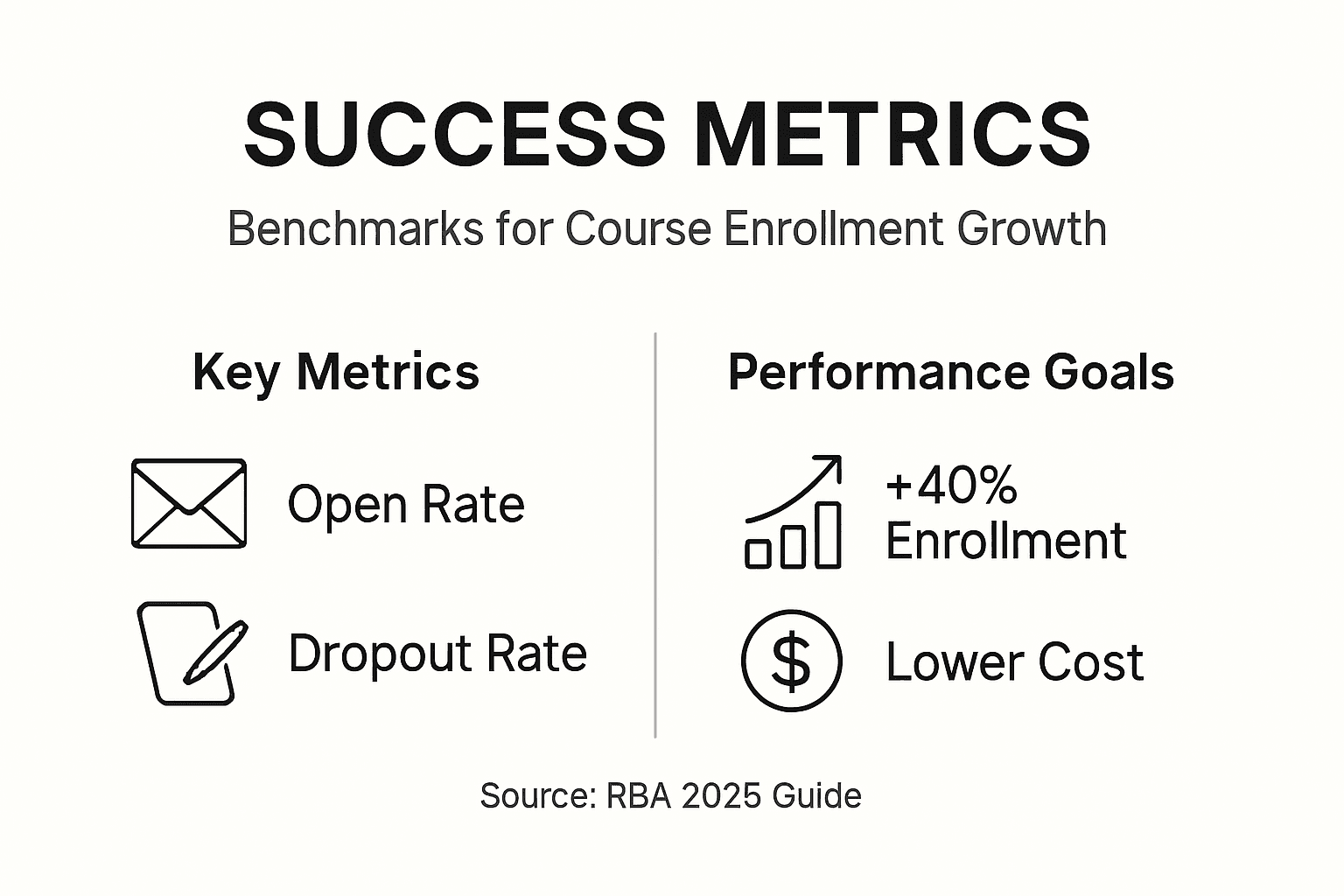
Set enrollment growth targets based on your promotional budget and channel mix. A comprehensive multi-channel campaign should generate 25 to 40% more enrollments compared to your baseline single-channel results. Track this growth month over month to identify seasonal patterns and optimize timing for future courses.
Monitor these critical success metrics:
- Email open rates of 20 to 35% indicate effective subject lines and sender reputation
- Click-through rates of 8% or higher show compelling course descriptions and clear calls to action
- Landing page conversion rates above 15% demonstrate strong alignment between promotional messaging and course value
- Course completion rates exceeding 60% validate your delivery platform and content engagement
- Average time to completion under your stated course hours confirms accurate credit hour estimates
Course approval timelines directly affect your promotional window. Track submission to approval duration for each accreditation body and adjust future project schedules accordingly. Delays beyond the typical 8 to 12 week window signal documentation issues requiring process improvements.
Revenue per enrollment and customer acquisition cost determine promotional sustainability. Calculate total marketing spend divided by new enrollments to establish your cost per acquisition, then compare this against course pricing and lifetime customer value if you offer multiple courses. Review measuring CE course promotion results for industry benchmarks and optimization strategies.
Key Statistic: Transparent credit tracking systems that allow learners to monitor their progress toward certification requirements increase completion rates by 20%, directly improving your course’s reputation and generating positive word-of-mouth referrals.
Enhance Your Online CE Course Promotion with Ron Blank & Associates
Applying these promotional strategies requires expertise in both continuing education requirements and effective marketing to AEC professionals. Ron Blank & Associates specializes in developing and promoting accredited courses for architects, engineers, and interior designers while integrating building product specification services that create natural promotional synergies.
Our proven approach combines AIA accreditation knowledge with targeted marketing strategies that consistently achieve enrollment growth. Whether you need assistance developing compliant course content, navigating the accreditation process, or implementing multi-channel promotional campaigns, our team brings decades of experience serving the AEC professional community. We help building product manufacturers integrate their solutions into continuing education content, creating the 15% enrollment boost that benefits both educators and specification-driven businesses. Partner with Ron Blank & Associates to transform your continuing education offerings into high-performing professional development resources that architects, engineers, and interior designers actively seek.
Frequently Asked Questions About Promoting Online CE Courses for AEC Professionals
What are the key accreditation bodies for AEC CE courses?
The American Institute of Architects (AIA) provides the primary continuing education accreditation for architects through its Continuing Education System (CES). The Registered Continuing Education Program (RCEP) serves engineers and other design professionals with broader multi-discipline recognition. Both organizations maintain strict standards for educational content, instructor qualifications, and learning outcome documentation. GBCI serves LEED Professionals and IDCEC serves Interior Designers.
How long does AIA accreditation approval typically take?
AIA course approval requires several weeks from initial submission to final approval, though incomplete applications can extend this timeline significantly.Build these timelines into your promotional schedule to avoid marketing courses before receiving accreditation confirmation.
What marketing channels yield best engagement rates with AEC professionals?
Targeted email marketing delivers 20 to 40% open rates and 8% click-through rates, making it the highest-performing channel for direct course promotion. LinkedIn Groups and professional association partnerships provide strong secondary channels for building awareness and credibility. Mobile-optimized on-demand platforms achieve 60 to 75% completion rates, far exceeding live webinar attendance.
How can I reduce course dropout rates effectively?
Mobile optimization stands as the single most impactful improvement, reducing dropout rates by 40% by accommodating professionals’ varied schedules and device preferences. Clear credit tracking systems increase completion by 20% through transparent progress monitoring. Breaking longer courses into shorter modules with intermediate completion certificates maintains engagement throughout the learning journey.
Are building product integrations beneficial for CE course promotion?
Integrating building product promotion with continuing education content increases enrollment while providing practical specification knowledge that professionals value. This approach creates win-win partnerships where manufacturers gain exposure and specification opportunities while your course offers real-world application context. The strategy works best for courses focused on materials, systems, and construction techniques where product knowledge directly supports learning objectives.