

Building codes are not red tape. That framing has cost more than a few design teams serious time and money when a permit gets rejected or a redesign lands in their lap mid-construction documents. The truth is that understanding codes early, before schematic design is even finished, is one of the most powerful workflow tools available to architects and engineers. It also connects directly to your professional development, since code-related topics sit squarely within AIA Health, Safety, and Welfare (HSW) continuing education requirements. If you have ever felt like codes were something to deal with later, this article is here to change that perspective.
Table of Contents
- What are building codes and why do they matter?
- Core requirements: Structure, safety, and sustainability
- Navigating code compliance: Methodologies and best practices
- Common pitfalls and edge cases for designers
- Building codes and your career: Earning AIA CE credits
- Advance your building code expertise with Ron Blank & Associates
- Frequently asked questions
Key Takeaways
| Point | Details |
|---|---|
| Early code integration | Reviewing codes from project start prevents costly redesigns and streamlines workflow. |
| Holistic compliance approach | Coordinating across teams and phases is essential to avoiding violations and missed requirements. |
| AIA CE and HSW alignment | Building code mastery supports both compliance and ongoing CE credits for licensure renewal. |
| Local nuance matters | Always confirm local code amendments and AHJ guidelines to avoid project delays. |
What are building codes and why do they matter?
Building codes in the US are not arbitrary checklists. They represent decades of hard lessons learned from structural failures, fires, and accessibility shortfalls. At their core, US building codes exist to protect public health, safety, and welfare, and they do that by setting enforceable minimum standards for how buildings are designed, constructed, and maintained.
The primary framework most designers work within comes from the International Code Council (ICC) family of model codes. The IBC minimum requirements cover structural integrity, fire safety, health, accessibility, and sustainability across virtually every building type. States and municipalities adopt these model codes, often with local amendments, which is why the code environment can feel like a moving target depending on where your project is located.
“Building codes are living documents. They evolve in direct response to disasters, new materials, and shifting environmental priorities, which means staying current is not optional for practicing professionals.”
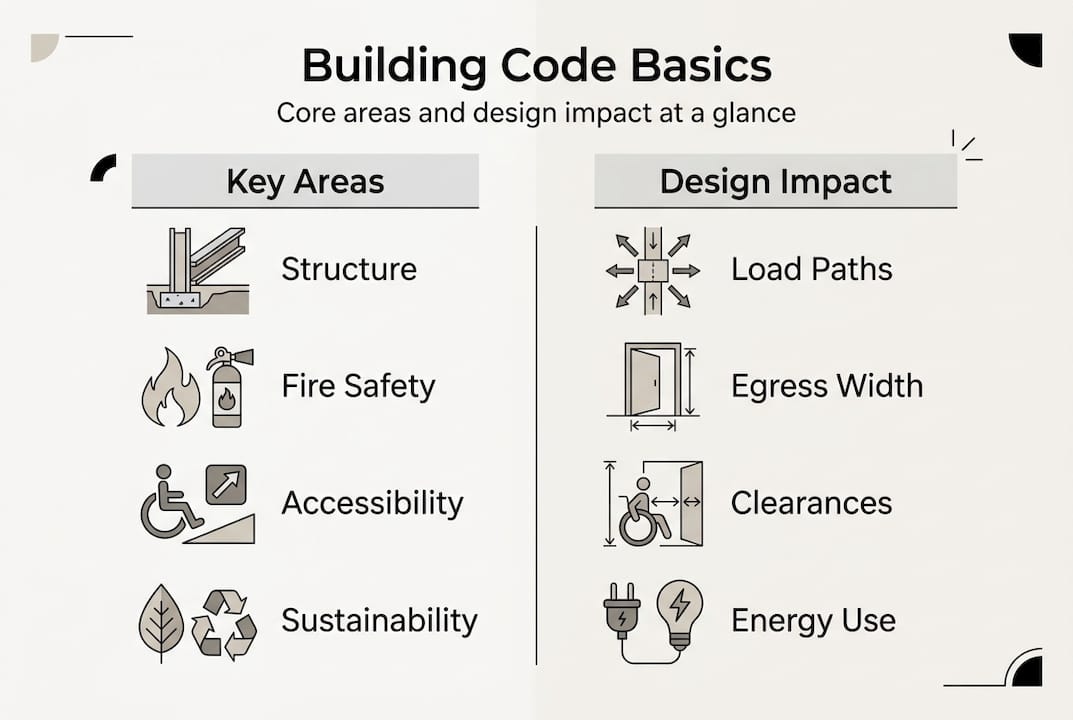
Here is what codes typically govern:
- Structural integrity: Load paths, material specifications, and safety margins for gravity and lateral forces
- Fire safety: Egress design, fire-rated assemblies, and compartmentation strategies
- Accessibility: ADA clearances, reach ranges, and accessible routes through all phases of design
- Sustainability: Energy performance benchmarks tied to the International Energy Conservation Code (IECC) and ASHRAE standards
- Health: Ventilation, plumbing, and indoor air quality minimums
Codes are updated on a regular cycle, typically every three years for ICC documents, and each update cycle reflects new research, failure investigations, and policy priorities. Knowing which edition your jurisdiction has adopted is step one.
Core requirements: Structure, safety, and sustainability
Once you understand what codes are trying to accomplish, the specific requirements start to make more sense. Let us walk through the four pillars that show up most consistently in design practice.
Structural systems require designers to account for load paths from roof to foundation, material-specific safety factors, and seismic or wind zone requirements based on project location. Getting this wrong early means expensive structural redesigns later.
Fire protection is where many designers underestimate complexity. Egress width calculations, travel distances, rated corridor assemblies, and compartmentation all interact with each other. A single occupancy classification change can cascade into a completely different fire protection strategy.

Accessibility under ADA and the IBC is non-negotiable and touches every phase of design. Clearances at doors, turning radii, counter heights, and accessible parking ratios all need to be verified, not assumed.
Sustainability is increasingly code-driven rather than voluntary. ASHRAE 90.1-2022 cost-effectiveness data confirms life-cycle cost savings from updated energy standards, and building operations contribute roughly 40% of global CO2 emissions, which is why energy codes keep tightening.
| Code area | Primary standard | Key design impact |
|---|---|---|
| Structural | IBC Chapter 16 | Load combinations, material limits |
| Fire safety | IBC Chapter 7 and 10 | Rated assemblies, egress geometry |
| Accessibility | ADA and IBC Chapter 11 | Clearances, routes, fixtures |
| Energy | IECC and ASHRAE 90.1 | Envelope, mechanical, lighting |
Pro Tip: Run an energy code compliance check during schematic design, not at the end of design development. Catching envelope performance gaps early is far less painful than retrofitting insulation values into a nearly complete set of construction documents.
Navigating code compliance: Methodologies and best practices
Knowing the code is one thing. Integrating it into your workflow is another. The most effective teams treat practical code compliance steps as a design tool, not a final hurdle.
Here is a practical sequence that works across project types:
- Schematic design: Establish occupancy classification, construction type, allowable height and area, and required fire separations. Build a code matrix that the whole team can reference.
- Design development: Verify egress paths, rated assembly locations, accessibility compliance, and energy code strategy. Coordinate with structural and MEP engineers at this stage, not after.
- Construction documents: Run a formal code review checklist before issuing for permit. Document any decisions made near code limits and the rationale behind them.
- Permit and construction: Track any field changes against the approved drawings. Unauthorized deviations are a leading cause of violations and stop-work orders.
- Local amendment check: Before finalizing any phase, confirm which code edition and local amendments the Authority Having Jurisdiction (AHJ) enforces. This step gets skipped more often than it should.
Interdisciplinary coordination is where compliance gaps most often appear. Structural, mechanical, and architectural drawings need to be cross-referenced at every milestone. Trade interfaces, where one discipline’s work meets another’s, are where firestopping failures and accessibility conflicts tend to hide.
Pro Tip: Create a shared code log that all disciplines contribute to throughout the project. When an assumption is made near a code limit, document it immediately. That record becomes invaluable if the AHJ raises questions during plan review.
Common pitfalls and edge cases for designers
Even experienced designers run into code problems. The difference between a minor correction and a costly redesign usually comes down to when the issue is caught.
Common code violations during construction include firestopping failures, fire-rated assembly breaches, accessibility clearance gaps, MEP conflicts, and deviations from approved drawings. These happen because of lack of detail in the documents, trade silos, and rushed schedules.
Here are the pitfalls that show up most often in practice:
- Occupancy misclassification: Assigning the wrong use group affects construction type, egress, fire protection, and structural requirements. Catching this late means redesigning multiple systems simultaneously.
- Ignoring local amendments: A project that complies with the model IBC may still fail plan review if the local jurisdiction has adopted stricter or different provisions.
- Performance-based alternatives without documentation: IBC section 104.11 allows alternative methods and materials, but they require thorough documentation and explicit AHJ approval. Assuming approval is not the same as receiving it.
- Field changes without authorization: Any deviation from approved drawings, even a seemingly minor one, needs to go through the proper change process. Undocumented changes are a primary trigger for violations.
“Substantial alterations to existing buildings can trigger full code compliance requirements, not just compliance for the altered portion. This is one of the most frequently misunderstood edge cases in renovation and adaptive reuse projects.”
| Pitfall | Typical consequence | Prevention strategy |
|---|---|---|
| Occupancy misclassification | Full system redesign | Confirm use group in SD phase |
| Skipping local amendments | Permit rejection | AHJ pre-application meeting |
| Undocumented field changes | Stop-work order | Formal change management process |
| Performance path without AHJ buy-in | Delayed approval | Early AHJ coordination |
Building codes and your career: Earning AIA CE credits
Here is something worth recognizing: the time you invest in understanding building codes is not just good for your projects. It is also good for your license. HSW continuing education for architects and engineers covers topics including building codes, project planning, design, documentation, and construction evaluation, all of which qualify for AIA CE credits.
Most US jurisdictions require between 12 and 24 hours of continuing education annually, with a significant portion dedicated to HSW topics. Code-focused courses satisfy both the HSW requirement and general AIA CE credit, making them one of the most efficient ways to meet your annual obligations.
Here is what to look for when selecting code-related CE courses:
- Courses that address the current IBC edition and recent amendments
- Content covering fire protection, accessibility, and energy code updates
- Programs that include real-world case studies and design scenarios
- AIA code course options that are registered with the AIA and clearly labeled as HSW
- Providers who update their content after each new code cycle
Documenting your credits properly is just as important as earning them. Keep records of course completion certificates, provider information, and credit hours. Licensure renewal audits do happen, and having organized documentation protects you.
Code mastery is not a one-time achievement. It is an ongoing practice, and the CE system is designed to support exactly that kind of continuous learning. Treating code education as a career investment rather than a compliance checkbox changes how you approach it entirely.
Advance your building code expertise with Ron Blank & Associates
If this article has reinforced how central code knowledge is to your daily practice, the next step is finding the right learning resources to keep that knowledge current. Ron Blank & Associates offers AIA-registered continuing education courses designed specifically for architects, engineers, and designers who want to go deeper on code compliance, building systems, and HSW topics.

Our courses are available on demand, so you can earn AIA continuing education credits on your schedule without sacrificing project time. Whether you are looking to strengthen your foundation in IBC requirements, stay current with energy code updates, or explore emerging best practices in fire protection and accessibility, we have targeted learning pathways built for working professionals. Visit us at ronblank.com to explore the full course catalog and start earning credits that genuinely advance your practice.
Frequently asked questions
What is the main difference between prescriptive and performance-based building code paths?
Prescriptive codes provide fixed, predictable requirements that are straightforward to apply, while performance-based alternatives allow design flexibility as long as the outcome meets the code’s intent and receives explicit AHJ approval.
How do local amendments impact building code compliance?
Local amendments can override or add to model code requirements, so verifying them with the AHJ before finalizing your design is essential for avoiding permit rejections and costly revisions.
Do AIA CE credits for building codes count toward licensure renewal?
Yes, AIA HSW credits earned through code-focused courses typically count toward annual continuing education requirements for licensure renewal, as confirmed by NCARB CE guidelines.
What are the most common building code violations during construction?
The most frequent violations include firestopping failures, fire-rated assembly breaches, accessibility clearance gaps, MEP conflicts, and deviations from approved drawings, often driven by poor documentation and trade coordination gaps.