

TL;DR:
- Design-build integrates design and construction under a single contract, improving clarity and accountability.
- It overlaps project phases to increase efficiency, reduce change orders, and accelerate delivery schedules.
Most architects, engineers, and contractors have sat through a project kick-off meeting where the question quietly hangs in the air: who is actually responsible when the design and the build don’t line up? That tension is built into traditional project delivery, where design and construction are treated as separate, sequential activities handled by separate parties. Design-build solves this by placing both design and construction under a single contract, which means the owner manages fewer interfaces, accountability is clearer, and the whole team moves in the same direction from day one. This article walks through what design-build really means, how the workflow unfolds, the benefits it delivers, the risks worth watching, and the best practices that separate smooth projects from difficult ones.
Table of Contents
- What is the design-build process?
- Key phases in the design-build workflow
- Benefits of design-build for delivery efficiency
- Risks, challenges, and best practices
- Our perspective: What most design-build guides miss
- Advance your expertise in design-build
- Frequently asked questions
Key Takeaways
| Point | Details |
|---|---|
| Integrated approach | Design-build unifies design and construction under one contract for greater efficiency. |
| Overlapping phases | Project planning, design, and construction frequently overlap, reducing delays. |
| Collaboration benefits | Early teamwork between designers and builders identifies challenges sooner and cuts costs. |
| Bridging risks | Careful management during pre-award reduces risk from unclear contracts and immature designs. |
| Continuous learning | Ongoing education in design-build methods strengthens project delivery outcomes. |
What is the design-build process?
With confusion about project delivery methods on the table, let’s clarify exactly what the design-build process means and how it stands apart from its older sibling, design-bid-build.
In the traditional design-bid-build model, an owner first hires an architect or engineer to produce a complete set of construction documents. Those documents are then sent out to contractors for competitive bidding, and the lowest qualifying bid typically wins the construction contract. The two parties, designer and contractor, answer to the owner separately. When something goes wrong, and it often does, finger-pointing between the design team and the construction team is almost unavoidable.
Design-build changes that dynamic by placing one entity in charge of delivering both the design and the construction under a single contract. The owner has one point of contact, one team to hold accountable, and one contract to manage. That simplicity is not just convenient. It fundamentally reshapes how decisions get made, how risks are shared, and how fast a project can move.
“The design-build model removes the adversarial gap between designer and builder by making them one and the same team, aligned by shared accountability and a shared outcome.”
Here is a quick comparison to make the distinction concrete:
| Feature | Design-bid-build | Design-build |
|---|---|---|
| Contracts | Multiple (owner to designer, owner to contractor) | Single (owner to design-build team) |
| Accountability | Split between designer and contractor | Single point of responsibility |
| Communication | Owner manages two separate relationships | Owner communicates through one team |
| Design finalized before construction? | Yes, typically 100% complete | No, design evolves alongside construction |
| Risk distribution | Owner absorbs gap risk between design and build | Design-build entity absorbs integration risk |
What makes design-build especially relevant to AEC professionals today is that it is no longer a niche approach reserved for large commercial projects. It has expanded into residential remodeling, civic infrastructure, healthcare facilities, and education buildings. Understanding how it works is genuinely useful whether you are managing a complex hospital expansion or advising a client on a mid-size office renovation.
The core principle is integration. When the person doing the design talks daily with the person managing construction, problems that would otherwise surface during a costly RFI process get resolved in a hallway conversation or a weekly coordination meeting. That integration is not just a contractual arrangement. It is a mindset and a workflow.
Key phases in the design-build workflow
Now that we have established what design-build is, let’s explore how its workflow unfolds phase by phase.
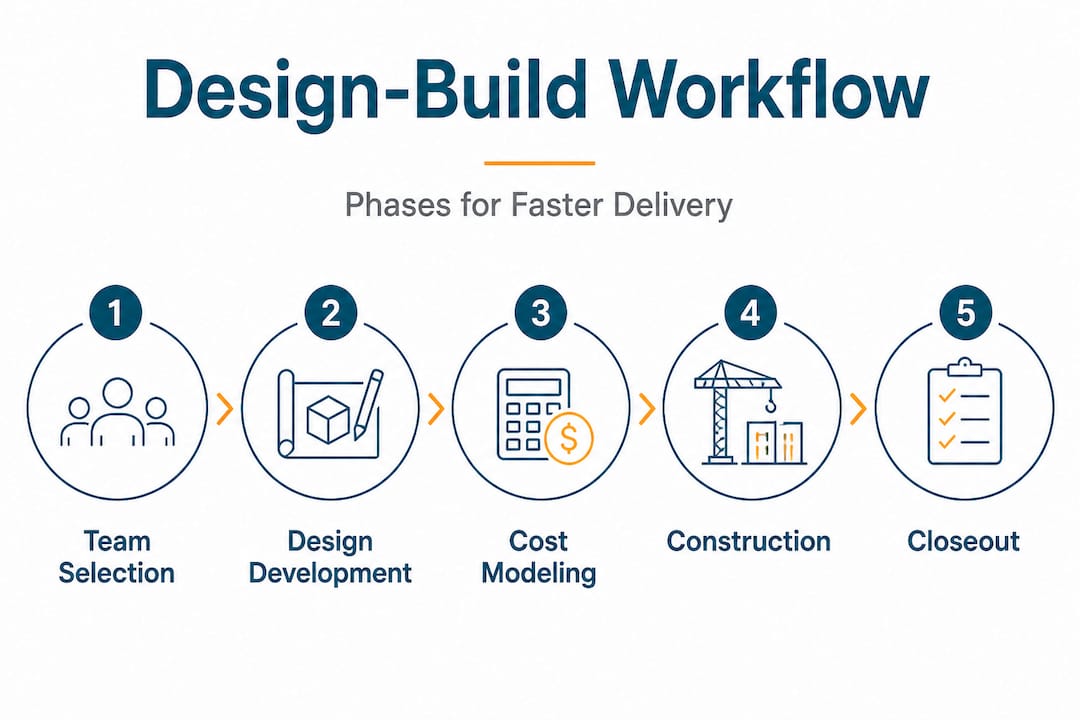
One of the most important things to understand about design-build is that its phases overlap by design, rather than operating as rigid sequential steps. This overlap is exactly where the efficiency gains come from. Here is how the workflow typically takes shape:
- Team selection and project initiation. Before a single drawing is produced, the owner selects the design-build entity, often through a qualifications-based process or a best-value procurement. This phase establishes the project’s goals, budget parameters, schedule targets, and preliminary scope. Getting this phase right matters enormously because the assumptions made here travel through every subsequent phase.
- Conceptual design and continuous estimating. As the design team develops schematic concepts, the construction team runs parallel cost models. Every design decision gets tested against real-world pricing before it becomes a commitment. This is a major departure from traditional practice, where the contractor sees pricing implications only after the design is complete. When a structural choice adds 12 percent to the steel budget, the team knows it in week three, not in month twelve.
- Design development with constructability reviews. As the design progresses from schematic to design development, the construction team actively flags sequencing issues, material lead times, and site logistics challenges. Value engineering happens naturally during this phase because the designer and builder are in the same room, working toward the same budget.
- Construction and ongoing coordination. Construction begins, often before design is 100 percent complete on all systems. This phased or fast-track approach is one of the most tangible ways design-build compresses schedules. While the structural steel goes up, the mechanical and electrical design for upper floors continues. Feedback from field conditions flows back to the design team in real time.
- Closeout and lessons learned. Commissioning, punch lists, and owner training wrap up the project. Because the design team and construction team are unified, warranty obligations and as-built documentation tend to be cleaner and more complete.
Pro Tip: During phase two, ask the design-build team to show you the cost model alongside the design drawings at every presentation. If the team cannot tell you the current budget projection, that is a signal that cost and design are not actually being integrated, which is the whole point of the method.
| Phase | Key activities | Who leads |
|---|---|---|
| Team selection | RFQ/RFP, goal setting, contract negotiation | Owner and design-build firm |
| Conceptual design | Schematic drawings, preliminary budget | Designer with contractor input |
| Design development | Constructability reviews, value engineering | Integrated design-build team |
| Construction | Fast-track building, field coordination | Construction lead with design support |
| Closeout | Commissioning, as-builts, owner training | Full team |
Benefits of design-build for delivery efficiency
With an understanding of how the phases connect, it is important to highlight the value that design-build brings to project delivery.
The efficiency case for design-build is well established, but let’s be specific about where the gains actually come from rather than speaking in generalities.
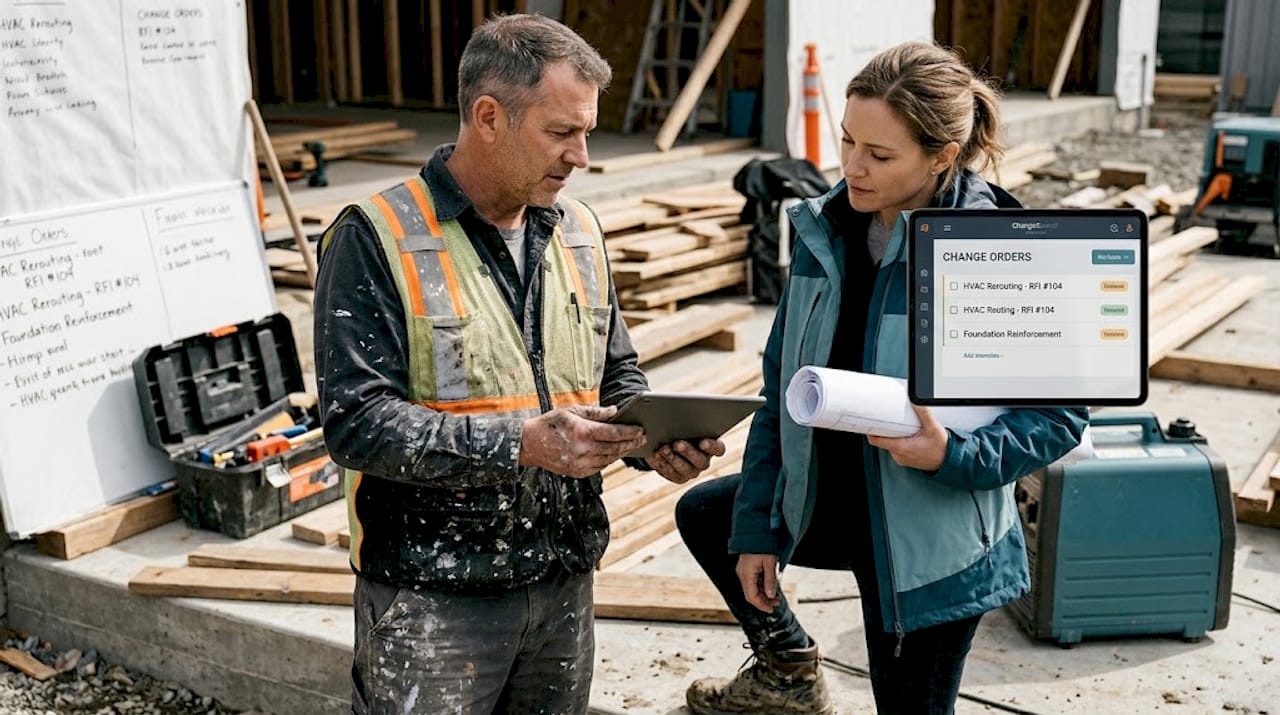
Reduced administrative friction. In a traditional delivery model, formal RFIs, architect supplemental instructions, and change order negotiations consume enormous amounts of project time. Early collaboration in design-build aligns design decisions with constructability, cost, and schedule before those decisions become contractual commitments, which dramatically reduces the volume of costly mid-construction changes.
Fewer change orders. Change orders are the budget killers of traditional construction. When the designer did not anticipate how a detail would actually be built, and the contractor did not know about the design intent, the result is a change order that someone has to pay for. Design-build teams catch those misalignments during design development, not during construction.
Faster project delivery. The ability to overlap design and construction phases can compress overall project schedules by 10 to 30 percent compared to traditional methods, depending on project type and complexity. For clients operating in competitive markets, that schedule compression translates directly to earlier occupancy and earlier return on investment.
Single point of accountability. When something goes wrong on a design-bid-build project, the owner often finds themselves mediating between the architect saying the contractor built it wrong and the contractor saying the architect drew it wrong. In design-build, there is one entity responsible for the outcome. That clarity does not eliminate problems, but it eliminates the defensive blame dynamic that makes problems expensive to resolve.
Value engineering as a design tool. Because the construction team participates in design from the start, value engineering is not a last-minute cost-cutting exercise imposed on a completed design. It is an ongoing conversation about how to achieve the owner’s goals within the available budget. That is a fundamentally healthier dynamic.
- Single contract reduces legal and administrative overhead
- Integrated team catches coordination conflicts early
- Continuous estimating prevents budget surprises
- Fast-track construction compresses schedule
- Unified accountability simplifies owner decision-making
Pro Tip: When evaluating a design-build team, ask specifically how they integrate cost estimating into the design process. Teams that use real-time cost modeling from day one deliver far better budget predictability than those that estimate only at major milestones.
Risks, challenges, and best practices
While design-build offers many advantages, there are important challenges and risk areas to consider, especially during the negotiation and preconstruction phase.
Design-build is not a magic cure for project complexity. It introduces its own set of risks, and professionals who understand those risks are better positioned to manage them proactively.
The bridging period risk. One of the most underappreciated risk areas in design-build is the pre-award period, often called the bridging period. During this phase, the design-build team may invest significant effort in developing design concepts and pricing to win the contract. The risk emerges when the pricing is based on an immature design, and the assumptions made during pursuit are not explicitly preserved in the final executed contract. Scope creep between what was priced and what gets built is a direct consequence.
“During the pre-award and bridging period, risk arises when pricing is based on an immature design basis, when responsibilities for design coordination drift between parties, and when proposal assumptions and qualifications are not clearly carried into the executed contracts.”
Unclear design coordination responsibilities. On a design-build team, the architect, engineers, and contractor are all working for the same entity, but the internal handoffs between them still need to be clearly defined. Who coordinates the mechanical and electrical rough-in with the structural penetrations? If that is not spelled out, the integrated model starts to look a lot like the fragmented model it was supposed to replace.
Owner involvement and decision speed. Design-build requires faster decision-making from owners than traditional delivery because design and construction are overlapping. Owners who are slow to approve design decisions can create ripple effects that stall construction. Setting a clear decision-making protocol at project inception is not optional. It is critical.
Here are the best practices that experienced design-build professionals apply consistently:
- Preserve proposal assumptions. Every assumption and qualification made during the proposal phase should be explicitly referenced in the executed contract. Do not let those nuances disappear into a generic scope narrative.
- Clarify design coordination responsibilities in writing. Internal team agreements should define who is responsible for each coordination activity, with clear handoff points.
- Document design decisions as they are made. Because design-build moves fast, verbal decisions can be forgotten or reinterpreted. A brief written record of every significant design or cost decision protects all parties.
- Build review checkpoints into the schedule. Even in a fast-track model, structured design review milestones with owner sign-off prevent scope drift and protect the team from unauthorized changes.
- Invest in preconstruction services. The preconstruction phase is where design-build earns its efficiency premium. Skimping on this phase to save fees is a false economy.
Pro Tip: Before signing a design-build contract, ask your legal counsel to review how proposal qualifications and assumptions are carried forward into the contract language. A two-hour legal review at this stage can prevent a six-figure dispute later.
Our perspective: What most design-build guides miss
Most articles on design-build focus on the contractual structure and stop there, as if having one contract is itself the source of the efficiency. That framing misses what actually makes design-build work in practice.
The single contract is a framework. It creates the conditions for integration, but it does not guarantee it. We have seen design-build projects where the architect and contractor operated in silos just as they would have in a traditional delivery model, simply because no one actively managed the integration. The contract was right, but the culture was not.
The real efficiency in design-build comes from continuous stakeholder engagement throughout the entire project lifecycle. That means the owner is genuinely involved in design development meetings, not just receiving monthly reports. It means the construction team is reviewing drawings in real time, not waiting for a formal design package to comment on. It means the design team walks the site regularly and listens to field feedback, rather than treating construction as someone else’s problem.
We also believe strongly that professional development plays a direct role here. Architects, engineers, and contractors who have invested in cross-disciplinary continuing education, who understand cost estimating, constructability, contract law, and project scheduling alongside their core discipline, are significantly more effective on design-build teams. The method rewards practitioners who can think beyond their traditional role, and that kind of thinking does not happen automatically. It is cultivated through deliberate learning.
If you are leading a design-build team, invest in structured learning for your people. Build in time for after-action reviews at project closeout. Create space for the kind of reflective practice that turns experience into expertise. The teams that do this consistently outperform those that simply rely on contractual structure to do the work for them.
Advance your expertise in design-build
Having gained clarity on design-build, you may be ready to take the next step in your professional learning journey. Mastering the nuances of integrated project delivery, from managing the bridging period to running effective preconstruction coordination, takes more than field experience. It takes structured education that connects theory to practice.
At Ron Blank and Associates, we develop AIA-registered continuing education for design-build and other delivery methods, available as online courses, webinars, podcasts, and face-to-face programs. Whether you are an architect sharpening your project management skills, an engineer learning to collaborate more effectively with contractors, or a contractor deepening your design literacy, our courses are built to move your practice forward. Explore what is available and invest in the learning that makes your next project run better than your last.
Frequently asked questions
What is the main difference between design-build and design-bid-build?
Design-build uses one firm for both design and construction under a single contract, while design-bid-build separates design and construction into distinct contracts managed independently by the owner.
Does design-build reduce project costs?
It often does because early collaboration aligns design with constructability, cost, and schedule, reducing administrative friction, change order volume, and the delays that typically occur when design and construction teams transition between separate contracts.
What risk should be watched during the design-build bridging period?
The key risks include pricing based on incomplete design and unclear responsibility for design coordination, both of which can lead to scope disputes if proposal assumptions are not carried explicitly into the executed contract.
How early is collaboration started in design-build?
Collaboration begins at project launch, with the construction team participating in schematic design and early estimating from day one rather than waiting until design documents are complete.