

TL;DR:
- Choosing sustainable building materials involves considering their full life cycle impacts, not just initial cost or appearance. Professionals must evaluate environmental, technical, economic, and social criteria, often using life-cycle assessment and verified EPDs, to make informed decisions. As embodied carbon becomes increasingly dominant, rigorous benchmarking and verification are essential for genuine sustainability claims in high-performance construction.
Choosing sustainable building materials sounds straightforward until you actually try to do it on a real project. The word “sustainable” gets thrown around so freely in product marketing that it has almost lost meaning, and that is a problem for professionals who need to make defensible, documented decisions. Sustainable building materials are those chosen to reduce environmental and resource impacts across a building’s full life cycle, not just at the point of purchase. That definition carries serious professional weight, and unpacking it is exactly what this article is designed to do.
Table of Contents
- What makes a building material sustainable?
- How life-cycle assessment (LCA) and EPDs define sustainability
- Benchmarking and comparing material impacts
- Advanced approaches: Carbon-storing materials and beyond
- The uncomfortable truth most professionals miss about sustainable materials
- Advance your knowledge in sustainable building materials
- Frequently asked questions
Key Takeaways
| Point | Details |
|---|---|
| Framework-driven selection | Choosing sustainable materials means balancing environmental, technical, economic, and social factors. |
| Life-cycle impact focus | Tools like LCA and EPDs help assess materials by their full-spectrum impacts, not just green claims. |
| Benchmarking for professionals | Use industry-supported tools like EC3 for comparing and specifying lower-emission materials. |
| Bio-based innovations | Advanced timber, recycled, and carbon-storing materials offer new ways to achieve sustainability goals. |
| Ongoing professional learning | Continuous education ensures you stay at the forefront as standards, tools, and materials evolve. |
What makes a building material sustainable?
With our scope defined, let’s examine what truly makes a material “sustainable” in practice. The honest answer is that no single characteristic qualifies a material. Sustainability is multi-dimensional, and professionals who treat it as a simple checklist are leaving real risk on the table.
Sustainable material selection is multi-dimensional, and professional frameworks typically weigh four distinct criteria groups:
- Environmental criteria (approx. 36.4% weight): Carbon emissions, energy use, water consumption, pollution potential, and end-of-life impacts. This is the most heavily weighted cluster in most frameworks.
- Technical criteria (approx. 28%): Structural performance, thermal efficiency, durability, and maintenance requirements over the building’s service life.
- Economic criteria (approx. 20%): First cost, life-cycle cost, availability, and the cost of replacing or disposing of the material prematurely.
- Social criteria (approx. 15.6%): Worker health during installation, community impacts, contribution to indoor air quality, and sourcing practices that affect local economies.
Notice that “recycled content” or “natural origin” does not appear as its own top-level criterion. Those are inputs to the environmental score, not standalone green passes. A bamboo flooring product sourced from the other side of the world, shipped in packaging with high emissions, and finished with solvent-based coatings may score poorly on environmental criteria even though it checks the “natural material” box.
“The dominant framing of sustainable materials as simply renewable or recycled is a starting point, not an endpoint. True professional rigor demands accounting for all four criteria clusters across the full building life cycle.”
The environmental impacts of new housing illustrate this well. Residential projects often focus on operational energy, but the embedded impacts in materials, from extraction through manufacturing, can represent a significant share of total life-cycle impact before a single resident moves in. That reality is reshaping how design teams prioritize material decisions even in early schematic phases.
Pro Tip: When a product rep presents a “green” product, ask specifically which sustainability criteria it performs well on and request third-party documentation. A single certification or a recycled content percentage is not a full sustainability profile.
How life-cycle assessment (LCA) and EPDs define sustainability
Once we understand the criteria, the question turns to measurement. How do you actually compare one material’s sustainability to another in a way that holds up to professional scrutiny?
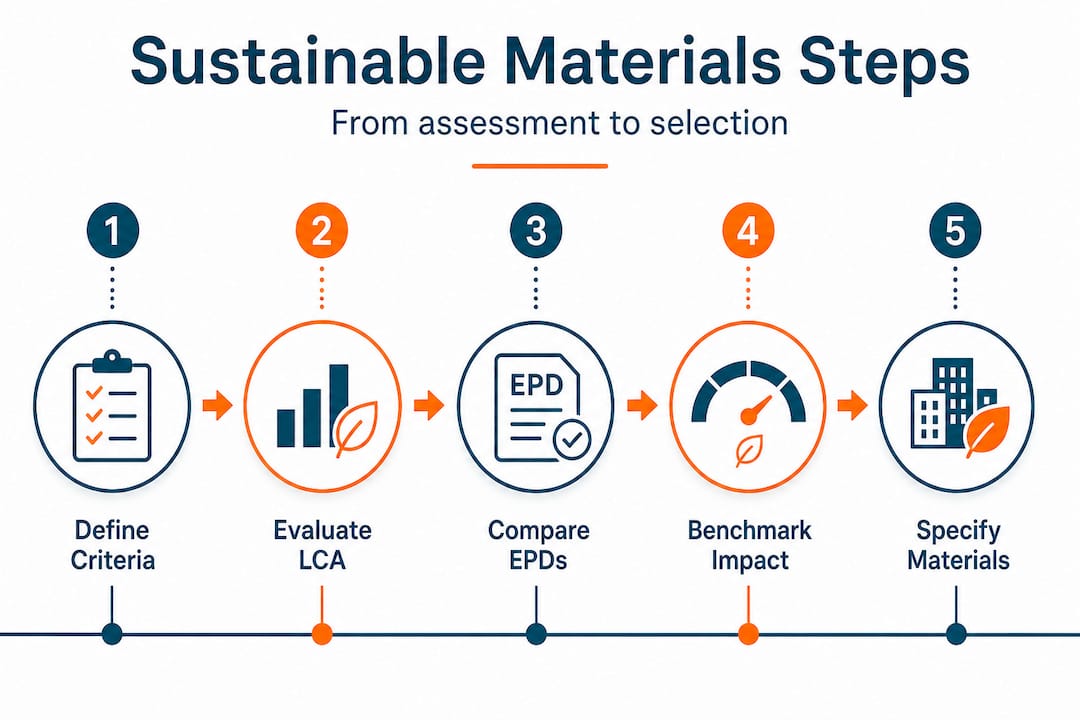
The answer is life-cycle assessment (LCA), which is the systematic process for quantifying environmental impacts across every stage of a material’s life. LCA in professional practice is increasingly operationalized through Environmental Product Declarations (EPDs), which are standardized, third-party verified documents that report a product’s environmental performance data in a consistent format.
Here is a practical four-step process for integrating LCA into your material selection workflow:
- Define the functional unit. Specify exactly what you are comparing, for example, one square meter of flooring with a 30-year service life at a defined load and wear category. Comparing materials without a consistent functional unit produces meaningless results.
- Set system boundaries. Decide whether your assessment covers cradle-to-gate (extraction through manufacturing), cradle-to-site (adding transport), or cradle-to-grave (full life cycle including disposal). For specification decisions, cradle-to-gate data is often what EPDs provide, but whole-building analysis should extend further.
- Gather and compare EPD data. Pull verified EPDs for each candidate material. Focus on Global Warming Potential (GWP) measured in kg CO2 equivalent, but also review acidification potential, eutrophication, and fossil fuel depletion where relevant.
- Interpret in context. Raw EPD numbers only matter relative to alternatives and project performance requirements. A material with lower GWP that requires replacement twice as often may generate higher total impacts than a durable conventional option.
One critical shift happening right now in the profession is the growing dominance of embodied carbon. As buildings become more energy efficient through better insulation and mechanical systems, embodied impacts can dominate once operational energy shrinks. That means your material choices carry more long-term emissions weight than they did a decade ago. This is not a future trend; it is the current reality on high-performance projects.
| Tool | Primary use | Key metrics tracked | Third-party verification |
|---|---|---|---|
| EC3 (Embodied Carbon in Construction Calculator) | Upfront embodied carbon benchmarking | GWP (A1-A3 stages) | Requires verified EPDs |
| Athena Impact Estimator | Whole-building LCA | Multiple impact categories | Internal database, peer-reviewed |
| OneClickLCA | Project-level and product comparison | GWP, acidification, eutrophication | Integrates verified EPDs |
| SimaPro | Academic and advanced practice LCA | Full impact category suite | User-defined databases |
Pro Tip: Always verify that an EPD has third-party certification from a recognized program operator such as UL Environment, NSF International, or the International EPD System. Self-declared EPDs without independent verification are not a reliable basis for specification decisions.
Benchmarking and comparing material impacts
Now that we have tools, let’s walk through practical benchmarking and material comparison in real-world projects. Benchmarking is where abstract sustainability frameworks become actionable design decisions.
Whole-building embodied carbon benchmarks are increasingly supported by tools like EC3, which allows project teams to pull EPD data for specific products and compare them against category averages. The process requires a few key data inputs:
- Verified EPDs for each material being evaluated
- Quantity takeoffs from your project drawings, even at a preliminary stage
- Functional unit definitions to ensure apples-to-apples comparisons
- Project baseline data if you are measuring against a code-minimum or industry-average benchmark
The results of that work can be striking. Consider how conventional structural and finish materials compare to their improved counterparts:
| Material category | Conventional option | Sustainable upgrade | Typical GWP reduction |
|---|---|---|---|
| Ready-mix concrete | Standard OPC mix | Low-carbon SCM blend (fly ash, slag) | 20% to 40% |
| Structural steel | Virgin steel, basic oxygen furnace | Electric arc furnace recycled content steel | 50% to 75% |
| Mass timber structure | Conventional concrete frame | Cross-laminated timber (CLT) | 30% to 60% (including biogenic carbon) |
| Exterior insulation | Petroleum-based foam board | Mineral wool or wood fiber board | 15% to 35% |
| Interior finishes | Standard vinyl flooring | Linoleum or reclaimed hardwood | 25% to 50% |
Key stat: Environmental performance carries approximately 36.4% of the weighting in professional sustainability frameworks, making it the single heaviest criterion cluster. That weight justifies the investment in proper benchmarking rather than relying on marketing claims.
Transparent benchmarking also strengthens your position at the specification table. When you can show a client or owner that switching from a standard concrete mix to a supplementary cementitious material blend reduces the project’s embodied carbon by 35% at equivalent structural performance and minimal cost premium, that is a compelling, documented argument. It moves the conversation from “this feels more sustainable” to “here is the verified impact.”

Advanced approaches: Carbon-storing materials and beyond
Having benchmarked standard and improved materials, let’s go further. A growing category of materials does not just reduce emissions; it actually sequesters carbon within the building assembly.
Carbon-storing approaches include bio-based materials like cross-laminated timber (CLT), mass timber, hempcrete, straw bale, and certain advanced concrete formulations that incorporate mineralized carbon. Wood products store biogenic carbon (carbon absorbed by trees during growth) within the assembly for the building’s service life, which can show up as a negative GWP value in an LCA. That is a remarkable characteristic, but it comes with important caveats.
Here is where each innovative material category fits best in current practice:
- Mass timber and CLT: Structural applications in mid-rise commercial and residential buildings. Strong carbon storage credentials, good thermal mass, and excellent aesthetic integration. Best when sourced from certified sustainable forestry operations.
- Hempcrete and straw bale: Envelope and infill wall applications, particularly in low-rise and renovation contexts. Outstanding thermal performance and carbon storage, but require skilled installation and careful detailing for moisture management.
- Low-carbon and carbon-mineralized concrete: Foundation systems, parking structures, and any application where concrete is unavoidable. Supplementary cementitious materials and carbon cure technologies reduce and offset embodied carbon significantly.
- Reclaimed and salvaged materials: Renovation projects and interior finishes. Eliminates upstream production impacts almost entirely, though sourcing reliability and documentation for LEED or LCA purposes can be challenging.
“Biogenic carbon accounting in LCA results is one of the most actively debated topics in the profession right now. Depending on the methodology used, a mass timber building can appear carbon-negative or carbon-neutral, which has major implications for project sustainability claims and reporting.”
The caution here is real. Carbon accounting for bio-based materials is not yet fully standardized across LCA methodologies. Some frameworks count biogenic carbon storage as a benefit at the point of installation and then charge it back at end of life; others discount it significantly due to uncertainties in permanence. You need to understand which convention your analysis tool uses before presenting results to clients or regulatory bodies. The science is strong, but the standardization is still catching up.
Verification matters enormously in this space. Forest Stewardship Council (FSC) certification for timber, Environmental Product Declarations that clearly state their biogenic carbon accounting approach, and independent third-party review of whole-building LCA claims are not optional extras; they are professional due diligence.
The uncomfortable truth most professionals miss about sustainable materials
With the technical best practices covered, it’s worth addressing a professional reality that few guides fully lay bare.
Checklists and green labels are a starting point. They are not a destination. We have seen projects where a product carried every recognizable green certification on the market, was specified with genuine care, and still failed to deliver on its sustainability promise because the design team did not verify how it performed in context. One example that comes to mind involves a “recycled content” composite decking product specified on a multifamily project. Within two years of installation, significant moisture-related degradation required wholesale replacement. The replacement cycle generated more total environmental impact, more waste, more transportation emissions, than a conventional pressure-treated timber deck with proper detailing would have produced. The certification was real. The performance was not adequate for that specific application.
Many professionals still describe sustainable materials primarily as renewable or recyclable, which is understandable given how the marketing frames these products. But professional frameworks are forcing a life-cycle accounting mindset, and that is genuinely good for the profession. It means you are building a more defensible, replicable decision process rather than relying on vendor claims.
The practical implication is this: sustainable material selection requires hands-on verification, nuanced benchmarking, and careful documentation of how all project constraints interact. That includes climate zone, occupancy type, maintenance capacity, structural loading, and budget reality. A material that is highly sustainable in one context can be the wrong choice in another. Life-cycle thinking is not an add-on to professional practice; it is increasingly core to it.
Pro Tip: Build a habit of revisiting your past material specifications. Did they perform as expected? What did you learn? The tools and science in this space evolve quickly, and professionals who update their assumptions regularly stay ahead of both compliance requirements and client expectations.
Advance your knowledge in sustainable building materials
If you’re serious about elevating your project outcomes and CE profile, the right resources can make all the difference. Understanding what sustainable building materials are is only the first step; applying that knowledge with professional rigor across real projects is where career-defining expertise is built.
At Ron Blank and Associates, we develop AIA-registered continuing education resources that go well beyond surface-level green building overviews. Our GreenCE courses cover life-cycle assessment methodology, EPD interpretation, embodied carbon benchmarking, and emerging material categories, all delivered through online courses, webinars, podcasts, and face-to-face formats. Whether you are pursuing AIA Learning Units, deepening your team’s specification confidence, or helping building product manufacturers get their products understood and specified correctly, we have courses built for exactly where you are in your practice. The professionals who invest in this kind of structured learning are the ones whose sustainability claims hold up under scrutiny.
Frequently asked questions
What is the difference between green and sustainable building materials?
Green and sustainable building materials both aim to reduce environmental impact, but sustainability measures life-cycle impacts across technical, economic, and social dimensions, not just environmental attributes at the point of manufacture.
How do life-cycle assessments (LCAs) help select sustainable building materials?
LCAs evaluate total environmental impact across a material’s entire lifespan, from raw material extraction through end of life, giving professionals a verified, comparable basis for material choices rather than relying on marketing claims.
Which tools are recognized for benchmarking embodied carbon in building materials?
The EC3 tool is widely recognized for benchmarking upfront supply chain emissions using third-party verified EPDs, and it integrates directly with project quantity takeoffs to produce project-level comparisons.
Can conventional materials like concrete and steel be sustainable?
Yes, specifying low-carbon or recycled content variants of concrete and steel can reduce embodied carbon by 20% to 75% compared to standard production methods, making familiar materials viable in high-performance sustainable projects.
Why is embodied carbon gaining importance relative to operational energy?
As buildings achieve greater energy efficiency through improved envelopes and mechanical systems, embodied impacts dominate the overall life-cycle emissions profile, which means material choices now carry more long-term environmental weight than they did in past decades.