

TL;DR:
- Facade engineering is a multidisciplinary discipline that designs, analyzes, and coordinates a building’s exterior envelope to ensure safety, durability, and performance. It involves managing structural loads, weatherproofing, fire safety, thermal and acoustical performance, and buildability, making it essential for long-lasting, high-performing buildings. Early and integrated facade engineering reduces project risks, failures, and costly changes, emphasizing continued education and system thinking for professionals in the field.
Facade engineering is often misunderstood as the practice of making buildings look good. Walk past any construction site, and you might hear someone describe the facade as “just the skin.” That framing, while catchy, is dangerously incomplete. Facade engineering is the discipline that designs, analyzes, and coordinates a building’s exterior envelope systems so they achieve structural safety and performance targets such as environmental enclosure, fire containment, and long-term durability. For architects and engineers working on complex building envelopes, this distinction is not academic. It is the difference between a building that performs for decades and one that fails at the first edge detail.
Table of Contents
- What facade engineering really means
- Core components and systems of a facade
- Key challenges: coordination, performance, and code compliance
- Continuing education: AIA-approved pathways for architects and engineers
- Why treating facade engineering as a discipline, not an afterthought, is essential
- Advance your expertise with AIA-certified facade engineering education
- Frequently asked questions
Key Takeaways
| Point | Details |
|---|---|
| Multidisciplinary approach | Façade engineering relies on integrating structural, environmental, and compliance factors beyond just appearance. |
| System interfaces matter | Joints, fixings, sealants, and movement must be coordinated for durability and safety. |
| Code and fire safety are core | Effective façade engineering ties closely to building code compliance and active fire protection. |
| Continuing education helps mitigate risk | AIA-accredited CE opportunities equip architects and engineers with actionable knowledge for complex façade challenges. |
| Attitude shift needed | Treating façade engineering as an engineered system, not a cosmetic detail, leads to safer, more resilient buildings. |
What facade engineering really means
With the overall importance established, it is worth clarifying what facade engineering actually involves and what it is not.
Most architects encounter facade systems through material selections and visual intent. A glazed curtainwall, a rain screen panel, or a precast concrete cladding system all look like design decisions on a drawing. But underneath every one of those choices sits a dense web of structural loads, moisture management requirements, thermal bridging risks, fire safety demands, and acoustic constraints. Facade engineering integrates structural, environmental, and aesthetic performance through careful coordination of multiple technical disciplines working simultaneously.
The misconception that facade equals aesthetics is persistent. It shows up in project schedules when facade coordination is treated as a late-stage task rather than a foundational design activity. It shows up in RFIs (requests for information) during construction when interface conditions between the facade system and the structural frame have not been resolved. And it shows up in litigation when water infiltration or cladding failures are traced back to inadequate engineering engagement at the early design phase.
Here is what facade engineering actually covers:
- Structural performance: Wind loads, seismic forces, gravity loads from cladding weight, and deflection compatibility with the primary structure
- Weathertightness: Rain screen principles, drainage planes, vapor control layers, and air barrier continuity
- Fire safety: Cavity barriers, fire stops at floor lines, and code-compliant enclosure of combustible elements
- Thermal performance: U-value targets, thermal bridge analysis, and compliance with energy codes such as ASHRAE 90.1
- Acoustics: Sound transmission class (STC) ratings and facade contribution to interior noise levels
- Durability: Material compatibility, corrosion protection, sealant life cycles, and maintenance access
- Buildability: Connection sequences, construction tolerances, and coordination with the structural frame
“A building’s exterior envelope is the boundary between a controlled interior environment and an uncontrolled exterior environment. Every joint, fixing, and interface in that boundary is an opportunity for failure if it is not carefully engineered.”
| Performance category | Key concern | Common failure mode |
|---|---|---|
| Structural | Wind and seismic loads | Bracket failure, glass breakage |
| Weathertightness | Air and water infiltration | Condensation, mold, water damage |
| Fire | Cavity and floor-line barriers | Uncontrolled fire spread |
| Thermal | Heat loss through frame | Energy penalty, condensation |
| Acoustics | External noise ingress | Code non-compliance, occupant complaints |
| Durability | Sealant and coating degradation | Water infiltration, corrosion |
Integration matters because failures rarely involve only one of these categories. A thermal bridge through a steel fixing bracket can cause condensation on an interior surface, which then contributes to corrosion of the fixing itself, ultimately compromising the structural integrity of the cladding attachment. The disciplines are not parallel. They are interdependent.
Core components and systems of a facade
After clarifying what facade engineering is, let’s unpack its core elements and why each one matters for project success.
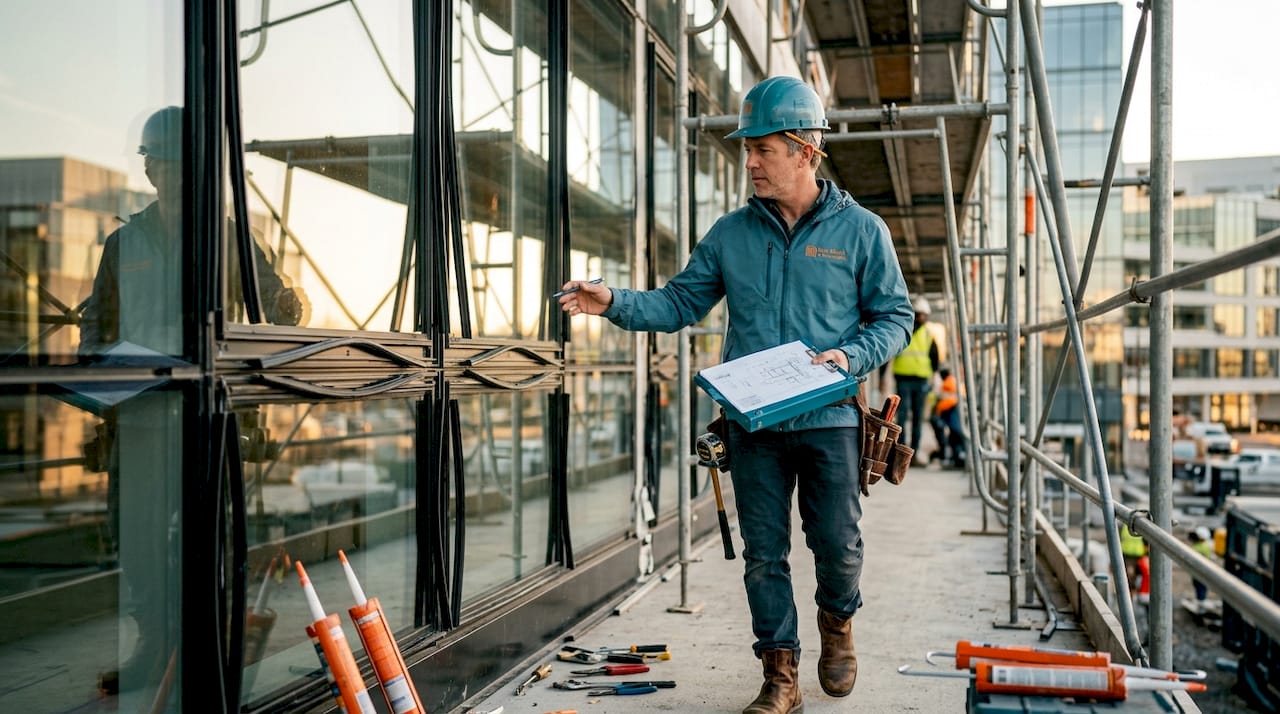
A facade system is not a single product. It is an assembly of layered components, each with its own performance requirement, tolerance band, and interface condition with adjacent elements. Facade engineering addresses the face material and the critical interfaces, including joints, sealants, drainage cavities, and movement accommodation. Missing any one of these layers can compromise the performance of the whole system.
Here are the major components and why each one demands engineering attention:
- Face material: Glass, metal panels, stone, terracotta, fiber cement, or precast concrete. Each has different weight, thermal expansion rates, and attachment requirements. Getting the face material wrong means the structural frame and fixings are also wrong.
- Primary structure and backup system: The steel or concrete frame that the facade brackets attach to. Deflection limits in the primary structure directly affect whether the facade system can accommodate movement without distress.
- Brackets and fixings: The mechanical connection between the facade system and the structure. Bracket geometry, material selection (stainless steel versus galvanized), and load transfer path are all engineered decisions.
- Thermal break elements: Insulators within the fixing system that reduce heat flow through metal anchors. Omitting these creates measurable thermal bridges that show up in energy modeling and infrared inspections.
- Air and vapor barriers: Continuous membranes that control air leakage and moisture movement. Continuity at window interfaces, penetrations, and floor lines is where most air barrier failures occur.
- Drainage and ventilated cavities: The space between the cladding and the air barrier that allows moisture to drain and vapor to escape. Cavity geometry, weep hole sizing, and insulation placement all affect cavity performance.
- Joints and sealants: Movement joints allow differential movement between facade panels or between the facade and the structure. Sealant selection, joint sizing, and substrate preparation are all engineered, not improvised on site.
- Fire stops and cavity barriers: Code-required elements that interrupt the cavity at floor lines and compartment boundaries to prevent fire and smoke spread through the facade cavity.
Pro Tip: When reviewing facade shop drawings, always trace the continuity of the air barrier and the fire stop line simultaneously. These two elements frequently conflict at window heads and floor line interfaces, and resolving the conflict in the drawing phase is far less expensive than resolving it during construction.
Joints and sealants deserve special mention because they are among the most frequent sources of facade failures in practice. A sealant joint that is too narrow cannot accommodate the thermal expansion of the adjacent panels, leading to sealant failure. A joint that is too wide fails cohesively under wind suction. The engineering of a sealant joint requires knowledge of panel material thermal expansion coefficients, expected temperature differentials, structural frame deflection values, and sealant elongation capacity. It looks like a line on a drawing but functions as a precision-engineered component.
Key challenges: coordination, performance, and code compliance
Understanding the components is essential, but it is equally important to see where even carefully specified facades can fail without proper coordination and code consideration.
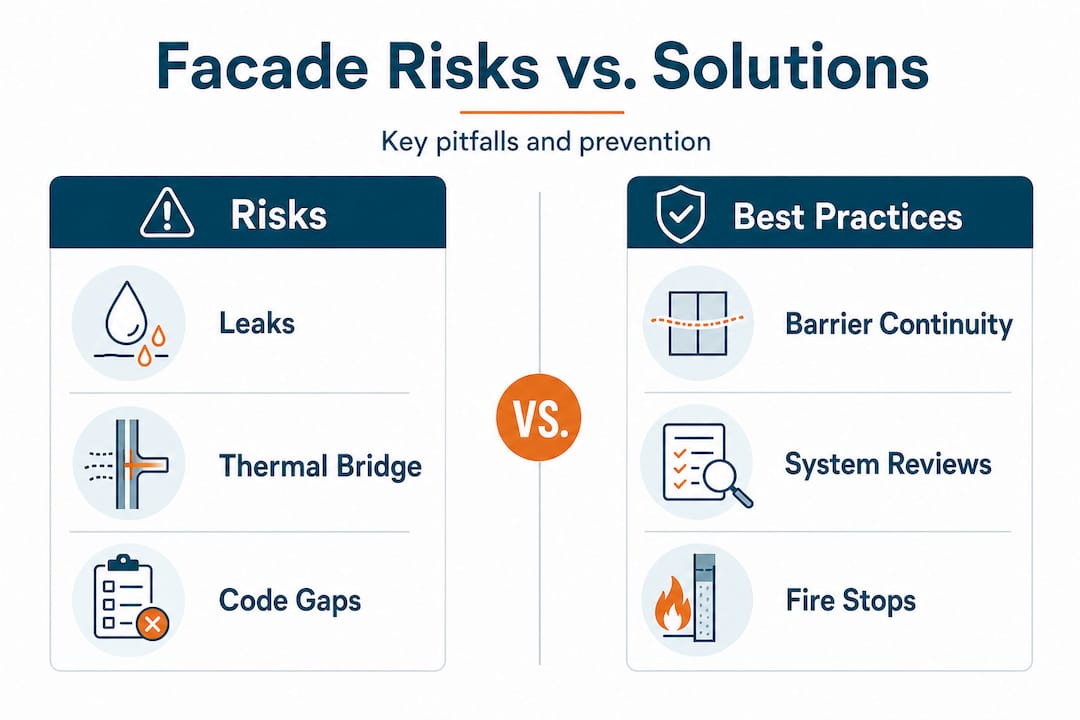
Facade engineering failures in practice almost never trace back to a single material deficiency. They trace back to coordination failures at the boundaries between design disciplines, construction trades, and procurement packages. Attachment mechanics, structural behavior, and code and fire compliance are core to the practice, and they are all areas where coordination gaps create disproportionate risk.
Consider some of the most common real-world challenges:
- Movement compatibility: The primary structure deflects under load. The facade must accommodate that deflection without transferring loads to adjacent panels or breaking glass. Getting the movement accommodation wrong is one of the leading causes of glass breakage and panel dislodgement.
- Interface failures: Edge failures have led to water ingress, thermal bridging, and glass breakage where coordination between the facade engineer, the structural engineer, and the facade contractor was not achieved. The edge of a slab is where the most concentrated risks sit.
- Fire and code compliance: Building codes require fire stops at every floor line in a ventilated facade cavity. These stops must be detailed, specified, and inspected. When they are missing or incorrectly installed, the consequences can be catastrophic. Architects and engineers should be familiar with fire protection compliancerequirements that apply to both new construction and facade renovation projects.
- Procurement fragmentation: On many projects, the facade system is split across multiple trade packages. The curtainwall contractor installs the glazing system, a separate contractor installs the backup wall, and another installs the waterproofing. Each contractor is responsible for their scope, but the interface conditions between scopes belong to no one unless the design team explicitly manages them.
- Late engagement: Facade engineers are sometimes brought onto projects after the architectural design is already well advanced. By that point, floor-to-floor heights, structural framing positions, and service routes may already preclude the most efficient facade solutions.
Pro Tip: Building in a formal facade interface review at the end of design development, before construction documents begin, allows the project team to resolve the most expensive coordination conflicts when changes are still relatively inexpensive.
The risk picture is significant. Water infiltration claims are among the most common construction defect litigation categories in the United States. Many of those claims trace to facade system failures at joints, interfaces, or penetrations that were not properly engineered during the design phase. This is why AIA continuing education in facade engineering is not a luxury for specialists. It is practical risk management for every architect involved in building envelope design.
Continuing education: AIA-approved pathways for architects and engineers
To stay current and reduce project risk, the field offers targeted learning options. Here is how you can access them effectively.
Facade engineering is not a static discipline. Building codes evolve, new facade system types enter the market, and forensic investigations of building failures regularly produce lessons that change best practice. Architects and engineers who rely on knowledge from five or ten years ago are working with an incomplete picture. AIA-approved continuing education is the most structured way to close that gap.
AIA CE courses in facade engineering, such as those offered by Hilti’s facade engineering series, target the specific technical areas where knowledge gaps cause project risk: attachment mechanisms, fire barriers, building code issues, and system-level performance. These are not survey courses. They address the precise technical interfaces that generate RFIs, change orders, and defect claims.
Here is how to choose facade CE that actually closes real skill gaps:
- Look for code-specific content: Generic facade CE that does not reference the International Building Code (IBC) or ASHRAE energy standards is unlikely to prepare you for the compliance decisions you face on real projects. Courses that walk through code requirements in the context of specific facade system types deliver more transferable value.
- Prioritize detail and connection content: The most consequential decisions in facade design happen at connections, interfaces, and transitions. CE that covers bracket design, air barrier continuity, and fire stop detailing is directly applicable to everyday practice.
- Seek courses that address failure modes: Learning what goes wrong and why is often more instructive than learning what to do correctly. CE courses that include case studies of facade failures provide a framework for recognizing risk on your own projects.
- Choose AIA-registered programs for LU/HSW credit: Health, Safety, and Welfare (HSW) hours are required for AIA membership renewal. Facade engineering, because it addresses fire safety, structural performance, and weathertightness, typically qualifies for HSW credit. Verify this before enrolling.
- Match course format to your learning style: Online self-paced courses, live webinars, and in-person sessions all deliver different learning experiences. Complex technical content often benefits from a format that allows questions and discussion.
Pro Tip: If you are a project architect managing a facade package for the first time, look specifically for CE courses that cover the facade procurement and coordination process, not just the technical content. Understanding how facade contracts are structured helps you ask better questions during design and construction.
Why treating facade engineering as a discipline, not an afterthought, is essential
We have worked with enough architects and engineers over the years to see a clear pattern. The projects that go smoothly are not always the ones with the most sophisticated facade systems. They are the ones where facade engineering was treated as a discipline with its own rigor and timeline, starting early and staying integrated throughout the process.
The reality of facade engineering as an engineered system with multidisciplinary constraints, failure risks across the entire envelope, and real buildability concerns means that a design mindset alone is insufficient. You need an engineering mindset: one that asks not just “does this look right?” but “how does this perform under the worst expected conditions?”
Real-world failures almost never stem from a facade that looks wrong. They come from physics that was not respected at a fixing point, a cavity that was not drained, a fire stop that was never installed, or a sealant joint that was sized for appearance rather than movement. These are engineering problems, not aesthetic ones.
We also see a tendency to treat facade engineers as consultants who review other people’s decisions rather than as core members of the design team who shape decisions from the start. That attitude is expensive. Facade engineers who are engaged early can influence floor-to-floor heights, structural frame positions, and service routing in ways that make the facade system more efficient, more buildable, and more cost-effective. Engaged late, they can only document problems and recommend expensive changes.
The professionals who distinguish themselves in this space are the ones who adopt a systems thinking approach. They recognize that every joint, bracket, and interface is part of a whole envelope that either performs or fails as a system. That mindset is teachable, and structured continuing education is one of the most reliable ways to build it.
Advance your expertise with AIA-certified facade engineering education
Facade engineering knowledge at this level does not happen by accident. It builds through deliberate study, practice, and structured exposure to the cases and code requirements that shape real project decisions.

At Ron Blank and Associates, we work with AIA-accredited course providers and building product manufacturers to deliver continuing education that connects technical depth with practical application. Our AIA facade engineering courses are available as online self-paced programs, live webinars, and in-person sessions, designed to fit into a working professional’s schedule. Whether you are building foundational knowledge or filling specific gaps in fire compliance or curtainwall detailing, our catalog has pathways that earn you LU/HSW credit while delivering skills you can use the next day on a real project. Visit us to explore what is available and take the next step in building your expertise.
Frequently asked questions
What exactly does a facade engineer do?
A facade engineer designs and manages the technical performance of a building’s outer envelope, ensuring structural safety, weatherproofing, and code compliance. Facade engineering involves design, analysis, and coordination of a building’s exterior envelope systems across multiple performance targets.
How does facade engineering differ from architectural design?
Facade engineering focuses on the technical and structural performance of the building envelope, while architectural design addresses both form and overall design intent. Facade engineering is a discipline integrating technical fields to ensure envelope performance, not aesthetics alone.
Why is movement compatibility important in facade engineering?
Movement compatibility prevents failures such as glass breakage or panel dislodgement by ensuring the facade system can accommodate structural and thermal shifts without distress. Facade and building movements must be coordinated to avoid these costly failure modes.
What topics do AIA-accredited facade engineering courses usually cover?
They typically include facade system types, attachment mechanisms, fire barrier requirements, and current building code compliance strategies. Hilti’s AIA-accredited facade course covers all four of these areas with practical application content.
Can facade engineering help reduce fire risk?
Yes. By addressing cavity barriers, fire stops at floor lines, and code-compliant enclosure details, facade engineers directly limit the conditions that allow fire to spread through an exterior envelope. Facade engineering resolves fire-related issues by integrating fire and cavity barriers as part of the overall envelope system.