

TL;DR:
- Understanding and strategically pursuing LEED credits through continuing education enhances both sustainability expertise and professional credentials.
- Professionals should verify course accreditation, document hours promptly, and align CE topics with project needs to maximize career growth.
Navigating the LEED credit system can feel like trying to read a blueprint without a legend. Many architects and engineers understand the value of LEED credentials, but the actual process of earning, documenting, and verifying those credits often creates confusion that leads to missed deadlines, unqualified courses, and lost opportunities. The good news is that once you understand the structure, earning LEED credits through continuing education (CE) becomes a manageable and genuinely rewarding part of your professional practice. This guide walks you through every step, from understanding what LEED credits mean for your career to verifying your completed hours with the right authorities.
Table of Contents
- Understanding LEED credits and their value
- What you need before starting: requirements and eligible courses
- Step-by-step: how to earn LEED credits through CE courses
- Common mistakes and how to avoid them
- Validating your credits: how to track and verify completion
- The real value of LEED credits—what most professionals overlook
- Take your LEED expertise further
- Frequently asked questions
Key Takeaways
| Point | Details |
|---|---|
| LEED credits explained | LEED credits represent professional steps toward sustainable design leadership. |
| Preparation is key | Check all eligibility and accreditation requirements before choosing courses. |
| Streamline your process | Use accredited, high-value CE courses that overlap with AIA and LEED needs. |
| Track everything carefully | Maintain a digital log to verify, document, and troubleshoot your credits. |
| Look beyond compliance | Maximizing LEED credits can unlock career advancement and meaningful project successes. |
Understanding LEED credits and their value
LEED, which stands for Leadership in Energy and Environmental Design, is the most widely used green building rating system in the world. Managed by the U.S. Green Building Council (USGBC) and its credentialing arm the Green Business Certification Inc. (GBCI), LEED measures how sustainable a building project is across categories like energy efficiency, water use, indoor environmental quality, and materials selection.
For architects and engineers, LEED credits serve two distinct purposes. First, they contribute to the sustainability score of a project under review for LEED certification. Second, earning LEED CE hours through continuing education helps you maintain your professional credentials, including your LEED AP or LEED Green Associate designation, and supports your AIA license renewal. That overlap is a major advantage that many professionals miss entirely.
Here is a quick breakdown of the core benefits:
- Career advancement: LEED credentials signal expertise in sustainable design, which clients, firms, and public agencies increasingly demand.
- Project compliance: On projects pursuing LEED certification, having credentialed team members strengthens the project’s standing with reviewers.
- Dual-purpose learning: LEED CE enhances AIA compliance and project sustainability qualifications, especially when focused on health, safety, and welfare (HSW) topics.
- Professional differentiation: In a competitive market, sustainability credentials separate you from peers who only hold basic licensure.
“The most strategic professionals don’t treat LEED CE as a separate obligation. They find courses that satisfy both AIA HSW requirements and LEED credit hours simultaneously, effectively doubling the return on their learning investment.”
Understanding green certification best practices before you start a project can also clarify which CE topics will be most relevant to your upcoming work. Aligning your education with your project pipeline is a smart move that few professionals make consistently.
What you need before starting: requirements and eligible courses
Before you register for your first qualifying course, you need to understand the landscape. Not every continuing education course earns LEED credit. There are specific accreditation and content requirements, and getting this wrong early costs you both time and money.

The GBCI requires LEED APs and Green Associates to earn 30 CE hours every two years, with at least six of those hours coming directly from LEED-specific topics. The AIA requires 18 HSW hours annually for license renewal. The overlap between HSW content and LEED topics is where smart professionals focus their energy.
| Requirement | Who governs it | Hours required | Content focus |
|---|---|---|---|
| LEED credential renewal | GBCI | 30 hours per 2-year cycle | At least 6 LEED-specific |
| AIA license renewal | AIA/state boards | 18 HSW hours/year (varies by state) | Health, safety, welfare |
| Overlap zone | Both | Variable | HSW + sustainability topics |
Courses that count toward LEED CE must come from approved education providers. These include AIA-registered providers, USGBC-recognized programs, and other GBCI-approved sources. Before you enroll, verify the course provider’s accreditation status directly on the GBCI or AIA websites.
Here is what you will need to gather before you begin:
- Active credential: Your LEED AP, LEED AP with specialty, or LEED Green Associate credential must be current.
- GBCI account: You will track and submit hours through your personal GBCI dashboard.
- AIA account (if applicable): AIA members use the AIA’s CE tracking system, which is separate from GBCI.
- Documentation readiness: Keep a folder, digital or physical, where you store completion certificates immediately after finishing each course.
When selecting courses, prioritize LEED-eligible materials and specification topics. These tend to satisfy both GBCI content requirements and AIA HSW criteria simultaneously.
Pro Tip: Before enrolling in any course, look for the specific credential notation on the course description. It should explicitly state that it provides LEED CE hours and identify the number of hours awarded. If that information is not clearly listed, contact the provider before you commit your time.
Step-by-step: how to earn LEED credits through CE courses
With all prerequisites in place, here is your clear road map for earning and recording LEED credits through continuing education.
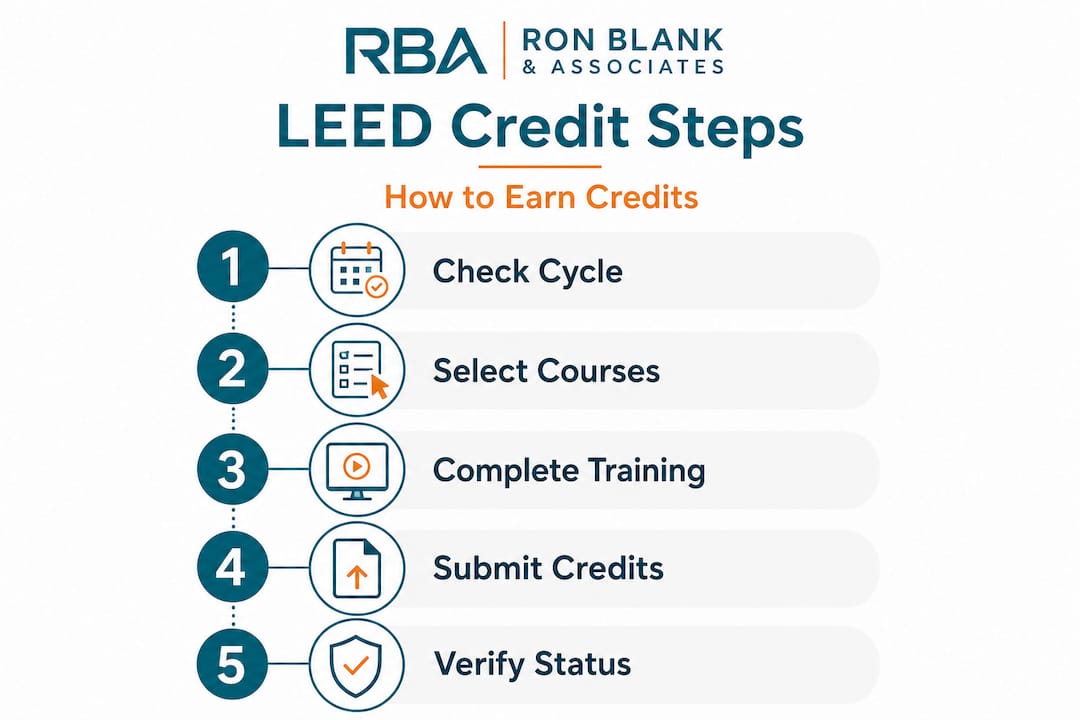
Step 1: Identify your required credits for LEED and AIA/GBCI reporting.
Log into your GBCI account and review your current credential cycle. Note the expiration date, how many hours you have already logged, and how many LEED-specific hours you still need. Do the same in your AIA account if you are a licensed architect. This gives you an accurate picture of your gap, not just a vague sense that you need “more credits.”
Step 2: Select relevant, accredited continuing education courses.
Search for courses that explicitly carry GBCI-approved CE hours. Prioritize topics that align with the LEED credit categories most relevant to your practice, such as energy and atmosphere, materials and resources, or indoor environmental quality. LEED CE enhances AIA compliance most effectively when you select courses that carry both HSW designation and LEED credit recognition.
Step 3: Complete the courses strategically.
Do not rush through courses just to check a box. The professionals who benefit most from LEED CE treat each course as a design tool. A course on natural materials and sustainable design can directly influence how you specify materials on a current project, creating an immediate return on your learning time.
Step 4: Document and submit CE credits to GBCI and AIA.
This is where many professionals stumble. After completing a course, you must actively report it. Some providers auto-report to GBCI or AIA, but many do not. Save your completion certificate immediately and log the hours manually in your GBCI or AIA dashboard within a few days of completion. Waiting until the end of your cycle creates risk.
Here is a comparison to help you decide between coursework and direct project participation:
| Credit pathway | Time required | Documentation burden | Best for |
|---|---|---|---|
| Accredited CE courses | Moderate | Low to moderate | Consistent annual credit earning |
| Project participation | High | Very high | Professionals actively working on LEED projects |
| Combination approach | Moderate to high | Moderate | Most professionals in active practice |
“Think of LEED CE coursework as the foundation and project participation as the specialization. You need both to build a truly credible sustainability practice.”
Pro Tip: Stack your learning. When you find a course that earns both AIA HSW hours and LEED CE hours, you are getting two credits for one investment of time. Many AIA-registered provider courses carry both designations, so look carefully at the course details before enrolling.
Common mistakes and how to avoid them
Even with a clear process, mistakes can cause setbacks. Here are the most common ones we see, and how to steer clear of them.
Mistake 1: Missing documentation deadlines.
GBCI credential cycles are strict. If your credential expires before you submit your required hours, your LEED designation lapses. Reinstating a lapsed credential takes extra effort, fees, and in some cases an exam retake. Set a calendar reminder at least 60 days before your credential expiration date to review your credit balance.
Mistake 2: Assuming all continuing education courses qualify.
This is one of the most expensive mistakes in the process. Not all CE courses earn LEED hours, even if they cover sustainability topics. The course must be from an approved provider and explicitly carry GBCI recognition. Always verify accreditation before enrolling, not after. Quality materials knowledge is valuable, but only counts toward LEED CE if the course delivering it is properly accredited.
Mistake 3: Missing the HSW and LEED topic overlap.
Many architects and engineers treat AIA renewal and LEED CE renewal as two completely separate tasks. They are not. Focusing on HSW topics creates natural overlap between the two systems, which saves you time and sharpens your professional expertise in areas that matter most to project quality.
Mistake 4: Poor record keeping.
Losing a completion certificate or forgetting to log a course that you actually finished is more common than you would think. If a course does not auto-report to GBCI or AIA, it is your responsibility to log it. Disputes over missing credits are stressful and hard to resolve after the fact.
“A professional who earns 40 credits but documents only 28 has the same standing as one who earned only 28. Documentation is not optional. It is the credential.”
Pro Tip: Set calendar reminders at three points in your credential cycle: at the start (when you plan your CE for the year), at the midpoint (to check your progress), and 60 days before expiration (to complete any remaining gaps and confirm submissions). This three-touch system eliminates end-of-cycle panic.
Validating your credits: how to track and verify completion
After avoiding the usual mistakes, you will need to verify your hard-earned credits to ensure they count toward your professional standing.
Step 1: Create a personal CE log.
Use a simple spreadsheet or a dedicated app to track every course you complete. Record the course name, provider, date completed, number of hours, credit type (LEED-specific, HSW, general), and whether you submitted it to GBCI or AIA. This log is your backup if any submission is disputed.
Step 2: Submit credit proof to GBCI and AIA.
After completing each course, check whether the provider auto-reports to GBCI or AIA. If they do, verify that the credits appear in your account within a week or two. If they do not auto-report, upload your certificate and log the hours manually. Do not wait until the end of your cycle to do a bulk submission.
Step 3: Troubleshoot missing or unrecognized credits.
If a course does not appear in your GBCI or AIA account after a reasonable period, contact the course provider first. They can often resubmit the data. If the issue persists, contact GBCI or AIA directly with your completion certificate as proof. Having your personal log and certificate stored together makes this process much smoother. Understanding green building fundamentals can also help you confirm that the courses you are taking genuinely fall within the recognized content categories.
Step 4: Confirm your credential status before the deadline.
Do not assume your submissions were accepted. Log into both GBCI and AIA dashboards a few weeks before your renewal date and confirm that your total hours meet the requirement. If there is a shortfall, you still have time to fill it.
Pro Tip: Several digital platforms allow you to consolidate CE tracking across multiple credential systems. Using one of these tools reduces the chance of losing hours between different reporting portals, especially if you hold both a LEED designation and an active AIA membership.
The real value of LEED credits—what most professionals overlook
With the practical process complete, it is time to rethink what earning LEED credits truly means for your career.
Most professionals treat LEED CE as a compliance obligation. Earn the hours, submit the documentation, move on. That mindset leaves a significant portion of the value on the table. The professionals we see making the biggest leaps in their careers are not just checking boxes. They are choosing CE topics that actively challenge their assumptions about sustainable design and push them toward specializations that open unexpected doors.
We have seen engineers who pursued LEED CE in indoor environmental quality go on to lead occupant wellness consulting practices. We have watched architects who invested time in materials and resources courses become the go-to specification experts in their firms. These outcomes were not accidental. They came from treating each course as a strategic career investment, not a renewal tax.
There is also a leadership dimension to LEED credentials that many professionals underestimate. Sustaining deep knowledge in CE through consistent HSW and sustainability-focused education positions you as the person in the room who actually understands why design decisions matter, not just what the code requires. That knowledge base creates influence.
The honest truth is that the LEED credit process is not difficult once you know it. What it rewards is intentionality. The professionals who extract the most value from it are those who plan their CE year with the same care they give their project schedules. That shift in mindset, from reactive compliance to proactive strategy, is where real career differentiation begins.
Take your LEED expertise further
Ready to move from knowing the process to making progress? The most effective way to close your LEED credit gap while also satisfying AIA renewal requirements is to work with a provider who understands both systems and has already done the accreditation work for you.

At Ron Blank and Associates, we offer GBCI CE courses on our siteGreenCE. that are registered with the American Institute of Architects and GBCI and designed specifically for architects, engineers, interior designers, and contractors. Our courses are available as online modules, webinars, podcasts, and face-to-face formats, so you can earn credits in the format that fits your schedule. Whether you need to fill a GBCI reporting gap or build deeper expertise in sustainable design, our course library gives you a structured, verified path forward. Start exploring your options today and make your next credit cycle your most productive one yet.
Frequently asked questions
What types of continuing education courses count for LEED credits?
Courses must be accredited by GBCI or an approved provider and focus on sustainability or HSW topics for overlap with AIA requirements. Generic professional development courses without recognized accreditation do not qualify.
How do I know if a course is LEED-approved?
Look for explicit notation of GBCI recognition in the course description, and verify the provider’s status through the USGBC or GBCI website before enrolling. AIA compliance and project sustainability qualifications are both strengthened when you confirm accreditation upfront.
Can I use the same course credit for both AIA and LEED renewal?
Yes, many HSW CE courses fulfill requirements for both AIA license renewal and LEED credential maintenance, making them a highly efficient use of your continuing education time.
What is the best way to document and track my LEED credits?
Keep a digital log of completed credits, certificates, and submission dates, and verify all entries with your GBCI and AIA dashboards well before your renewal deadline. Providers who enhance AIA compliance through dual-recognized courses make this tracking process significantly simpler.