

TL;DR:
- Architects can fulfill licensure requirements through numerous free AIA CE courses from various providers.
- Planning and tracking multi-state CE requirements prevent last-minute compliance issues.
- A year-round approach to CE enhances professional skills and ensures seamless renewal across states.
Keeping your architect’s license current feels simple on paper, but the reality is far more demanding. Between juggling project deadlines, multi-state licensing obligations, and the constant pressure to stay professionally relevant, finding time and money for quality continuing education can feel like solving a puzzle with missing pieces. The good news is that free AIA continuing education courses exist in abundance, and with the right strategy you can satisfy your licensure requirements, expand your skill set, and even advance toward AXP (Architectural Experience Program) credit milestones without spending a dime. This guide walks you through exactly how to do that.
Table of Contents
- Understanding AIA continuing education requirements
- How to find and select free AIA CE courses
- Step-by-step process to enroll and complete CE credits
- Troubleshooting common CE credit issues
- Why most architects underestimate CE planning—and how to stay ahead
- Discover free, accredited AIA CE courses and resources
- Frequently asked questions
Key Takeaways
| Point | Details |
|---|---|
| Plan for multi-state requirements | States mandate different CE hours and benchmarks, so tracking across jurisdictions is essential. |
| HSW and business CE balance | Mix HSW credits for licensure with non-HSW for business skills and career growth. |
| Use trusted, free resources | Select reputable, accredited providers for cost-free CE credits that count for renewal. |
| Document your progress | Keep organized records and automate reminders to never miss renewal deadlines. |
Understanding AIA continuing education requirements
Now that you understand why continuing education matters, let’s break down what you actually need and how requirements differ across states.
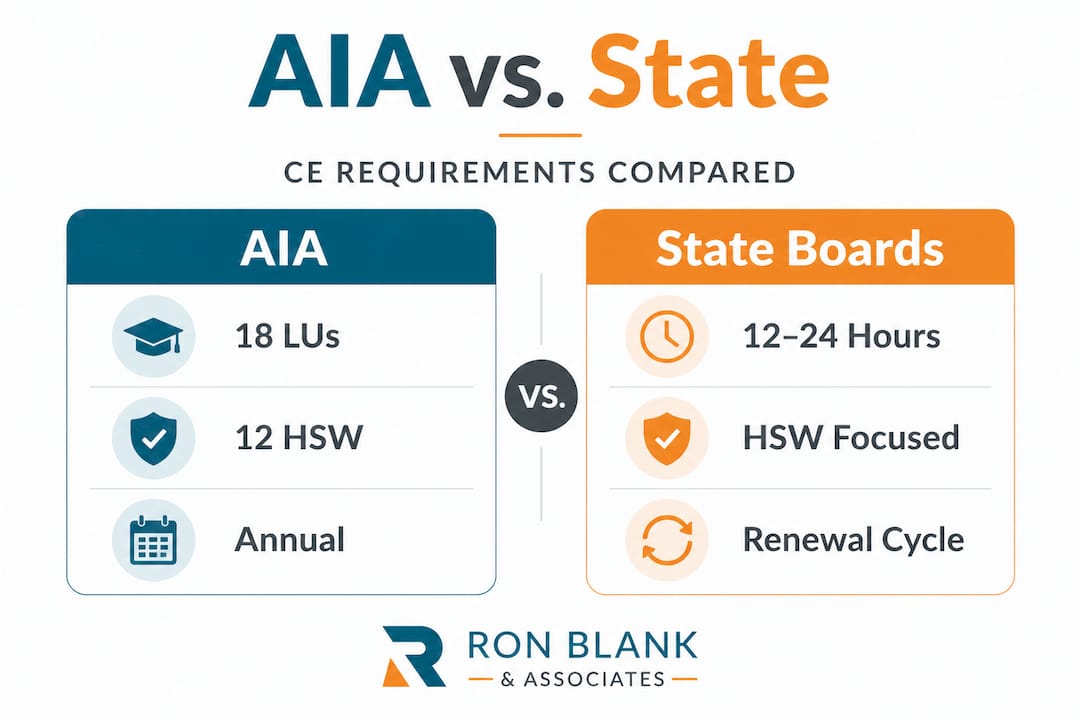
The AIA (American Institute of Architects) requires its members to complete 18 learning units (LUs) per year, with at least 12 of those hours designated as HSW credits. HSW stands for Health, Safety, and Welfare, and it covers topics like fire protection, structural systems, accessibility, and building codes. These are the credits that regulators and state boards care about most.
Non-HSW credits round out the remaining hours. They tend to cover business practices, project management, technology tools, and professional development topics. Don’t overlook these. Business skills are often the weak spot for architects who have strong technical training but less experience running a firm or managing contracts.
HSW vs. non-HSW: a quick comparison
| Credit type | Topics covered | State board priority | AXP eligibility |
|---|---|---|---|
| HSW | Safety, codes, accessibility, structures | High | Yes, up to 20 hrs per area |
| Non-HSW | Business, management, technology | Moderate | Typically no |
| Elective/specialty | Sustainability, LEED, product knowledge | Varies by state | Varies |
State requirements vary considerably, and that’s where planning gets complicated. Most states require architects to complete between 12 and 24 hours of CE per renewal cycle, but the exact number, the ratio of HSW to non-HSW, and even the renewal period itself differ from state to state. California, for example, has specific topic mandates around accessibility and seismic safety. Florida requires specific hours on laws and rules. Texas has its own AIA CE framework that doesn’t always align perfectly with what other states accept.
If you’re licensed in multiple states, and many experienced architects are, you need a structured plan that accounts for each state’s unique requirements. Simply earning 18 LUs through your AIA membership won’t automatically satisfy every state board you’re registered with.
Key requirements to track for each state:
- Total hours required per renewal cycle
- Minimum HSW hours
- Any mandatory topic areas (accessibility, laws, ethics)
- Renewal deadline and cycle length (annual vs. biennial)
- Accepted providers and reporting methods
The overlap between AIA requirements and state board requirements is real but not total. Understanding where they align and where they diverge is the foundation of smart CE planning. Architects who treat AIA compliance and state board compliance as separate checklists are in a much stronger position than those who assume one covers the other.
How to find and select free AIA CE courses
With requirements clear, your next step is to find the right courses without paying out of pocket.
Free AIA CE courses are more accessible than most architects realize. The key is knowing where to look and how to verify that a course actually counts for the credits you need.
Where to look for free courses:
- Building product manufacturers: Companies that make roofing systems, glazing, insulation, structural products, and other building materials frequently sponsor free AIA-registered CE courses. They use these courses to educate architects about their products in a legitimate educational context. Many of these courses carry HSW designation and cover genuinely useful technical content.
- AIA local chapters: Your regional AIA chapter often hosts free or low-cost CE events, lunch-and-learns, and webinars throughout the year. These are especially useful for meeting local code-specific requirements.
- Online CE platforms: Websites like Ron Blank & Associates (ronblank.com) offer free, AIA-registered online courses across a wide range of topics. These can be completed on your schedule without any registration fees.
- Trade associations: Organizations like the National Fire Protection Association (NFPA), the U.S. Green Building Council (USGBC), and the Construction Specifications Institute (CSI) periodically offer free CE content that qualifies for AIA credit.
- Podcasts and webinars: Some AIA-registered providers now deliver CE through podcast formats and live webinars, giving you flexibility to learn while commuting or during lunch.
When you find a course, don’t just assume it counts. Look for the AIA/CES (Continuing Education System) provider number and confirm whether the course is designated HSW or non-HSW. That designation must match your remaining credit needs, otherwise you risk earning hours that don’t check the right boxes for your state board.
Pro Tip: Build a simple spreadsheet with columns for state, required hours, HSW minimum, mandatory topics, and renewal deadline. Every time you complete a free course, log it immediately. This takes five minutes but saves hours of scrambling later. Tracking credit type alongside state requirements will show you exactly what gaps remain, especially when managing multi-state renewal planning.
Selecting courses strategically also means thinking beyond minimum compliance. Choose topics that align with the projects you’re currently working on or the direction you want your practice to go. A free course on mass timber construction or net-zero building envelope performance doesn’t just earn you credits. It makes you more valuable in the next client conversation, the next project pursuit, or the next hiring decision.
Step-by-step process to enroll and complete CE credits
Once you’ve chosen your courses, it’s time to ensure you maximize efficiency and never miss a CE credit deadline.
How to enroll and complete free AIA CE credits:
- Identify your current credit gap. Log into your AIA member portal and check how many LUs you’ve recorded. Note how many are HSW and whether any mandatory topic requirements remain unfulfilled.
- Search for relevant free courses. Use platforms that specialize in AIA-registered content, and filter by HSW designation and topic area.
- Verify provider credentials. Confirm the provider’s AIA/CES number before enrolling. A course without a valid AIA/CES provider number will not count toward your requirements.
- Enroll and complete the course. Most online free courses are self-paced. Take notes, engage with the content, and complete any required assessments. Passing scores are usually required to receive credit.
- Download your certificate. Always save your completion certificate as both a PDF and a backup copy to cloud storage. State boards may audit you at any time, sometimes years after renewal.
- Report your credits. Enter each completed course in the AIA’s CE tracking system (CES). Some providers auto-report directly to AIA/CES, which saves you a step.
- Verify state board reporting. If you’re licensed in states that use separate reporting systems, submit your credits there as well. Do not assume AIA reporting equals state board reporting.
Documentation to record for each completed credit:
| Field | What to capture |
|---|---|
| Course title | Exact name as listed by provider |
| Provider name and AIA/CES number | Required for verification |
| Credit type (HSW or non-HSW) | Determines state board eligibility |
| Hours earned | Full or partial LUs |
| Completion date | For renewal cycle tracking |
| Certificate file name/location | For audit readiness |
| States credited toward | Especially critical for multi-state licenses |
Pro Tip: Set calendar reminders at 90 days, 60 days, and 30 days before your renewal deadline in each state. Automate a monthly backup of your certificate folder to cloud storage. These small habits eliminate the biggest source of CE-related stress: discovering a gap two weeks before renewal.
Important: State boards do not accept late submissions or incomplete documentation as valid excuses. A license suspension due to a missed CE deadline is a matter of public record and can affect your professional standing, project contracts, and insurance coverage. Don’t treat your renewal deadline like a suggestion.
According to the state-specific benchmarks most states track, architects licensed in multiple jurisdictions face compounding deadlines that require year-round attention, not a last-minute sprint.

Troubleshooting common CE credit issues
Even with the best-planned approach, missteps can happen. Here’s how to fix them quickly and avoid bigger trouble.
CE credit problems tend to fall into a few predictable categories. Knowing them in advance means you can fix issues before they become real risks.
Common issues and how to solve them:
- Duplicate credits: Some architects accidentally complete the same course twice, especially when a course is offered on multiple platforms under slightly different titles. Always search your CE history before enrolling in a new course.
- Missing HSW designation: A course that covers building science or sustainability might seem like it qualifies for HSW, but unless the provider has specifically designated it as such, it does not count toward your HSW minimum. Always check the course listing, not just the topic.
- Multi-state reporting gaps: Completing a course and reporting it to AIA is only part of the job. If your state requires separate submission to the state board or a third-party system, you’re not done until that step is complete.
- Expired or unaccredited providers: Occasionally, an AIA/CES provider’s registration lapses. Before completing a course, verify the provider’s current status on the AIA’s website.
- Course content mismatch: Some states require CE on specific topics (seismic codes, accessibility, ethics). A general HSW course on building envelope design won’t satisfy a mandatory ethics requirement, even if it’s beautifully taught.
Pro Tip: Use only AIA’s official CES portal or your state board’s approved reporting system to verify and submit credits. Third-party tracking apps can be useful for personal organization, but they are not official records. If there’s ever a discrepancy, the official portal wins.
Watch out for cross-state compliance traps. A course fully accepted in your home state may not meet the requirements of a second state where you’re also licensed. Always check each state’s approved provider list separately, especially for mandatory topic areas like laws, rules, or ethics.
Architects who are licensed in three or more states know firsthand how quickly this complexity adds up. Building a simple tracking system early, rather than rebuilding it in a panic near renewal time, is the single most protective habit you can develop. The renewal planning resources available online are a solid starting point for organizing your multi-state approach.
Why most architects underestimate CE planning—and how to stay ahead
Here’s an uncomfortable truth most continuing education articles won’t say directly: the majority of architects treat CE like a tax filing. They ignore it for most of the year, panic in the final weeks, and rush through whatever courses are still available to fill the gap. That approach has real costs beyond stress.
When you binge credits at the last minute, you lose the ability to be selective. You end up taking whatever free courses are still open, regardless of whether the topic helps your practice or aligns with your career direction. You miss the window to take courses that earn you credit toward both your AIA requirements and your state board requirements simultaneously. And you definitely don’t have time to think about whether any of those HSW courses might apply toward AXP credit of up to 20 hours per experience area, which is a genuinely powerful but often overlooked benefit.
The smarter play is to treat CE as a year-round professional development rhythm, not a compliance emergency. Plan a rough schedule at the start of each renewal cycle. Identify two or three topic areas you want to explore, match those to available free courses, and spread your learning across the year. This isn’t just more pleasant. It actually makes you better at your job.
Non-HSW business skills credits are especially worth reclaiming as part of this mindset shift. Architects who use CE to build skills in contract negotiation, project financial management, or client communication often report that those hours pay off more directly in their daily practice than some of the more technical HSW topics. Don’t treat non-HSW as the leftover category. Treat it as an investment in the business side of architecture, which affects your success just as much as your technical knowledge.
Staying ahead of CE requirements also positions you well when taking on projects in new states. You already have a tracking system. You already know how to verify accreditation. You’re not starting from scratch. That readiness is a professional advantage that compounds over time.
Discover free, accredited AIA CE courses and resources
Ready to take action? Here’s where to get started with free, accredited courses.
If you’ve been putting off your CE credits or you’re simply looking for a more efficient way to stay compliant, we’ve built a library of free AIA CE courses specifically designed for architects, engineers, interior designers, and contractors. Our courses are AIA-registered, self-paced, and available online so you can complete them when it works for your schedule.

Ron Blank & Associates partners with leading building product manufacturers to develop courses that are both technically rigorous and practically relevant. That means you get real knowledge about real products and systems, not just checkbox content. Whether you need HSW credits on envelope systems, structural products, or sustainability, or non-HSW credits on business skills, our platform makes it straightforward to find, complete, and document your learning. Start browsing today and take control of your CE plan before the next deadline sneaks up on you.
Frequently asked questions
What is the difference between HSW and non-HSW CE credits?
HSW credits focus on Health, Safety, and Welfare topics like building codes, structural systems, and accessibility, while non-HSW credits cover areas like business practices and professional development. State boards typically prioritize HSW when setting minimum requirements.
How many continuing education hours do most states require?
Most states require between 12 and 24 hours of CE credits per renewal cycle, though the exact number, required topics, and renewal period vary by state. Always confirm your specific state board’s requirements directly.
Can AXP hours count toward required CE credits?
Certain HSW continuing education courses may apply toward up to 20 hours of AXP credit per experience area, making it possible to satisfy both CE and AXP requirements with the same learning activity.
What if I miss the CE renewal deadline?
State boards generally do not accept late CE submissions, and missing a renewal deadline can lead to license suspension or additional reinstatement fees. Set automated reminders well in advance and treat your renewal date as a firm, non-negotiable deadline.