

TL;DR:
- Engineering ethics comprises moral principles and professional standards that ensure engineers prioritize public safety, sustainability, and integrity. Recognized organizations like NSPE underline these standards as essential to responsible decision-making in all engineering roles.
- It encompasses core principles such as honesty, respect for life, responsible leadership, and accuracy, which guide engineers in navigating complex ethical dilemmas across environmental, social, and technical domains.
Engineering ethics is defined as the set of moral principles and professional standards that govern how engineers conduct their work to protect public safety, promote sustainability, and uphold the integrity of the profession. Recognized formally by organizations like the National Society of Professional Engineers (NSPE) and the Engineering Council, these standards are not optional guidelines. They are the foundation of every responsible engineering decision. Whether you are a student entering the field or a licensed professional managing complex projects, understanding engineering ethics is the first step toward practicing with genuine accountability.
What is engineering ethics and why does it matter?

Engineering ethics is the discipline that defines the moral obligations engineers carry alongside their technical responsibilities. The NSPE code of ethics states that engineers must prioritize public safety and perform only work within their area of expertise. That single requirement has enormous implications. It means an engineer who spots a structural flaw cannot stay silent because a client wants to cut costs. It means a software engineer cannot deploy code they know is unsafe simply because a deadline is looming.
The importance of engineering ethics extends beyond individual decisions. Ethical engineering protects communities and preserves the long-term reputation of the profession as a whole. When engineers act with integrity, the public trusts bridges, buildings, medical devices, and software systems. When they do not, the consequences range from financial loss to loss of life. The Challenger space shuttle disaster and the Hyatt Regency walkway collapse are two of the most studied engineering ethics case studies in academic programs precisely because they illustrate what happens when professional responsibility is compromised under pressure.
What are the fundamental principles of engineering ethics?
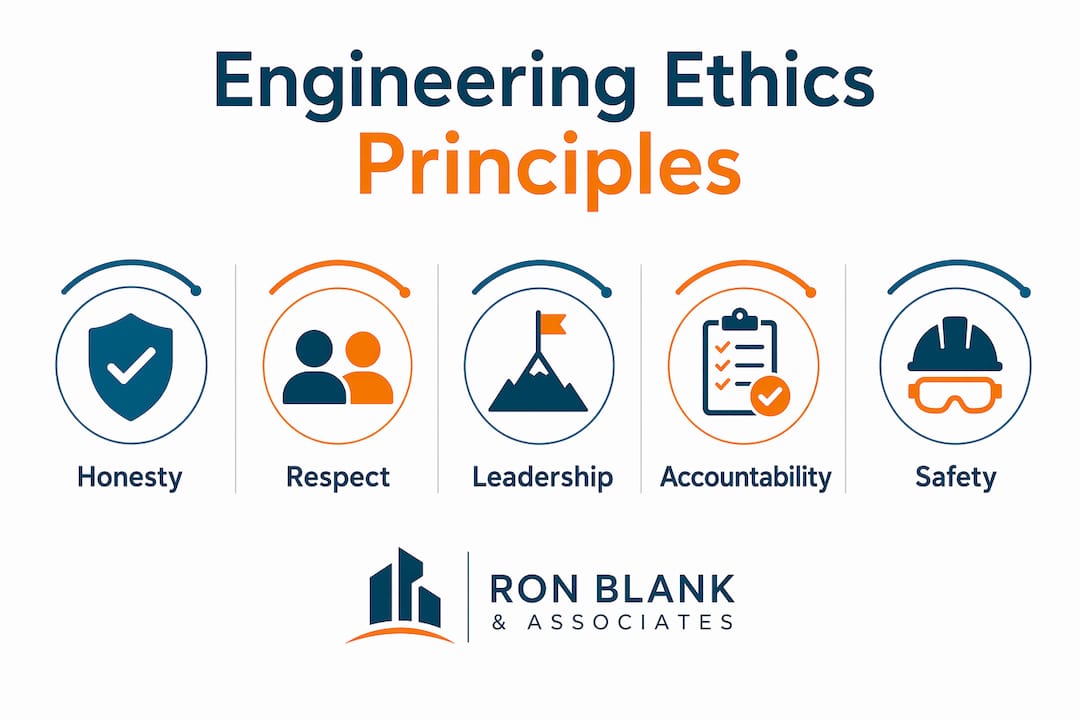
The four fundamental ethical principles recognized by the Engineering Council and the Royal Academy of Engineering are honesty and integrity, respect for life and the law, responsible leadership, and accuracy and rigor. These principles provide a framework for achieving sustainable and equitable outcomes across all engineering activities. They are not abstract ideals. They translate directly into daily decisions about how you document your work, how you communicate risk to clients, and how you respond when something goes wrong.
| Principle | Description |
|---|---|
| Honesty and integrity | Disclose conflicts of interest and represent your qualifications accurately |
| Respect for life and the law | Prioritize public safety above client or employer pressure |
| Responsible leadership | Take ownership of decisions and their consequences for communities |
| Accuracy and rigor | Verify your work, acknowledge uncertainty, and never overstate confidence |
These principles work together rather than in isolation. An engineer who is technically rigorous but withholds findings from a client is violating honesty. An engineer who is honest but lacks rigor in calculations is violating the safety principle. The framework only holds when all four are applied consistently.
Pro Tip: When you feel uncertain about a decision, run it through all four principles before acting. If it fails even one, treat that as a signal to pause and consult a colleague or your professional code.
How is engineering ethics categorized?
Engineering ethics is categorized into three domains: environmental ethics, social ethics, and technical ethics. Each domain addresses a distinct set of responsibilities, and understanding the differences helps engineers recognize which type of obligation applies in a given situation.
Environmental, social, and technical ethics guide engineers to avoid conflicts of interest and maintain public trust across all project types. Environmental ethics focuses on minimizing harm to ecosystems and designing for long-term sustainability. Social ethics addresses public safety, health, and community well-being. Technical ethics covers professional responsibilities such as staying within your area of competence and managing conflicts of interest transparently.
| Domain | Focus Area | Example |
|---|---|---|
| Environmental ethics | Safety and minimizing ecological harm | Designing drainage systems that prevent downstream flooding |
| Social ethics | Public health, safety, and community welfare | Refusing to approve a building design that does not meet fire code |
| Technical ethics | Professional responsibility and conflict of interest | Disclosing a financial relationship with a supplier to your client |
These three categories often overlap on real projects. A civil engineer designing a water treatment facility in a low-income community is simultaneously navigating environmental obligations, social equity concerns, and technical standards. Recognizing which domain is most at stake in a given moment sharpens your ethical judgment considerably.
What are common ethical dilemmas engineers face?
Ethical dilemmas in engineering rarely arrive with a clear label. Ethical breaches often occur unintentionally due to pressures rather than malicious intent. A project manager pushes for faster sign-off. A client asks you to omit a finding from a report. A budget shortfall creates pressure to use a cheaper material that meets the minimum spec but not the spirit of the design. These are the situations where professional ethics gets tested in practice.
The American Society of Mechanical Engineers (ASME) identifies workplace culture as a critical factor in ethical outcomes. Engineers face daily ethical decisions under pressure, making a culture that empowers raising concerns absolutely necessary. If your organization punishes people for flagging problems, ethical behavior becomes structurally difficult regardless of individual intentions. This is why the role of ethics in engineering extends to leadership and organizational design, not just individual conduct.
Here are the most common ethical pitfalls engineers encounter and the practices that counter them:
- Conflicts of interest: Disclose any financial or personal relationships that could influence your professional judgment. Silence is not neutrality.
- Scope creep beyond your expertise: Refer work outside your competence to qualified colleagues rather than stretching your credentials.
- Pressure to compromise safety: Document your concerns in writing and escalate through proper channels. Verbal objections disappear; written records do not.
- Incomplete or misleading reporting: Report findings accurately even when the results are inconvenient for the client or project timeline.
- Failure to stay current: Using outdated standards or methods is an ethical issue, not just a technical one.
For engineers working in construction and infrastructure, supporting ethical project delivery requires both individual discipline and organizational systems that make the right choice the easier choice.
Pro Tip: ASME recommends developing a personal “sniff test.” If something feels off about a decision, that instinct is worth examining before you proceed. Emotional intelligence is a legitimate professional tool, not a soft skill to be dismissed.
Why is engineering ethics more important now than ever?
Ethics is central to engineering as technological advances like artificial intelligence and biotechnology require integrity that goes well beyond technical skills. Engineers today make decisions with profound societal impacts. An algorithm that allocates resources in a hospital system, a structural sensor network embedded in a smart building, or a data analytics platform used in urban planning all carry ethical weight that previous generations of engineers did not face at the same scale.
The technological dimension
AI and machine learning introduce ethical dilemmas that existing codes of ethics were not written to address directly. Who is responsible when an AI-assisted structural analysis produces a flawed recommendation? How should an engineer handle a situation where an automated system flags a safety concern that the client wants to override? These questions require engineers to apply foundational principles to genuinely new territory, which is why ethical reasoning skills matter more than memorizing a code.
The educational shift
Academic institutions have made engineering ethics mandatory to prepare students for real-world accountability and to protect public safety. Including ethics in the curriculum promotes long-term safety and reduces costs associated with failures. Universities and professional development programs now treat ethics as a core competency alongside structural analysis or thermodynamics. This shift reflects a broader recognition that technical excellence without ethical grounding produces engineers who can build things but cannot always be trusted to decide what should be built, or how.
Integrity as a foundational skill is now as important as any technical certification. Engineers who invest in ethical literacy throughout their careers are better positioned to lead projects, earn client trust, and navigate the increasingly complex regulatory and social environments that define modern practice.
Key takeaways
Engineering ethics is the non-negotiable foundation of professional practice, requiring engineers to apply honesty, rigor, and public accountability across every technical decision they make.
| Point | Details |
|---|---|
| Core definition | Engineering ethics governs moral and professional conduct to protect public safety and professional integrity. |
| Four fundamental principles | Honesty, respect for life, responsible leadership, and accuracy form the ethical framework for all engineering work. |
| Three ethical domains | Environmental, social, and technical ethics each address distinct responsibilities that often overlap on real projects. |
| Dilemmas are often unintentional | Pressure from deadlines and budgets creates most ethical lapses, making proactive awareness and workplace culture critical. |
| Ethics education is mandatory | Academic programs now require ethics training because technical skill alone is insufficient for responsible modern engineering. |
Ethics is not a checkbox. It is a career-long practice.
I have spent years working with engineers and AEC professionals across continuing education programs, and one pattern stands out clearly. The engineers who struggle most with ethical situations are not the ones who lack knowledge of the codes. They are the ones who treat ethics as a compliance exercise rather than a professional mindset.
The most common mistake I see is waiting for a formal ethical dilemma to think about ethics. By the time a situation looks like a clear violation, the small compromises that led there have already accumulated. The engineer who agreed to omit one finding from a report six months ago is now being asked to sign off on something far more serious. Ethical practice is built in the ordinary moments, not the dramatic ones.
What I find genuinely encouraging is the shift happening in engineering education and professional development. The fact that mandatory ethics education is now standard in engineering programs signals that the profession is taking this seriously. Students entering the field today are better prepared for these conversations than previous generations were. The challenge is sustaining that preparation through the pressures of real project work, which is exactly where continuing education and peer accountability become so valuable.
My advice to any engineer reading this: find a colleague you trust enough to say “I might be wrong about this.” That relationship is worth more than any code of ethics document you will ever read.
— Brad
Continuing your professional development with Ronblank

Ronblank develops continuing education courses specifically for engineers, architects, interior designers, and contractors who want to stay current on professional responsibilities, building standards, and ethical practice. The courses are registered with the American Institute of Architects and delivered as online courses, webinars, podcasts, and face-to-face programs. If you are working toward licensure renewal or simply want to deepen your understanding of professional ethics standards, Ronblank offers a practical, peer-respected path forward. Explore the full course catalog at Ronblank and find the program that fits your schedule and professional goals.
FAQ
What is the engineering ethics definition?
Engineering ethics is the set of moral principles and professional standards that govern how engineers conduct their work to protect public safety, promote sustainability, and maintain professional integrity. Organizations like the NSPE and Engineering Council codify these standards into formal codes of conduct.
What are the four fundamental principles of engineering ethics?
The four fundamental principles are honesty and integrity, respect for life and the law, responsible leadership, and accuracy and rigor. These principles are recognized by the Engineering Council and the Royal Academy of Engineering as the foundation for ethical engineering practice.
How do engineers handle ethical dilemmas in practice?
Engineers handle ethical dilemmas by documenting concerns in writing, disclosing conflicts of interest, and escalating issues through proper channels. ASME recommends developing emotional intelligence and a personal “sniff test” to recognize ethical issues before they escalate.
Why is engineering ethics mandatory in academic programs?
Academic institutions made engineering ethics mandatory because technical skill alone is insufficient for protecting public safety and managing the societal impacts of modern technology. Ethics training reduces the costs associated with engineering failures and prepares graduates for real-world accountability.
How does engineering ethics apply to emerging technologies like AI?
AI and machine learning introduce ethical questions that existing codes were not written to address directly, requiring engineers to apply foundational principles to new territory. Engineers working with AI systems must consider accountability, transparency, and public safety with the same rigor they apply to physical structures.