

TL;DR:
- Staying current with AIA standards is essential for maintaining licensure, reducing liability, and ensuring ethical practice. The AIA Continuous Education System and Contract Document updates evolve with building codes, technology, and legal standards, making ongoing learning critical. Verifying provider registration and strategically aligning courses with practice areas enhance compliance, reputation, and project success.
Staying updated on AIA standards is the professional obligation that separates architects and engineers who lead projects with confidence from those who expose themselves to liability, license risk, and costly design errors. The American Institute of Architects sets standards through two primary vehicles: AIA Contract Documents, which govern project agreements, and the AIA Continuing Education System (CES), which governs professional learning requirements. Both evolve regularly, and both carry real consequences when ignored. Whether you are a licensed architect managing complex project teams or an engineer navigating multi-state licensure, understanding why staying current with AIA guidelines matters is not optional. It is the foundation of competent, ethical practice.
Why stay updated on AIA standards: the core professional case
AIA standards are not static documents. They reflect the current state of building codes, construction technology, legal precedent, and public safety requirements. When those inputs change, the standards change with them, and professionals who miss those updates carry outdated knowledge into active projects.
The AIA Continuing Education System requires architects to complete 18 annual Learning Units, including 12 credits specifically designated as Health, Safety, and Welfare (HSW). That HSW designation is not bureaucratic labeling. It signals that the content directly affects how buildings perform for the people inside them, from fire egress design to seismic resistance to indoor air quality.
AIA Contract Documents follow a different update cycle, typically revised on roughly 10-year intervals to incorporate changes in construction law, risk allocation, and delivery methods. The 2017 series, for example, introduced significant revisions to insurance requirements and dispute resolution language. Professionals still using older versions on new projects risk misaligned contract terms that no longer reflect current legal standards.
Here is what the update cycle covers across both tracks:
- Building codes and regulations: IBC, NFPA, and ASHRAE standards feed directly into AIA course content and contract language revisions.
- Emerging construction technology: BIM protocols, prefabrication, and digital delivery methods require updated contractual and technical frameworks.
- Sustainability requirements: LEED, WELL, and energy code updates shift design obligations and specification standards.
- Legal and liability developments: Court decisions and insurance market changes drive contract document revisions that protect all project parties.
- HSW-specific content: Annual CE requirements prioritize topics where outdated knowledge creates the greatest public risk.
Why is it crucial for professionals to stay current with AIA standards?
The consequences of falling behind on AIA standards are not theoretical. They show up in license renewals, project disputes, and, in the worst cases, building failures.

State licensing boards mandate CE compliance as a condition of license renewal. An architect who misses annual credit requirements does not simply get a warning. They risk license suspension, which halts their ability to practice and sign drawings. The AIA Code of Ethics frames continuing education as a professional and moral obligation, not just a regulatory checkbox. That framing matters because it shifts the mindset from compliance-as-burden to competence-as-responsibility.
The liability exposure from outdated knowledge is equally serious. Outdated architectural knowledge can produce unsafe approvals in seismic or fire safety design, areas where errors do not just cost money. They cost lives. States mandate CE compliance precisely to reduce these design-related public hazards.
“Professionals who treat continuing education as a credit-accumulation exercise miss the strategic benefit: mastering new codes ahead of enforcement minimizes costly compliance errors on active projects.”
Consider the financial dimension as well. Poor compliance audits carry an estimated 12% rejection rate, with remediation costs averaging $70,000 and project delays of approximately three months. That figure applies across compliance disciplines, and it illustrates the real cost of treating standards as an afterthought.
The professional reputation argument is equally compelling. Clients, contractors, and project owners increasingly expect their design professionals to demonstrate current knowledge. An architect who references outdated contract terms or misses a code update that affects a project’s permit approval damages trust in ways that are difficult to recover from. Staying current is, in practical terms, a client service issue as much as a compliance issue.
- License protection: Annual CE completion prevents suspension and keeps your practice legally active.
- Liability reduction: Current knowledge reduces design errors that trigger professional liability claims.
- Ethical standing: The AIA Code of Ethics ties professional competence directly to public protection.
- Client confidence: Demonstrating current knowledge builds the trust that generates referrals and repeat work.
- Project efficiency: Professionals who know current codes catch issues in design development rather than during permit review.
How does the AIA Continuing Education System ensure quality and compliance?
The AIA CES is not a self-reporting honor system. It is a structured provider registration and course approval process designed to verify that education content meets defined standards before credits are awarded.
Providers who want their courses to count toward AIA CE requirements must register with the AIA CES and submit courses for approval. That approval process evaluates content accuracy, learning objectives, and HSW relevance. Once approved, courses carry the AIA CES designation, which tells professionals that the content has been vetted and the credits will be recognized.
Here is how the compliance chain works in practice:
- Provider registration: Organizations apply to become AIA CES registered providers, agreeing to content standards and reporting obligations.
- Course approval: Individual courses are reviewed and approved before they can be marketed as AIA CES credit-bearing.
- Learner completion reporting: Registered providers must report learner completions within 10 business days to ensure credits count toward mandatory requirements.
- Record keeping: Professionals should maintain their own records of completed courses and reported credits, particularly if they hold licenses in multiple states.
- Audit readiness: High-quality CE reporting and record-keeping protects credentials during licensing audits and reduces costly renewal complications.
The distinction between registered and non-registered providers is one that many professionals overlook until it costs them. A course from a non-registered provider may be genuinely educational, but the credits will not appear in the AIA’s system and will not count toward your annual requirement. Verifying AIA CES provider registration before enrolling is a step that takes 60 seconds and prevents a compliance gap that can take months to fix.
Pro Tip: Before enrolling in any continuing education course, search the AIA’s online provider directory to confirm the provider’s registered status. A course that looks credible but lacks CES registration delivers zero credit toward your annual requirement.
Comparing free vs. paid AIA CES courses: what you should know
Cost is a real factor in CE planning, particularly for professionals managing multiple license renewals across different states. The good news is that price does not determine quality in the AIA CES world.
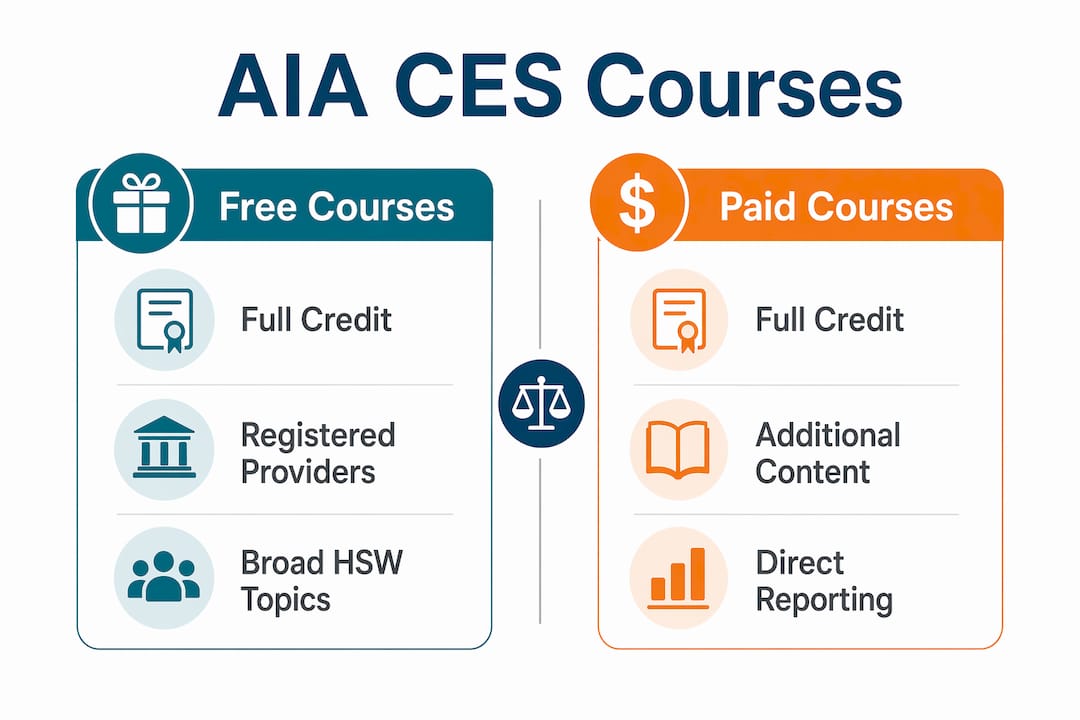
Free courses from providers like Ronblank fully meet AIA CES approval standards, covering broad HSW topics with the same reporting services as paid alternatives. The approval process does not distinguish between free and paid content. A course either meets the standard or it does not.
| Factor | Free AIA CES courses | Paid AIA CES courses |
|---|---|---|
| AIA credit recognition | Full credit, same as paid | Full credit |
| HSW eligibility | Available in many free courses | Available |
| Content quality | Vetted through AIA CES approval | Vetted through AIA CES approval |
| Reporting to AIA | Provided by registered providers | Provided by registered providers |
| Cost over time | $0, significant annual savings | Variable, can add up across multiple licenses |
| Topic range | Broad, including product-specific content | Often broader specialization options |
The practical implication for professionals holding multiple licenses is significant. Multi-license holders face complex CE scenarios requiring optimized learning paths, and free courses reduce the financial burden of meeting requirements across jurisdictions without sacrificing credit quality.
The one genuine risk with free courses is selecting content from providers who claim AIA approval without actually holding it. That is why provider verification matters regardless of price point.
Practical strategies for integrating AIA updates into your workflow
Compliance does not happen by accident. Professionals who stay consistently current build systems around their CE obligations rather than scrambling at renewal time.
- Set calendar reminders 90 days before your renewal deadline. This gives you time to identify gaps and complete remaining credits without rushing into whatever course happens to be available.
- Align course topics with your active project types. Strategic CE course selection fills knowledge gaps relevant to your practice rather than accumulating hours on topics that do not apply to your work.
- Track completions in a dedicated folder or spreadsheet. Store certificates, course names, provider details, and credit amounts in one place. If your state board audits your renewal, you want documentation ready within hours, not days.
- Use online platforms for flexibility. Webinars, podcasts, and on-demand courses let you complete credits during commutes, lunch breaks, or slow project periods rather than blocking full days for in-person events.
- Monitor AIA contract document updates proactively. When the AIA releases a revised document series, read the summary of changes before your next project kicks off. Real-time awareness of construction updates reduces the risk of using outdated contract language on new agreements.
Pro Tip: If you hold licenses in more than one state, map each state’s CE requirements against your AIA CES completions at the start of each year. Some states accept AIA HSW credits directly; others have specific topic mandates. Knowing the overlap early prevents duplicate effort and gaps.
Key takeaways
Staying current with AIA standards protects your license, reduces project liability, and fulfills the ethical obligation the AIA Code of Ethics places on every practicing professional.
| Point | Details |
|---|---|
| Annual CE requirement | AIA mandates 18 Learning Units per year, with 12 designated as HSW credits. |
| Compliance risk | Poor compliance practices can trigger costly remediation and project delays averaging three months. |
| Provider verification | Always confirm AIA CES registration before enrolling to avoid credits that do not count. |
| Free courses qualify | Free AIA-approved courses meet identical standards as paid options and report credits the same way. |
| Strategic selection | Aligning CE topics with your practice area delivers more value than accumulating hours on unrelated content. |
The real cost of treating CE as a checkbox
I have watched architects treat their annual CE requirement the way most people treat a car registration renewal: something you handle at the last minute, pick the fastest option available, and forget about until next year. I understand the impulse. Project deadlines are real, and 18 credits can feel like one more obligation stacked on top of an already full schedule.
But here is what that approach actually costs. When a new energy code cycle rolls out and you have not taken a single course on building envelope performance in three years, you are the last person in the room to know. Your specifications reflect what was standard practice in 2022. Your contractor catches the discrepancy during submittal review. Now you have a change order, a delay, and a client who is quietly wondering whether they hired the right firm.
The professionals I respect most in this industry treat CE as a competitive tool, not a compliance burden. They pick courses that map directly to the project types they want to win more of. They finish their credits in the first half of the year so they are not scrambling in December. They use the knowledge they gain to write better specifications, catch code issues earlier, and have more credible conversations with clients about why certain design decisions matter.
The AIA certification seal on contract documents signals quality and protects all project parties. That same principle applies to your professional knowledge. Currency is credibility. Staying ahead of AIA updates is not just about keeping your license. It is about being the kind of professional whose work holds up under scrutiny.
Keep your AIA credits current with Ronblank
Ronblank is a registered AIA CES provider offering free and paid continuing education courses designed specifically for architects, engineers, interior designers, and contractors. Every course in the catalog meets AIA CES approval standards, covers topics from HSW fundamentals to product-specific technical content, and includes full credit reporting to the AIA on your behalf.

You do not need to spend hundreds of dollars annually to stay compliant. Ronblank’s free AIA courses give you access to quality, approved content across a broad range of topics, with the flexibility to learn online at your own pace. Whether you need HSW credits, want to deepen your knowledge of sustainable design, or are exploring new product categories for your specifications, the Ronblank catalog is built to meet you where you are. Start exploring today and make 2026 the year your CE strategy works for your practice, not against it.
FAQ
What are AIA standards and why do they matter?
AIA standards include AIA Contract Documents and the AIA Continuing Education System requirements, both of which govern professional practice in architecture and engineering. They matter because they set the legal, ethical, and technical benchmarks that protect professionals, clients, and the public.
How many CE credits do architects need annually?
The AIA Continuing Education System requires 18 Learning Units per year, including 12 HSW credits covering Health, Safety, and Welfare topics. Missing this requirement puts your license renewal at risk.
Do free AIA CES courses count toward my annual requirement?
Free courses from registered AIA CES providers count fully toward your annual requirement and are reported to the AIA the same way paid courses are. The key is confirming the provider holds active AIA CES registration before enrolling.
What happens if I use an outdated AIA contract document?
Using an outdated AIA contract document can create misaligned terms that no longer reflect current legal standards, insurance requirements, or dispute resolution processes. This exposes all project parties to unnecessary legal and financial risk.
How do I verify that a CE provider is AIA-registered?
Search the AIA’s online provider directory using the provider’s name before enrolling in any course. A provider without active registration cannot report your credits to the AIA, and those hours will not count toward your annual requirement.