

Balancing project deadlines and licensing requirements is a constant challenge for busy architects and interior designers. Meeting continuing education standards often means finding flexible solutions that fit real-world schedules. Online design courses offer an accessible way to earn AIA or IDCEC credits while developing new technical and creative skills at your own pace. This article breaks down what defines a quality course and highlights features that support your professional growth and credential renewal.
Table of Contents
- Defining Online Design Courses for Professionals
- Types of Online Courses: AIA, GBCI, IDCEC
- How Online Learning Platforms Function
- Requirements for Earning Continuing Education Credits
- Comparing Online and Face-To-Face Education
- Mistakes to Avoid When Choosing Courses
Key Takeaways
| Point | Details |
| Accreditation Matters | Ensure online courses are AIA, GBCI, or IDCEC accredited to count toward continuing education requirements. |
| Flexibility in Learning | Online courses provide the ability to learn at your own pace, making it easier to integrate education with a busy work schedule. |
| Diverse Learning Opportunities | Look for courses that offer interactive content and opportunities for collaboration to enhance learning outcomes. |
| Documentation is Key | Save completion certificates and maintain a continuing education portfolio for proof when renewing professional credentials. |
Defining Online Design Courses for Professionals
Online design courses for professionals are structured educational programs delivered through digital platforms that teach the skills and knowledge needed to advance careers in architecture, interior design, engineering, and related fields. These courses are specifically designed for working professionals who need flexibility to balance education with their current responsibilities. Unlike traditional classroom settings, online design courses allow you to learn at your own pace, access course materials on demand, and engage with instructors and peers through virtual collaboration tools.
These programs cover a broad range of topics tailored to design professionals. You’ll encounter content spanning graphic design principles, user interface design, color theory, typography, and the technical skills needed to master industry-standard software. The curriculum typically emphasizes problem-solving with a user-centered approach that considers aesthetic, functional, cultural, and societal factors. Many courses also integrate building science, sustainability, and compliance topics relevant to architects and interior designers seeking continuing education credits through organizations like the American Institute of Architects (AIA), the Green Business Certification Inc. (GBCI), or the International Interior Design Association (IDCEC).
What sets these courses apart for professionals is their dual focus on technical competency and continuing education requirements. When you enroll in an AIA-registered online design course, you’re not just learning new skills in a passive format. You’re engaging with content that meets rigorous standards for professional development, often including case studies, interactive assignments, and assessments that validate your learning outcomes. GBCI education courses carry additional weight for professionals pursuing LEED certification, while IDCEC-approved courses address the specific needs of interior designers. The flexibility of online delivery means you can complete coursework during evenings or weekends without disrupting your work schedule or current project timelines.
Pro tip: When selecting an online design course, verify that it carries AIA, GBCI, or IDCEC approval from the outset. This ensures your time investment translates directly into documented professional credits that satisfy your continuing education requirements.
Types of Online Courses: AIA, GBCI, IDCEC
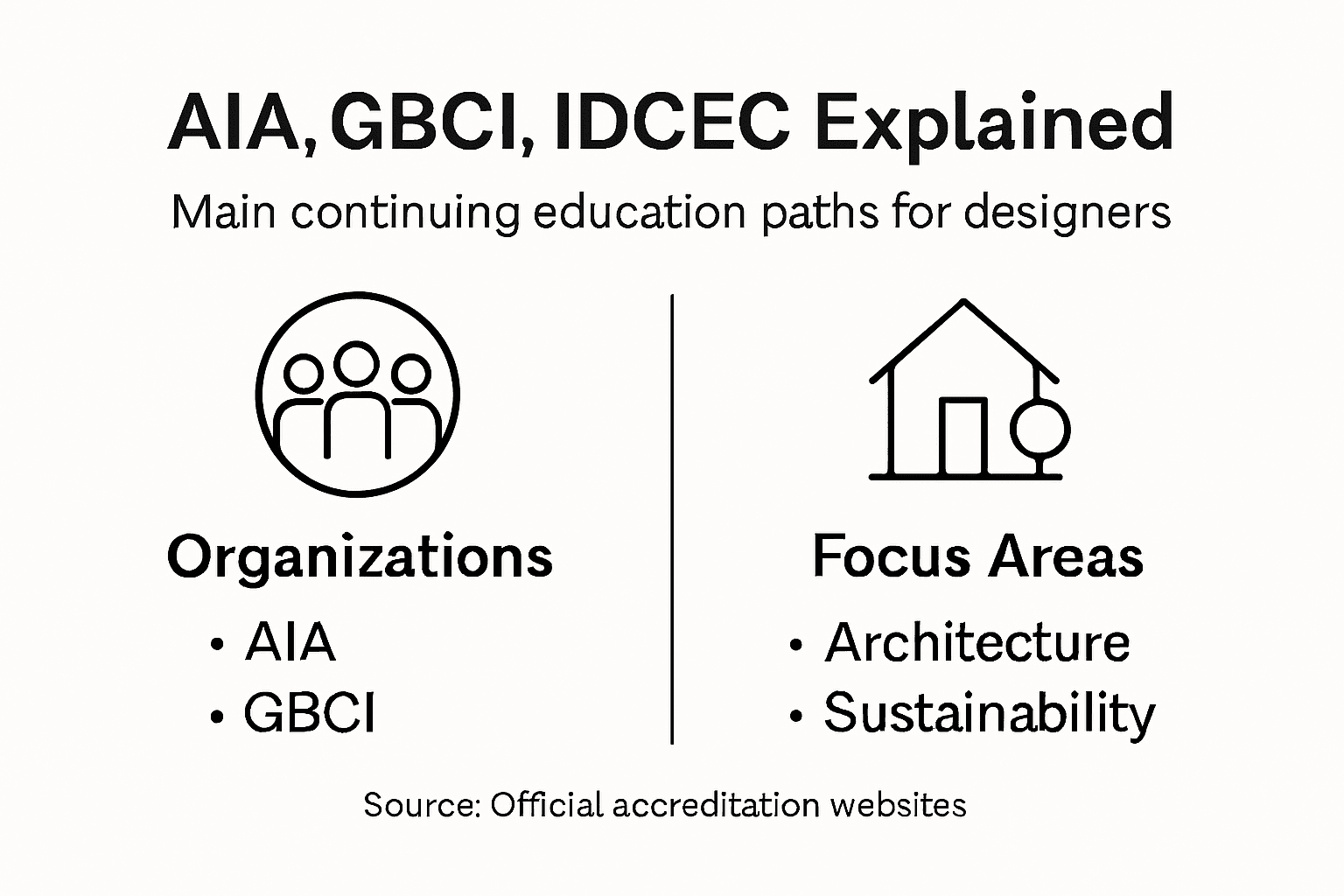
Not all online courses are created equal when it comes to professional credits. The three main organizations that accredit continuing education for design professionals each have distinct standards and requirements. Understanding the differences between AIA courses, GBCI courses, and IDCEC courses helps you choose programs that align with your career goals and licensing requirements.
AIA Continuing Education
The American Institute of Architects (AIA) accredits online courses that help architects maintain their professional licenses and stay current with industry best practices. AIA-registered courses cover topics ranging from building codes and sustainability to project management and professional practice. When you complete an AIA-approved online course, you earn Health Safety Welfare (HSW) credits or general professional development (LU) credits that count toward your mandatory continuing education requirements. The rigor of AIA accreditation means the content meets strict standards for relevance, instructor qualifications, and learning outcomes. Many architects rely on these courses because they provide documented proof of continuing education that state licensing boards recognize.
GBCI Education and LEED Credentials
The Green Business Certification Inc. (GBCI) focuses on sustainability and environmental building practices. If you’re pursuing LEED accreditation or need to maintain your LEED credential, GBCI-approved online courses are essential. These programs teach the principles and practices of sustainable building design, energy efficiency, and green construction methods. GBCI education goes beyond basic environmental awareness to provide technical knowledge that demonstrates your expertise in sustainable design practices. Many professionals combine AIA and GBCI courses to develop comprehensive knowledge across both traditional design principles and green building strategies.
IDCEC and Interior Designer Requirements
The International Interior Design Association (IDCEC) oversees continuing education specifically for interior designers. IDCEC-approved online courses address the unique challenges interior designers face, from space planning and human factors to materials, codes, and professional ethics. Interior designers pursuing formal credentials or maintaining their professional standing depend on IDCEC-accredited education. These courses often emphasize the client-focused design process and practical applications that interior designers use in their daily work.
| Organization | Focus Area | Credit Type | Best For |
| AIA | Architecture and professional practice | HSW or LU credits | Architects and engineers |
| GBCI | Sustainable building practices | LEED credentials | Sustainability-focused professionals |
| IDCEC | Interior design and spaces | Interior design credits | Interior designers |
The reality is that many professionals need credits from multiple organizations. An architect might need AIA credits for licensing while maintaining their LEED accreditation. An interior designer working on sustainable projects might combine IDCEC and GBCI courses. Online delivery makes it feasible to complete these diverse requirements without sacrificing your work schedule.
Pro tip: Before enrolling in any online course, check your state licensing board or professional organization website to confirm which course types and credit hours you need, then verify the course carries the specific accreditation required rather than assuming generic professional development credits will apply.
How Online Learning Platforms Function
Online learning platforms are the backbone of professional continuing education courses. At their core, these systems function as Learning Management Systems (LMS), which serve as centralized hubs where instructors upload course materials, students access lessons, and administrators track progress. Think of an LMS as the digital equivalent of a school building. Just as a physical building houses classrooms, offices, and a library, an LMS organizes courses, discussion boards, assignments, and grade books in one accessible location. When you log into an online course platform, you’re entering this organized digital space where everything you need for your education is available.

How LMS Platforms Support Your Learning
The real power of online learning platforms lies in how they overcome traditional barriers to education. Asynchronous and synchronous learning opportunities mean you can watch recorded lectures at 10 PM on a Tuesday or join live webinars with instructors on Thursday afternoons. You control when and where you learn. Most platforms feature multimedia content including videos, interactive diagrams, PDFs, and case studies that engage different learning styles. For architects and interior designers, this means you might watch a video demonstration of a new material specification technique, then complete an interactive assessment to verify your understanding before moving forward.
These platforms also facilitate collaboration and communication despite the distance between you and your instructors. Built-in discussion forums let you ask questions and learn from peers facing similar challenges. Many professional online courses include live Q and A sessions where you can interact directly with experts. Assessment tools within the platform track your progress, provide immediate feedback, and generate certificates documenting completion. This creates accountability and proof of learning that satisfies AIA, GBCI, or IDCEC requirements.
Features That Matter for Professional Development
Effective LMS platforms balance structured learning with flexibility. Progress tracking lets both you and instructors see which modules you’ve completed and where you might need additional support. Personalized feedback and problem-solving opportunities help you apply new knowledge to real work situations. For example, a course on sustainable material selection might include case studies where you evaluate actual building products and make specification decisions. The platform records your work, creating a portfolio of learning outcomes you can reference in your professional practice.
Mobility matters too. Most modern platforms work seamlessly on phones, tablets, and laptops, so you can continue your course on whatever device you have available. If you’re between meetings at a project site, you can spend 15 minutes reviewing a module. When you return to your office, you resume exactly where you left off. This flexibility makes it realistic for busy professionals to complete continuing education requirements without abandoning their work responsibilities.
Here’s how popular LMS features affect professional learning success:
| LMS Feature | Professional Benefit | Typical Business Impact |
| Progress Tracking | Keeps learners accountable | Ensures timely course completion |
| Mobile Access | Enables flexible participation | Supports busy professionals on-the-go |
| Feedback Tools | Improves knowledge retention | Raises course effectiveness |
| Collaboration Options | Fosters peer learning | Builds professional networks |
Pro tip: Test the platform’s interface before committing to a full course by reviewing the free preview or trial materials, ensuring the navigation and tools feel intuitive for your workflow and learning preferences.
Requirements for Earning Continuing Education Credits
Earning continuing education credits isn’t automatic. You can’t simply watch a video and expect the hours to count toward your professional requirements. There are specific standards and processes that online courses must meet to qualify as legitimate continuing education. Understanding these requirements ensures your time investment translates into documented credentials that licensing boards and professional organizations actually recognize.
What Makes a Course Count
First, the course itself must be registered or approved by the relevant organization. An AIA-registered course meets standards for content quality, instructor expertise, and learning outcomes established by the American Institute of Architects. GBCI-approved courses follow similar rigorous evaluation processes. This accreditation process isn’t rubber-stamping. Course developers must document that their content aligns with professional standards, that instructors have appropriate credentials, and that learning assessments actually measure whether you’ve gained the knowledge being taught.
You also need to actively participate and complete course requirements. Most online courses require you to watch all modules, submit assignments, pass quizzes or exams, and sometimes participate in discussions. Some courses have mandatory attendance for live sessions. The platform tracks this completion data and generates certificates proving you finished. This documentation is critical because state licensing boards and professional organizations want evidence that you actually engaged with the material, not just enrolled.
Credit Requirements by Organization
Earning and maintaining professional credentials requires completing approved courses and continuing education in specified timeframes. For LEED professionals, a Green Associate must complete 15 continuing education hours within a two-year period, while a LEED AP must earn 30 hours. AIA requirements vary by state but typically require architects to complete several continuing education hours annually or periodically renew their credentials. IDCEC maintains its own credit requirements that interior designers must meet to maintain their credentials.
Not all credits count equally toward all requirements. You might complete a course on sustainable materials that earns you AIA general professional development (LU) credits, GBCI LEED credits, and potentially IDCEC credits if the content aligns with interior design practice. Conversely, a course on specialized construction technology might only count toward AIA credits. This is why checking accreditation before enrolling matters so much. You need courses that align with your specific credential renewal requirements.
Tracking and Documentation
Online platforms maintain detailed records of your completion. When you finish a course, you receive a certificate showing the course title, credit hours earned, the organization that accredited it, and the date of completion. Save these certificates. You’ll need them if you’re audited by your licensing board or if you need to prove compliance during credential renewal. Many professionals maintain a continuing education portfolio organized by year and organization type, making it simple to demonstrate compliance whenever required.
The beauty of online courses is that documentation happens automatically. You don’t have to manually fill out forms or track hours yourself. The platform records everything and generates the proof you need.
Pro tip: Create a spreadsheet tracking your course completion, credits earned, organization type (AIA, GBCI, IDCEC), and certificate file location, so you can quickly reference your continuing education progress and confirm you’re meeting all renewal requirements before deadlines arrive.
Comparing Online and Face-To-Face Education
The choice between online and face-to-face continuing education often comes down to what works for your schedule and learning style. Both formats have distinct advantages, and the reality is more nuanced than marketing claims suggest. Research shows that online education can produce equivalent or superior learning outcomes, particularly for developing higher-order thinking skills. This challenges the assumption that in-person instruction automatically delivers better results. What matters most is course quality, your commitment to learning, and how well the format aligns with your professional needs.
The Face-to-Face Experience
Face-to-face continuing education offers real-time interaction with instructors and peers. You can ask questions immediately, observe demonstrations firsthand, and engage in spontaneous discussions that deepen understanding. For architects and interior designers, this might mean examining actual material samples in person, touring a LEED-certified building with an expert guide, or working through design problems collaboratively in a room. The networking aspect matters too. You build relationships with other professionals, often leading to future collaborations or referrals. Some professionals find the structured schedule of in-person courses helps them stay accountable and complete the material.
The downside is obvious. Face-to-face courses require you to be somewhere at a specific time. If you’re managing multiple projects, traveling between sites, or working irregular hours, attending a three-day conference or weekly evening classes becomes genuinely difficult. Travel time and costs add up. You sacrifice flexibility for the benefit of in-person interaction.
Why Online Education Works for Professionals
Online courses solve the scheduling dilemma entirely. You access materials whenever you can carve out time. You can watch a lecture on sustainable building materials at 6 AM before a site visit, then revisit it during lunch if something didn’t make sense. This flexibility doesn’t mean lower quality. When courses are well-designed, learning outcomes can match or exceed face-to-face environments, and you often retain information better because you’re controlling your pace.
Online formats also accommodate different learning preferences. Visual learners appreciate on-demand videos they can rewatch. Readers benefit from detailed written materials. People who need to process information slowly before participating in discussions value asynchronous forums where they can craft thoughtful responses. For busy professionals, online learning isn’t a compromise. It’s often the only realistic way to complete continuing education without disrupting your career.
Making Your Choice
Consider your specific situation. Do you prefer real-time interaction and have a predictable schedule? Face-to-face might suit you. Are you juggling multiple projects with unpredictable timing? Online provides the control you need. Some professionals do both. They might attend an annual in-person conference for networking and intensive learning, then complete additional online courses for flexibility. Many courses now offer hybrid formats combining recorded content with optional live sessions, giving you the best of both approaches.
| Aspect | Face-to-Face | Online |
| Scheduling flexibility | Limited | Excellent |
| Networking opportunities | Strong | Moderate to strong |
| Real-time instructor interaction | Direct | Delayed but available |
| Self-paced learning | No | Yes |
| Travel time and costs | Yes | No |
| Learning outcomes | Strong | Equivalent or superior |
Pro tip: For your first online course, choose one on a topic you’re already familiar with so you can focus on adapting to the platform and learning style rather than struggling with completely new material.
Mistakes to Avoid When Choosing Courses
Choosing the wrong online course wastes time and money while potentially leaving you without the credits you actually need. Many professionals make predictable mistakes when evaluating continuing education options, often driven by convenience or cost rather than actual quality and fit. Understanding what to avoid helps you invest your limited professional development time wisely.
Here’s a summary of key factors to consider when selecting an online design course:
| Selection Factor | Why It Matters | Impact on Your Career |
| Accreditation | Ensures credits are recognized | Enables credential renewal |
| Instructor Experience | Provides relevant industry insight | Enhances learning outcomes |
| Course Interactivity | Supports engagement and retention | Improves skill application |
| Platform Usability | Facilitates consistent progress | Saves time for professionals |
| Student Reviews | Reveals real user satisfaction | Helps avoid poor investments |
Prioritizing Price Over Accreditation
The biggest mistake architects and interior designers make is enrolling in a cheap course without verifying accreditation. A course might cost $50 and promise valuable content, but if it’s not AIA, GBCI, or IDCEC approved, those hours won’t count toward your continuing education requirements. You’ve wasted both money and time. Always verify accreditation status before enrolling. Check the course description carefully. It should explicitly state which organization accredited it and what credit type you’ll earn. If the course description doesn’t mention accreditation, contact the provider directly. The lowest price is worthless if the credits don’t apply to your professional requirements.
Ignoring Instructional Quality
Effective online courses require clear learning objectives, rich multimedia, and interactive elements that engage learners. Look for courses that include videos, interactive case studies, discussion forums, and assessments that actually test your understanding. Read course reviews from other professionals when available. Check whether the platform provides instructor contact information and support. Does the course feel rushed, or does it give you time to absorb material and apply it to your work?
Overlooking Instructor Credentials
Who teaches the course matters significantly. An instructor should have genuine expertise and professional experience in the subject matter. A course on sustainable building materials taught by someone with actual architecture or materials science background carries more weight than one taught by a generic online instructor. Check the course materials for instructor bios. Look for people who actively practice in the field, not just content creators. If the instructor information is vague or missing, that’s a red flag. Professionals teaching professionals should be transparent about their qualifications.
Elevate Your Career with Trusted Online Design Courses for AIA Credits
Balancing a demanding architecture career with continuing education requirements can feel overwhelming. The challenge is finding flexible, high-quality courses that are not only engaging but also officially recognized for your AIA credits. This article highlights the importance of selecting accredited programs that deliver real value and align with your professional growth needs.
At Ron Blank, we specialize in developing continuing education courses registered with the American Institute of Architects. Our offerings include online courses, webinars, and podcasts specifically designed to help you earn Health Safety Welfare (HSW) or Learning Unit (LU) credits efficiently and confidently. We also collaborate with building product manufacturers to provide you with the latest, practical insights that you can immediately apply to your projects.
Take control of your professional development today. Experience how our expertly crafted courses combined with a user-friendly learning platform can turn your continuing education journey into an empowering and seamless process. Explore our full range of courses and start earning your AIA credits with confidence at Ron Blank.
Discover our course offerings and make your next step count.

Frequently Asked Questions
What are online design courses for AIA credits?
Online design courses for AIA credits are educational programs delivered digitally that focus on topics relevant to architects. These courses help professionals maintain their licenses and earn necessary continuing education credits recognized by the American Institute of Architects (AIA).
How do I know if an online design course is AIA-approved?
You can verify if an online design course is AIA-approved by checking the course description for accreditation details. AIA-approved courses will explicitly mention their accredited status and specify the type of credits offered, such as Health Safety Welfare (HSW) or Learning Units (LU).
What types of topics do AIA-registered online courses cover?
AIA-registered online courses typically cover a variety of topics including building codes, sustainability, project management, and professional practice. The content is designed to keep architects informed of industry best practices and compliance standards.
Can I earn multiple types of credits from one online course?
Yes, some online courses may be designed to meet the requirements of multiple organizations. For example, a course on sustainable materials may offer AIA credits as well as credits for GBCI and IDCEC, depending on the content’s relevance and accreditation. Always check the course details to know which credits are applicable.