

Keeping up with ever-changing building codes can feel like a moving target when your focus is on creating truly inclusive and sustainable spaces. The American Institute of Architects (AIA) supports your professional progress with a flexible system for earning continuing education credits, letting you choose learning pathways in accessible design and sustainability that impact your projects and your credentials. Understanding these core concepts in AIA continuing education helps you meet state requirements while driving real value for your practice.
Table of Contents
- AIA Continuing Education: Core Concepts Explained
- Required Learning Units and HSW Standards
- Earning Credits: Course Types and Formats
- Accessible Design and Sustainability Focus Areas
- How to Track, Report, and Avoid Common Mistakes
- Partnering With AIA Providers as a Manufacturer
Key Takeaways
| Point | Details |
| AIA Continuing Education Structure | The AIA’s program focuses on maintaining critical knowledge and skills for architects, utilizing a credit system where one Learning Unit (LU) equals one hour of approved instruction. |
| HSW vs. General Learning Units | Architects must understand the distinction between Health, Safety, and Welfare (HSW) credits and General Learning Units (LU) |
| Credit Earning Flexibility | Continuing education can be earned through various formats, including in-person seminars, online courses, and teaching, allowing professionals to tailor their learning to their needs. |
| Tracking & Reporting Credits | Maintaining organized records of earned credits simplifies the renewal process and helps avoid common mistakes that could lead to license complications. |
AIA Continuing Education: Core Concepts Explained
Continuing education for architects isn’t just about checking a box on your licensure renewal. It’s about staying current with building codes, sustainability practices, and design innovations that directly impact your projects. The American Institute of Architects (AIA) has structured its continuing education program to ensure that professionals like you maintain the knowledge and skills required for ethical practice and career advancement. When you understand how AIA continuing education credits work, you can strategically plan your learning to address both regulatory requirements and your professional interests.
At its core, AIA continuing education revolves around a credit system that measures your learning. One AIA learning unit (LU) equals one hour of instruction in an approved program. This is where your projects in sustainable design, accessible spaces, and health-conscious materials become valuable learning experiences. The system also recognizes that professional credibility and career advancement grow through diverse educational pathways, whether you’re attending in-person seminars, completing online courses, or participating in webinars led by industry experts.
What makes this system work for you is flexibility. You can earn credits through formal AIA-approved courses, self-directed learning activities, teaching and presenting, and even professional involvement. Some architects earn credits by speaking at conferences or publishing articles about their design approach. Others complete specialized training in accessible design standards or passive house principles. Interior designers might focus on credits related to sustainable materials, building wellness, or universal design principles. The key is that these learning activities must align with AIA standards and contribute meaningfully to your professional competence. Understanding this framework helps you see continuing education as something that serves your practice, not simply as a regulatory burden.
Pro tip: When planning your annual credits, group similar topics together and look for courses that satisfy multiple learning objectives at once. A single webinar on low-emitting materials in healthcare environments, for example, might address sustainability, indoor environmental quality, and accessible design all at once, helping you meet diverse requirements more efficiently.
Required Learning Units and HSW Standards
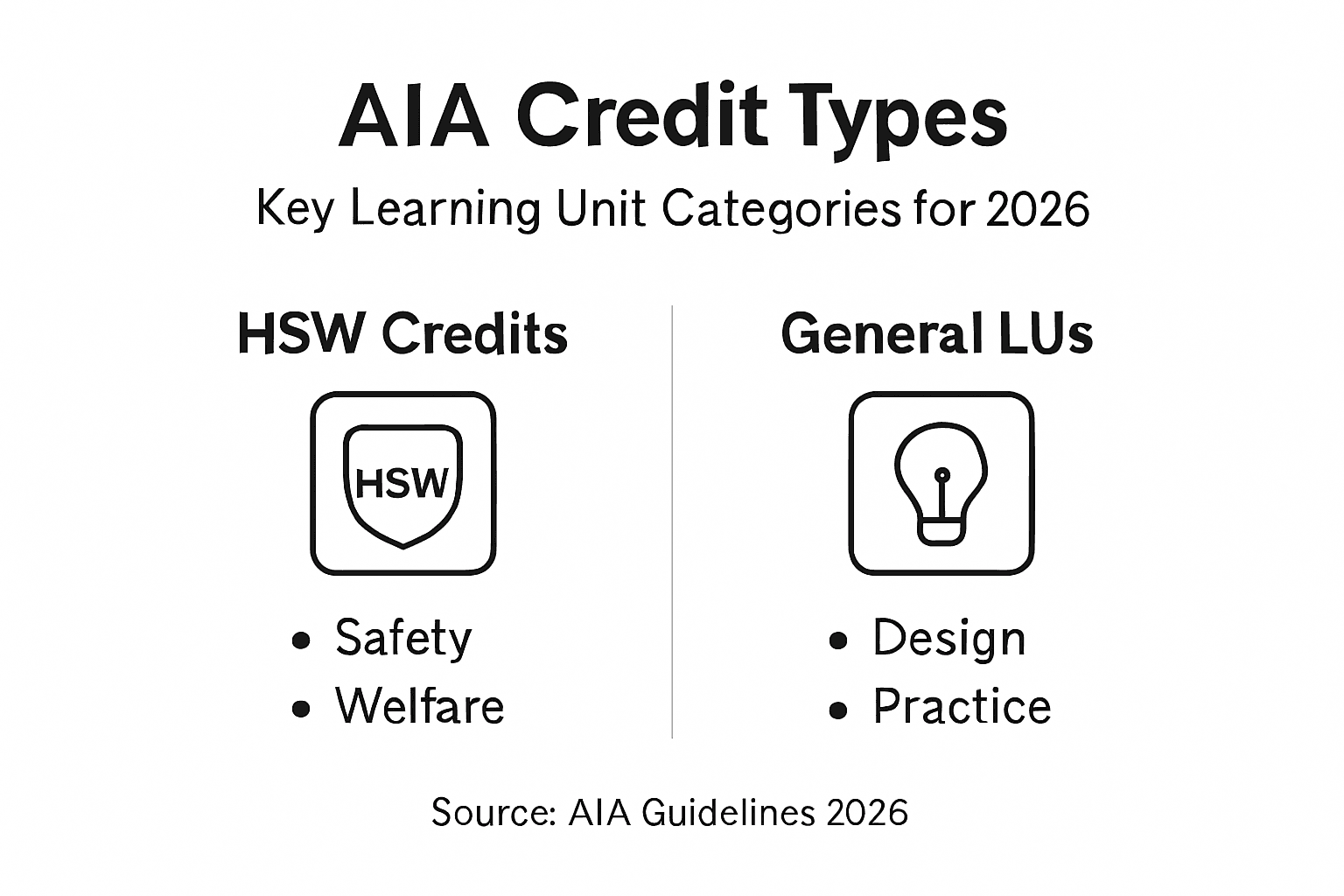
When you look at your AIA continuing education requirements, you’ll notice two distinct credit categories: general Learning Units (LU) and Health, Safety, and Welfare (HSW) credits. Understanding the difference between these categories is critical because California and most states treat them differently in their licensure requirements. General LUs cover a broad range of professional topics from business management to design technology, while HSW credits specifically address content that protects the public by covering building safety, accessibility standards, fire life safety, structural integrity, and other welfare concerns. The state doesn’t view these categories as interchangeable, so you need to know which credits satisfy which requirements.
Tracking these credits accurately prevents renewal headaches down the road. The AIA maintains official records of AIA-approved continuing education courses and credit types, and you report your completed hours either directly to the state licensing board. When you enroll in any continuing education program, verify upfront whether it carries LU credit, HSW credit, or both. Some well-designed courses actually provide both types of credit simultaneously. For instance, a webinar on passive house principles and accessibility integration might count as HSW because it addresses safety and welfare, but it also provides general LU credit for the design innovation component.
Pro tip: Start tracking your HSW credits first during your two-year cycle, then fill the remaining hours with general LUs that address your professional development goals, rather than waiting until renewal is approaching and scrambling to find HSW courses that might not align with your interests.
Earning Credits: Course Types and Formats
AIA continuing education comes in multiple formats, and the beauty of this system is that it accommodates different learning styles and schedules. You can earn credits through traditional in-person seminars, live online webinars, self-paced online courses, recorded presentations, and even structured self-directed learning activities. Each format carries the same credit value when delivered by an AIA-approved provider. A full-day in-person conference session on sustainable design might earn you 6 learning units, while a one-hour recorded webinar on accessibility standards earns 1 LU. The format doesn’t matter as much as the content quality and whether the provider is officially recognized by the AIA.
For architects juggling multiple projects, online courses offer significant flexibility. You can complete a self-paced course on passive house design principles at 10 PM after your team leaves the office, or break it into smaller sessions throughout the week. Many providers now offer hybrid options where you can attend live sessions synchronously but also access recordings afterward if you miss a time slot. In-person seminars and conferences remain valuable because they include networking opportunities with other design professionals, direct access to expert speakers, and the chance to ask specific questions about your projects. Some architects find that conference attendance energizes their practice and exposes them to emerging trends they wouldn’t discover through solo online learning. Interior designers often prioritize in-person events focused on sustainable materials and universal design, where they can see and touch product samples while learning about specifications.

Teaching and presenting also count as continuing education. When you deliver a presentation at a regional AIA chapter meeting about your firm’s approach to accessible design, you earn credits for that teaching activity. Publishing an article in a professional journal about a specific design challenge and solution qualifies as self-directed learning with documented evidence. Some firms organize internal lunch-and-learn sessions where team members present on emerging technologies or code changes, and participants can receive credits if the session meets AIA standards. This approach builds knowledge-sharing culture within your office while fulfilling renewal requirements simultaneously.
Pro tip: Mix your course formats strategically: use online courses for foundational knowledge you can consume flexibly, attend one in-person conference or seminar annually for networking and inspiration, and contribute a presentation or article when your expertise aligns with a conference theme or publication need.
Below is an overview of popular AIA continuing education course formats and their unique benefits:
| Format Type | Flexibility Level | Networking Opportunity | Typical Credit Value |
| In-person seminar | Limited | High | 1–8 credits |
| Online course | High | Low | 1–6 credits |
| Webinar | Moderate | Moderate | 1–2 credits |
| Teaching/Presenting | Variable | High | 1–4 credits |
Accessible Design and Sustainability Focus Areas
For architects in California, accessible design and sustainability represent more than trending topics. They are professional imperatives that directly shape your practice and licensing requirements. These focus areas align perfectly with AIA continuing education priorities because they address health, safety, and welfare while positioning your firm as a leader in ethical design practice. When you invest in courses covering universal design principles, you learn how to create spaces that work for everyone, including people with disabilities, aging populations, and families with diverse mobility needs. Sustainability training teaches you to specify materials and systems that reduce environmental impact while meeting California’s increasingly strict energy codes and indoor air quality standards. Both skill sets translate directly into competitive advantages for your firm and better outcomes for your clients.
Accessible design courses typically cover California Title 24 standards, ADA compliance, and principles that go beyond minimum requirements to create genuinely inclusive environments. You’ll learn about wayfinding systems that help people with vision impairments navigate spaces intuitively, kitchen layouts that accommodate wheelchair users while remaining functional for everyone, and material selections that support people with sensory sensitivities. Interior designers benefit greatly from courses that dive deep into universal design principles and equity in built environments, because these topics directly influence how you approach material selections, color contrasts, acoustic control, and spatial planning. Sustainability training covers low-emitting materials, carbon footprint assessment, passive design strategies, and renewable energy systems. These courses help you understand lifecycle assessments, where a material might seem sustainable initially but carries significant environmental cost in manufacturing or transportation. Understanding these nuances makes you a more credible specification advisor when working with building product representatives and manufacturers.
What makes these focus areas essential for your 2026 renewal is that they address real market demand. Clients increasingly ask for accessible and sustainable design solutions, and insurance companies reward firms with demonstrated expertise through better rates and lower liability exposure. When you complete courses on accessible design and sustainability, you can confidently discuss design decisions with clients, justify material choices to cost-conscious stakeholders, and integrate these principles into your standard practice rather than treating them as special requests. Many of the best AIA-approved courses combine both focus areas, showing how accessible design and sustainability complement each other. A course on healthy material specifications for schools, for example, addresses both sustainability through low-VOC selections and accessibility through inclusive design that supports students with chemical sensitivities.
Pro tip: Prioritize courses that include case studies of recently completed projects, as these show real-world application of codes you work with daily and give you concrete examples to reference when discussing design approaches with clients and team members.
How to Track, Report, and Avoid Common Mistakes
Tracking your continuing education credits requires more attention than you might think. Many architects and interior designers wait until their renewal deadline approaches, only to discover missing documentation or credits that don’t count toward their requirements. The solution is straightforward: maintain a personal spreadsheet or document from day one of your renewal cycle. Record the course title, provider name, completion date, number of credits earned, credit type (LU or HSW), and confirmation number or certificate. This simple habit prevents the scramble that happens when you’re six weeks from renewal and realize you only have 10 credits instead of the required 18 for AIA members. Store your course certificates in a dedicated folder, either physical or digital, organized by year. When renewal notices arrive, you can quickly verify that your records match what the state board has on file.
Timing matters significantly here. Don’t wait until the final deadline to submit your records. Common reporting mistakes include misclassifying credits and failing to submit timely documentation, both of which can result in license suspension or mandatory makeup hours. Interior designers report through their respective licensing boards with similar deadlines. One frequent error is assuming that a course counts as HSW when it actually qualifies as general LU only. A course on firm management or marketing, for instance, earns general credits but won’t count toward your HSW requirement. Always verify credit classification before enrolling, not after. Another mistake is taking courses from providers not officially approved by the AIA or your state board. A fantastic webinar from an excellent speaker might be worthwhile for your professional growth, but if the provider isn’t AIA-approved, those hours won’t count toward renewal.
Documentation is non-negotiable. Keep copies of certificates of completion, course syllabi, and any correspondence from providers confirming credit awards. If you complete self-directed learning activities like publishing an article or presenting at a conference, maintain evidence such as published articles, conference programs listing your presentation, or email confirmations from event organizers. The state board may request documentation years after your renewal, especially if an audit occurs. Having organized records prevents delays and protects your license. Some architects also hold LEED accreditation, which has its own continuing education requirements separate from AIA credits. Don’t mix these systems up.
Pro tip: Set a calendar reminder for the midpoint of your renewal cycle (typically 12 months into a 24-month period) to review your accumulated credits and identify any gaps so you can plan remaining courses strategically rather than scrambling at the deadline.
Stay Ahead With Expert AIA Continuing Education Solutions
If you found the complexities of earning AIA continuing education credits overwhelming, especially balancing Health, Safety, and Welfare (HSW) requirements with general Learning Units (LU), you are not alone. Managing the right mix of approved courses while ensuring timely tracking and reporting can feel like a daunting challenge. You want flexible, high-quality options that cover critical topics like accessible design and sustainability without the stress of administrative guesswork.
At Ron Blank & Associates, we deliver expertly developed continuing education courses tailored precisely for architects, interior designers, and other design professionals. Our courses are officially registered with the American Institute of Architects and are available as online classes, webinars, podcasts, and live sessions. We not only make it easier to fulfill your 2026 AIA continuing education credit requirements but also connect you with courses focusing on the exact Health, Safety, and Welfare standards that matter most to your licensure renewal. Whether you want to maximize your HSW credits efficiently or deepen your expertise in sustainable building products, our offerings empower you to succeed in your professional goals.

Don’t wait until renewal deadlines add pressure. Take control of your continuing education now by exploring our full range of courses and learning formats at Ron Blank & Associates. Stay compliant, stay inspired, and keep your license active with confidence.
Frequently Asked Questions
What is the difference between Learning Units (LU) and Health, Safety, and Welfare (HSW) credits?
Learning Units (LU) cover a broad range of professional topics, while HSW credits specifically address content that protects public health, safety, and welfare, such as building safety and accessibility standards.
Can I earn AIA continuing education credits through online courses?
Yes, AIA continuing education credits can be earned through various formats, including online courses, in-person seminars, webinars, and structured self-directed learning activities.
What types of topics should I focus on when earning my continuing education credits?
Focusing on topics like accessible design, sustainable design, building safety, and energy code compliance will not only fulfill your license requirements but also enhance your professional competence.