

TL;DR:
- Proper documentation of continuing education hours is essential to maintain licensure and avoid audit failures for architects, engineers, and construction professionals. Accurate records, including course details, completion dates, provider credentials, and completion certificates, must be retained for at least six years to ensure compliance and quick response during audits. Implementing automated tracking systems and organizing PDFs in cloud folders significantly reduces administrative burden and safeguards career progression.
Documenting continuing education hours is the process of maintaining detailed, verifiable records of completed courses to prove compliance with licensure and professional development requirements. For architects, engineers, and construction professionals, this is not optional paperwork. Forty percent of audit failures stem from documentation problems, not from failing to complete the required coursework. You can finish every required course and still lose your license if you cannot produce the records. The American Institute of Architects (AIA), state licensing boards, and NCEES all place the burden of proof squarely on the individual licensee.

Why document continuing education hours: the core requirement
Continuing education documentation refers to the organized collection of completion certificates, course records, and provider credentials that prove a licensee has met state board requirements. The term used across most state boards and professional associations is “CE record retention,” and it carries legal weight. State boards do not automatically have access to provider records. Boards require licensees to present original or certified completion certificates during an audit. That single fact changes how you should think about every course you complete.
The importance of documenting CE hours goes beyond checking a renewal box. Your records are legal documents. Treat them the way you treat tax filings or professional liability insurance. If a state board selects you for audit and you cannot produce your certificates within the required window, the consequences are real and immediate.
What must your CE documentation include?
Accurate CE records contain specific data points. Missing even one field can invalidate a credit during an audit. Every certificate you retain should include all of the following:
- Course title as it appears in the provider’s official records
- Completion date and the number of credit hours awarded
- Provider name and accreditation status (AIA CES provider number, PDH provider ID, etc.)
- Licensee’s full legal name matching the name on the license
- Course description confirming the subject matter and learning objectives
Incomplete certificates that lack course descriptions or provider approval information cause credit loss and audit failures. A certificate that shows only a course title and hours completed is not sufficient in most jurisdictions.
How long do you need to keep CE records?
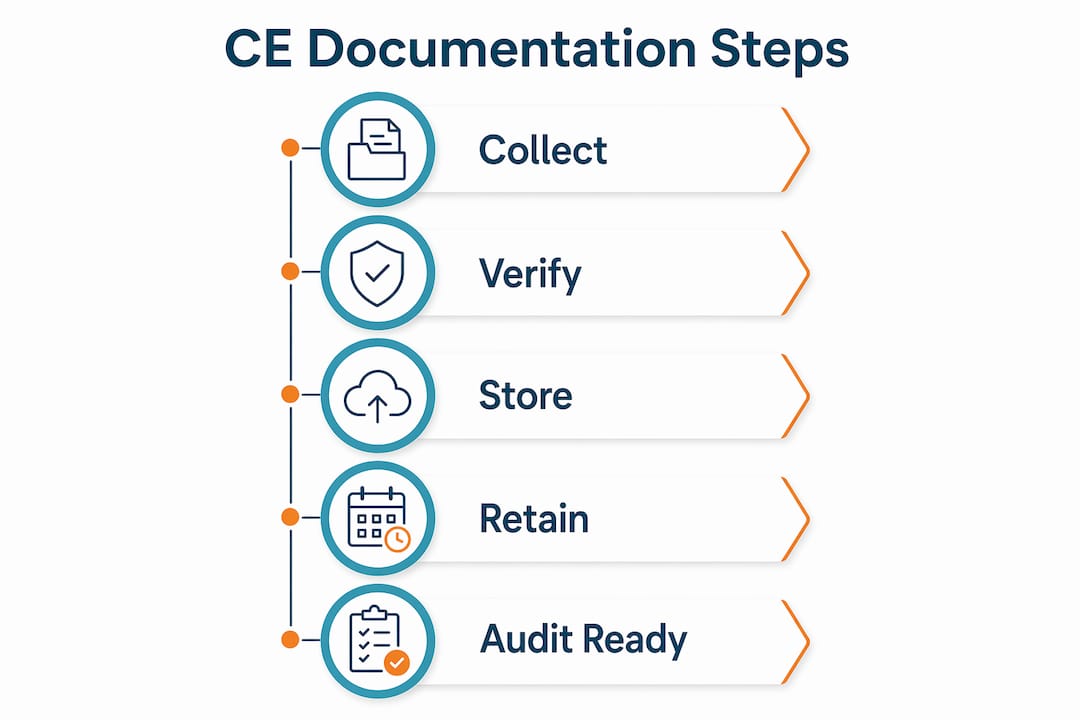
Retention timelines vary by state, but the trend is consistent. Many boards mandate CE record retention for at least six years, covering three full renewal cycles. Here is a quick comparison of common retention requirements:
| Jurisdiction Type | Minimum Retention Period |
|---|---|
| Most state architecture boards | 5–6 years |
| Most state engineering boards | 3–6 years |
| AIA membership records | 3 years (current cycle) |
| General best practice | 6 years |
Six years is the safe standard. If you are unsure of your specific state’s rule, default to six years and you will be covered in virtually every jurisdiction.
Pro Tip: Scan every certificate to a PDF immediately after course completion and save it to a cloud folder labeled by renewal year. Do not rely on the provider to resend it later. Providers change platforms, go out of business, or archive old records.
How to track CE credits without losing your mind
Tracking CE hours strategically means building a system that works automatically, not one you scramble to reconstruct every renewal cycle. Here is a practical approach that works for busy AEC professionals:
- Log completions within 24 hours. Manual spreadsheet tracking is prone to errors and data rot. The longer you wait to record a course, the higher the chance of missing details or losing the certificate entirely.
- Use a digital tracking system. Learning management systems (LMS) and platforms like CE Broker centralize your records and generate audit-ready reports. Automated tracking systems reduce administrative time by 25–35% compared to manual methods.
- Create a dedicated certificate vault. Store all PDFs in a single folder structure organized by license type, state, and renewal year. Google Drive, Dropbox, or a firm-managed SharePoint folder all work.
- Set calendar reminders 90 days before renewal. This gives you time to identify gaps and complete missing hours without rushing into low-quality courses.
- Separate topic-specific requirements. Many boards require hours in specific subjects, such as health and safety, accessibility, or sustainable design. Track these categories separately so you can confirm compliance at a glance.
Construction and engineering firms that deploy automated CE tracking systems report saving hundreds of hours per year in administrative work across their licensed staff. That time savings compounds when you consider that a single audit response for one employee can consume 10 or more hours of HR and legal time if records are disorganized.
Pro Tip: If your firm has five or more licensed professionals, a shared LMS or CE management platform pays for itself after the first avoided audit penalty. Look for systems that integrate with your existing HR software.
What happens when CE documentation fails an audit?
The audit process is faster and less forgiving than most professionals expect. Audit response windows are typically 30–60 days. That is your entire window to locate, compile, and submit every required certificate. Miss that deadline and the disciplinary process begins.
The consequences of poor CE documentation include:
- Fines and monetary penalties assessed per missing credit hour or per violation
- License suspension that prevents you from practicing until compliance is demonstrated
- Public disciplinary records that appear in state board databases and can affect future employment, project bids, and professional references
- Mandatory course retakes at your own expense, even for courses you completed but cannot document
“The burden of proof during audits rests entirely on the licensee. State boards do not automatically have access to provider records.” — Everything You Need to Know About Continuing Medical Education
Hidden costs of poor documentation far exceed the investment in a reliable tracking system. Retaking a 12-hour health and safety course costs time and money. A license suspension costs clients, projects, and reputation. Neither outcome is recoverable quickly in a competitive AEC market.
For construction professionals working on compliance documentation across multiple subcontractors or project teams, the risk multiplies. One unlicensed or non-compliant team member can create project delays and contract liability.
Does CE documentation help your career beyond compliance?
The benefits of continuing education records extend well past avoiding penalties. Comprehensive CE records correlate with higher earning potential and faster promotions within firms. Employers and clients use CE portfolios to assess whether a professional stays current with codes, materials, and methods.
Here is how thorough documentation creates career advantages:
- Demonstrates adaptability. A record showing courses in mass timber, passive house design, or LEED v4.1 tells a hiring manager you invest in current knowledge.
- Supports performance reviews. Firms that track CE internally use those records to identify candidates for project leadership and senior roles.
- Builds a professional development portfolio. Architects pursuing AIA Fellowship or engineers seeking PE reciprocity in additional states need documented proof of ongoing learning.
- Strengthens client proposals. Some clients, particularly government agencies and institutional owners, ask for evidence of staff qualifications. A clean CE record is a direct answer to that request.
Staying ahead with compliance training strategies also positions you as a resource within your firm, not just a practitioner meeting minimums.
Best tools and systems for CE documentation in 2026
The right tools make CE record-keeping nearly automatic. Here are the most practical options for AEC professionals:
- CE Broker: Widely used in licensed professions, it tracks hours, sends renewal reminders, and stores certificates in a searchable database.
- Learning management systems (LMS): Platforms like TalentLMS or Absorb LMS work well for firms managing CE across large teams of engineers or contractors.
- Cloud storage with folder templates: For solo practitioners, a structured Google Drive or OneDrive folder with consistent naming conventions works reliably.
- AIA’s CES Discovery: Architects can use the AIA’s Continuing Education System to track AIA-registered courses directly.
Digital tracking systems serve as secure vaults for regulatory documentation and reduce the time needed to respond to an audit from days to hours. The key is choosing a system you will actually use consistently, not the most feature-rich option that sits unused.
Pro Tip: Whatever system you choose, test it by running a mock audit on yourself once per year. Pull every certificate for the current renewal cycle and confirm each one contains all required data fields. You will catch gaps while there is still time to fix them.
Key takeaways
Meticulous CE documentation is the single most effective way to protect your license, reduce audit risk, and build a career record that speaks for itself.
| Point | Details |
|---|---|
| Documentation is a legal requirement | Boards require original certificates from licensees; provider records alone do not satisfy audit demands. |
| Six years is the safe retention standard | Most state boards require CE records for at least three renewal cycles, making six years the reliable default. |
| Log completions within 24 hours | Immediate digital logging prevents data rot and ensures all required certificate fields are captured accurately. |
| Audit windows are short | Professionals typically have only 30–60 days to respond to an audit before disciplinary action begins. |
| Records support career advancement | Documented CE history correlates with higher earning potential, faster promotions, and stronger client proposals. |
Manage your CE records with Ronblank
Ronblank develops AIA-registered continuing education courses for architects, engineers, interior designers, and contractors, delivered as online courses, webinars, podcasts, and face-to-face programs. Every course comes with a completion certificate that meets state board documentation requirements, making it straightforward to build and maintain a compliant CE record.

If you are looking for a reliable source of documented, accredited CE hours that hold up in any audit, explore Ronblank’s course catalog and start building your professional development record today. Whether you need health and safety credits, sustainability hours, or product-specific technical education, Ronblank has courses designed for the way AEC professionals actually work.
FAQ
What does CE documentation need to include?
Every CE certificate must show the course title, completion date, credit hours, provider name and accreditation number, and the licensee’s full legal name. Incomplete certificates that lack course descriptions or provider approval details cause credit loss during audits.
How long should architects and engineers keep CE records?
The standard is six years, covering three full renewal cycles. Most state architecture and engineering boards require this minimum, and defaulting to six years protects you across virtually all jurisdictions.
Can i rely on my CE provider to keep my records?
No. Boards require licensees to produce original or certified certificates themselves. Provider records are not a substitute, and many providers archive or delete old records after a few years.
What happens if i fail a CE audit?
Audit response windows are typically 30–60 days. Failure to respond with complete documentation can result in fines, license suspension, mandatory course retakes, and a public disciplinary record on your state board profile.
What is the fastest way to improve my CE tracking system?
Switch to a digital tracking tool such as CE Broker or an LMS, log each completion within 24 hours, and run a self-audit once per year to confirm all certificates contain the required data fields. Automated tracking systems reduce administrative time by 25–35% compared to manual methods.