

TL;DR:
- Earning AIA credits requires completing courses from AIA CES-registered providers, entering your member number during registration, and regularly reviewing your transcript for accuracy.
- Platforms like Ronblank offer free, on-demand courses with automatic reporting to help architects meet their annual requirements efficiently.
Earning AIA credits means completing continuing education courses from AIA CES-registered providers, which automatically report your Learning Units to the AIA transcript system. AIA Architect and International Associate members must complete 18 Learning Units annually, with at least 12 of those designated as Health, Safety, and Welfare credits, all by December 31 each year. That split matters more than most architects realize until they are scrambling in November. Platforms like Ronblank make it possible to fulfill most or all of those requirements at no cost, with courses available around the clock and automatic transcript reporting built in.
How to earn AIA credits: understanding approved education
AIA-approved education is defined as any course delivered by a provider registered with the AIA Continuing Education System, commonly called AIA CES. Registration is not automatic. Providers must apply, meet content standards, and have individual courses reviewed before those courses qualify for credit. This distinction separates a legitimate AIA course from a general webinar or product presentation that happens to mention architecture.
Two credit types govern what counts toward your annual requirement:
- LU (Learning Unit): Any approved course earns LU credit. These count toward your 18-unit total but cannot satisfy the mandatory HSW portion.
- LU|HSW (Health, Safety, and Welfare): Courses covering topics like fire protection, structural systems, accessibility, or building envelope performance earn this designation. You need at least 12 of these per year.
- LU|Elective: A subset of LU credit, sometimes used to categorize courses that fall outside the HSW scope. These fill the remaining six units of your annual requirement.
Only courses from AIA CES-registered providers count toward AIA membership requirements and receive automatic transcript reporting. If a provider is not registered, the credit simply does not count, regardless of how good the content is. You can verify any provider or course through the AIA CES database at aia.org before investing your time.
Pro Tip: AIA CES registration confirms a provider meets content standards, but it does not mean AIA endorses that provider’s commercial products or services. Evaluate course quality independently.
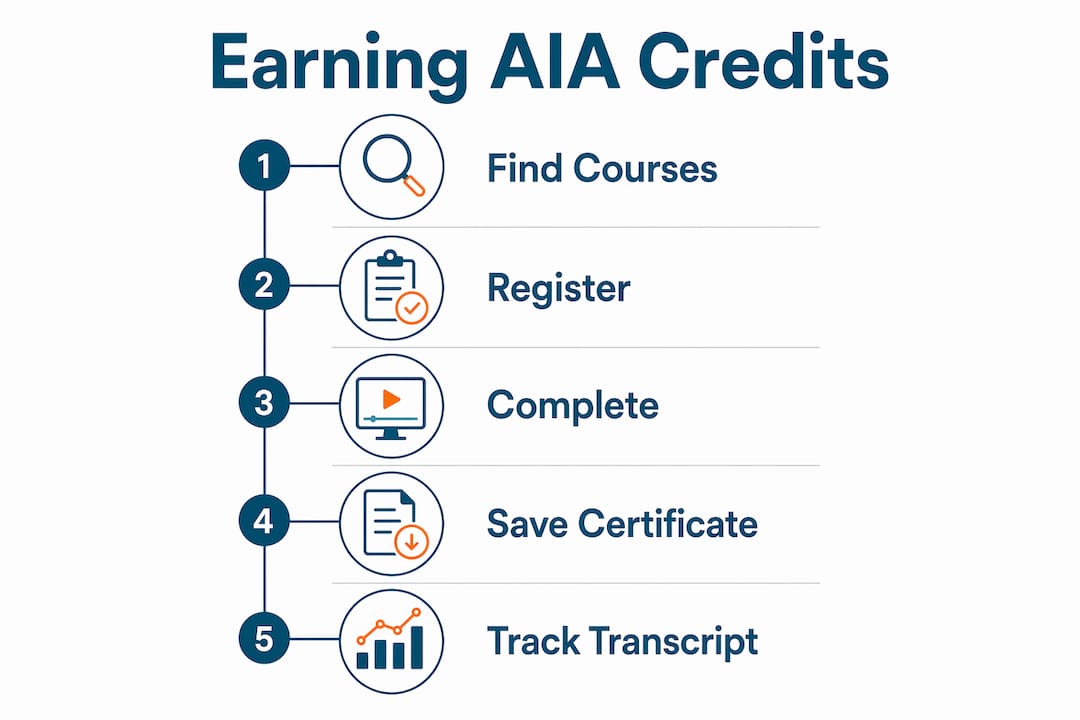
How to register for AIA courses and complete them correctly
Getting credit is not just about sitting through a course. The registration process itself determines whether your completion gets reported. Follow these steps to make sure nothing falls through the cracks.
- Locate an AIA CES-registered provider. Search the AIA CES database or go directly to a known provider like Ronblank, which lists its full course catalog at ronblank.com with clear LU and HSW designations for each course.
- Create or log into your account on the provider’s platform. Most platforms require a profile before you can enroll in a course.
- Enter your AIA member number during registration. This step is the most commonly skipped, and it is the most consequential. Omitting your member number blocks automatic reporting and forces you into a manual correction process later.
- Complete the course content. Formats vary by provider. Ronblank delivers courses as on-demand online modules, live webinars, podcasts, and face-to-face lunch and learn sessions. Each format counts equally as long as the provider is AIA CES-registered.
- Pass the assessment. Assessment passing thresholds typically fall between 70% and 80%. Passing generates a certificate of completion, which serves as your official record of the credit.
- Download and save your certificate immediately. Providers occasionally retire courses or restrict access to older certificates. A saved PDF is your backup if a transcript dispute arises later.
Pro Tip: Save PDF certificates right after course completion. Providers may remove access to courses or certificates, and you will want that documentation if your transcript is ever audited.
Courses on platforms like Ronblank are designed to be completed in one sitting, typically one hour per LU. That format makes it practical to batch several courses on a single afternoon and knock out a significant portion of your annual requirement in one focused session.
Strategies to fulfill AIA requirements efficiently
Most architects treat continuing education as a year-end obligation. The smarter approach treats it as a quarterly habit, which removes the December panic and gives you more flexibility in choosing courses that actually interest you.

Free vs. paid platforms: what each delivers
| Platform type | Cost | Credit types available | Reporting |
|---|---|---|---|
| Ronblank (free) | $0 | LU and LU | HSW |
| AIAU (AIA’s own platform) | Subscription or per-course | LU, LU | HSW, specialized topics |
| Manufacturer-sponsored courses | $0 | LU | HSW (product-focused) |
| Conference sessions (AIA Conference on Architecture) | Registration fee | LU and LU | HSW |
Ronblank offers a large catalog of free AIA-approved courses with 24/7 access and automatic reporting, making it one of the most efficient ways to meet the LU|HSW requirement without spending anything. AIAU, the AIA’s own learning platform, is worth considering for specialized content in areas like practice management, urban design, or emerging technology, where free options are thinner.
Manufacturer-sponsored courses are an underused resource. Building product manufacturers often fund AIA CES-registered courses on topics like glazing systems, roofing membranes, or mass timber construction. These courses are free, technically rigorous, and frequently earn LU|HSW credit because they cover real performance and safety topics.
- Batch three to four one-hour courses in a single session to accelerate credit accumulation without disrupting your project schedule.
- Check your state licensing board’s requirements separately. Some states require live instruction for a portion of credits, which on-demand courses cannot satisfy.
- Prioritize LU|HSW courses early in the year. Elective credits are easy to find later, but HSW-designated content requires more deliberate selection.
- Mix formats. A podcast-based course during a commute, a webinar during lunch, and an on-demand module on a slow Friday afternoon can collectively cover six credits with minimal schedule disruption.
How to track, report, and troubleshoot your AIA transcript
Your AIA transcript is the official record of every credit you have earned. Reviewing it regularly is not optional if you want to stay compliant without surprises.
- Log into your AIA account and pull your current transcript before enrolling in new courses. Checking your transcript first prevents redundant credit-chasing and shows you exactly where your gaps are. You may already have eight LU|HSW credits and only need four more, which changes which courses you prioritize.
- Allow 10 business days after course completion before checking for the credit. Providers must submit completion reports within 10 business days, and processing time accounts for attendance verification and data transfer. Checking too early creates unnecessary concern.
- Verify credit type, not just credit count. A transcript showing 18 LUs is meaningless if only eight of them are LU|HSW. Confirm the designation for each entry.
- Contact the provider first if a credit is missing after 10 business days. Most issues trace back to a mismatched member number or a processing delay on the provider’s end. The provider can correct member number errors and resubmit the completion report.
- Escalate to AIA Member Services if the provider cannot resolve the issue. AIA has a dispute process for credit recording errors, and Member Services can intervene when a provider is unresponsive.
Self-reported credits count only as LU|Elective and cannot satisfy the mandatory 12 LU|HSW requirement. If you are relying on self-reporting to fill your HSW gap, you will not meet the annual requirement regardless of your total credit count.
One detail that catches architects off guard: AIA membership reporting and state licensure reporting are entirely separate systems. Completing your AIA transcript does not automatically satisfy your state board’s continuing education requirements. Verify with your state licensing board whether additional manual submissions are needed, particularly if you are licensed in multiple states.
Key takeaways
Earning AIA credits requires completing courses from AIA CES-registered providers, entering your member number at registration, and reviewing your transcript regularly to confirm both credit count and credit type.
| Point | Details |
|---|---|
| Annual credit requirement | Complete 18 LUs per year, with at least 12 designated as LU |
| Provider verification | Only AIA CES-registered providers issue credits that count and report automatically. |
| Member number at registration | Always enter your AIA member number when enrolling to enable automatic transcript reporting. |
| Free credit options | Ronblank and manufacturer-sponsored courses offer free LU |
| Transcript review | Check your transcript before enrolling in new courses to identify gaps and avoid duplicate effort. |
Earn AIA credits for free with Ronblank’s course library
Ronblank has built one of the most accessible free AIA continuing education libraries available to architects and design professionals today.

The platform offers on-demand courses covering the full range of required HSW topics, from fire-rated assemblies and accessibility standards to sustainable building systems and structural performance. Every course is AIA CES-registered, and completions are reported automatically to your AIA transcript, typically within 10 business days. You can access courses at any hour, work through them at your own pace, and download your certificate immediately after passing the assessment. Visit ronblank.com to browse the full catalog and start earning credits today.
FAQ
What are the AIA continuing education requirements?
AIA Architect and International Associate members must complete 18 Learning Units per year, with at least 12 designated as LU|HSW, by December 31. Failure to meet this requirement can affect membership standing.
How do I verify that a course counts for AIA credit?
Check the AIA CES database at aia.org to confirm the provider and specific course are registered. Only courses from AIA CES-registered providers count toward your annual requirement.
Can I self-report AIA credits for HSW requirements?
Self-reported credits count only as LU|Elective and cannot satisfy the mandatory 12 LU|HSW annual requirement. HSW credits must come from AIA CES-registered providers who report completions directly.
How long does it take for a completed course to appear on my transcript?
Providers must submit completion reports within 10 business days. If a credit does not appear after that window, contact the provider first, then escalate to AIA Member Services if the issue is not resolved.
Are free AIA-approved courses as valid as paid ones?
Yes. Credit validity depends on AIA CES registration, not course cost. Free platforms like Ronblank offer fully registered LU|HSW courses that report automatically and count equally toward your annual requirement.