
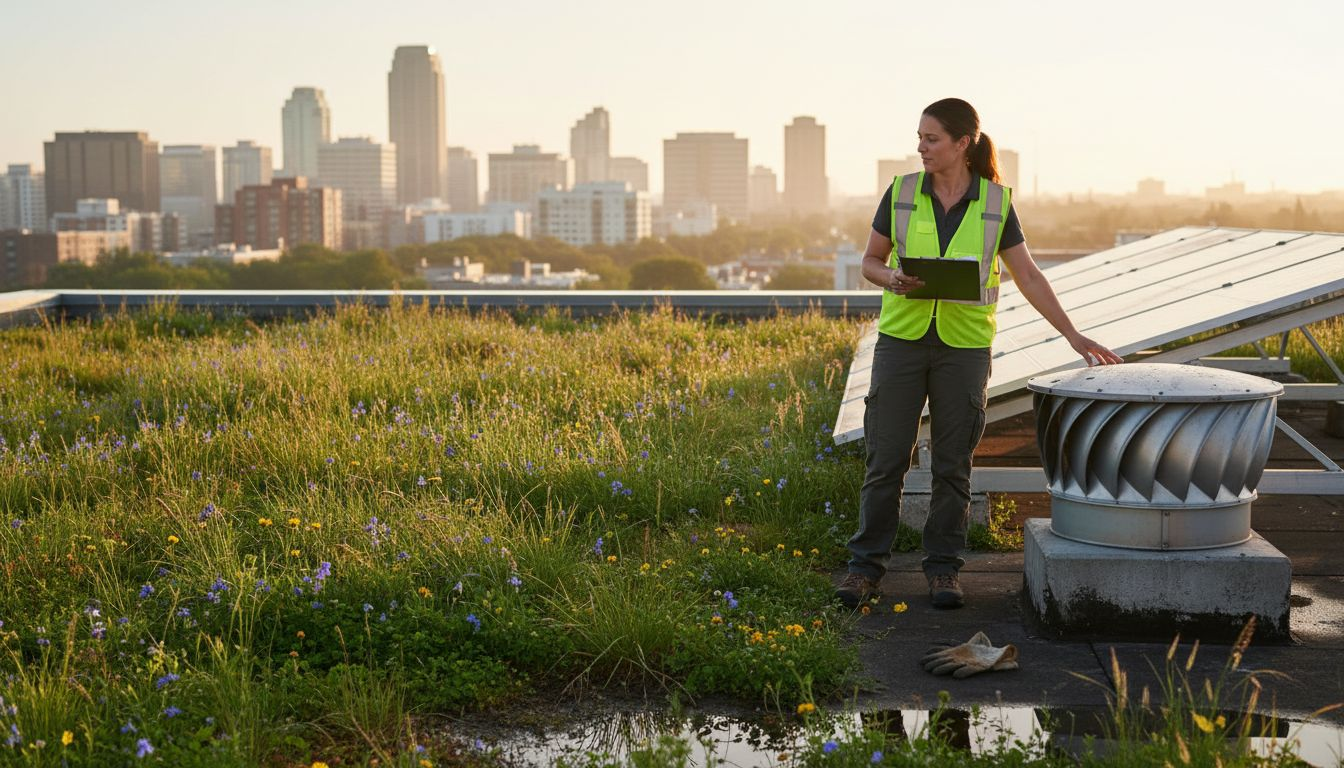
Choosing the right sustainable design strategies feels overwhelming when every option promises transformative results. Architects, engineers, and interior designers pursuing AIA continuing education credits need evidence-based guidance to cut through the marketing noise. Studies show that combining passive solar design with solar photovoltaic systems can reduce building energy consumption by over 80%, proving that strategic integration beats isolated solutions. This article distills five proven sustainable design examples with quantified benefits, helping you make informed specification decisions that advance both project performance and certification goals.
Table of Contents
- Selection Criteria For Sustainable Design Examples
- Green Roofs: Cooling Urban Spaces And Managing Stormwater
- Solar Energy Integration: Cutting Operational Costs And Emissions
- Low-VOC Materials: Enhancing Indoor Air Quality For Health And Compliance
- Passive Solar Design: Architecture That Saves Energy Naturally
- Summary Comparison And Situational Recommendations
- Explore Sustainable Design Solutions With Ron Blank & Associates
- FAQ
Key Takeaways
| Point | Details |
|---|---|
| Selection Criteria | Environmental impact, cost effectiveness, project suitability, and certification compliance guide sustainable design choices. |
| Energy Savings Range | Passive solar design cuts energy use 25-60%, while solar integration reduces electricity costs 50-90%. |
| Indoor Air Quality | Low-VOC materials decrease emissions by 90%, benefiting occupant health and LEED v4 compliance. |
| Urban Benefits | Green roofs mitigate urban heat islands by up to 40% while managing stormwater naturally. |
| Integration Advantage | Combining multiple strategies maximizes energy savings, environmental impact, and certification points. |
Selection Criteria for Sustainable Design Examples
Effective sustainable design selection requires evaluating multiple factors beyond initial appeal. Environmental impact reduction stands as the primary consideration, measuring how each strategy decreases carbon emissions, resource consumption, and ecological footprint. You need quantifiable metrics here, not vague sustainability claims.
Cost effectiveness and return on investment determine project feasibility. Calculate payback periods by comparing upfront installation costs against operational savings over the building’s lifecycle. Energy modeling tools help forecast these financial projections with reasonable accuracy.
Project type, climate zone, and local conditions heavily influence which strategies work best. A passive solar design optimized for cold climates delivers minimal value in tropical regions. Similarly, green roofs require sufficient structural load capacity, eliminating them from many retrofit scenarios.
Certification compliance with LEED, WELL, or regional green building standards often drives design decisions. Review specific credit requirements early in schematic design to ensure selected strategies contribute maximum points. Material availability and technical feasibility create real-world constraints that theoretical benefits cannot overcome.
Pro tip: Create a weighted matrix scoring each sustainable design option against your project’s priorities. This quantitative approach reveals the best fit faster than subjective comparison.
- Environmental impact metrics (carbon reduction, resource conservation)
- Financial analysis (ROI, payback period, operational savings)
- Climate and site suitability factors
- Certification credit contributions
- Local material availability and contractor expertise
Green Roofs: Cooling Urban Spaces and Managing Stormwater
Green roofs transform conventional rooftops into living ecosystems that deliver multiple environmental benefits. These vegetated systems reduce urban heat island effects by up to 40% through evapotranspiration and shade provision, lowering ambient temperatures in dense cityscapes. The insulation value cuts heating and cooling loads by 20-30% compared to traditional roofing systems.
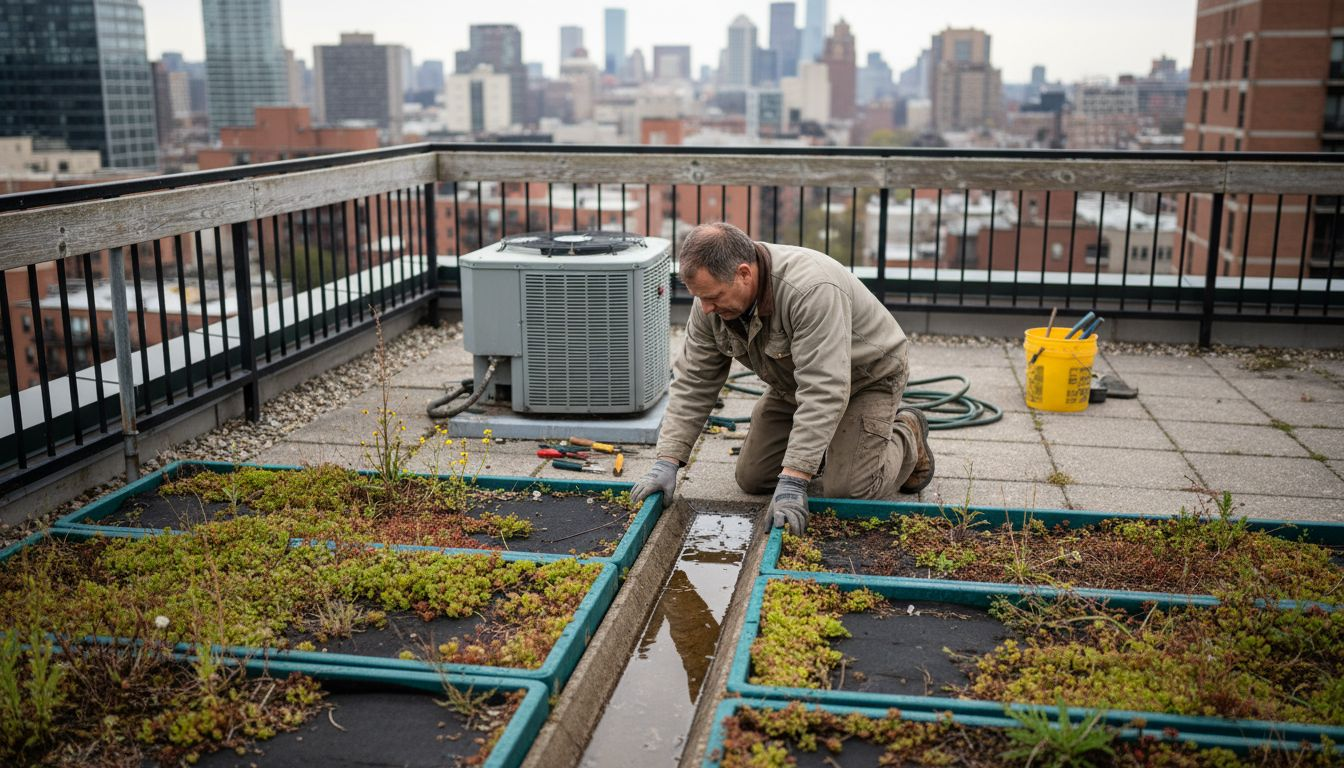
Stormwater management represents another critical advantage. Green roofs absorb 50-90% of rainfall depending on substrate depth and plant selection, reducing runoff volume and peak flow rates that overwhelm municipal systems. This benefit alone justifies installation in many urban jurisdictions with stormwater fees or regulations.
Structural considerations create the primary limitation. Existing buildings require engineering analysis to confirm roof load capacity can support 15-50 pounds per square foot of saturated growing medium. New construction accommodates green roofs more easily by incorporating structural requirements during initial design.
Upfront costs run $10-25 per square foot installed, roughly double conventional roofing. However, extended roof membrane life, reduced HVAC equipment sizing, and stormwater credit savings improve the financial case. Maintenance needs remain modest after establishment, requiring seasonal inspections and occasional weeding.
Pro tip: Combine green roofs with rooftop solar panels in a biosolar configuration. Panels benefit from cooler operating temperatures while vegetation thrives in partial shade, creating synergistic performance gains.
- Reduces urban heat islands by 40% through natural cooling
- Provides R-10 to R-30 additional insulation value
- Manages 50-90% of stormwater on-site
- Extends roof membrane life by 2-3 times
- Requires structural capacity verification before installation
Solar Energy Integration: Cutting Operational Costs and Emissions
Solar photovoltaic systems generate clean electricity with minimal operational requirements once installed. Modern installations reduce electricity costs by 50-90% depending on system size, building load profiles, and utility rate structures. Net metering policies in many jurisdictions allow excess generation credits, effectively using the grid as battery storage.
Applicability spans virtually every building type with adequate solar access. Roof-mounted arrays work for most projects, while ground-mounted systems suit campuses or sites with available land. Building-integrated photovoltaics (BIPV) replace conventional building materials with electricity-generating alternatives, though at premium costs.
Payback periods typically range from 5-10 years when combining federal tax credits, state incentives, and utility rebates. After payback, systems generate essentially free electricity for 20-30 years with minimal maintenance. This long-term value proposition strengthens as electricity rates increase over time.
Carbon emission reductions contribute significantly to sustainability goals. A typical commercial solar array prevents 100-300 tons of CO2 annually, equivalent to removing 20-60 cars from roads. LEED projects earn renewable energy credits easily through solar integration, with points scaling based on the percentage of building energy offset.
Compatibility with other sustainable strategies enhances overall performance. Solar panels complement green roofs as mentioned, while battery storage enables resilience and time-of-use optimization. Smart building systems maximize self-consumption by shifting loads to match solar generation patterns.
Pro tip: Specify solar-ready infrastructure even if immediate installation is not feasible. Including conduit pathways, electrical panel capacity, and structural reinforcement during construction costs little but enables future upgrades without major renovations.
- Reduces electricity costs by 50-90% with net metering
- Achieves 5-10 year payback periods with incentives
- Prevents 100-300 tons of annual CO2 emissions per system
- Requires minimal maintenance over 25-30 year lifespan
- Combines effectively with battery storage and smart controls
Low-VOC Materials: Enhancing Indoor Air Quality for Health and Compliance
Volatile organic compounds (VOCs) are chemicals that evaporate at room temperature from building materials, releasing harmful gases that degrade indoor air quality. Traditional paints, adhesives, sealants, and finishes contain high VOC levels causing headaches, respiratory irritation, and long-term health effects. Occupants in buildings with poor air quality experience 20-30% lower productivity according to indoor air quality research.
Low-VOC alternatives reduce these emissions by 90% while maintaining performance characteristics. Modern formulations match or exceed conventional products in durability, coverage, and aesthetic options. The slight cost premium of 5-15% disappears when considering health benefits and avoided sick building syndrome issues.
LEED v4 interior projects mandate low-VOC materials in over 90% of cases to achieve indoor air quality credits. WELL Building Standard requirements prove even more stringent, creating market demand that has expanded product availability dramatically. Manufacturers now offer low-VOC options across virtually every material category.
Best applications include interior renovation projects where occupants remain during construction, and new construction prioritizing occupant wellbeing. Healthcare facilities, schools, and office environments gain maximum benefit from improved air quality. Exterior applications see less impact since outdoor ventilation dilutes any emissions quickly.
Specification requires attention to total VOC content limits defined by SCAQMD Rule 1113 or comparable standards. Third-party certifications like Greenguard Gold provide verification of low emissions. Proper application and curing procedures ensure materials perform as tested.
- VOC emissions decreased by 90% compared to conventional materials
- Required in 90% of LEED v4 interior projects
- Improves occupant health and productivity measurably
- Adds only 5-15% cost premium with broad availability
- Essential for schools, healthcare, and occupied renovations
Passive Solar Design: Architecture that Saves Energy Naturally
Passive solar design uses building orientation, window placement, thermal mass, and shading to naturally regulate interior temperatures without mechanical systems. Department of Energy studies document heating and cooling energy reductions of 25-60% depending on climate zone and design execution quality. These savings persist throughout the building’s life without operational costs or maintenance.
Cold climates benefit most from passive solar heating strategies. South-facing glazing captures winter sunlight, while thermal mass materials like concrete or masonry absorb and slowly release heat. Overhangs and deciduous landscaping provide summer shading, preventing overheating without blocking winter sun angles.
Hot climates flip the priorities toward cooling. Minimal west-facing windows reduce afternoon heat gain, while high-performance glazing blocks solar radiation. Natural ventilation through strategically placed operable windows creates cooling breezes. Light-colored exterior surfaces reflect rather than absorb solar energy.
Design integration requires commitment during early schematic design when building orientation and massing get established. Retrofitting existing buildings proves difficult since passive solar principles depend on fundamental architectural decisions. Work with energy modelers to optimize window-to-wall ratios, overhang depths, and thermal mass placement for your specific location.
Challenges include balancing daylighting with glare control and preventing overheating in swing seasons. Operable shading, either exterior or between-glass, provides necessary flexibility. Thermal mass works best with night ventilation strategies that flush accumulated heat.
Climate Zone Energy Savings:
| Climate Type | Heating Savings | Cooling Savings | Best Strategies |
|---|---|---|---|
| Cold | 40-60% | 15-25% | South glazing, thermal mass, insulation |
| Temperate | 25-40% | 20-35% | Balanced glazing, moderate thermal mass |
| Hot-Dry | 10-20% | 35-50% | Minimal west glass, night ventilation |
| Hot-Humid | 5-15% | 30-45% | Shading, cross ventilation, dehumidification |
- Reduces heating and cooling energy by 25-60% naturally
- Requires no operational costs or mechanical maintenance
- Most effective when integrated during initial design phases
- Climate-specific strategies optimize performance regionally
- Combines well with high-performance envelope systems
Summary Comparison and Situational Recommendations
Comparing sustainable design examples side by side reveals distinct advantages suited to different project priorities. Solar energy integration delivers the highest energy savings potential at 50-90% electricity cost reduction, though requiring significant upfront investment. Passive solar design provides 25-60% savings with minimal added construction cost when incorporated early.
Green roofs excel in urban contexts where stormwater management and heat island mitigation matter most. The 40% temperature reduction benefit extends beyond individual buildings to improve neighborhood conditions. Low-VOC materials cost little extra while providing immediate occupant health benefits and supporting LEED indoor air quality credits.
Integrated strategies multiply benefits beyond individual component capabilities. A building combining passive solar orientation, high-performance envelope, solar photovoltaics, and low-VOC finishes can approach net-zero energy while providing superior indoor environmental quality. The whole exceeds the sum of parts.
Comparison of Sustainable Design Examples:
| Strategy | Energy Savings | Cost Range | Payback Period | Best Application |
|---|---|---|---|---|
| Solar PV | 50-90% electricity | $15-25/sq ft | 5-10 years | Buildings with good solar access |
| Passive Solar | 25-60% heating/cooling | Minimal added | Immediate | New construction, major renovations |
| Green Roofs | 20-30% HVAC | $10-25/sq ft | 10-15 years | Urban buildings, stormwater issues |
| Low-VOC Materials | Indirect savings | 5-15% premium | N/A | All interior projects |
Project priorities should guide selection. Energy cost reduction favors solar and passive strategies. Indoor air quality concerns prioritize low-VOC materials and enhanced ventilation. Urban sustainability goals benefit from green infrastructure like vegetated roofs. LEED certification pursuits require balanced approaches addressing multiple credit categories.
Climate suitability cannot be overstated. Cold-climate projects maximize passive solar heating gains and high-performance insulation. Hot-climate designs emphasize shading, ventilation, and cool roofing technologies. Temperate zones enjoy flexibility to pursue multiple strategies effectively.
Budget constraints influence timing and phasing. Passive solar design costs little when incorporated during initial planning but proves expensive to retrofit. Solar photovoltaics allow phased installation as funding becomes available. Low-VOC materials substitute directly for conventional products at minimal premium.
Recommendations by Priority:
- Maximum energy savings: Combine passive solar design with rooftop solar PV and high-performance envelope
- Best air quality: Specify low-VOC materials throughout with enhanced mechanical ventilation
- Urban impact: Install green roofs with native plantings and integrated stormwater management
- Fastest ROI: Focus on solar PV in high electricity cost markets with strong incentives
- Certification points: Balanced approach addressing energy, water, materials, and indoor quality
Explore Sustainable Design Solutions with Ron Blank & Associates
Translating sustainable design knowledge into successful project specifications requires experienced guidance. Ron Blank & Associates connects design professionals with professional sustainable design resources and continuing education opportunities that deepen your expertise while earning AIA credits.
Our sustainable design services bridge the gap between theory and practice, helping you navigate product selection, certification requirements, and technical detailing challenges. Partner with our team to access expert sustainable project solutions that enhance both building performance and your professional development.
FAQ
What are the most cost-effective sustainable design options?
LED lighting retrofits and solar energy integration typically offer the fastest return on investment, with payback periods under five years in favorable conditions. Local utility incentives and tax credits significantly influence economics, making solar particularly attractive in states with strong renewable energy programs. Passive solar design adds tremendous value during new construction at minimal incremental cost.
How do green roofs contribute to building sustainability?
Green roofs reduce urban heat islands by up to 40% while naturally managing 50-90% of stormwater on-site, decreasing runoff into municipal systems. The vegetated layer provides additional insulation worth R-10 to R-30, reducing heating and cooling loads by 20-30%. Best suited for urban projects with structural capacity to support the 15-50 pounds per square foot of saturated growing medium.
Can sustainable design examples help achieve LEED certification?
Absolutely. Solar photovoltaics contribute to Energy and Atmosphere credits, low-VOC materials earn Indoor Environmental Quality points, and green roofs support Sustainable Sites goals. Strategic selection addressing multiple credit categories optimizes certification level while improving building performance. Work with your LEED consultant early to align sustainable design choices with targeted credits and project scope.
Which sustainable strategies work best in different climate zones?
Cold climates maximize benefits from passive solar heating, high-performance insulation, and triple-pane windows to reduce heating loads. Hot climates prioritize shading, cool roofing, natural ventilation, and minimal west-facing glazing to control cooling demands. Temperate zones enjoy flexibility to pursue balanced approaches incorporating elements from both strategies. Local climate data should drive every sustainable design decision.
How do you combine multiple sustainable design strategies effectively?
Start with passive strategies like optimal orientation, high-performance envelope, and daylighting that require no operational input. Layer active systems like solar PV and efficient HVAC to handle remaining loads. Specify sustainable materials and water-efficient fixtures throughout. Use energy modeling to verify synergies and avoid conflicts between systems, ensuring integrated performance exceeds individual component benefits.