
Many architects expect minimalism to continue dominating 2026, but the reality is strikingly different. The design landscape is shifting toward warmer, textured, human-centered styles that embrace maximalism and eclecticism. This article unpacks major style shifts, the evolving role of materials, AI’s impact on creativity, and the sustainability paradoxes reshaping our profession. Whether you’re seeking to stay current or fulfill AIA continuing education requirements, these evidence-based insights will equip you to navigate 2026’s design directions with confidence and authority.
Table of Contents
- The Shift From Minimalism To Maximalism And Eclecticism
- Materials, Sustainability, And The Sustainability Paradox In 2026 Architecture
- AI’s Impact On Architectural Creativity And The Need For Human Intuition
- Applying 2026 Trends In Your Architectural And Interior Designs
- Explore Expert Architectural Services And Resources
- Architectural Trends In 2026 FAQ
Key takeaways
| Point | Details |
|---|---|
| Maximalism rises | Nearly 40% of designers favor maximalism and eclecticism over sterile minimalism |
| Material honesty matters | Warm, textured materials create human-centered spaces that feel authentic |
| AI needs human touch | Algorithmic design risks flatness without creative intuition guiding decisions |
| Sustainability paradox | AI tools increase energy demands, challenging green building infrastructure goals |
The shift from minimalism to maximalism and eclecticism
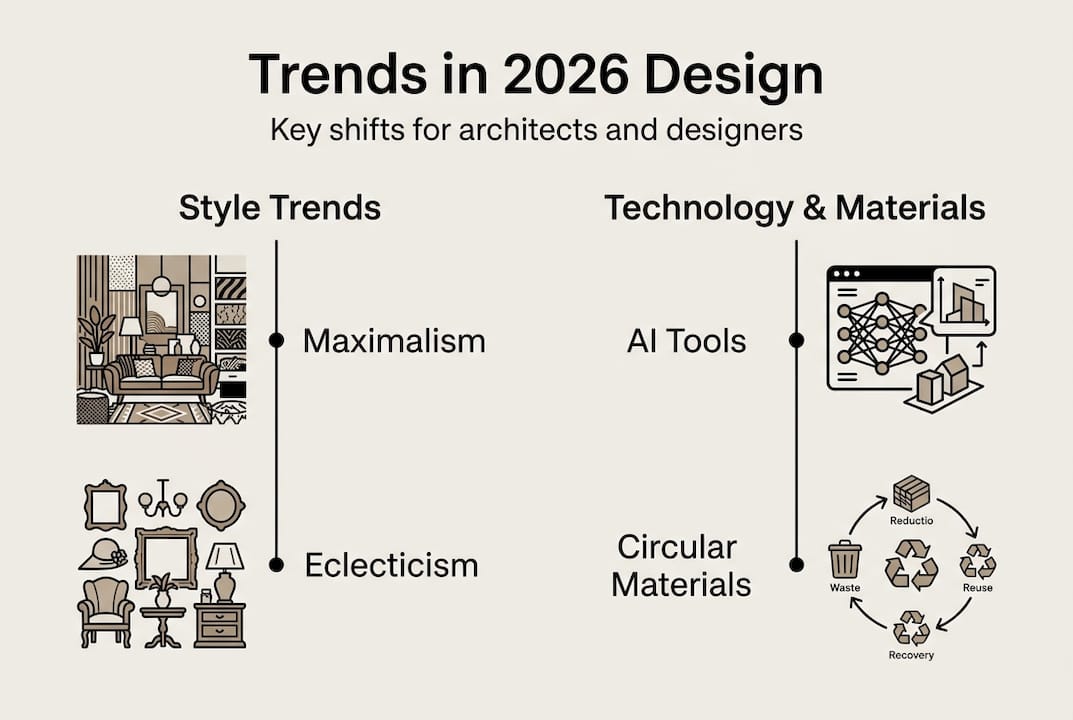
The architectural community is witnessing a profound aesthetic transformation. Designers predict maximalism (39%) and eclecticism (38%) as the leading styles, marking a decisive move away from the stark white palettes that defined the past decade. This isn’t just a pendulum swing. It represents a fundamental rethinking of how spaces should feel and function for human occupants.
White and sterile interiors are giving way to moody, tactile environments rich with color and texture. Architects are rediscovering the value of ornamentation, not as superficial decoration but as meaningful expression of material honesty. Exposed wood grain, raw concrete with visible formwork, and hand-applied plaster finishes celebrate the inherent beauty of building materials rather than concealing them behind uniform surfaces.
This trend reflects a broader cultural shift toward human-centered design philosophy. Spaces that emphasize comfort, richness, and sensory engagement are replacing the clinical precision of minimalist aesthetics. Clients increasingly request environments that feel lived-in and personal rather than showroom-perfect.
Key characteristics distinguishing these emerging styles include:
- Maximalism embraces bold patterns, layered textures, and saturated colors that create visual interest and emotional warmth
- Eclecticism blends historical references with contemporary elements, mixing materials and styles for unique character
- Material honesty showcases authentic finishes rather than synthetic replicas or concealed construction
- Ornamentation returns as intentional design language, adding depth and cultural meaning to architectural details
- Warm palettes featuring terracotta, deep greens, and rich browns replace cool grays and stark whites
“The sterile aesthetic is over. Designers are creating spaces that acknowledge human needs for warmth, texture, and visual complexity. This isn’t chaos, it’s intentional richness.”
For architects, this shift demands a recalibration of design instincts. You need to balance complexity with coherence, ensuring that layered spaces remain functional and purposeful. The goal isn’t visual noise but rather a carefully orchestrated symphony of materials, colors, and forms that engage occupants on multiple sensory levels.
Materials, sustainability, and the sustainability paradox in 2026 architecture
Material selection has become the cornerstone of sustainable design practice, yet architects face an unexpected challenge. While designers prioritize circular, eco-friendly materials that align with warmer, textured interiors, the tools we use to design these spaces are creating their own environmental burden. AI increases energy demand, straining the very infrastructure needed to support green building initiatives.
This sustainability paradox forces architects to make complex tradeoffs. AI-powered design tools offer unprecedented efficiency in optimizing building performance, generating design alternatives, and analyzing environmental impacts. However, the computational power required for these analyses consumes significant energy, often sourced from fossil fuel-dependent grids. The carbon footprint of digital design processes can partially offset the environmental benefits they help achieve.

| Aspect | Sustainability Benefits | Energy Costs |
|---|---|---|
| AI design optimization | Reduces material waste by 15-25% through precise calculations | High server energy consumption for complex modeling |
| Generative design | Explores thousands of efficient alternatives quickly | Requires intensive cloud computing resources |
| Building performance analysis | Identifies energy-saving opportunities in real time | Continuous data processing increases grid demand |
| Material databases | Connects designers with verified sustainable products | Maintaining updated databases requires constant server operation |
Navigating this paradox requires strategic thinking about when and how to deploy AI tools. You can maximize benefits while minimizing environmental impact through selective application of computational resources.
Pro Tip: Run complex AI analyses during off-peak hours when grids rely more heavily on renewable energy sources, and batch similar calculations to reduce redundant processing.
Sustainable material choices for 2026 reflect both environmental consciousness and aesthetic preferences:
- Reclaimed wood and salvaged materials bring authentic patina and reduce demand for virgin resources
- Bio-based insulation from hemp, mycelium, or cellulose offers carbon-negative alternatives to petroleum products
- Recycled metal and glass maintain structural performance while diverting waste from landfills
- Natural plasters and clay finishes regulate humidity while eliminating volatile organic compounds
- Locally sourced stone reduces transportation emissions and connects buildings to regional character
- Cross-laminated timber sequesters carbon while enabling innovative structural expressions
The key is understanding the full lifecycle impact of material choices, not just their immediate environmental credentials. A locally produced material with higher embodied energy might still outperform a certified green product shipped across continents. Context matters enormously in sustainable design decisions.
AI’s impact on architectural creativity and the need for human intuition
Artificial intelligence has transformed architectural workflows, yet its proliferation brings unexpected creative challenges. While AI aids design efficiency by rapidly generating options and analyzing performance metrics, reliance without human input risks bland aesthetics that lack soul and meaningful expression. The algorithmic approach optimizes for quantifiable factors but struggles with the intangible qualities that make spaces memorable and emotionally resonant.
You’ve likely noticed that AI-generated designs often converge on similar solutions. Machine learning models train on existing built work, naturally gravitating toward statistical averages rather than breakthrough innovation. The result is technically competent but aesthetically flat, missing the cultural references, historical awareness, and personal vision that distinguish great architecture from merely adequate buildings.
Human intuition injects the essential qualities that algorithms cannot replicate. Your ability to sense spatial relationships, anticipate emotional responses, and weave narrative into built form remains irreplaceable. Meaningful ornamentation, contextual sensitivity, and the subtle calibration of proportion and scale require judgment honed through experience and cultural literacy, not computational power.
Strategies for using AI as a tool without sacrificing creativity:
- Deploy AI for preliminary massing studies and constraint analysis, then refine results with artistic judgment
- Use generative design to explore structural options, but apply human curation to select solutions with character
- Leverage AI for technical coordination and code compliance while reserving conceptual design for human creativity
- Treat algorithmic outputs as starting points for iteration rather than finished solutions
- Maintain hands-on engagement with physical models and sketching to develop spatial intuition
- Collaborate with AI by setting creative parameters that reflect your design philosophy and values
Pro Tip: Integrate AI early in schematic design to handle computational heavy lifting, then shift to analog methods for design development where tactile exploration and intuitive refinement add layers of meaning and authenticity.
“The danger isn’t that AI will replace architects. It’s that architects will become passive consumers of algorithmic suggestions, losing the confidence to trust their own creative instincts and cultural judgment.”
The most successful 2026 practices treat AI as an intelligent assistant rather than a design author. You remain the creative director, using computational tools to expand possibilities while applying human judgment to make final decisions. This balanced approach captures efficiency gains without surrendering the artistic vision that defines architectural excellence.
Applying 2026 trends in your architectural and interior designs
Translating trend insights into successful projects requires methodical planning and thoughtful execution. Here’s how to incorporate maximalism, eclecticism, and material honesty while maintaining sustainability and creative integrity.
| Traditional approach | 2026 trend approach |
|---|---|
| Uniform white walls throughout | Layered color palettes with accent walls in deep, saturated tones |
| Hidden structural elements | Exposed beams, columns, and mechanical systems as design features |
| Synthetic finishes mimicking natural materials | Authentic materials showcasing inherent texture and imperfections |
| Minimal ornamentation for clean lines | Intentional decorative elements reflecting cultural or historical references |
| Single dominant style throughout project | Eclectic mix of styles unified by material palette or spatial strategy |
Implementation steps for successful trend adoption:
- Conduct thorough client discovery to understand their comfort level with visual complexity and textured environments
- Develop material palettes early, prioritizing circular and locally sourced options that align with sustainability goals
- Integrate AI tools strategically for technical optimization while reserving conceptual design for human creativity
- Perform lifecycle assessments that account for both material embodied energy and digital tool energy consumption
- Create detailed specifications that ensure authentic material expression rather than applied finishes
- Establish clear communication protocols with contractors to maintain material honesty during construction
- Document design decisions in ways that support AIA continuing education credits for your team
Pro Tip: Avoid the common pitfall of confusing maximalism with clutter by establishing a clear organizational logic. Use a limited material palette applied in varied ways, or create visual hierarchy through strategic placement of bold elements against calmer backgrounds.
Successful projects balance trend adoption with timeless design principles. Maximalism works best when grounded in functional clarity. Eclecticism succeeds when unified by consistent scale, proportion, or material relationships. Material honesty requires detailing expertise to ensure exposed elements age gracefully rather than appearing unfinished.
Your role as architect extends beyond aesthetic choices to educating clients about the deeper value these trends represent. Warmer, textured spaces aren’t just stylish, they support psychological well-being and create environments where people want to spend time. Material honesty reduces maintenance by eliminating applied finishes that deteriorate. Thoughtful AI integration improves building performance without sacrificing design quality.
Fulfilling AIA continuing education requirements through engagement with these cutting-edge, evidence-backed trends positions you as a forward-thinking professional. The design directions emerging in 2026 aren’t fleeting fashions but responses to genuine cultural shifts toward human-centered, sustainable, and authentic built environments.
Explore expert architectural services and resources
Understanding 2026’s architectural trends is just the beginning. Implementing them successfully requires access to expert guidance, proven methodologies, and ongoing professional development. Ron Blank & Associates specializes in supporting architects and designers through comprehensive continuing education programs that translate trend insights into practical skills.
Our AIA-registered courses cover emerging design directions, sustainable material selection, and the strategic integration of new technologies in architectural practice. Whether you’re looking to deepen your expertise in human-centered design or navigate the complexities of AI-assisted workflows, our online courses, webinars, and podcasts deliver the knowledge you need. Visit Ron Blank & Associates to explore our full range of educational resources and discover how we help design professionals stay at the forefront of their field.
Architectural trends in 2026 FAQ
What defines maximalism in 2026 architecture?
Maximalism in 2026 emphasizes rich, layered interiors with bold patterns, saturated colors, and varied textures that create visual interest and emotional warmth. Unlike minimalism’s restraint, maximalist spaces celebrate abundance while maintaining functional clarity through careful composition.
How can architects balance AI use with creative design?
Use AI for technical optimization, constraint analysis, and performance modeling, but reserve conceptual design and aesthetic decisions for human judgment. Treat algorithmic outputs as starting points that require refinement through your creative vision and cultural literacy.
What are circular materials and why are they popular now?
Circular materials are designed for disassembly, reuse, or biological decomposition at end of life, keeping resources in continuous cycles rather than becoming waste. They’re popular because they reduce environmental impact while often providing the authentic textures and warm aesthetics that 2026 design trends favor.
How does the sustainability paradox affect design decisions?
The paradox forces architects to weigh AI tool benefits against their energy consumption, requiring strategic choices about when computational analysis justifies its carbon footprint. Smart designers batch calculations, use AI selectively for high-impact decisions, and complement digital tools with low-tech design methods.
What should designers prioritize to meet AIA continuing education on trends?
Focus on evidence-based learning about human-centered design principles, sustainable material lifecycles, and the thoughtful integration of emerging technologies. Seek courses that translate trend insights into practical skills rather than superficial style surveys, ensuring your education supports both professional growth and better client outcomes.