

Many believe a formal degree is all you need to succeed in architecture, but that’s only the beginning. Education in architecture spans accredited degrees, professional licensing, and lifelong learning through continuing education. Understanding these pathways is essential for architects and engineers who want to advance their careers, maintain licensure, and stay competitive in an evolving profession. This guide breaks down the educational journey from degree selection through ongoing professional development, clarifying requirements and opportunities at every stage.
Table of Contents
- Educational Pathways For Architects And Engineers
- Licensing And Certification Requirements In Architecture
- Continuing Education And Professional Development For Architects And Engineers
- Comparing Educational Paths: Architecture Vs. Engineering In The Building Industry
- Enhance Your Architectural Knowledge With Ron Blank
- FAQ
Key takeaways
| Point | Details |
|---|---|
| Architectural education includes degrees, licensing, and continuing education | Success requires formal study, supervised experience, examinations, and ongoing learning throughout your career. |
| Understanding educational pathways helps with career planning | Knowing degree options, accreditation standards, and licensing steps allows you to map your professional trajectory effectively. |
| Licensing requires accredited degrees and experience | Most jurisdictions mandate graduation from NAAB-accredited programs plus supervised practice hours and passing exams. |
| Continuing education is vital to maintain licensure and skills | Annual CEU requirements keep architects current on codes, technologies, and sustainability practices. |
| Choosing the right educational path impacts professional opportunities | Your degree type and specialization shape the projects you can pursue and the roles you can fill. |
Educational pathways for architects and engineers
Choosing the right degree sets the foundation for your entire career. The Bachelor of Architecture (BArch) is the most direct route, typically requiring five years of intensive study combining design studios, technical courses, and architectural history. Students learn to balance creative vision with structural reality, developing skills in drafting, 3D modeling, building systems, and construction methods. The curriculum integrates design thinking with practical knowledge of materials, codes, and environmental considerations.
For engineers transitioning into architecture, Master of Architecture (MArch) programs offer a pathway. These graduate programs vary in length depending on your undergraduate background. If you hold an unrelated bachelor’s degree, expect three years of study. With a pre-professional architecture degree, you might complete the MArch in two years. These programs compress the essential architectural education into an accelerated format while building on your existing technical knowledge.
Architectural licensure requires graduation from an accredited program in many jurisdictions. The National Architectural Accrediting Board (NAAB) evaluates programs to ensure they meet professional standards. Accreditation matters because most state licensing boards only accept degrees from NAAB-approved schools. Before committing to a program, verify its accreditation status to avoid complications later in your licensing journey.
Degree comparison:
| Degree Type | Duration | Best For | Key Focus |
|---|---|---|---|
| Bachelor of Architecture (BArch) | 5 years | Students starting directly after high school | Comprehensive design and technical training |
| Master of Architecture (MArch) | 2-3 years | Career changers or those with related degrees | Intensive professional preparation |
| Master of Science in Architecture | 1-2 years | Specialization in technology or research | Advanced technical or theoretical study |
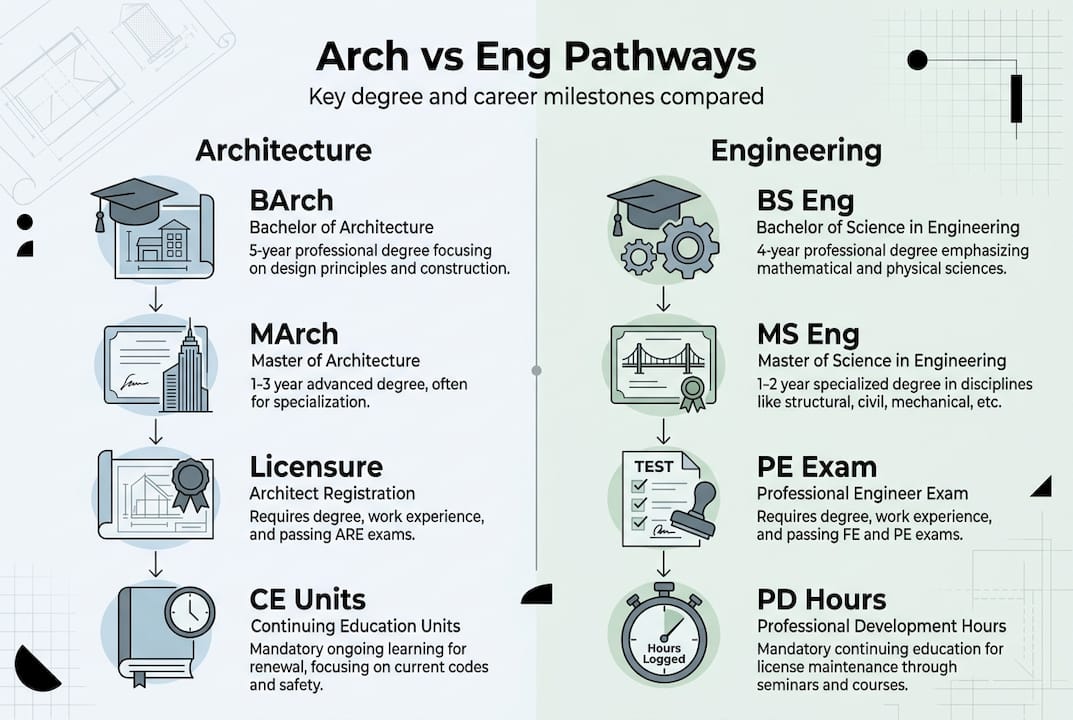
Engineering education follows a different trajectory. Civil and structural engineers typically complete four-year bachelor’s programs focused on mathematics, physics, and applied mechanics. While architects learn to envision spaces, engineers calculate loads, analyze stresses, and ensure structural integrity. Both professions require accredited degrees, but engineering programs receive approval from ABET (Accreditation Board for Engineering and Technology) rather than NAAB.
Pro Tip: If you’re uncertain between architecture and engineering, consider that architecture emphasizes creative problem solving and user experience, while engineering prioritizes technical precision and safety calculations. Many successful professionals start in one field and later pursue credentials in the other to broaden their expertise.
Licensing and certification requirements in architecture
Your degree is just the first step toward professional practice. Becoming a licensed architect requires completing the Architectural Experience Program (AXP), a structured mentorship that documents your development across six practice areas. You’ll log hours in project management, programming and analysis, project planning and design, project development and documentation, construction and evaluation, and practice management. The AXP requires approximately 3,740 hours of supervised work, ensuring you gain real-world competency before practicing independently.
Experience alone isn’t enough. You must also pass the Architect Registration Examination (ARE), a comprehensive assessment of your knowledge and judgment. The ARE consists of six divisions covering practice management, project management, programming and analysis, project planning and design, project development and documentation, and construction and evaluation. Each division combines multiple-choice questions with case studies that test your ability to apply knowledge to realistic scenarios. Most candidates spread the exams over one to two years, studying while gaining AXP hours.
Steps to licensure:
- Graduate from a NAAB-accredited architecture program
- Enroll in and complete the Architectural Experience Program (AXP)
- Pass all six divisions of the Architect Registration Examination (ARE)
- Apply for licensure in your jurisdiction
- Maintain your license through continuing education and renewal
Licensing requirements vary by state and country. Some jurisdictions allow you to start the ARE before completing your degree, while others require full graduation first. A few states mandate additional exams covering local building codes or seismic design. Research your specific jurisdiction’s requirements early to avoid surprises and plan your timeline accordingly.
Beyond basic licensure, the NCARB Certificate offers portability. This credential streamlines the process of obtaining licenses in multiple states, essential if you plan to work on projects across state lines or relocate during your career. While not mandatory, NCARB certification demonstrates that you meet consistent national standards and simplifies reciprocity applications.
Pro Tip: Start documenting your experience immediately after graduation, even if you’re not yet enrolled in the AXP. Retroactive reporting is possible, but contemporaneous records are more accurate and easier to verify when you submit for review.
Continuing education and professional development for architects and engineers
Licensure isn’t a finish line but a checkpoint. Most states require architects to complete continuing education units annually to maintain their licenses. Requirements typically range from 12 to 24 hours per year, with specific mandates for topics like accessibility, building codes, or sustainable design. These CEU requirements ensure you stay current as standards evolve and new technologies emerge.

Continuing education comes in multiple formats to fit your schedule and learning style. Online courses offer flexibility, letting you study at your own pace from anywhere. Live webinars provide real-time interaction with instructors and peers. In-person seminars and workshops deliver hands-on experience with new materials or software. Conferences combine education with networking, exposing you to cutting-edge projects and industry leaders. Many architects mix formats throughout the year to meet requirements while maximizing learning value.
Popular continuing education topics:
- Sustainable design strategies and green building certifications
- Building information modeling (BIM) and digital collaboration tools
- Updated building codes and accessibility standards
- Emerging construction materials and assembly methods
- Historic preservation techniques and adaptive reuse
- Project management and client communication skills
The profession is evolving rapidly in 2026. Climate change drives demand for expertise in passive design, renewable energy integration, and carbon-neutral construction. Digital fabrication and parametric design tools are reshaping how architects conceptualize and document projects. Modular construction and prefabrication are gaining traction as solutions to housing affordability. Your continuing education should address these trends to keep your skills relevant and marketable.
“Continuing education isn’t just about checking boxes for licensure renewal. It’s an investment in your ability to deliver better solutions for clients and contribute meaningfully to the built environment. The architects who thrive are those who remain curious and committed to growth throughout their careers.”
Professional organizations support your development beyond mandatory CEUs. The American Institute of Architects (AIA) offers extensive resources including online learning libraries, specialty certifications, and mentorship programs. State and local AIA chapters host regular events where you can earn credits while connecting with colleagues. Engineering societies like ASCE provide parallel resources for those working at the architecture-engineering interface.
Pro Tip: Don’t wait until December to scramble for CEUs. Spread your learning throughout the year, focusing on topics that genuinely interest you or fill knowledge gaps in your practice. This approach makes continuing education more enjoyable and more likely to impact your work positively.
Comparing educational paths: architecture vs. engineering in the building industry
Architecture and engineering education prepare you for different but complementary roles. Architecture programs emphasize design thinking, spatial relationships, and the human experience of buildings. You’ll spend countless hours in design studios, iterating concepts and defending your ideas through critiques. The focus is on synthesizing aesthetic, functional, and technical considerations into coherent proposals that respond to site, program, and culture.
Engineering education prioritizes quantitative analysis and problem solving. While architecture focuses on design and planning, engineering emphasizes structural and technical aspects like load calculations, material properties, and system performance. Engineering students take more mathematics and physics, applying theoretical principles to ensure buildings stand safely and systems function reliably. The curriculum develops your ability to analyze forces, model behavior, and optimize designs for efficiency and safety.
Architecture vs. engineering education:
| Aspect | Architecture | Engineering |
|---|---|---|
| Primary Focus | Design, aesthetics, user experience | Technical analysis, structural integrity |
| Accreditation Body | NAAB | ABET |
| Typical Degree Length | 5 years (BArch) | 4 years (BS) |
| Core Skills | Spatial thinking, design synthesis, representation | Mathematical modeling, system analysis, optimization |
| Licensing Exam | Architect Registration Examination (ARE) | Fundamentals of Engineering (FE) and Professional Engineering (PE) |
| Career Emphasis | Holistic building design and project leadership | Specialized technical design and calculations |
Despite these differences, the professions overlap significantly in practice. Architects must understand structural principles to design buildable projects. Engineers need to appreciate design intent to support architectural vision effectively. Successful projects require close collaboration, with each profession respecting the other’s expertise and contributions.
Key considerations when choosing your path:
- Architecture suits those drawn to creative problem solving and holistic thinking
- Engineering appeals to those who enjoy mathematics and technical precision
- Architecture involves more client interaction and project leadership
- Engineering offers deeper specialization in specific building systems
- Both paths lead to rewarding careers shaping the built environment
Some professionals pursue credentials in both fields, though this requires significant time and commitment. An architect with engineering knowledge can better coordinate technical consultants and catch potential issues early. An engineer with architectural training can contribute more meaningfully to design discussions and understand how technical decisions impact user experience. Cross-training is challenging but valuable for those seeking comprehensive expertise.
Career outcomes differ in focus but not in impact. Licensed architects typically lead design teams, manage client relationships, and coordinate consultants throughout projects. They’re responsible for the overall vision and ensuring all building systems integrate successfully. Professional engineers specialize in particular systems like structural, mechanical, electrical, or civil, providing deep technical expertise that makes architectural concepts feasible and code-compliant.
Enhance your architectural knowledge with Ron Blank
Your educational journey doesn’t end with licensure or annual CEU requirements. Staying inspired and informed requires ongoing engagement with design excellence and professional resources. Ron Blank develops continuing education courses specifically for architects, engineers, interior designers, and contractors, delivering AIA-registered content through online courses, webinars, podcasts, and face-to-face sessions.

Whether you’re seeking to fulfill your annual continuing education requirements or explore emerging topics in sustainable design and building technology, Ron Blank provides accessible, high-quality learning experiences. The platform also connects design professionals with building product manufacturers, helping you discover innovative materials and systems that can elevate your projects. Explore the Ron Blank homepage to discover courses that align with your interests and professional development goals.
FAQ
What degrees are required to become an architect?
A Bachelor of Architecture or Master of Architecture from a NAAB-accredited program is typically required for licensure in most jurisdictions. The degree provides the foundational knowledge in design, technical systems, and professional practice that licensing boards expect. Some states may accept degrees from non-accredited programs but impose additional requirements, so verify your jurisdiction’s specific rules before selecting a program.
How long does it take to become a licensed architect?
The complete path usually takes seven to ten years including education, supervised experience, and examinations. A five-year BArch plus three years of AXP experience plus one to two years for ARE completion represents a typical timeline. Individual progress varies based on factors like exam preparation, work environment, and whether you pursue education part-time or full-time.
Is continuing education mandatory for architects?
Most states require architects to complete continuing education units annually to maintain their licenses. Requirements typically range from 12 to 24 hours per year, with some jurisdictions mandating specific topics like accessibility or sustainable design. These requirements ensure licensed professionals stay current on evolving codes, technologies, and best practices throughout their careers.
Can engineers become licensed architects?
Engineers can pursue architectural licensure by completing additional education and meeting accreditation requirements. Most will need to earn a professional architecture degree from a NAAB-accredited program, then complete the AXP and pass the ARE. Some jurisdictions offer alternative paths recognizing substantial architectural experience, but these are uncommon and require extensive documentation of equivalent competency.
What topics should I prioritize in continuing education?
Focus on areas that address knowledge gaps in your practice or emerging trends affecting the profession. Sustainable design, building information modeling, updated accessibility standards, and new construction technologies are consistently valuable. Also consider topics that support career goals, like project management if you’re moving into leadership roles or specialized technical areas if you’re developing niche expertise.