

Architectural drawings capture design intent visually, but they tell only half the story. Without detailed specifications, contractors face ambiguity about materials, installation methods, and quality standards, leading to costly disputes and rework. Specifications transform drawings into actionable construction documents by defining exactly what gets built and how. This guide explores specification methodologies, common pitfalls, cost impacts, and educational opportunities for architects, engineers, and building product manufacturers seeking to master this critical skill in 2026.
Table of Contents
- What Are Architectural Specifications And Why Do They Matter?
- Specification Methodologies: Performance, Prescriptive, And Hybrid Approaches
- Common Pitfalls And Nuances In Architectural Specifications
- Impact Of Specification Quality On Project Costs And Schedules
- Architectural Specification Education And Opportunities For Manufacturers In 2026
- Enhance Your Architectural Specification Skills With Ron Blank & Associates
- Frequently Asked Questions About Defining Architectural Specifications
Key takeaways
| Point | Details |
| Specifications define construction details | They establish materials, methods, workmanship standards, and performance criteria beyond what drawings show. |
| Different methodologies exist | Performance specs focus on outcomes while prescriptive specs detail exact products, with hybrid approaches combining both. |
| Poor specs cause major overruns | Ambiguous specifications contribute to change orders averaging 8-14% of contract value and schedule delays in 80% of projects. |
| Education supports specification expertise | AIA continuing education requires 18 learning units yearly, with manufacturers developing courses to showcase technical knowledge. |
What are architectural specifications and why do they matter?
Architectural specifications are detailed written documents that complement drawings by defining materials, products, installation methods, workmanship standards, performance criteria, and quality requirements for construction projects. While drawings communicate spatial relationships and dimensions, specifications address the qualitative aspects that ensure proper execution. Together, they form complete construction documents that leave no room for interpretation.
Specifications typically include several critical components. Product and material details identify manufacturers, model numbers, grades, and acceptable alternatives. Installation methods describe techniques, sequences, and coordination requirements. Quality standards establish inspection protocols, testing procedures, and acceptance criteria. Performance requirements define how systems must function under various conditions, from structural loads to environmental stresses.
The construction industry organizes specifications using the CSI MasterFormat system, which divides project requirements into numbered divisions. Division 01 covers general requirements like submittal procedures and quality control. Divisions 02 through 50 address specific construction disciplines:
- Division 03 covers concrete materials and placement methods
- Division 07 defines thermal and moisture protection systems
- Division 08 specifies openings including doors and windows
- Division 09 addresses finishes from flooring to ceilings
Architects write specifications with input from structural engineers, MEP consultants, and specialty designers. This collaborative process ensures technical accuracy across all building systems. Specifications evolve throughout design phases, starting with outline specs during schematic design and culminating in detailed specifications for construction documents. Without this written component, drawings alone cannot convey the depth of information contractors need to execute work correctly.
Specification methodologies: performance, prescriptive, and hybrid approaches
Architects choose from several specification writing approaches based on project complexity, design intent, and desired contractor flexibility. Performance specifications outline desired outcomes without dictating specific products or methods. For example, a performance spec might require a roofing system to achieve a specific R-value and withstand 120 mph winds without naming a particular manufacturer. This approach encourages innovation and allows contractors to propose cost-effective solutions that meet stated criteria.
Prescriptive specifications take the opposite approach by detailing exact products, manufacturers, and installation procedures. A prescriptive spec might require a specific brand and model of curtain wall system installed per manufacturer instructions. This methodology gives architects maximum control over aesthetics and quality but limits contractor flexibility and potentially increases costs by restricting competition.
Hybrid specifications blend both approaches strategically. An architect might prescriptively specify a signature facade system while using performance criteria for concealed mechanical equipment. This balanced method applies tight control where design intent matters most while allowing value engineering opportunities elsewhere. Most complex projects benefit from hybrid specifications that optimize both quality and cost.
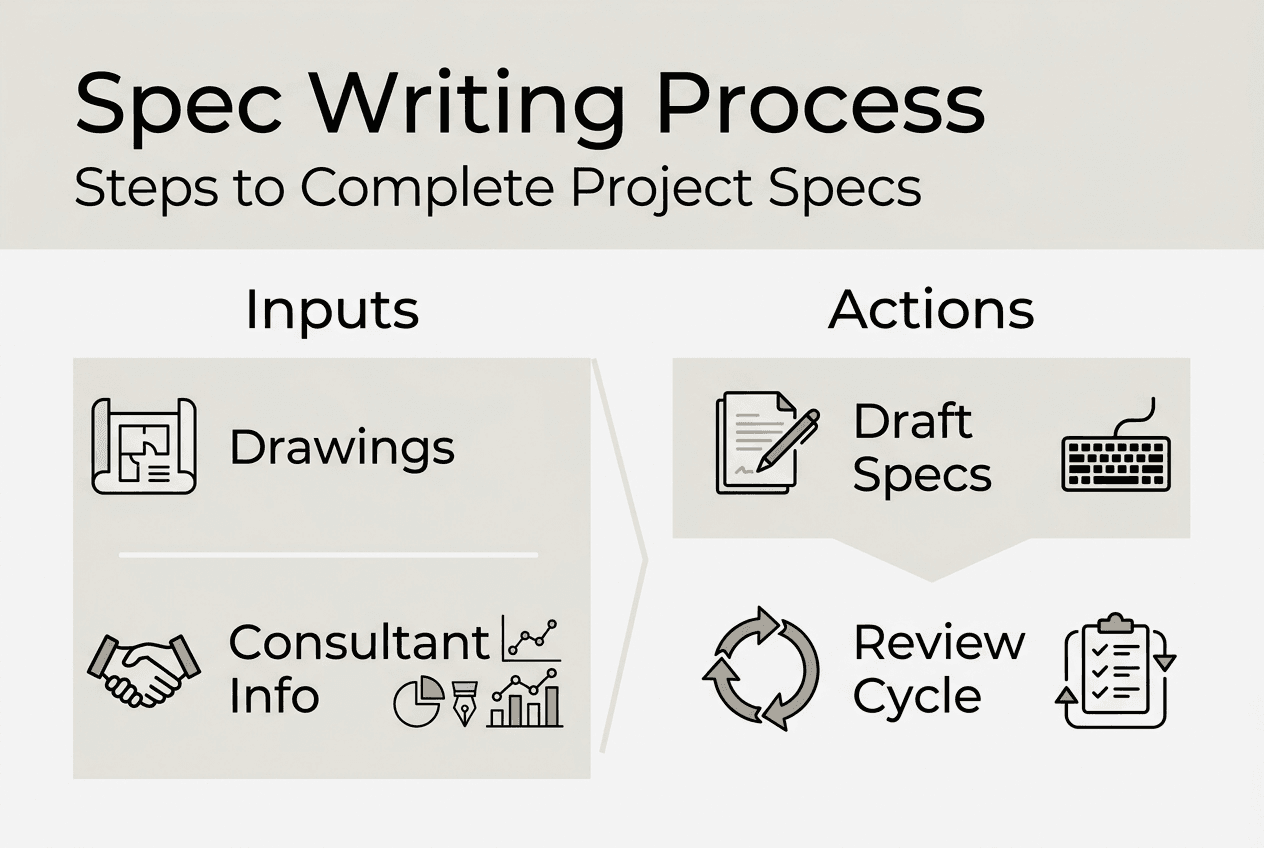
The specification writing process follows a structured sequence:
- Analyze project scope and identify all required systems and materials
- Research products and manufacturers to understand available options
- Organize content using CSI MasterFormat divisions and sections
- Write clear requirements using consistent terminology and active voice
- Coordinate specifications with drawings to eliminate conflicts
- Review for completeness, accuracy, and constructability
Pro Tip: Always use active voice and imperative mood in specifications. Write “Install flashing at all penetrations” rather than “Flashing shall be installed.” This direct approach eliminates ambiguity and clearly assigns responsibility to contractors.
Coordination between specifications and drawings requires constant vigilance. When drawings show one detail and specs describe another, contractors face confusion that leads to requests for information, change orders, and delays. Establish clear protocols for cross-referencing, use consistent terminology across all documents, and conduct thorough reviews before issuing construction documents.
Common pitfalls and nuances in architectural specifications
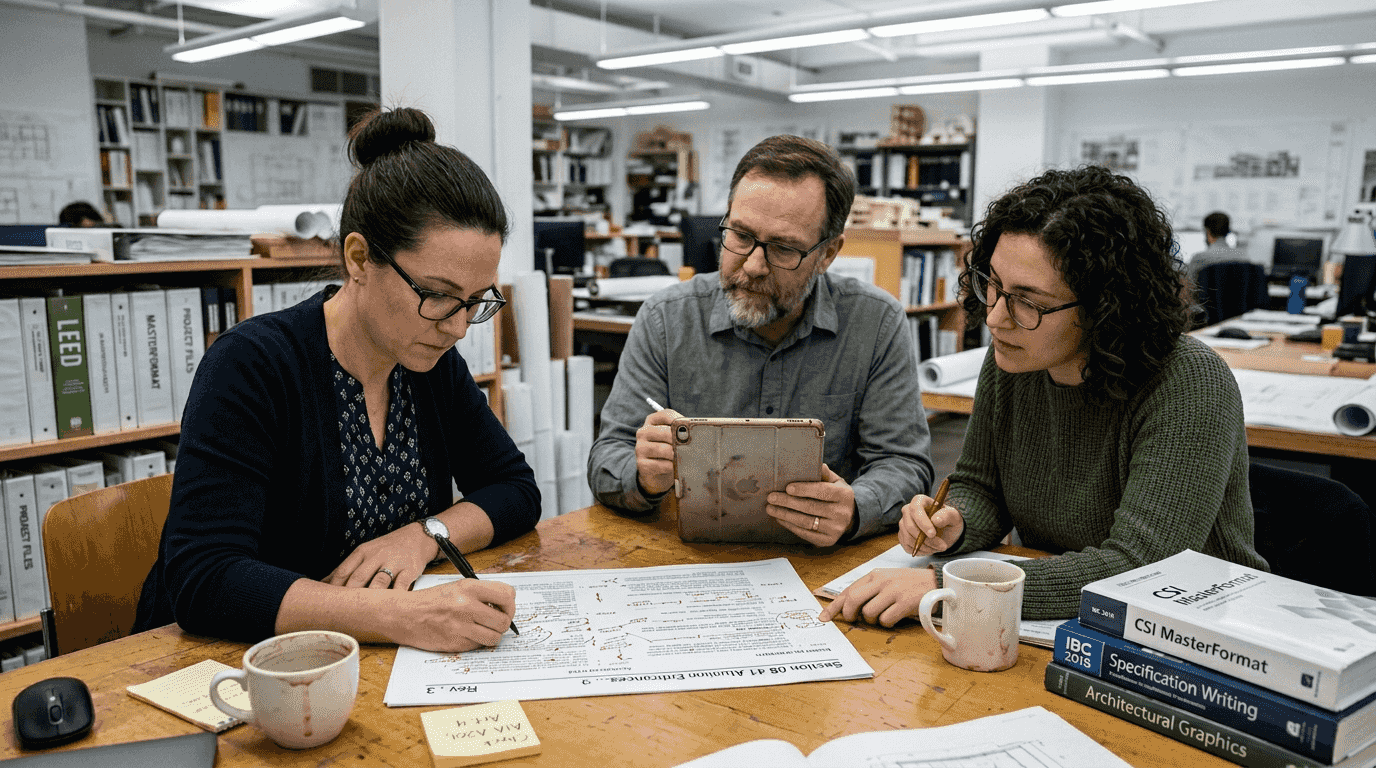
Even experienced specification writers encounter recurring challenges that compromise document quality and project outcomes. Poor coordination between specifications and drawings tops the list of problems. When specs reference details not shown on drawings or contradict graphic information, contractors must seek clarification, delaying progress and increasing costs. Regular coordination meetings between architects, engineers, and specification writers prevent these disconnects.
Vague language creates interpretation problems that lead to disputes. Terms like “high quality,” “substantial,” or “adequate” mean different things to different people. Replace subjective descriptions with measurable criteria. Instead of “provide durable flooring,” specify “provide flooring with minimum Class III wear rating per ASTM F1869.” Quantifiable requirements eliminate arguments about compliance.
Copy-pasting boilerplate specifications without project-specific adaptation introduces errors and irrelevant requirements. A master spec developed for commercial office buildings will contain inappropriate provisions when applied to healthcare or industrial projects. Customize every specification section to match actual project conditions, climate, and functional requirements. Delete inapplicable clauses rather than leaving contradictory requirements in place.
Ambiguous “or equal” clauses frustrate contractors and manufacturers alike. Simply stating “Product X or approved equal” without defining equivalency criteria invites disputes. Establish clear parameters for substitutions:
- List specific performance characteristics that alternates must match
- Define submittal requirements including test data and samples
- Specify approval timelines and procedures
- Reserve architect’s right to reject alternates that don’t meet intent
Interdisciplinary conflicts arise when architectural, structural, and MEP specifications contain contradictory requirements. A structural engineer might specify one concrete strength while architectural specs reference another. Resolve these conflicts during document coordination, not in the field where corrections cost exponentially more.
“Forensic analysis of construction disputes reveals that specification issues often stem from inconsistent terminology across disciplines, conflicting standards references, and failure to update specs when drawings change during design development.”
Best practices for avoiding specification pitfalls include using precise technical language, defining all abbreviations and acronyms on first use, maintaining consistent terminology throughout all documents, adhering strictly to CSI MasterFormat organization, and conducting peer reviews before finalizing specifications. These disciplines transform specifications from potential liability into powerful tools for project success.
Impact of specification quality on project costs and schedules
The financial consequences of poor specifications extend far beyond initial document preparation costs. Change orders represent the most visible impact, with industry data showing they average 8-14% of original contract values across construction sectors. Architect and engineer errors, many stemming from specification deficiencies, cause 3-5% of these changes. When specs fail to clearly define requirements or contain errors, contractors must stop work, seek clarification, and implement corrections at premium rates.
Rework costs associated with quality failures trace directly to inadequate specifications. When specs don’t clearly establish inspection criteria, testing protocols, or acceptance standards, substandard work proceeds undetected until later phases. Correcting deficient work after installation costs 4-12% of total project budgets. A concrete slab poured with wrong admixtures because specifications were unclear might require complete removal and replacement, consuming weeks of schedule and hundreds of thousands of dollars.
The following table quantifies typical cost impacts from specification-related issues:
| Issue Type | Cost Impact Range | Primary Causes |
| Change orders from spec errors | 3-5% of contract value | Ambiguous language, missing details, conflicts with drawings |
| Rework from quality failures | 4-12% of project cost | Unclear acceptance criteria, inadequate testing requirements |
| Schedule delays | 10-25% time overrun | RFIs, substitution reviews, conflict resolution |
| Dispute resolution | $50K-$500K+ per claim | Contradictory requirements, vague performance criteria |
Schedule overruns plague 80% of construction projects, with specification issues contributing significantly to delays. Each request for information generated by unclear specs consumes days or weeks waiting for responses. Substitution requests triggered by overly restrictive specifications require architect review, testing, and approval processes that halt related work. These interruptions cascade through project schedules, delaying subsequent trades and extending completion dates.
Projects with comprehensive, well-coordinated specifications experience 40% fewer RFIs and 30% fewer change orders compared to projects with minimal specification development.
The inverse relationship between specification quality and project costs demonstrates clear return on investment for thorough specification development. Spending additional time during design to create precise, coordinated specifications saves multiples of that investment during construction. Architects who treat specifications as afterthoughts rather than integral design documents expose their clients to unnecessary risk and expense.
Litigation costs from specification-related disputes can dwarf other impacts. When specs contain contradictions, ambiguities, or errors that lead to project failures, owners sue designers for professional negligence. Defense costs alone run tens of thousands of dollars, while settlements or judgments can reach millions. Professional liability insurers increasingly scrutinize specification quality when underwriting policies and investigating claims.
Architectural specification education and opportunities for manufacturers in 2026
Architects and engineers maintain licensure through continuing education that includes specification-related topics. The American Institute of Architects requires members to complete 18 learning units annually, with 12 focused on health, safety, and welfare subjects. Specification courses addressing fire resistance, structural performance, accessibility, and environmental quality fulfill these HSW requirements while building practical skills professionals apply immediately.
Continuing education courses cover diverse specification topics relevant to current practice. Technical writing workshops teach clear communication strategies and CSI MasterFormat organization. Material science seminars explore performance characteristics of building products and appropriate specification language. Case study programs analyze real specification failures and lessons learned. Technology courses address specification software, building information modeling integration, and digital delivery methods.
Building product manufacturers develop educational content that serves dual purposes: educating design professionals while showcasing technical expertise. By creating AIA-registered courses, manufacturers position themselves as thought leaders and trusted resources. These courses must provide genuine educational value focused on broader industry knowledge rather than product promotion.
The process for developing manufacturer-sponsored continuing education follows specific steps:
- Identify knowledge gaps in specification practices related to your product category
- Frame content around HSW topics like fire safety, structural integrity, or indoor air quality
- Develop objective educational material that teaches principles applicable across products
- Include your products as examples within broader technical context
- Register courses through AIA Continuing Education System provider process
- Deliver content via webinars, self-study modules, lunch-and-learns, or conferences
Course approval typically requires 2-4 weeks for AIA CES review. Manufacturers must demonstrate educational rigor, avoid overt marketing, and provide learning objectives aligned with competency standards. Once approved, courses remain valid for two years before requiring renewal with updated content.
Pro Tip: Structure manufacturer courses around specification challenges rather than product features. A window manufacturer might offer “Specifying High-Performance Fenestration for Energy Codes” rather than “Our Window Product Line.” This approach delivers value while naturally incorporating your solutions as examples.
Manufacturers benefit from continuing education programs through multiple channels. Courses create touchpoints with specifiers during design phases when product selection occurs. Educational relationships built through training often translate to specification inclusion on projects. Course rosters provide qualified leads of active design professionals. Most importantly, education establishes credibility that differentiates manufacturers in crowded markets where technical performance increasingly matters more than price alone.
Enhance your architectural specification skills with Ron Blank & Associates
Mastering architectural specifications requires ongoing education and expert guidance. Whether you’re an architect seeking to strengthen specification writing skills or a building product manufacturer looking to develop educational content that reaches design professionals, specialized support accelerates your success.

Ron Blank & Associates provides comprehensive solutions for specification education and product positioning. The firm develops AIA-registered continuing education courses delivered through multiple formats including webinars, online modules, and face-to-face seminars. For manufacturers, the company creates educational programs that showcase technical expertise while helping architects specify products correctly. Discover how Ron Blank & Associates can support your specification goals with customized education and strategic guidance.
Frequently asked questions about defining architectural specifications
What is the difference between performance and prescriptive specs?
Performance specifications define desired outcomes and functional requirements without mandating specific products or methods, allowing contractors flexibility to propose solutions that meet stated criteria. Prescriptive specifications detail exact products, manufacturers, and installation procedures, giving architects maximum control but limiting alternatives. Hybrid approaches combine both methods strategically based on project priorities.
How can architects avoid common specification writing mistakes?
Use precise, measurable language instead of subjective terms, coordinate specifications with drawings throughout design development, customize boilerplate sections for each project rather than copying blindly, define clear criteria for product substitutions, and conduct thorough peer reviews before issuing documents. Consistent terminology and adherence to CSI MasterFormat organization also prevent confusion.
What role do specifications play in controlling project costs?
Clear, comprehensive specifications reduce change orders by eliminating ambiguity, prevent rework by establishing definite quality standards, minimize delays from requests for information, and decrease dispute resolution costs. Well-written specs save 40% on RFIs and 30% on change orders compared to minimal specification efforts, directly protecting project budgets.
How do building product manufacturers benefit from AIA CES courses?
Manufacturer-developed continuing education establishes technical credibility with design professionals, creates relationship touchpoints during specification phases, generates qualified leads from course participants, and differentiates products through demonstrated expertise. Educational content must provide genuine value beyond product promotion to earn AIA approval and specifier trust.