

Many architects and engineers assume online training can fully replace face-to-face learning for continuing education credits. This belief overlooks critical differences in how professionals retain and apply complex technical knowledge. While digital platforms offer convenience, face-to-face training delivers 60-80% knowledge retention compared to just 10-20% for online methods. For architects, engineers, and contractors pursuing AIA, GBCI, or RCEP credits, understanding when face-to-face training becomes essential can transform professional development outcomes and project success rates.
Table of Contents
- Why Face-To-Face Training Excels In Skill Development
- Limitations And Challenges Of Face-To-Face Training In The AEC Industry
- Comparing Face-To-Face Training With Other Methods: Effectiveness And Engagement
- Applying Face-To-Face Training To Meet AIA And RCEP Continuing Education Requirements
- Summary: Why Face-To-Face Training Is Indispensable For AEC Continuing Education In 2026
- Enhance Your Continuing Education With Ron Blank & Associates
Key takeaways
| Point | Details |
| Superior retention | Face-to-face training achieves 60-80% knowledge retention versus 10-20% for online methods |
| Real-time feedback | Immediate instructor guidance and peer interaction strengthen applied skills critical for complex projects |
| Professional networking | In-person sessions create valuable industry connections and collaborative learning opportunities |
| Resource demands | Higher costs and logistical requirements compared to digital alternatives require strategic planning |
| Optimal approach | Combining face-to-face training with digital supplements maximizes learning outcomes and credit fulfillment |
Why face-to-face training excels in skill development
Face-to-face training produces strong outcomes for applied and interpersonal skills through immediate feedback, behavior modeling, and peer interaction. These elements prove especially valuable for architects and contractors developing technical competencies that directly impact project safety and code compliance. When an instructor observes a professional struggling with a building code interpretation, they can adjust explanations in real time rather than waiting for quiz results or forum responses.
The interactive nature of face-to-face sessions enables professionals to practice nuanced skills that online platforms struggle to replicate. During workshops on structural analysis or sustainable design principles, participants can ask clarifying questions, observe expert demonstrations, and receive personalized coaching. This dynamic exchange builds confidence in applying complex concepts to actual project scenarios. MIT architecture faculty emphasize that face-to-face training allows nuanced exchange of ideas and critical thinking development impossible to achieve through pre-recorded content.
Social learning amplifies the value of in-person training sessions. When contractors discuss real-world challenges they encountered on job sites, peers gain insights from multiple perspectives and problem-solving approaches. This collaborative environment fosters deeper engagement than passive video watching. Participants often report higher motivation when learning alongside colleagues who share similar professional goals and challenges.
Key advantages of face-to-face training include:
- Immediate correction of misconceptions before they become ingrained habits
- Observation of expert techniques and problem-solving processes in action
- Opportunity to practice interpersonal skills like client presentations or team coordination
- Access to specialized equipment or materials not available for home study
- Networking with industry professionals who may become future collaborators or mentors
Pro Tip: Prioritize face-to-face formats when training covers skills requiring hands-on practice, such as material testing procedures, site safety protocols, or collaborative design charrettes where real-time interaction proves essential.
Experts consistently highlight face-to-face training’s unmatched role in developing critical thinking beyond simple information transfer. While online courses efficiently deliver factual content about building codes or material specifications, face-to-face sessions excel at teaching professionals how to apply those facts to ambiguous real-world situations. An architect learning about accessibility standards benefits more from discussing edge cases with an instructor than from reviewing static compliance checklists.
Limitations and challenges of face-to-face training in the AEC industry
Face-to-face training demands significant resources including venue costs, instructor travel, and participant time away from billable work. A single day-long workshop for 20 architects might cost $5,000 to $10,000 when accounting for facility rental, expert facilitator fees, and materials. These expenses create barriers for smaller firms or individual practitioners operating on tight budgets. Planning logistics around multiple professionals’ schedules adds complexity that online alternatives eliminate.
Instructor skill and group dynamics create variability in training quality that organizations struggle to control. An experienced facilitator can adapt content delivery based on participant responses, while a less skilled instructor might rigidly follow slides regardless of audience confusion. Group composition also affects outcomes. A session with engaged, experienced professionals generates richer discussions than one dominated by passive attendees or significant skill level disparities.
Scaling face-to-face training to large audiences presents practical obstacles. While an online course can accommodate thousands of simultaneous learners, effective face-to-face workshops typically cap enrollment at 15 to 30 participants to maintain interaction quality. Organizations needing to train hundreds of employees across multiple locations face multiplied costs and coordination challenges. This limitation makes face-to-face training less practical for standardized content that doesn’t require hands-on practice.
Common challenges include:
- Geographic constraints limiting access for professionals in remote areas
- Scheduling conflicts preventing participation despite interest
- Inconsistent delivery quality across different instructors or sessions
- Limited ability to revisit content after the training concludes
- Higher per-participant costs compared to self-paced digital alternatives
Ignoring these constraints leads to misaligned expectations and resource planning failures. A firm investing heavily in face-to-face training without considering scheduling realities may achieve poor attendance rates. However, construction industry analyses show that reduced upfront costs of online training often get offset by increased project errors and rework when professionals lack proper skill development. A contractor who skips hands-on safety training to save money may face far greater costs from workplace incidents or regulatory violations.
The difficulty of maintaining consistency across multiple face-to-face sessions creates quality assurance challenges. Unlike online courses where every learner receives identical content, face-to-face training varies based on instructor interpretation, participant questions, and time constraints. Two architects attending different sessions on the same topic might receive notably different depth of coverage or practical examples.
Comparing face-to-face training with other methods: effectiveness and engagement
Face-to-face training achieves 60-80% knowledge retention compared to 10-20% for online methods, with 40-60% better practical application of learned skills. This dramatic difference stems from active engagement, immediate feedback, and social accountability that in-person formats provide. When architects practice building code interpretations during workshops, they internalize concepts far more effectively than reading the same material independently.
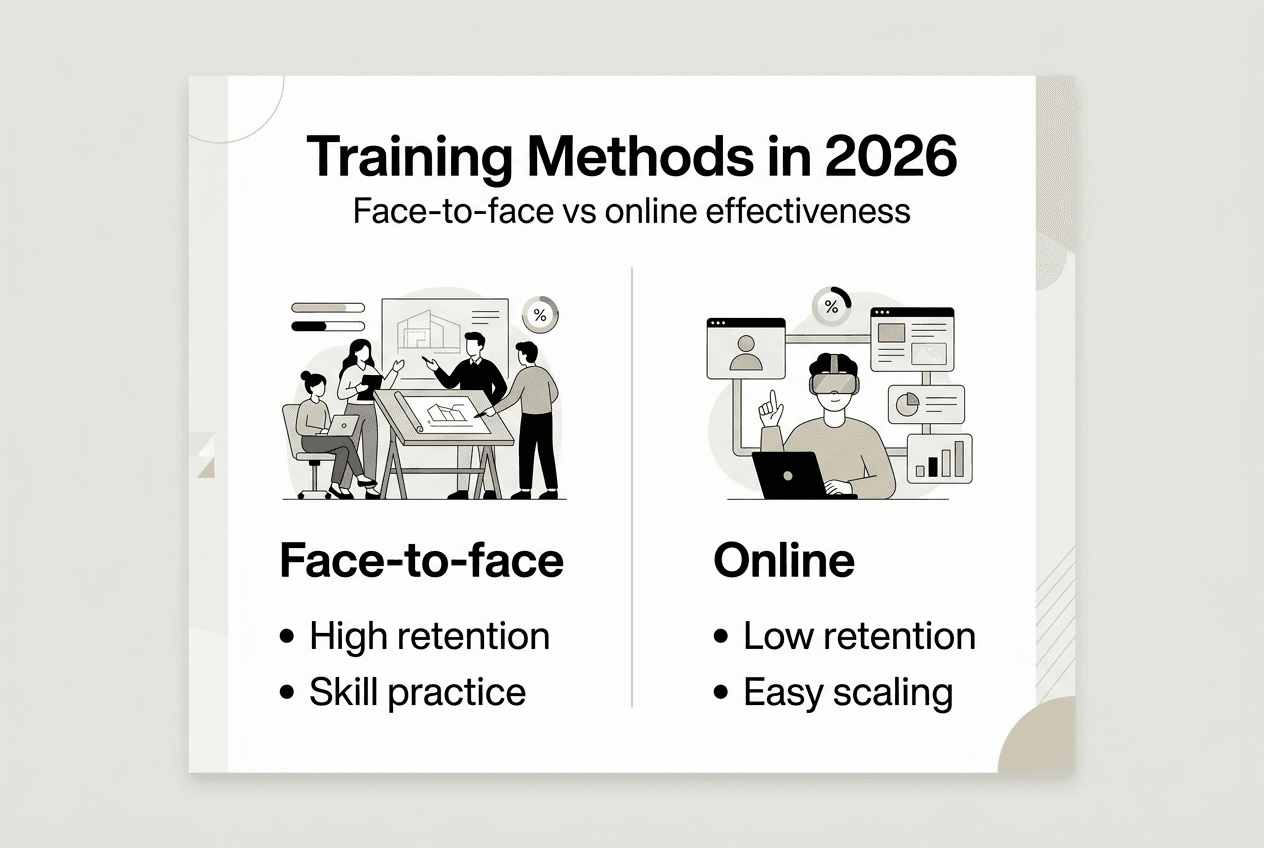
Interactive elements transform passive information consumption into active learning experiences. Workshop discussions and group activities significantly boost both learning outcomes and participant engagement compared to lecture-only formats. A structural engineering session incorporating case study analysis and peer problem-solving produces better skill transfer than an instructor simply presenting calculation methods. Participants remember concepts they actively applied rather than merely heard.
Pre-recorded videos serve valuable roles as cost-effective supplements but cannot replace live interaction for complex skill development. They work well for introducing foundational concepts or providing reference materials professionals can review multiple times. However, videos lack the adaptive responsiveness that makes face-to-face training effective for nuanced topics requiring discussion and clarification.
Training method effectiveness ranking:
- Face-to-face workshops with hands-on practice deliver highest retention and skill application
- Live virtual sessions with interactive elements provide moderate engagement and feedback
- Self-paced online courses with assessments offer flexibility but limited interaction
- Pre-recorded video lectures serve as reference tools with lowest engagement and retention
This hierarchy reflects each method’s capacity for personalized feedback, active participation, and social learning. Face-to-face training dominates when skill complexity and application requirements increase.
| Training Method | Cost per Participant | Knowledge Retention | Engagement Level | Scalability |
| Face-to-face | $200-500 | 60-80% | Very High | Low |
| Live online | $50-150 | 30-50% | Moderate | High |
| Self-paced digital | $20-75 | 10-20% | Low | Very High |
| Hybrid approach | $100-300 | 50-70% | High | Moderate |
The hybrid approach combines face-to-face sessions for complex skills with digital content for foundational knowledge, balancing effectiveness with practical constraints. An architect might complete online modules covering building code basics, then attend face-to-face workshops applying those codes to design scenarios. This strategy optimizes both learning outcomes and resource efficiency.
Applying face-to-face training to meet AIA and RCEP continuing education requirements
AIA members must complete 18 Learning Units yearly, with 12 focusing on Health, Safety & Welfare topics, all within the calendar year. RCEP requirements vary by state but typically mandate similar annual credit totals. Face-to-face training effectively fulfills these obligations while delivering superior skill development compared to passive online completion. Understanding how to strategically incorporate in-person sessions maximizes both compliance and professional growth.
Face-to-face training particularly supports retention of complex concepts like building codes, accessibility standards, and construction safety protocols. When contractors learn fall protection requirements through hands-on demonstrations rather than reading regulations, they better understand practical application on actual job sites. Face-to-face formats enhance retention and practical application crucial for architectural and construction topics where mistakes carry serious consequences.

Immediate feedback during face-to-face sessions prevents knowledge gaps that online training might miss. An engineer misunderstanding load calculations can receive correction and clarification before completing the course, ensuring accurate comprehension. Networking opportunities also provide lasting professional value beyond credit hours. Connections made during face-to-face training often lead to future collaborations, mentorship relationships, or knowledge sharing that extends learning well past the formal session.
Steps to effectively integrate face-to-face training into annual CE plans:
- Identify required credit categories and prioritize Health, Safety & Welfare topics
- Select face-to-face sessions for complex subjects requiring hands-on practice or discussion
- Schedule in-person training early in the year to avoid year-end compliance rushes
- Combine face-to-face workshops with supplemental online courses for cost efficiency
- Maintain detailed records including certificates, attendance verification, and course descriptions
- Review state-specific requirements if pursuing both AIA and RCEP credits simultaneously
Pro Tip: Document all credits carefully using provider certificates and personal records to avoid audit issues. Choose face-to-face sessions from AIA-registered providers offering robust documentation and immediate certificate delivery rather than relying on manual tracking.
Hands-on practice opportunities distinguish quality face-to-face continuing education from basic credit accumulation. A session on sustainable design principles gains value when participants analyze actual building projects and discuss implementation challenges rather than simply reviewing green building standards. This applied learning directly improves professional competence in ways that benefit future projects and clients.
Summary: why face-to-face training is indispensable for AEC continuing education in 2026
Face-to-face training delivers superior skill development, knowledge retention, and practical application despite resource demands and scalability challenges. The 60-80% retention rate compared to 10-20% for online methods represents a meaningful difference in professional competence, not just a marginal improvement. For architects and contractors whose work directly impacts public safety and project success, this enhanced learning translates to fewer errors, better code compliance, and stronger client outcomes.
The immediate feedback, social learning, and hands-on practice that characterize effective face-to-face training cannot be fully replicated through digital alternatives. While online courses offer undeniable convenience and cost advantages, they serve different learning objectives. Complex skills requiring nuanced judgment, interpersonal interaction, or physical demonstration demand in-person formats. Strategic professionals recognize this distinction and allocate training budgets accordingly.
Combining face-to-face learning for high-value skills with digital supplements for foundational knowledge creates an optimal continuing education strategy. This hybrid approach balances learning effectiveness with practical constraints like cost, scheduling, and geographic access. An architect might complete online modules covering code updates, then attend face-to-face workshops applying those updates to design challenges. This combination maximizes both compliance efficiency and skill development.
Key considerations for continuing education planning:
- Face-to-face training excels for applied skills, complex topics, and interpersonal competencies
- Resource intensity and scalability limitations require strategic session selection
- Hybrid approaches combining face-to-face and digital methods optimize outcomes and efficiency
- Quality face-to-face training from registered providers ensures both learning value and credit compliance
- Documentation and planning prevent last-minute compliance issues and audit complications
Professionals who view continuing education as genuine skill development rather than mere credit accumulation gain competitive advantages. The knowledge and connections acquired through quality face-to-face training compound over careers, improving project outcomes and professional reputation far beyond annual compliance requirements.
Enhance your continuing education with Ron Blank & Associates
Face-to-face training’s proven advantages for skill development and knowledge retention make it essential for architects and contractors serious about professional growth. Ron Blank & Associates offers comprehensive continuing education combining engaging face-to-face training options with flexible online formats tailored to busy professionals’ schedules and learning needs. Ron Blank & Associates CE Academy program offers face-to-face education in multiple states awarding AIA CE hours to design professionals.

Their courses meet AIA requirements including Health, Safety & Welfare credits through content developed by industry experts who understand real-world application challenges. Engaging instructors and practical formats optimize skill development while ensuring compliance documentation. Whether you need specialized technical training or broad professional development, their catalog provides options matching your practice areas and career goals. Explore available courses to advance your professional skills while efficiently fulfilling annual credit requirements.
FAQ
How does face-to-face training improve knowledge retention?
Face-to-face training includes immediate feedback and hands-on practice that significantly boost knowledge retention compared to online alternatives. Studies show 60-80% retention rates for face-to-face methods versus just 10-20% for online training. The interactive nature allows instructors to clarify misconceptions immediately and adapt content based on participant responses, creating stronger neural pathways for long-term memory.
What are the challenges of implementing face-to-face training for AIA credits?
Face-to-face training requires higher costs and more complex logistics than online alternatives, including venue rental, instructor travel, and coordinating multiple professionals’ schedules. Research confirms these sessions are resource-intensive and difficult to scale consistently. Variability in instruction quality based on facilitator skill and group dynamics also creates challenges that organizations must manage through careful provider selection.
Can face-to-face training help with complex architectural and construction topics?
Direct interaction and hands-on practice dramatically improve comprehension of complex subjects like building codes, structural analysis, and construction safety protocols. The opportunity to ask questions and receive immediate feedback facilitates deeper learning than passive content consumption. Face-to-face training enhances practical application and understanding crucial for topics where professionals must apply knowledge to ambiguous real-world situations.
What should AIA members know about audits and documentation for face-to-face CE credits?
Keep detailed records of all face-to-face training attended, including certificates, attendance logs, and course descriptions with provider information. AIA may audit members and require documentation proving claimed education credits were completed. Choose registered providers offering immediate certificate delivery and maintain personal backup records to ensure audit compliance without scrambling for proof months or years after completing training.