

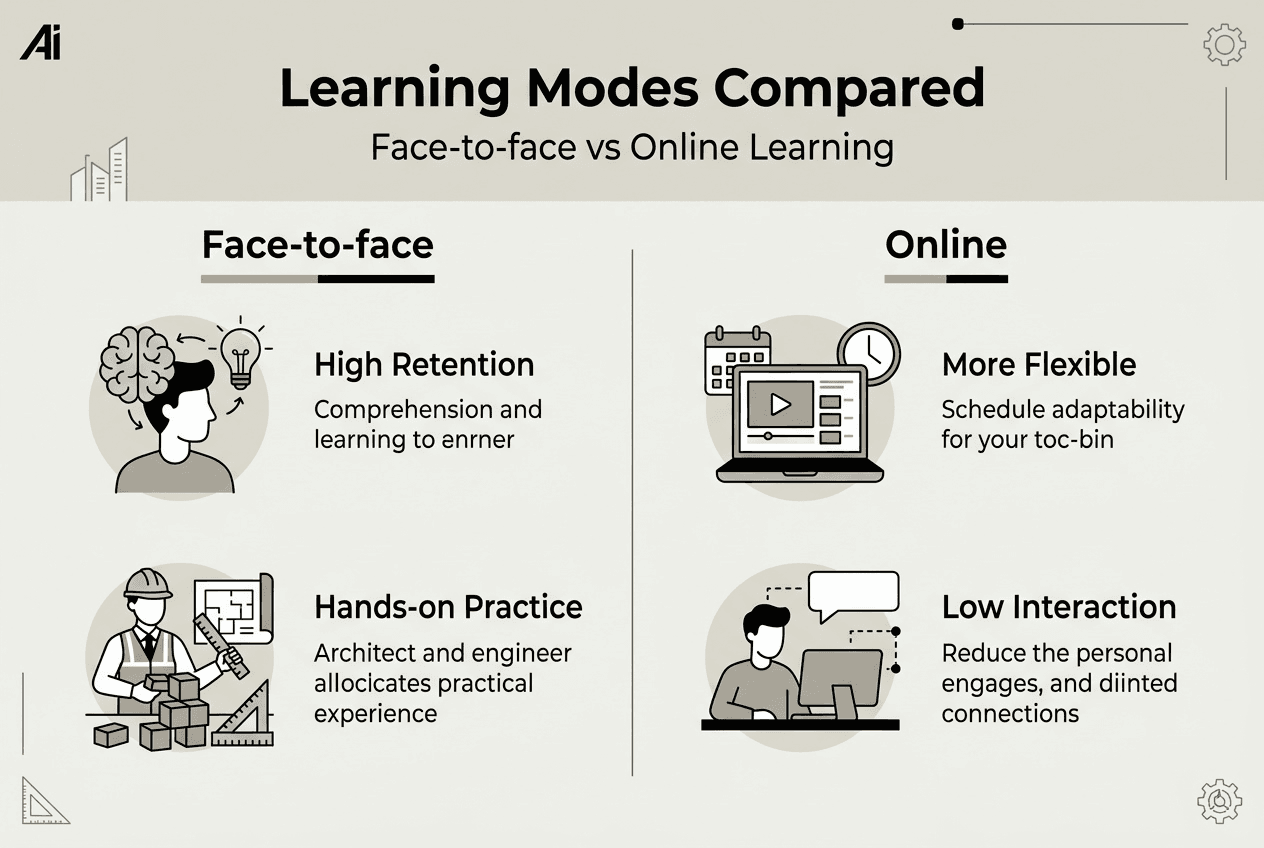
Face-to-face education delivers measurably better outcomes for architects and engineers pursuing continuing education. Research shows 15-20% higher knowledge retention compared to online formats, with even stronger results for Health, Safety, and Welfare topics that demand interactive instruction. For professionals managing complex building systems and life safety requirements, this learning format provides immediate feedback, collaborative problem solving, and hands-on skill development that online courses simply cannot replicate. Understanding why face-to-face instruction works and how to leverage it for your AIA requirements can transform your professional development strategy and enhance your practice capabilities.
Table of Contents
- Understanding Face-to-Face Learning In Architecture And Engineering
- Why Face-To-Face Learning Is Crucial For Health, Safety, And Welfare Education
- Tailoring Face-To-Face Learning For Diverse Architecture And Engineering Professionals
- Comparing Face-To-Face And Online Learning: Knowledge Retention And Practical Application
- Enhance Your Professional Growth With AIA-Certified Face-To-Face Learning
- Frequently Asked Questions
Key takeaways
| Point | Details |
| Retention advantage | Face-to-face learning produces 15-20% higher knowledge retention than online courses for technical professionals. |
| HSW effectiveness | Interactive demonstrations and discussions make face-to-face instruction essential for Health, Safety, and Welfare topics. |
| Personalized instruction | Expert instructors adapt content delivery to match diverse learning styles and experience levels in real time. |
| Practical application | Hands-on activities and collaborative exercises translate directly to improved on-the-job performance. |
Understanding face-to-face learning in architecture and engineering
Face-to-face learning refers to instructor-led educational sessions where participants and teachers interact in the same physical space. For architects pursuing AIA-approved continuing education, this format creates opportunities for immediate dialogue, hands-on demonstrations, and collaborative problem solving that asynchronous online courses cannot provide. The physical presence of peers and instructors enables spontaneous questions, real-time clarification of complex concepts, and dynamic group activities that mirror the collaborative nature of professional practice.
This learning approach proves particularly valuable for technical professionals because face-to-face sessions foster collaborative problem solving through live interaction. When you encounter a challenging building code interpretation or unfamiliar construction detail during a session, you can ask questions and receive expert guidance within seconds rather than waiting hours or days for email responses. The instructor observes your comprehension through body language and facial expressions, adjusting explanations when confusion appears across the room.
Key advantages of face-to-face learning for continuing education include:
- Immediate feedback from experienced instructors who can clarify misconceptions before they become ingrained
- Collaborative exercises that simulate real project scenarios and encourage peer learning
- Networking opportunities with other professionals facing similar challenges in their practices
- Hands-on demonstrations of materials, systems, and technologies that require physical interaction
- Dynamic discussions that explore multiple perspectives on design solutions and regulatory compliance
Online courses offer convenience and flexibility, but they sacrifice the interactive elements that drive deeper understanding. You might watch a recorded lecture about fire-rated assemblies, but without the ability to examine physical samples or discuss installation challenges with peers, the knowledge remains abstract. Face-to-face sessions transform passive consumption into active engagement, creating stronger neural pathways that improve long-term retention and practical application.
Why face-to-face learning is crucial for Health, Safety, and Welfare education
Health, Safety, and Welfare topics form the foundation of responsible architectural and engineering practice. These subjects address life safety systems, accessibility requirements, structural integrity, and environmental health considerations that directly impact building occupants. Because HSW topics require interactive discussions and practical demonstrations, face-to-face instruction delivers significantly better outcomes than self-paced online modules.
Consider egress design requirements under current building codes. Reading text descriptions of corridor widths and door swing directions provides basic information, but understanding how these elements work together during emergency evacuations requires visual demonstrations and group discussions. An instructor can physically demonstrate how panic hardware operates, explain common installation errors that compromise safety, and facilitate conversations about balancing code compliance with design intent. These interactive elements create memorable learning experiences that stick with you when reviewing construction documents or conducting site observations.
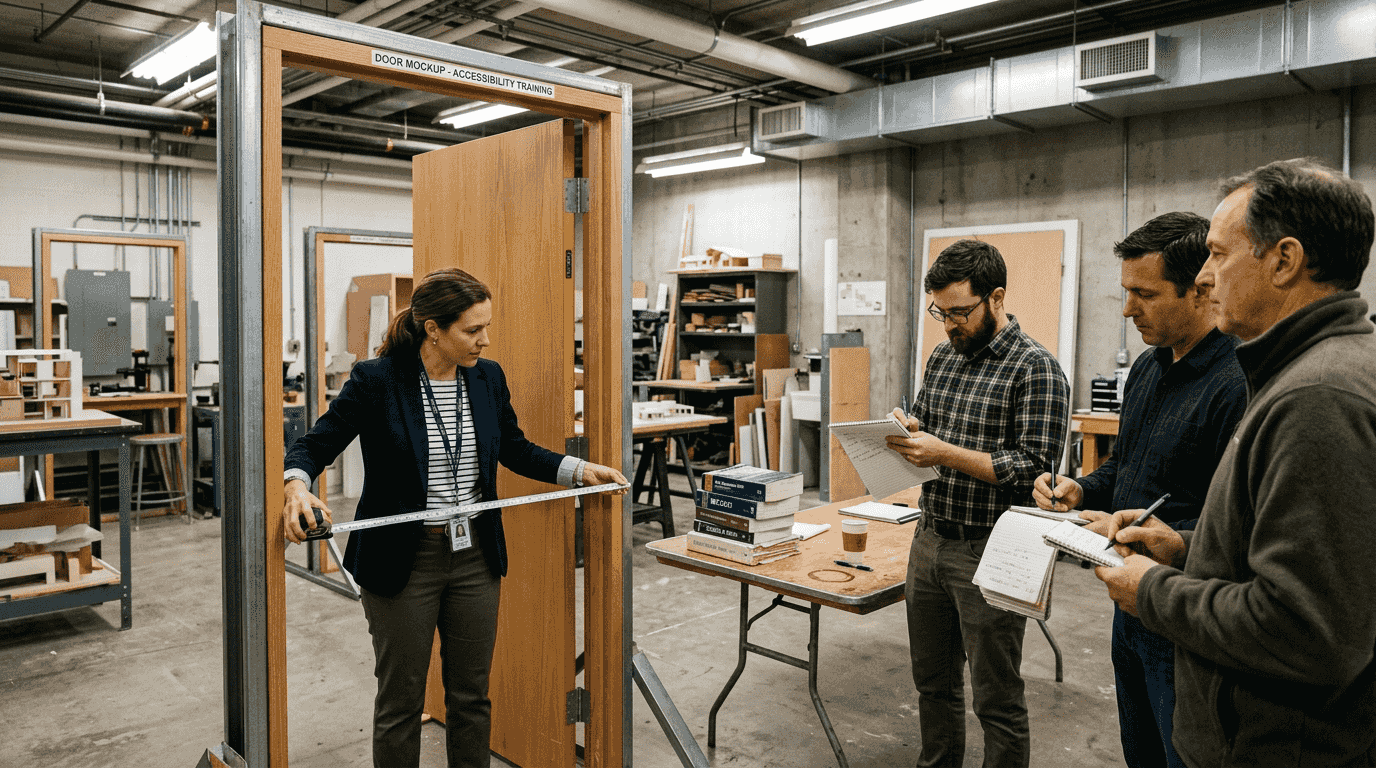
Practical demonstrations cement HSW knowledge in ways that diagrams and videos cannot match. When you see a properly installed fire damper or examine the difference between compliant and non-compliant handrail installations, you develop visual references that inform future design decisions. You can ask questions about specific project scenarios, learn from the experiences of other participants, and gain insights from instructors who have encountered countless real-world applications.
Face-to-face HSW education produces measurable improvements:
- Enhanced comprehension of complex regulatory requirements through interactive discussion
- Better recognition of safety hazards during construction administration
- Improved ability to communicate life safety concepts to clients and contractors
- Stronger professional judgment when evaluating code compliance alternatives
Pro Tip: Before attending AIA face-to-face HSW sessions, review your current projects and identify specific code questions or safety concerns. Bringing real scenarios to class enables you to apply new knowledge immediately and get expert feedback on actual challenges you face in practice.
The collaborative nature of AIA face-to-face HSW education also exposes you to diverse perspectives from professionals working in different building types and jurisdictions. A residential architect might learn about healthcare accessibility requirements, while a structural engineer gains insights into fire protection systems. These cross-disciplinary exchanges broaden your professional knowledge base and enhance your ability to collaborate effectively on complex projects.
Tailoring face-to-face learning for diverse architecture and engineering professionals
Architects and engineers bring varied backgrounds, experience levels, and learning preferences to continuing education sessions. Effective face-to-face instruction recognizes this diversity and adapts teaching methods to maximize engagement and knowledge transfer. Unlike pre-recorded online courses that deliver identical content to every viewer, live instruction allows instructors to adapt teaching methods based on participant needs and responses.
Learning style diversity significantly impacts how professionals absorb and retain information:
- Visual learners benefit from diagrams, photographs, physical samples, and demonstration videos that illustrate concepts through imagery.
- Auditory learners excel when instructors explain concepts verbally, facilitate group discussions, and encourage questions that prompt detailed explanations.
- Kinesthetic learners need hands-on activities like assembling building components, sketching details, or physically examining materials and systems.
- Social learners thrive in collaborative exercises, group problem solving sessions, and peer discussions that explore multiple viewpoints.
Experienced instructors observe participant responses during face-to-face sessions and adjust their delivery accordingly. If visual aids generate confused looks, they provide additional verbal explanation. When a complex topic prompts multiple questions, they slow the pace and offer supplementary examples. This real-time adaptation ensures that all participants grasp core concepts before moving forward, preventing knowledge gaps that undermine learning objectives.
Pre-session assessments enable further customization by identifying participant experience levels and specific learning goals. An instructor might discover that half the class consists of recent graduates while the other half includes seasoned practitioners seeking updates on code changes. This information allows them to balance foundational explanations with advanced applications, ensuring relevant value for everyone in the room.
Pro Tip: Complete pre-session assessments thoroughly and honestly. Instructors use this information to customize examples, adjust technical depth, and select case studies that match your experience level and professional focus. Generic responses limit their ability to deliver personalized value.
The interactive nature of face-to-face learning also accommodates questions and discussions that address individual concerns. You might ask how a new energy code provision applies to renovation projects, prompting the instructor to explore compliance strategies specific to existing buildings. Other participants benefit from this exchange even if they did not initially consider the question, creating shared learning opportunities that online courses cannot replicate.
Comparing face-to-face and online learning: knowledge retention and practical application
Quantitative research demonstrates clear performance differences between face-to-face and online continuing education formats. Studies measuring knowledge retention and practical application reveal that face-to-face workshops produce 15-20% higher retention and 10-15% better practical skills compared to online courses covering identical content. These differences prove especially significant for technical professionals who must apply complex information to real-world design and construction challenges.
The retention advantage stems from multiple factors that distinguish face-to-face instruction:
- Active engagement through discussions, questions, and collaborative exercises creates stronger memory formation than passive video watching
- Social interaction with peers and instructors adds emotional context that enhances recall
- Immediate feedback corrects misunderstandings before they become ingrained, preventing the need to unlearn incorrect information later
- Physical presence in a dedicated learning environment minimizes distractions that fragment attention during online sessions
| Learning Format | Knowledge Retention | Practical Application | Interaction Level | Flexibility |
| Face-to-face | 85-90% after 30 days | 75-80% skill transfer | High (real-time) | Low (fixed schedule) |
| Live webinar | 70-75% after 30 days | 60-65% skill transfer | Medium (limited) | Medium (scheduled) |
| Self-paced online | 65-70% after 30 days | 55-60% skill transfer | Low (none) | High (anytime access) |
Practical application improvements reflect the hands-on nature of face-to-face learning. When you physically examine a building component, practice sketching a detail, or work through a code compliance scenario with peers, you develop muscle memory and procedural knowledge that transcends theoretical understanding. These activities create neural pathways that activate when you encounter similar situations in professional practice, enabling faster problem recognition and solution development.
| Skill Area | Face-to-Face Advantage | Contributing Factors |
| Code interpretation | 18% higher accuracy | Interactive discussion, immediate clarification, real examples |
| Detail development | 22% faster execution | Hands-on practice, peer review, instructor feedback |
| Material selection | 15% better decisions | Physical samples, comparative analysis, group evaluation |
| Problem diagnosis | 20% quicker resolution | Collaborative troubleshooting, multiple perspectives, case studies |
The interactivity inherent in face-to-face sessions also promotes deeper cognitive processing. When you explain a concept to a peer during group work or defend a design decision during class discussion, you engage in elaborative rehearsal that strengthens understanding. Online courses rarely create these opportunities for active knowledge construction, limiting learners to recognition and recall rather than synthesis and application.
Research confirms that collaborative learning environments produce superior outcomes for complex professional topics because they mirror the team-based nature of actual practice. You learn not just from the instructor but from the collective expertise and diverse perspectives of fellow participants.
These measurable advantages make face-to-face learning especially valuable for HSW topics, emerging technologies, and complex regulatory updates where deep comprehension directly impacts public safety and professional liability. While online courses serve important roles in continuing education, they function best as supplements to rather than replacements for interactive instruction.
Enhance your professional growth with AIA-certified face-to-face learning
Your continuing education choices directly impact your professional capabilities and career advancement. AIA Face-to-face learning delivers the interactive instruction, hands-on skill development, and collaborative experiences that transform basic knowledge into practical expertise.

Explore AIA-approved face-to-face learning opportunities designed specifically for architects pursuing professional development in 2026. These courses combine expert instruction with interactive formats that maximize knowledge retention and practical application. Whether you need HSW credits, want to master emerging building technologies, or seek to deepen your understanding of current codes and standards, face-to-face sessions provide the engaging learning experiences that online formats cannot match. Invest in your professional growth through education that delivers measurable results and lasting value.
Frequently asked questions
What is AIA face-to-face learning?
AIA face-to-face learning involves instructor-led educational sessions where participants and teachers interact in the same physical location. For architects and engineers, this format typically includes lectures, demonstrations, hands-on activities, group discussions, and collaborative exercises focused on technical topics relevant to professional practice. AIA-certified face-to-face courses provide continuing education credits while delivering interactive instruction that enhances knowledge retention and practical skill development.
How does face-to-face learning improve knowledge retention?
Face-to-face instruction produces 15-20% higher knowledge retention than online courses because it engages multiple learning pathways simultaneously. Immediate feedback from instructors corrects misunderstandings before they become ingrained, while group discussions and collaborative activities create emotional and social context that strengthens memory formation. Hands-on demonstrations and physical interaction with materials build procedural knowledge that persists long after theoretical information fades. The dedicated learning environment also minimizes distractions that fragment attention during online sessions.
Why is face-to-face learning preferred for Health, Safety, and Welfare topics?
AIA HSW topics demand interactive instruction because they involve complex regulatory requirements and life safety systems that require practical demonstration and discussion. Face-to-face sessions allow instructors to show physical examples of code-compliant installations, facilitate conversations about real-world application challenges, and provide immediate clarification of confusing provisions. These interactive elements prove essential for developing the deep comprehension needed to protect public safety and avoid professional liability. Online courses cannot replicate the hands-on demonstrations and collaborative problem solving that cement HSW knowledge.
Can face-to-face learning be tailored to different experience levels?
Experienced instructors customize face-to-face sessions based on participant backgrounds, learning styles, and professional goals identified through pre-session assessments. They adjust technical depth, select relevant examples, and modify pacing to ensure that both recent graduates and seasoned practitioners gain valuable knowledge. Real-time observation of participant responses enables further adaptation during the session, with instructors providing additional explanation when confusion appears or accelerating through familiar material when comprehension is strong. This flexibility ensures relevant value regardless of your experience level.
How do face-to-face courses compare to webinars for continuing education?
Face-to-face courses deliver superior knowledge retention and practical skill development compared to webinars, though webinars offer greater scheduling flexibility. Live instruction enables hands-on activities, physical material examination, and spontaneous discussions that webinars cannot provide. You benefit from networking with peers, observing instructor demonstrations from multiple angles, and engaging in collaborative exercises that simulate real project scenarios. While webinars serve valuable roles for specific topics and time-constrained professionals, face-to-face sessions produce measurably better learning outcomes for complex technical content.