

Choosing the right online courses to fulfill your IDCEC credits can feel overwhelming when every hour counts toward your professional renewal. For interior designers, staying current with Health, Safety, and Welfare requirements means your courses must be approved and documented, not just interesting. This guide shares how to identify credible sustainable design and product specification courses, align with industry standards, and ensure your learning truly fits your career goals, with a focus on practical value and verified accreditation.
Table of Contents
- Step 1: Assess Current IDCEC Credit Requirements
- Step 2: Identify Sustainable Design Course Offerings Online
- Step 3: Evaluate Product Specification Courses For Practical Value
- Step 4: Verify Course Provider Accreditation And Reputation
- Step 5: Choose Courses With Dynamic, Professional Imagery
Quick Summary
| Key Point | Explanation |
| 1. Assess Your CEU Status | Review your IDCEC credits and renewal cycle to avoid mismatching course selections that won’t meet your needs. |
| 2. Find Relevant Courses | Search for courses that focus on sustainable design topics relevant to your career to enhance your skills effectively. |
| 3. Confirm HSW Credit Alignment | Ensure selected courses qualify for Health, Safety, and Welfare credits essential for your licensing requirements. |
| 4. Verify Provider Accreditation | Check the course provider’s accreditation through the IDCEC registry to avoid unaccredited programs that don’t count towards your credits. |
| 5. Evaluate Visual Representation | Look for courses that feature authentic, professional imagery, indicating the provider’s commitment to diversity and inclusion in learning. |
Step 1: Assess current IDCEC credit requirements
Before you enroll in any online course, you need to know exactly where you stand with your continuing education credits. This step takes just a few minutes but saves you from the frustration of completing courses that don’t meet your actual needs. Think of this as taking inventory before you shop. You wouldn’t buy office furniture without knowing what space you have to fill, and the same principle applies here.
Start by logging into the IDCEC registry to see your complete credit history and current balance. This is your official record, the one that matters when renewal time comes around. When you access your account, you’ll see several important pieces of information. Look for your total CEUs earned, how many Health, Safety, and Welfare (HSW) credits you’ve completed, and the dates those credits were recorded. The HSW requirement is critical because not all continuing education counts equally. According to the CIDQ continuing education guidelines, your credits must be health, safety, and welfare focused to count toward your professional licensing renewal. This means a course on interior design trends might build your portfolio knowledge, but it won’t fulfill your regulatory requirements.
While you’re reviewing your account, check your renewal cycle dates. Your credit requirements operate on an annual cycle, and knowing when your renewal window closes matters more than you’d think. Some designers discover mid-year that they’re short on credits and scramble to find courses that fit their schedule. Instead, grab your CIDQ renewal calendar now and work backward. If your renewal is in six months and you need 12 HSW credits, you’re looking at roughly 2 credits per month. This timeline helps you choose courses that actually fit your life rather than courses that create panic. Also pull any course completion certificates from your files. You’ll need them handy if you encounter an audit, and having them organized now prevents that frantic search later when someone asks for documentation.
Tip for success Document your current status by taking a screenshot of your IDCEC registry showing your credit balance and renewal date, then email it to yourself with the subject line “CEU Status.” This gives you a dated reference point and a quick way to remember your numbers when comparing courses.
Step 2: Identify sustainable design course offerings online
Now that you know your credit standing, it’s time to find courses that actually align with your sustainability interests and IDCEC requirements. This step involves searching strategically rather than just browsing randomly, which saves you hours and ensures you find programs that genuinely move your career forward in sustainable design.
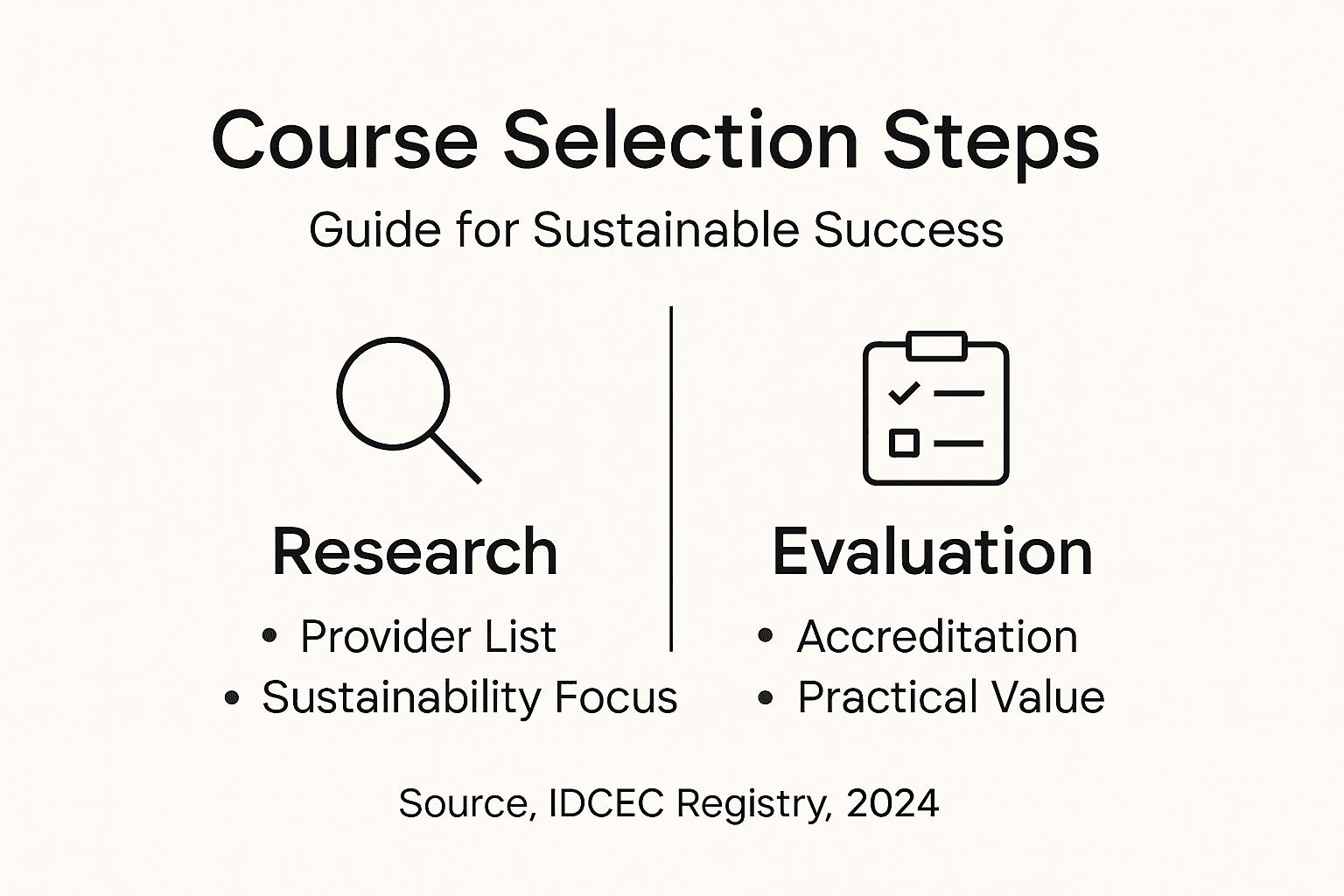
Start by identifying what sustainability topics matter most to your design practice. Are you drawn to material sourcing and life cycle analysis? Perhaps green building certifications and LEED compliance speak to your work? Maybe you’re interested in how social responsibility connects to interior environments? Once you know your focus area, search for IDCEC approved courses in that direction. University programs often offer the most rigorous content. The University of Michigan provides an online certificate in sustainability science designed specifically for working professionals, covering topics like life cycle analysis and ecosystem management with flexible scheduling that works around your client projects. Yale School of the Environment similarly offers online sustainability certificate programs focused on climate change, clean energy, and green chemistry, all accessible to designers globally. These university programs tend to be deeper than typical single courses, giving you comprehensive knowledge rather than surface level understanding.
Beyond universities, search the IDCEC course directory for programs that combine sustainability with your specific design specialty. Look for courses from established providers that specifically mention Health, Safety, and Welfare components, since not every sustainable design course automatically qualifies for HSW credits. Read the course descriptions carefully, paying attention to learning outcomes. A course titled “Sustainable Materials” might focus on environmental impact, but does it address how those materials affect indoor air quality and occupant health? That connection matters for HSW credit approval.
Also check the course length and format. A one hour webinar delivers different depth than a 10 hour online module, and both serve different purposes depending on your schedule and learning style. Some designers prefer short webinars they can complete while traveling between client meetings, while others want deeper dives into complex topics. Look at the provider’s reputation too. Courses from established architecture firms, professional organizations, and universities carry more weight on your credential record than courses from unknown sources.
As you build your list of potential courses, note which ones address emerging trends in sustainable interior design. Products and specifications are changing rapidly. Zero VOC materials, biophilic design principles, and circular economy approaches are becoming standard practice rather than niche topics. Choosing courses that cover these current issues means you’re not just meeting requirements, you’re staying competitive in the market.
Professional tip Create a simple spreadsheet with course title, provider, HSW hours, cost, and start date for each option you’re considering, then sort by which courses satisfy your credit gaps while matching your learning style and budget, making your final selection much faster.
Step 3: Evaluate product specification courses for practical value
Finding a course is one thing. Finding a course that actually improves how you specify products on real projects is another. This step separates courses that look good on your transcript from courses that transform how you work. You’re looking for practical applicability, not just theoretical knowledge.
Start by examining what the course teaches about material selection and product research. Does it explain how to read technical data sheets, compare performance specifications, and understand the difference between marketing claims and actual product performance? A quality specification course walks you through real examples, showing you how to evaluate whether a product truly meets your project requirements for safety, durability, and sustainability.
The American Society of Interior Designers emphasizes that continuing education in product specification enhances your ability to select materials and products meeting industry standards for safety, sustainability, and aesthetics while supporting project success. This means the best courses don’t just teach you what to specify, they teach you how to justify those specifications with data and documentation. Look for courses that connect material choices to actual outcomes. For instance, a course that discusses low VOC finishes should explain the health benefits, which products deliver those benefits, how to verify claims, and what you actually write on your specification sheets. That’s practical value. A course that only says low VOC is better without showing you how to evaluate and specify it leaves you hanging.

Consider whether the course addresses current industry challenges you actually face. Are you struggling with specifying sustainable textiles but unsure how to verify environmental claims? Does your firm need stronger knowledge of circular economy principles and how they apply to your material selections? Perhaps you’re working on more LEED or Living Building Challenge projects and need to understand how product specifications support those certifications. The best courses align with gaps in your current knowledge. Also evaluate the course instructor’s background. Who is teaching this? Are they product specialists, manufacturers, specifiers with decades of experience, or academics? Different perspectives offer different value.
A manufacturer’s course teaches you how products are made and their actual capabilities. A specifier’s course teaches you real world application and common pitfalls. An academic course builds foundational understanding. You likely benefit from all three types, just know what you’re getting. Finally, check if the course includes practical tools you can use immediately. Does it provide specification language templates, product comparison frameworks, or resources for researching materials? These tools often outlive the course itself, becoming part of your design practice.
One more consideration: does the course address the intersection of specification and sustainability? Your clients increasingly care about environmental impact, indoor air quality, and responsible sourcing. Courses that show you how to specify sustainable products while meeting aesthetic and performance requirements give you competitive advantage. You’re not just meeting continuing education requirements, you’re gaining skills that directly improve your marketability and project outcomes.
Designer strategy Before enrolling, email the course instructor with a specific question about a product or specification challenge you currently face, and see how they respond. A helpful, detailed answer tells you whether the course will deliver the practical problem solving you need.
Step 4: Verify course provider accreditation and reputation
Not every course that claims to offer continuing education credits actually delivers them. This step protects your time and investment by confirming that the provider is legitimate and that your completed course will actually count toward your IDCEC requirements. It takes just a few minutes but prevents enrollment in courses that won’t satisfy your renewal obligations.
Start by checking whether the provider appears on the official IDCEC registry of approved providers. IDCEC maintains this public list specifically so you can verify legitimacy before committing. The process is straightforward. Visit the IDCEC website and search for the public registry of approved providers to confirm the organization offering your course has undergone the required registration and approval process. This matters because IDCEC requires providers to register, submit detailed course materials, and pass a rigorous review ensuring quality and relevance. Providers who skip this process can’t officially grant CEU credits, which means your time spent in their course won’t count. If a provider isn’t listed, that’s your immediate red flag. Some organizations offer valuable content but simply haven’t pursued IDCEC accreditation, so their courses won’t satisfy your licensing requirements even if they teach excellent material. This distinction is critical. You’re not necessarily looking for the provider with the most marketing or flashy website. You’re looking for providers who have invested in the accreditation process because it demonstrates commitment to standards.
Beyond the registry check, investigate the provider’s professional standing. Have you heard of them mentioned in industry conversations? Do they have established relationships with your professional organizations like ASID or AIA? Check their website for credentials, instructor backgrounds, and client testimonials. Look for providers that have been operating for several years rather than brand new operations. Established providers have reputational incentive to maintain quality because designers talk, and word travels fast in professional communities.
Read recent reviews if available, but take them with appropriate skepticism since online reviews can be biased in either direction. Instead, ask colleagues which providers they’ve used successfully. Your network often provides more reliable information than strangers online. Also consider whether the provider offers transparent course policies. Can you see the full curriculum before enrolling? Do they clearly state what happens if you can’t complete the course? Are their pricing and refund policies straightforward? Providers that hide details often hide problems too. Finally, check if the provider is affiliated with building product manufacturers or organizations that might bias their content. A course on sustainable materials offered by a company trying to sell you sustainable materials might present incomplete information. This doesn’t automatically disqualify a provider, but you should recognize the potential bias and account for it when evaluating what you learn.
One practical step is to contact the provider directly with a question about the course. How quickly and helpfully they respond tells you something about their professionalism and customer service. A provider who answers thoroughly and promptly likely maintains that standard throughout their operations.
Accreditation check Before enrolling, verify the provider on the IDCEC registry and screenshot the confirmation, then save it with your enrollment confirmation email so you have documented proof the course was approved at the time you took it.
Step 5: Choose courses with dynamic, professional imagery
This step might seem unusual in a course selection guide, but it matters more than you think. The visual presentation of a course platform reveals something important about how the organization values representation and creates inclusive learning environments. When you’re evaluating courses, pay attention to the imagery used throughout the course materials and platform. Look specifically for well-lit, professional photographs, design settings, and educational contexts. This tells you something meaningful about the course provider’s values and who they envision as the professional audience. Research consistently shows that representation in educational materials influences learning outcomes and professional confidence, particularly for women in design fields. When you see yourself reflected in the course materials, you’re more likely to engage deeply and apply what you learn.
When comparing similar courses with comparable content and pricing, let representation and visual quality be your tiebreaker. Choose the provider whose materials make you feel seen, professional, and confident that you’re learning from an organization that values inclusion and quality throughout their entire operation.
Representation matters Bookmark screenshots of course platforms that feature professional inclusive imagery well done, then reference them when discussing course quality with colleagues, reinforcing that visual representation is a legitimate evaluation criterion for learning experiences.
Compare approaches for choosing sustainable CEU courses based on practical and professional value:
| Evaluation Aspect | Practical Impact | Professional Signal |
| Course Accreditation | Ensures credits are valid | Demonstrates compliance with industry standards |
| Provider’s Imagery Quality | Reflects course’s attention to detail | Indicates support for diversity and inclusion |
| Content Depth | Applies knowledge to real projects | Strengthens resume and client trust |
Here’s a quick summary of key steps for evaluating sustainable design CEU courses:
| Step | What To Do | Why It Matters |
| Assess CEU Status | Review IDCEC credits and renewal cycle | Prevent course mismatches, avoid renewal delays |
| Research Course Topics | Match course focus to sustainability needs | Ensures course content supports your growth |
| Confirm HSW Alignment | Check if credits qualify toward Health, Safety, and Welfare | Guarantees credits count for license renewal |
| Check Provider Reputation | Verify IDCEC approval and review background | Avoids unaccredited or low-quality programs |
| Review Visual Representation | Look for authentic, professional women imagery | Confirms provider’s commitment to inclusion and professionalism |
Elevate Your Sustainable Interior Design Expertise with Trusted Continuing Education
Selecting courses that fulfill your Health, Safety, and Welfare requirements while offering practical, sustainable design insights can be overwhelming. The article highlights key challenges like verifying IDCEC accreditation, finding content that impacts real project specifications, and valuing providers who prioritize professional representation and inclusion through quality visuals. These pain points can leave designers feeling uncertain about their course investments and renewal readiness.
At Ron Blank, we understand these challenges and are committed to delivering education solutions tailored for interior designers seeking sustainable success. Our courses are carefully registered with respected organizations such as the IDCEC and American Institute of Architects ensuring your CEUs count toward your professional licensing. We partner with building product manufacturers to bring you courses that not only meet HSW credit standards but also teach practical product specification skills critical to your projects. With engaging multimedia formats including online courses, webinars, and podcasts, we value both the content depth and the inclusive, professional presentation that supports diverse learners.
Take charge of your continuing education by exploring our offerings today at Ron Blank. Experience the difference in courses designed to bridge the gap between regulatory compliance and real-world sustainable design application.
Discover more on how our accredited courses empower designers like you to meet your credit needs confidently and stay competitive in a rapidly evolving industry. Start your journey now with trusted education built for your success.
Are you ready to choose courses that truly elevate your practice and fulfill your CEU requirements with confidence?

Visit Ron Blank to enroll in accredited sustainable design courses crafted for today’s interior professionals. Don’t delay your success—complete your CEUs with courses that align with your goals and represent your professional values.
Frequently Asked Questions
How do I assess my current IDCEC credit requirements?
To assess your current IDCEC credit requirements, log into the IDCEC registry and check your complete credit history and balance. Take a screenshot of this information for easy reference when comparing courses and planning your continuing education timeline.
What topics should I focus on when selecting sustainable design courses?
Identify the sustainability topics that align with your design practice, such as material sourcing, green building certifications, or social responsibility in design. This will help you narrow down your course search to those that genuinely support your career development in sustainable design.
How can I ensure that a course qualifies for Health, Safety, and Welfare credits?
To confirm that a course qualifies for Health, Safety, and Welfare credits, carefully read its description, focusing on its learning outcomes related to safety, health, and indoor air quality. This ensures that the credits you earn will meet your professional licensing requirements.
Why is it important to check the course provider’s accreditation?
Checking the course provider’s accreditation is crucial to ensure the courses offer valid continuing education credits. Use the IDCEC registry to verify that the provider is approved, preventing wasted time and investment in irrelevant programs.
How can the visual quality of course materials impact my learning experience?
The visual quality of course materials, particularly the imagery used, can affect your engagement and confidence in the learning environment. Choose courses that feature professional and inclusive imagery, as this indicates a commitment to high-quality education and representation in the field.
What should I do if I encounter issues with completing a course?
If you encounter issues completing a course, review the provider’s policies, which should clarify procedures for cancellations or refunds. Always communicate directly with the provider as early as possible, ideally within a few days of the problem, to receive the best support.