

Keeping up with professional licensure can be a challenge when busy schedules and shifting industry standards leave little room for lengthy coursework. For American and Canadian architects and engineers, staying compliant means understanding the real requirements behind CEU credits. With every project relying on accurate building product specifications, finding clear, accessible ways to earn high-quality AIA continuing education is essential. This guide clarifies what counts as valid CEU credit and helps you sidestep common misunderstandings that could risk your credential status.
Table of Contents
- CEU Credit Defined and Common Misunderstandings
- Types of CEU Credits for Architecture
- How CEU Credits Are Earned and Tracked
- AIA and State CEU Reporting Requirements
- The Impact of CEU Choices on Professional Growth
Key Takeaways
| Point | Details |
|---|---|
| Understanding CEUs is Essential | CEUs are critical for architects to maintain licensure and stay updated on industry standards. |
| Select Accredited Courses | Ensure that CEUs come from accredited providers and meet professional development standards to avoid misunderstandings. |
| Track CEU Progress | Maintain meticulous documentation of CEU activities to streamline license renewal and comply with varying state requirements. |
| Strategic CEU Choices Foster Growth | Thoughtful selection of CEUs enhances professional competence, marketability, and career advancement opportunities. |
CEU Credit Defined and Common Misunderstandings
Continuing Education Units (CEUs) represent structured educational experiences designed to help professionals maintain and enhance their professional competencies. For architects, these credits are not merely optional training, but a critical component of maintaining professional licensing and staying current with industry standards.
In the architecture profession, CEU credits have specific parameters that professionals must understand. Architects guidelines highlight that these educational credits must meet rigorous standards, particularly around Health, Safety, and Welfare (HSW) topics. Key characteristics of valid CEU credits include:
- Minimum one-hour course duration
- Clear, unbiased learning objectives
- Content focused on professional development
- Delivered through accredited providers
- Documented proof of completion
Common misunderstandings about CEU credits often stem from confusion about what constitutes legitimate educational content. Many architects mistakenly believe that marketing materials or vendor presentations automatically qualify as continuing education. However, true CEU credits require independent, educational content that provides substantive professional knowledge without direct product promotion.
Most design professionals refer to a CEU as a single Learning Unit (LU) or 1-hour of education. However, there are other organizations that define one Continuing Education Unit (CEU) as 10 contact hours of participation in an organized, qualified continuing education program.
Professional Verification is crucial when selecting continuing education courses. Not all training programs meet licensing board requirements, so architects must carefully evaluate each course’s accreditation and alignment with professional development standards.
Pro tip: Always request and retain official documentation of your completed CEU credits, including course details, learning objectives, and provider credentials to ensure smooth license renewal.
Types of CEU Credits for Architecture
Architects must navigate a complex landscape of continuing education credits to maintain their professional licensing and stay current with industry standards. CEU courses for architects encompass several specialized credit types that address critical professional development needs.
The primary types of CEU credits in architecture include:
- Health, Safety, and Welfare (HSW) Credits
- Focused on protecting public health and building safety
- Mandatory for most state licensing requirements
- Cover topics like building codes, accessibility, and risk management
- Sustainable Design Credits
- Address Zero Net Carbon Design (ZNCD)
- Emphasize environmental performance and energy efficiency
- Help architects develop expertise in green building technologies
- Accessibility and Inclusive Design Credits
- Concentrate on ADA compliance
- Ensure designs accommodate diverse user needs
- Explore barrier-free architectural solutions
Each credit type serves a unique purpose in advancing architectural practice. While some credits are universally recognized, requirements can vary significantly between different state licensing boards and professional organizations.

Professional Specialization plays a crucial role in determining which CEU credits are most relevant. An architect focusing on healthcare design, for instance, might prioritize HSW credits with medical facility design components.
Pro tip: Maintain a detailed tracking system for your CEU credits, documenting course details, dates, and specific credit categories to simplify license renewal and professional development reporting.
How CEU Credits Are Earned and Tracked
Architects have multiple pathways to earn and document their continuing education credits, each requiring strategic planning and meticulous record-keeping. Learning management systems streamline the process of tracking professional development activities and maintaining compliance with licensing requirements.
Professionals can earn CEU credits through various educational formats:
- Structured Learning Opportunities
- Professional conferences and seminars
- Workshops and training sessions
- Online courses and webinars
- Technical presentations by industry experts
- Documentation Methods
- Collect completion certificates
- Maintain digital transcripts
- Log course details and dates
- Track specific credit categories
The American Institute of Architects (AIA) provides a comprehensive transcript system that allows architects to automatically record and verify their Learning Units (LUs). AIA transcript services enable professionals to centralize their educational achievements and simplify license renewal processes.
Professional Accountability requires architects to understand their specific jurisdictional requirements. Each state licensing board may have unique continuing education expectations, making personal tracking and documentation critical for maintaining professional credentials.
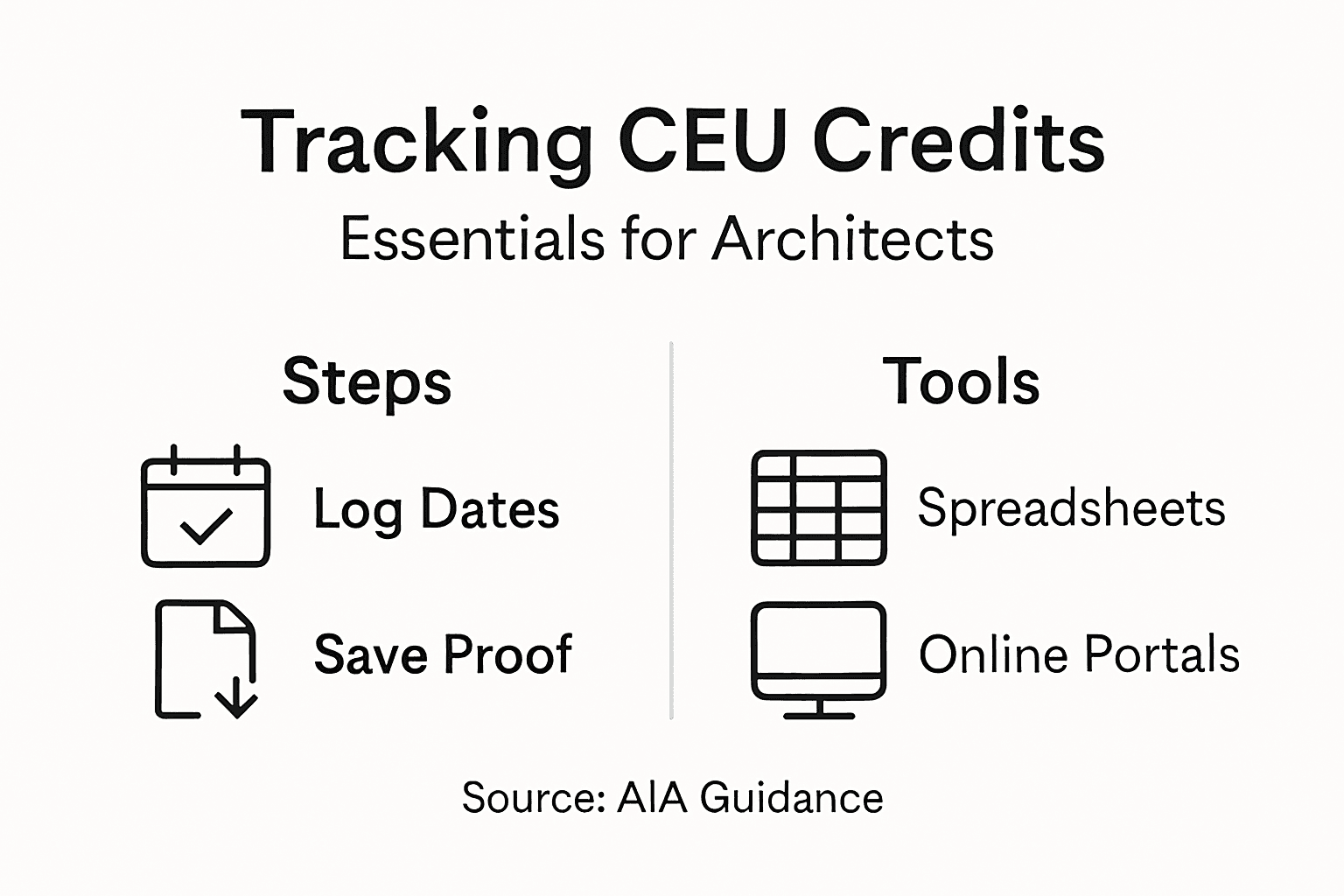
Pro tip: Create a dedicated digital folder or spreadsheet to systematically track your CEU credits, including course names, dates, credit hours, and specific category classifications to streamline future reporting.
AIA and State CEU Reporting Requirements
Navigating the complex landscape of continuing education requirements demands precision and strategic planning for architects seeking to maintain their professional credentials. AIA state requirements establish a comprehensive framework that architects must carefully understand and follow to ensure ongoing licensure and professional development.
The national requirements for CEU credits typically include:
- AIA Annual Learning Unit Requirements
- 18 total Learning Units (LUs) per year
- 12 mandatory Health, Safety, and Welfare (HSW) credits
- Minimum of 16 hours of structured learning activities
- State-Specific Reporting Variations
- Unique credit hour requirements
- Additional topic-specific mandates
- Specific reporting deadlines
- Potential audit requirements
Each state licensing board may implement slightly different continuing education regulations, creating a complex compliance landscape for architects practicing across multiple jurisdictions. Some states mirror AIA standards precisely, while others introduce nuanced additional requirements that demand careful attention.
Professional Compliance requires architects to maintain meticulous documentation of their continuing education activities. This includes preserving completion certificates, tracking credit categories, and understanding the specific reporting mechanisms for their primary licensing jurisdiction.
Here’s a quick comparison of CEU credit requirements for architects under national and state guidelines:
| Requirement Type | National (AIA) Standards | State-Specific Variations |
|---|---|---|
| Annual Learning Units | 18 LUs per year | Ranges from 12 to 24 LUs |
| Mandatory HSW Credits | 12 HSW per year | May require extra topics |
| Structured Activities | 16 hours minimum | Varies by state |
| Reporting Deadlines | Once annually | May differ by jurisdiction |
Pro tip: Develop a comprehensive digital tracking system that automatically categorizes your CEU credits by HSW and non-HSW classifications, enabling quick verification and simplified reporting during license renewal periods.
The Impact of CEU Choices on Professional Growth
Continuing education represents far more than a regulatory requirement for architects—it is a strategic pathway for professional transformation and career advancement. Architects’ ultimate guide to continuing education reveals that strategic CEU choices can dramatically enhance an architect’s professional trajectory.
Strategic CEU selections can yield significant professional benefits:
- Technological Competence
- Stay current with emerging design technologies
- Learn advanced software and modeling tools
- Understand cutting-edge design methodologies
- Professional Marketability
- Differentiate yourself in competitive markets
- Demonstrate commitment to ongoing learning
- Expand specialized knowledge domains
- Increase potential for career advancement
Beyond compliance, thoughtful CEU choices enable architects to develop specialized expertise that distinguishes them in an increasingly complex professional landscape. Courses focusing on sustainable design, technological innovations, and interdisciplinary approaches can transform routine continuing education into meaningful professional development.
Professional Innovation emerges from deliberately selecting CEU credits that challenge existing knowledge boundaries. Architects who view continuing education as an opportunity for growth, rather than a bureaucratic requirement, position themselves as forward-thinking practitioners.
Here’s a summary of how strategic CEU selection impacts professional growth in architecture:
| Benefit Area | Result of Strategic CEU Choices | Business Impact |
|---|---|---|
| Technological Skills | Adopts latest design tools | Increases project quality |
| Market Differentiation | Expands knowledge and expertise | Boosts competitive status |
| Career Advancement | Opens leadership opportunities | Enhances promotion odds |
| Innovation Potential | Integrates interdisciplinary topics | Drives creative solutions |
Pro tip: Develop an annual learning strategy that aligns CEU credits with your long-term career goals, prioritizing courses that bridge current knowledge gaps and anticipate future industry trends.
Elevate Your Architectural Career with Trusted CEU Solutions
Many architects face the challenge of navigating complex CEU credit requirements while striving to grow professionally. This article highlights critical pain points including understanding valid CEU content, tracking Health, Safety, and Welfare (HSW) credits, and aligning continuing education with state-specific standards. Staying compliant and competitive requires access to accredited, relevant courses that fit your busy schedule.
At Ron Blank & Associates, we specialize in developing continuing education courses specifically designed for architects. Our programs are registered with the American Institute of Architects and offer flexible learning options like online courses, webinars, and face-to-face sessions. With clear documentation and expert content focused on HSW, sustainable design, and accessibility, you can confidently meet all licensing requirements while advancing your expertise.
Looking for a seamless way to earn and track your CEU credits and stay ahead in the profession?

Explore our full range of accredited CEU courses today and secure your professional growth with trusted education at Ron Blank & Associates. Visit continuing education courses for architects to start fulfilling your CEU requirements with ease and precision.
Frequently Asked Questions
What are Continuing Education Units (CEUs) in architecture?
CEUs are structured educational experiences designed to help architects maintain their professional licensing and enhance their competencies. They are essential for staying current with industry standards and requirements.
How do I earn CEU credits as an architect?
Architects can earn CEU credits through structured learning opportunities like professional conferences, workshops, online courses, and seminars. It is important to attend accredited programs to ensure the credits are valid.
What types of CEU credits are required for architects?
Architects commonly need Health, Safety, and Welfare (HSW) credits, sustainable design credits, and credits focusing on accessibility and inclusive design. Specific requirements may vary depending on the state licensing board.
Why is documentation important for CEU credits?
Documentation is crucial as it provides proof of completion for CEU credits. Architects should collect and retain certificates, transcripts, and course details to ensure compliance with licensing requirements and simplify the license renewal process.